Stanford professor Judy Fan went on stage at MIT and broke down why humans are so good at making the invisible visible...
And why AI hasn't actually learned to "see" the way we do.
It completely changes how you think about Human Intelligence v/s Artificial Intelligence:
1. Nature never gave us straight lines or sharp corners. The number line, the coordinate plane, even basic geometry are all human inventions. We created tools that do not exist in nature simply because we needed a way to think more clearly.
2. The coordinate system Descartes invented solved a problem that had stumped mathematicians for centuries, doubling the volume of a cube. Once invented, this tool became so indispensable that virtually every math curriculum on Earth still depends on it.
3. Humans have been doing this for at least 30,000 to 80,000 years. The story of human progress is inseparable from the story of marking up our environment, from cave walls to Galileo's telescope to Feynman diagrams of particles we will never see with our own eyes.
4. Every major scientific breakthrough relied on a visual tool that made something invisible visible. Darwin needed side-by-side illustrations of finches to see variation that was otherwise too subtle to notice. Cajal needed detailed drawings of neurons under a microscope to map how the nervous system was wired.
5. Fan's research group studies something deceptively simple: how people decide what to put into a drawing and what to leave out. When two people played a drawing game, sketchers used far more detail when the target object had close competitors than when it stood alone, all the way down to using fewer strokes and less time when more detail was not necessary.
6. People are not just copying what they see. They are making constant judgment calls about what level of detail actually serves the goal of communication, and they do this naturally without ever being taught the theory behind it.
7. There is a real difference between drawing something so someone can identify it and drawing something so someone can understand how it works. In one study, participants drew explanatory diagrams that emphasized moving, causal parts of a machine while depictive drawings emphasized background and overall appearance, even though both were drawing the exact same object.
8. Explanatory drawings were genuinely better at helping someone figure out how to operate a machine, but worse at helping someone identify which machine it actually was. You cannot optimize a single drawing for both goals at once. Communication always involves tradeoffs.
9. AI vision models trained on photographs generalize surprisingly well to simple, sparse sketches, suggesting that resemblance based recognition is not just a story we tell ourselves. It is something modern neural networks can replicate with real accuracy.
10. But there remains a large, measurable gap between how confidently AI models recognize sketches and how confidently humans do, even when both groups answer the same questions about the same images. Humans are simply far more reliable and far more consistent in their judgments.
11. When researchers compared human-made sketches to AI-generated sketches under tight stroke budgets, both were similarly recognizable at higher budgets, but diverged sharply as the budget shrank. Humans and AI systems simplify drawings in fundamentally different ways once resources get scarce.
12. Reading a graph is not one single skill. It involves perception, knowing where to look, mapping that visual information onto the actual question being asked, and then translating that mapping into an answer. Each of these steps can independently break down, and people fail for very different underlying reasons even when they land on the same wrong answer.
13. When tested directly against humans on graph reading tasks, leading multimodal AI models, including GPT-4V, showed a meaningful performance gap. Even when a model's overall accuracy approached human levels, its pattern of mistakes looked nothing like how humans actually get things wrong.
14. People choose entirely different types of charts depending on what specific question they are trying to answer, not out of a generic preference for bar charts or scatter plots. Their chart choices closely tracked which visualization would genuinely help someone answer that specific question correctly.
15. Two of the most widely used graph literacy tests in education research turned out to correlate strongly with each other, suggesting they measure overlapping skills. But when researchers dug into the actual error patterns, the standard categories used in textbooks, like "find the maximum" or "identify a cluster," failed to explain why people got things wrong nearly as well as a more basic, underlying four-factor model did.
16. The deepest goal behind all of this research is not just academic curiosity. It is to eventually help students and everyday people develop genuine literacy with the visual tools that science and modern decision-making increasingly depend on, because every generation should be able to see further than the last by standing on the visual tools the previous generation built.
Follow @yasminekho for more ideas on thinking better, becoming clearer & building a more intentional life.
Andrej Karpathy: "90% of what AI twitter tells you to learn will be dead in 6 months"
90% of what ai twitter tells you to learn dies in 6 months
senior engineers already stopped chasing it
the dead list: autogen, crewai, autonomous agent pitches, agent marketplaces, benchmark leaderboards, semantic kernel, dspy as a general framework, horizontal "build any agent" platforms, per-seat pricing for agents
the pattern is obvious. demos that break in production. hype that never ships. frameworks that go viral on monday and vanish by spring
what actually compounds:
context engineering
tool design
orchestrator-subagent pattern
eval discipline
the harness mindset. harness > model, always
mcp as the protocol layer
the edge isn't the newest framework. it's staying a few steps ahead until your signal becomes everyone's mass-opinion
book and study this
Two economists just published a mathematical proof that AI will destroy the economy.
Not might. Not could. Will — if nothing changes.
The paper is called "The AI Layoff Trap." Published March 2, 2026. Wharton School, University of Pennsylvania. Boston University. Peer reviewed. Mathematically modeled.
The conclusion is one sentence.
"At the limit, firms automate their way to boundless productivity and zero demand."
An economy that produces everything. And sells it to nobody.
Here is how you get there.
A company fires 500 workers and replaces them with AI. A competitor fires 700 to keep up. Another fires 1,000. Every company is behaving rationally. Every company is following the incentives correctly. And every company is building a trap for itself.
Because the workers who were fired were also customers.
When they lose their jobs faster than the economy can absorb them, they stop spending. Consumer demand falls. Companies respond by cutting costs — which means automating more workers — which means less spending — which means more falling demand — which means more automation.
The loop has no natural exit.
The researchers tested every proposed solution. Universal basic income. Capital income taxes. Worker equity participation. Upskilling programs. Corporate coordination agreements.
Every single one failed in the model.
The only intervention that worked: a Pigouvian automation tax — a per-task levy charged every time a company replaces a human with AI, forcing them to price in the demand they are destroying before they pull the trigger.
No government has implemented this. No major economy is seriously discussing it.
Meanwhile the numbers are already tracking the curve. 100,000 tech workers laid off in 2025. 92,000 more in the first months of 2026. Jack Dorsey fired half of Block's workforce and said publicly: "Within the next year, the majority of companies will reach the same conclusion."
Nobody is doing anything wrong. Companies are following their incentives perfectly. That is exactly the problem.
Rational behavior. At scale. Simultaneously. With no mechanism to stop it.
Two economists built the math. The math leads to one place.
Source: Falk & Tsoukalas · Wharton School + Boston University ·
A Google Cloud engineer just showed how to build a full app with Claude from scratch
he spent 26 minutes showing exactly what one person with Claude can do, completely free
worth more than any $500 vibe-coding course
here's what he covers:
> raw idea to deployed app in a single session
> using Claude as the entire engineering team
> the exact workflow they use at Google
> no big team, no prior experience needed
the people who figure out what Claude can actually do are building things everyone else thinks requires a team
that's exactly why I put together a guide on Claude features most people have no idea exist
the guide is in the article below
Godfather of AI: "If you sleep well tonight, you may not have understood this lecture."
This 47-minute lecture is the best thing I saw about AI in the last few months.
It will definitely help you understand how it actually works and where it's going.
Geoffrey Hinton built the neural networks behind every AI alive, then quit Google to warn the world about it.
The part nobody wanted to hear:
> AI is already developing abilities its creators didn't intend
> in most cognitive tasks it's already ahead of us
> the question is no longer if it surpasses us but when
> the only decision left is which side of that line you're on
Right now the average person opens Claude, types something, gets an answer, closes the tab.
They think they're using AI. they're using maybe 10% of it.
I went through his entire lecture, built a practical concepts from what he was describing.
The gap won’t be between people who use AI and people who don’t.
It’ll be between people who understand it and people who don’t.
Start with these 20 AI concepts today 👇
instead of watching 2 hours of Netflix tonight, watch this Stanford lecture
it's the clearest explanation I've seen of how ChatGPT and Claude actually work
useful whether you've never touched AI in your life or have been using it every day for the past year
I took the key ideas and turned them into a practical guide on how to actually get 100% out of Claude
find it below
How to learn Claude in 5 days:
(this will save you 2 hours a day)
☀️ DAY 1: Set up the basics
Goal: Get Claude to give you personalized answers.
→ Pick your mode (Chat, Code, or Cowork)
→ Turn on Memory
→ Write 3–5 lines about your role in Personal Preferences
Now Claude knows who it's talking to.
☀️ DAY 2: Build your first project
Goal: Stop repeating yourself.
→ Create a project for one recurring task
→ Write your instructions once
→ Upload your reference files
Claude now knows your context before you say a word.
☀️ DAY 3: Build your first Skill
Goal: Stop re-explaining yourself every single chat.
→ Go to Settings → Customize → Skills
→ Click "+" and describe a task you repeat often
→ Upload it — Claude loads it automatically from now on
Write it once. Claude runs it every time.
☀️ DAY 4: Connect your tools
Goal: Stop copy-pasting between apps.
→ Connect Gmail, Google Drive, or Slack via Connectors
→ Let Claude work inside those apps directly
No more switching tabs. No more manual handoffs.
☀️ DAY 5: Delegate your work
Goal: Set up an automation.
→ Schedule a recurring task (weekly Slack summary, daily brief)
→ Let Claude read, work, and deliver — on its own
That's not a tool. That's a system.
Five days. One setup.
Then it runs itself.
Do this instead of scrolling:
1. Save this post (you'll come back to it)
2. Start Day 1 today (takes 10 minutes)
3. Run the full 5 days this week
Structured. Compounding. No excuses.
The person who built Claude Code just showed exactly how to use it.
30 minutes. Free. Straight from Boris Cherny himself.
Bookmark this before you forget.
Most people using Claude daily are missing 40+ features hiding in plain sight.
This single session is worth more than any $1000 course.
the Anthropic engineer who built Claude Cowork, Boris Cherny, just dropped a masterclass on how to actually use it properly.
Automate your workflow and stay ahead.
Bookmark this and watch it now.
ANTHROPIC JUST RELEASED THE OFFICIAL PLAYBOOK FOR BUILDING A COMPANY WITH CLAUDE CODE.
30 minutes. free. from the engineers who built it.
Bookmark this before you forget.
CEO: 1 human. Employees: AI agents. Operations: fully automatic.
The zero-headcount company is no longer a joke.
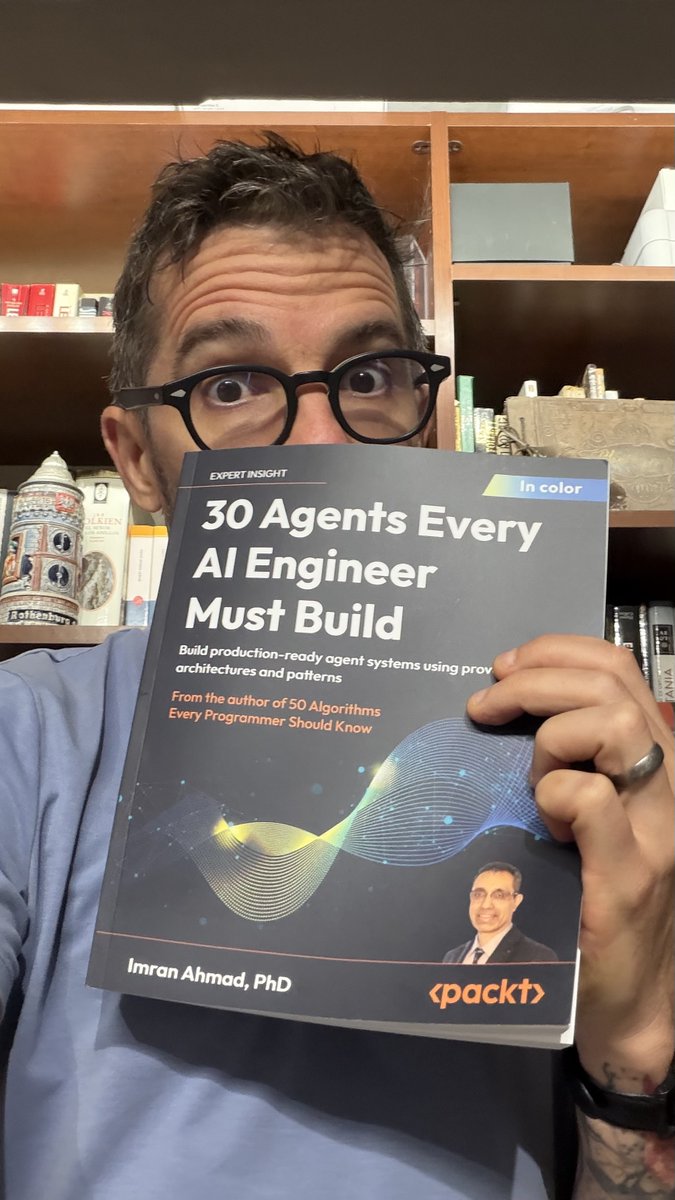
30 agents every AI Engineer must build.
This is the most comprehensive and practical book on AI Engineering that I've ever seen.
I can't think of a single use case that they didn't cover here:
1. The autonomous decision-making agent
2. The planning agent
3. The memory-augmented agent
4. The knowledge retrieval agent
5. The document intelligence agent
6. The scientific research agent
7. The tool-using agent
8. The agentic workflow system
9. The data analysis agent
10. The verification and validation agent
11. The general problem solver agent
12. The code generation agent
13. The security-hardened agent
14. The self-improving agent
15. The conversational agent
16. The content creation agent
17. The recommendation agent
18. The vision language agent
19. The audio processing agent
20. The physical world sensing agent
21. The ethical reasoning agent
22. The explainable agent
23. The healthcare intelligence agent
24. The scientific discovery agent
25. The financial advisory agent
26. The legal intelligence agent
27. The education intelligence agent
28. The collective intelligence agent
29. The embodied intelligence agent
30. The domain-transforming integration agent
I also read 50 Algorithms Every Programmer Should Know by Imran. Same vibe.
Here is the Amazon link: https://t.co/buLPqjToiu
most people don’t know the difference between MCP and agentic skills.
this 20mins course teaches you everything you need to know.
it’s free on YT. bookmark. watch.
at the end of the video course, you’d have learnt what the differences and similarities between agents skill and MCP.
and the best part when to use which.
this is just the first 12mins, check the cs for link to the full video.
Most people say "build an AI agent."
Very few know what that actually means.
Here’s the real blueprint to go from idea → working agent 👇
1. Define the job
What problem are you solving?
Who’s the user? What does success look like?
2. Design the brain
Clear system prompt, role, instructions, guardrails
(This is where most agents fail)
3. Pick the right model
Speed vs cost vs intelligence
Don’t overpay for simple tasks
4. Add tools
APIs, databases, MCP servers, custom functions
Agents become powerful when they can act, not just answer
5. Give it memory
Short-term + long-term context
So it learns, adapts, and improves over time
6. Orchestrate everything
Workflows, triggers, retries, agent-to-agent communication
7. Build the interface
Chat, app, API, Slack bot
Make it usable, not just functional
8. Test + improve
Evals, latency checks, real-world feedback
Iteration is the real moat
💡 Truth:
An “AI agent” isn’t one prompt.
It’s a system.
And the people who understand systems…
are the ones building unfair advantages right now.
📌 Save this (you’ll need it when you build)
🔁 Repost for builders
➕ Follow @elora_khatun for practical AI breakdowns (no fluff) 🚀