For my first post, I’m sharing a letter @NVIDIA signed on why open models matter.
AI will transform every industry, power every company, and be built by every country.
Open models strengthen safety and cybersecurity, accelerate innovation and diffusion, and enable sovereignty.
The world needs both frontier closed models and frontier open models.
https://t.co/AUKzoQ5Ikb
Karpathy just mass-produced the most expensive part of ML research for free.
The bottleneck in neural network development has always been researcher iteration speed. A senior ML engineer costs $400K-$800K/year, runs maybe 3-5 meaningful experiments per day, and spends 80% of their time on the exact loop Karpathy just automated: tweak, train, evaluate, repeat.
This agent ran 276 experiments in a few days. Found bugs in QKnorm, missing regularization, wrong AdamW betas, and overly conservative attention patterns. These are the kinds of things a PhD student finds over months of staring at training curves. The agent found them while Karpathy slept.
The math gets worse. Tobi Lutke cloned the approach for Shopify’s query expansion model, went to bed, and woke up to a 0.8B parameter model that outperformed his previous 1.6B model. 37 experiments in 8 hours. A smaller model beating a larger one because the agent had more at-bats optimizing it than a human team would get in a week.
This tells you something about how frontier labs will allocate headcount over the next 18 months. The “run experiments and iterate” function of ML research is about to get compressed by 10-50x. What remains is the part agents can’t do yet: choosing what problems to work on, designing the evaluation metrics, and writing the program.md that tells the agent how to think.
Karpathy’s own framing is revealing. He said humans “optionally contribute on the edges.” That word, optionally, should make every ML researcher who defines their value as “I tune models” extremely uncomfortable.
The 630 lines of code in this repo fit inside a single LLM context window. That’s by design. The constraint that unlocks autonomous research isn’t intelligence or compute. It’s keeping the codebase small enough that the agent can hold the entire system in working memory. Every company with a training pipeline longer than 630 lines just got a reason to refactor.
I think it’s pretty clear that simulation is the next frontier for AI.
The most impressive feats of AI to date are when we have a clear environment + reward, whether it be beating Le Sedol at Go, winning an IMO gold medal, or writing entire apps from scratch. In these cases, the RL algorithm can try different actions, and observe the well-defined consequences in the safety of a docker container.
But what about messy real-world situations involving people? The rewards are unclear, the stakes are high, and you can’t experiment in the real world. But these situations are precisely where the next big opportunity in AI is. To crack this, we need to *simulate* society (“put society into a docker container”). Concretely, this means building a model that can predict what will happen in any given situation (real or hypothetical). If we can do this, we are only limited by our imagination: predict the future, optimize for better outcomes, answer hypothetical (“what if”) questions. Ultimately, this goes beyond making better decisions, but it’s about giving us a better understanding of ourselves and the world.
Simulation is the whole enchilada. And this is exactly the research that @simile_ai is working on. Read more here:
https://t.co/eBMW2beHdT
🤖 Can an agent earn money by delivering food in a realistic 3D city?
🚚 We present 𝗗𝗲𝗹𝗶𝘃𝗲𝗿𝘆𝗕𝗲𝗻𝗰𝗵, a realistic embodied benchmark for long-horizon food delivery.
⚖️ To earn more, agents must make trade-offs under multiple, interacting constraints (e.g., deadlines, expenses, and battery levels).
😮 Surprisingly, even top models (e.g., Gemini-2.5-Pro, Claude-3.7-Sonnet) earn 𝗳𝗮𝗿 𝗹𝗲𝘀𝘀 per hour than humans. They still make basic mistakes, like packing hot meals together with ice cream.
👇 Project website + more details in the thread ...1/
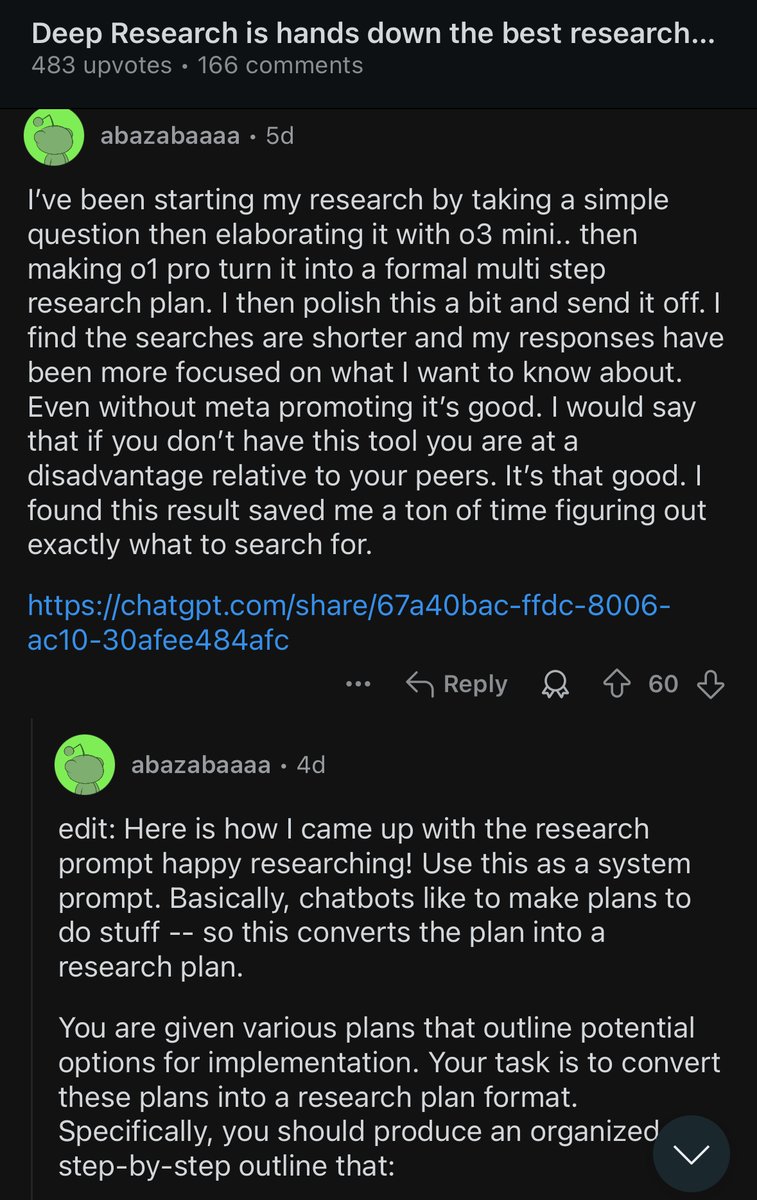
Reddit user metaprompts a simple question to o3 mini then o1 pro then Deep Research and gets incredible results.
It built a ~10,000 word software architecture design on making a Python interpreter in Kubernetes.
The answer is better than 99% of tech teams, imo.
Link to it:
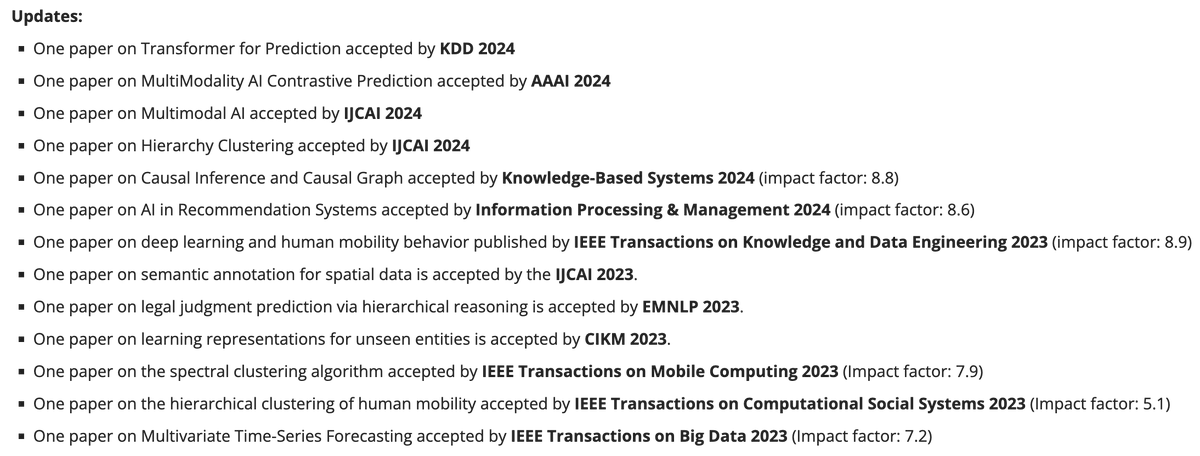
I am thrilled to share that our paper has been accepted by KDD 2024! This marks the 13th top ML/AI publication since last year, covering a wide range of topics including Generative AI, LLM, NLP, and Multimodal AI. Thanks to my co-authors for their significant contributions!
Introducing Pika 1.0, the idea-to-video platform that brings your creativity to life.
Create and edit your videos with AI.
Rolling out to new users on web and discord, starting today. Sign up at https://t.co/JHRrinsIwx
A student just finished an internship in our lab as part of our Department's Undergraduate Research Opportunities Programme. He asked me suggestions about "Computer Science books". This is a possible list of 5 (semi-)classic non-technical books, in non particular order. 1/7
Our paper "Iteratively Learning Representations for Unseen Entities with Inter-Rule Correlations" has been accepted as a full paper at #CIKM2023, joint work w/ @ZihanWa54274484, @jayren3, @_Kai_Zhao, Zhumin, and @mdr
Armed with more data than ever, companies know what key customers need. But do they know exactly when they need it? An analysis of 2,000 ridesharing commuters by professor Eva Ascarza and colleagues shows how companies can anticipate a customer's routine. https://t.co/QdGjDflOVL