Some rooms are built for visibility, and others are built for contribution.
I've joined the World Economic Forum Expert Network.
The opportunity to contribute to conversations that shape real decisions at scale matters far more than any badge or title.
We are entering a period where geopolitics, AI, industrial policy, and supply chain risk can no longer be discussed in isolation, because they are colliding and reshaping how companies compete, how governments act, and how value chains are designed, with consequences measured in trillions and in lives.
Our work at KŌSE ADVISORY through ODI Global, the Exiger Executive Forum, Hope for Justice and Slave-Free Alliance and the broader fight against modern slavery, GLOBSEC, and London Defence Conference, and in rooms where these decisions actually get made, has always sat at this intersection, and now I get to bring that perspective directly into WEF's policy conversations.
What I intend to contribute are actionable and tangible insights grounded in data, foresight, and human intelligence, built from an understanding that stability and security are the foundation from which prosperity is possible, and that the harder questions about who actually controls the AI supply chain, about the energy, the rare earths, the processing capacity, and what that concentration of power means for economic security and national resilience, belong at the center of every serious policy conversation right now. That means challenging bias and prejudice where it exists, and driving intelligence and security-informed thinking into the policy rooms that need it most.
A special thank you to Ian Cronin, MBA, MPP, Manager of the Advanced Manufacturing and Supply Chains Forum at WEF, who proposed me for this network and made it happen. That kind of trust means everything. 🙏
To General John R. Allen, Dr Rebecca Nadin, Ali Serim, Brandon Daniels, Kody Gurfein, Sarah Clarke, Susan E. Walton, Róbert Vass, Iain Martin and everyone in this extended network who keeps pushing these conversations forward, the work continues. 🫡
#WorldEconomicForum #WEF #ExpertNetwork #Geopolitics #SupplyChain #AI #Leadership #GlobalStrategy #ValueChainStatecraft #CalmIsTheNewAdvantage #ModernSlavery #HopeForJustice
Globalization has new owners. 🔥
One of the great geopolitical assumptions of the past three decades was that economic interdependence would make conflict less likely. What we are witnessing today is more nuanced. Interdependence has created prosperity, but it has also created leverage. 💪
As governments reassess economic security, strategic autonomy, and national resilience, "Value-Chain Statecraft" is emerging as one of the defining forces shaping the global economy.
Across #semiconductors, #energy, #criticalminerals, #procurement, #logistics, #technology, and #data, nations are reevaluating where they are exposed, where they are dependent, and where they hold influence.
The strategic design and control of value chains increasingly shapes economic resilience, industrial competitiveness, technological leadership, and geopolitical leverage.
Access, alignment, trust, and resilience now carry strategic weight alongside cost and efficiency.
This shift reflects a broader transition.
For decades, multinational corporations were the primary architects of globalization. Today, states and alliances are playing a far more active role in shaping the movement of capital, technology, resources, talent, and infrastructure in the age of #ReGlobalization.
The result is a global economy increasingly organized around strategic interests, industrial policy, and long-term national objectives.
For business leaders, the challenge extends far beyond operational optimization. It requires understanding the #political, #regulatory, #technological, and #security dynamics embedded within the systems they depend on, source from, sell into, and help enable.
There is a Turkish saying I grew up with:
"Bugün ektiğini yarın biçersin, ama hangi toprağa ektiğini unutursan, hasada şaşırırsın."
"What you sow today, you will reap tomorrow, but if you forget which soil you planted in, you should not be surprised by the harvest."
In an era defined by Value-Chain Statecraft, success depends not only on the seeds we plant such as capital, technology, partnerships, and contracts, but also on understanding the soil: the alliances, institutions, histories, and strategic interests that ultimately determine what grows.
My latest #Forbes article explores how #ValueChainStatecraft is reshaping the global order and why corporate strategy is becoming inseparable from national security.
@ODI_Global | @GLOBSEC | @ExigerLLC | @Forbes | @ForbesTechCncl | KŌSE ADVISORY
Read the full article here: https://t.co/lgoSLexwWa
#ValueChainStatecraft #Geopolitics #SupplyChain #NationalSecurity #EconomicSecurity #IndustrialPolicy #GlobalTrade #CriticalMinerals #Semiconductors #Resilience
Today, I was appointed Special Adviser to the Centre for the Geopolitics of Global Change at @ODI_Global .
Most institutions are still mapping yesterday’s risks. ODI Global is already shaping tomorrow’s responses. That is precisely why this role matters.
For more than 60 years, ODI Global has delivered independent research and policy insight that informs decisions at the highest levels of government, finance, and international affairs.
Its Centre for the Geopolitics of Global Change addresses one of the defining challenges of our time: the convergence of #geopolitics,
#geoeconomics, critical minerals, trade reconfiguration, #technology, and #AI in reshaping the international system. It is an institution whose reach and influence deserve far wider recognition.
This is where analysis meets consequence.
My work with the Centre will sit at the intersection of geopolitics, geoeconomics, technology, and AI, and what that convergence means for economic resilience, global value chains, policy, and the national security frameworks that increasingly govern them.
Dr Rebecca Nadin has built something rare: a research institution that does not wait for the world to catch up to its findings. And Ali Serim, whose instinct for bringing the right people together at the right moment I have come to respect deeply, made this partnership possible.
This appointment also connects closely with work I am already doing as inaugural Senior Fellow at the GeoTech Research Center of @GLOBSEC, a role I took on at the invitation of General John R. Allen.
The convergence of these institutions and their mandates reflects where some of the most consequential work on geopolitics, technology, and national security is now happening.
At KŌSE ADVISORY, this is precisely the convergence we have been built to navigate, and this appointment deepens the institutional foundation from which we operate.
The work ahead is serious. That is exactly why it matters.
#Geopolitics #Geoeconomics #ArtificialIntelligence #NationalSecurity #GlobalValueChains #CriticalMinerals #Technology
The West built walls. China built factories inside them.
Chinese EV exports surged 40% in April. U.S. tariff: 100%. EU tariff: 35.3%.
278,081 units exported. BYD and Chery doubled sales in Europe year-over-year. Chinese brands crossed 15% of Europe's EV market for the first time. In the UK, 1 in 7 cars sold is now a Chinese brand. Approaching 10% of Europe's TOTAL auto market.
The tariffs redirected the flow. Full stop.
Here's what actually happened:
👉 BYD localized directly inside the EU. Tariffs made irrelevant by design.
👉 China pivoted exports to Brazil (+221%), South Korea, Australia; all markets with no walls or thinner ones.
👉 The EU's 35.3% vs. the U.S. fortress 100% created an arbitrage gap. Exploited immediately.
👉 Stellantis partnered with Leapmotor and Dongfeng. European OEMs opened the door themselves.
👉 France, Spain, Italy, the Netherlands, Lithuania meanwhile all screaming at Brussels for tougher trade defense.
Germany? Silent. €360 billion in trade exposure to China doesn't let Berlin lead.
This is Multipolar Chaos. Live and in front of you.
And it connects directly to what I witnessed at GLOBSEC Forum 2026 in Prague last week.
Europe is sleepwalking and celebrating regulations as if they were capabilities. Deploying words like "de-risking" and "resilience" while changing nothing about where capital, talent and political will actually go.
Moralising about values while outsourcing energy, defence and digital sovereignty to actors it doesn't control.
A Europe that lectures the world while depending on others for energy, defence, chips, data and platforms is exposed.
The EV story is a power story about who controls the future of mobility infrastructure and about who writes the industrial rules of the next decade.
CPOs and CSCOs running EV and battery sourcing as a cost optimization exercise are already behind not understanding that these are geopolitical votes now.
As I wrote in my Forbes piece last week 👇
https://t.co/f6gTS3Nwqt
"While the clever one looks for a bridge, the madman has already crossed the river."
China crossed. And now it's setting the terms.
What's your next move?
#MultipolarChaos #OperationalDarwinism #SupplyChain #Geopolitics #EV #TradePolicy #CalmIsTheNewAdvantage #Procurement #Leadership #GLOBSEC2026
My @GLOBSEC Forum 2026 takeaway: Europe is sleepwalking into strategic irrelevance behind a comforting fog of process, platitudes and performative outrage.
Let’s talk about the *woke, complacent and illusionist* side of European politics and the comfortable people and some elites who echo the same narrative:
- They moralise about “values” while outsourcing energy, defence and digital sovereignty to actors they don’t control.
- They celebrate regulations as if they were capabilities, mistaking legal text for real power.
- They speak of “existential threats,” yet their budgets, alliances and personal risk profiles show that nothing truly uncomfortable has been reprioritised.
In my Forbes work on trade, tech and “operational Darwinism,” I argue this isn’t just bad policy but it’s strategic self‑disarmament.
Read up here: https://t.co/f6gTS3O4g1
A Europe that lectures the world while depending on others for energy, defence, chips, data and platforms is not principled, it is exposed.
Here’s the paradox provocation:
If your strategy still assumes benign globalisation, infinite US security guarantees and painless green and digital transitions managed by PowerPoint, you are not progressive but delusional and you are living in a simulation.
And if you deploy words like “de‑risking” and “resilience” without changing where you put capital, talent and political will, you’re not defending Europe’s future; you’re curating its decadence and rather invest in global gateway project to build a trainstation in rural Uganda than taking care of energy infrastructure in Europe.
The world will not slow down to match Europe’s process. Power, not narrative, will decide who writes the next chapter. It’s sad to watch the demise in real time.
If you work in policy, business or finance: which dogma must Europe abandon *now* and what concrete sacrifice are you personally willing to accept to remain relevant in a multipolar, AI‑driven world?
The pain level isn’t yet high enough in Europe to truly change the course of history.
More pain is needed apparently which is the most unfortunate part of this all.
#GLOBSEC2026 #Prague #MultipolarWorld #OperationalDarwinism #Geopolitics
#EuropeanPolitics #EU #StrategicAutonomy #SupplyChainWars #AIPolicy
#EnergySecurity #DigitalSovereignty #RiskGovernance #TradeAndTech
#ForbesTechCouncil #Leadership #Resilience #PowerNotProcess
🚨 China advises banks to curb U.S. Treasury exposure.
A supply chain lead indicator hiding in plain sight.
Chinese regulators have verbally guided major commercial banks to limit new U.S. Treasury purchases and reduce oversized positions, citing concentration risk and market volatility.
Prudent risk management. Sovereign and state holdings are exempt.
Context matters.
China’s total Treasury holdings sit around $683B as of late 2025, down sharply from the 2013 peak above $1.3T.
Is this just a bond market story? Far from it.
Chinese commercial banks hold on the order of $300B in USD‑denominated bonds and are among the most important providers of working capital and trade finance for exporters embedded in China‑dependent supply chains.
When regulators signal lower comfort with USD concentration, lending behavior adjusts.
Loan tenors shorten.
Covenants tighten.
RMB use increases.
Cheap dollar liquidity fades.
Cross‑border dollar lending by Chinese banks to emerging markets is down roughly 10% since 2022. At the same time, the RMB share of their overseas lending has surged to nearly 40%.
This is de facto de‑dollarization at the supplier‑funding level.
Dear Procurement and Supply Chain "EchoChamber" members: You will not see this first in OTIF, quality scores, or lead‑time variance. You will not hear this from the shiny new agentic AI heroes on the block calling themselves the messiah of procuretech. They are clueless in both good tech and good procurement practice.
Your exposure to this shows up earlier. Suppliers asking to renegotiate payment terms. Banks pushing new collateral or currency structures. Credit lines tightening just enough to make “just in time” feel fragile.
And this is not just a U.S. problem fellow Europeans.
European manufacturers, retailers, and industrials are deeply exposed to China‑centric value chains starting from autos and machinery to chemicals, electronics, and fashion. Germany's beloved "Mittelstand" exporters, Italian luxury, Nordic industrials, UK retailers and logistics networks all rely on Chinese‑financed suppliers for critical components and finished goods.
When Chinese banks reprice dollar risk, European working capital and inventory assumptions quietly go out of date.
Procurement tracks operations. Finance tracks yields and regulation. Very few organizations bridge the gap to map which Tier 1, Tier 2, and Tier 3 suppliers rely on Chinese bank funding, and in which currency.
That blind spot is where real risk hides.
For all with China exposure - free advise:
Audit core suppliers’ dependence on Chinese commercial banks.
Clarify USD versus RMB denomination of key facilities.
Stress‑test Q2 and Q3 deliveries assuming tighter, not looser, liquidity.
Calm preparation is the new competitive edge.
Do you know how exposed your value chain is to these funding dynamics?
#SupplyChain #Geopolitics #RiskManagement #DeDollarization #Procurement #Finance #USChinaTrade #Europe
Everyone says we’re “bringing manufacturing back.”
Very few are honest about what that actually requires.
Since 2020, hundreds of billions have been announced for reindustrialization across the U.S. and Europe. Yet a growing share of these projects are stalled before construction even begins. Not because of a lack of capital or political will, but because the physical system is pushing back.
Power is missing.
Skilled labor is aging out.
Permits are stuck.
Tariffs are quietly inflating the cost of rebuilding the very infrastructure we claim to protect.
Reindustrialization is failing because the constraints are being ignored.
The idea remains strong.
In my latest piece, I break down five structural constraints global value chain strategy cannot ignore:
👉 why grids, not incentives, are the real bottleneck
👉 why blue-collar labor has become a strategic asset
👉 why decision-making power is shifting to states and regions
👉 why defense spending won’t magically rebuild industrial depth
👉 why AI is colliding with physical limits faster than most roadmaps admit
We’ve entered the era of the sandbag.
Resilience is key.
Execution is physical.
If your strategy assumes the system will “catch up”, dream on, business is not run on hope because that reality is already behind.
📄 Read the full article here 👇
#Reindustrialization #SupplyChains #IndustrialStrategy #Energy #Manufacturing #Geopolitics #AI #Resilience
https://t.co/wlZrS04541 via @LinkedIn
Decoding #Davos: From Monroe to “Donroe”
If you want a solid baseline for interpreting what is being said in Davos this week, this article will save you time.
A lot is being discussed in the Alps.
Strip it down and the same themes keep appearing: power, enforcement, resilience, security, energy, capital, and technology.
They play out through chokepoints, supply chains, sanctions, capital flows, data, and compliance systems.
That is what this article focuses on.
It looks at where leverage actually sits today and how it is being exercised. It connects Taiwan, energy and sanctions, the Americas under what is newly called the hashtag#DonroeDoctrine, Europe’s rearmament particularly Germany’s, and the fragmentation of technology and trade into a single framework.
The intent is to offer a way to interpret the signals behind the noise and understand what matters for decision-making.
If you are trying to make sense of the week rather than consume it, this is a good place to start.
Understanding where power sits makes interpretation easier.
#WEF
https://t.co/V1StlqUHmS via @LinkedIn
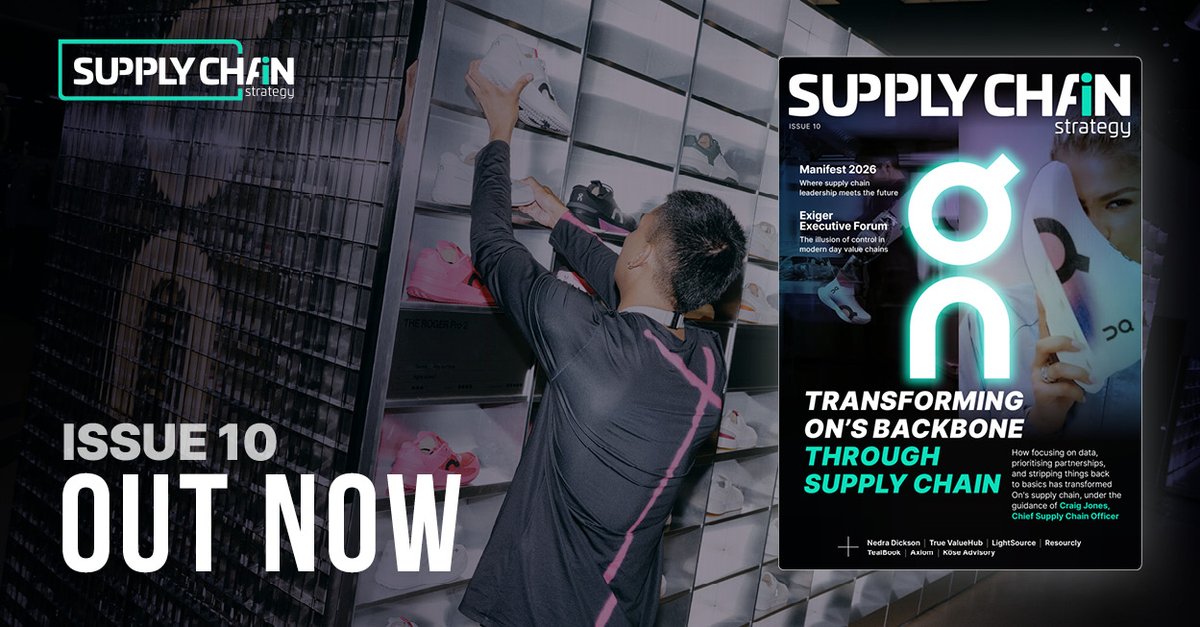
Much appreciation and thanks to Mike Sadr, Sean Galea-Pace, and the entire team for pulling together a genuinely relevant and well-curated issue.
Great to see such a thoughtful mix of leadership perspectives, resilience, and execution. I appreciate the coverage of both Exiger’s Executive Forum and KŌSE ADVISORY, and the quality of the conversations reflected throughout.
📢 Issue 10 of SupplyChain Strategy is OUT NOW!
In this quarter's issue, we’re shining a spotlight on the rapidly-growing sportswear brand, On.
📖 𝙍𝙚𝙖𝙙 𝙣𝙤𝙬: https://t.co/IJWf1EIkO1
#SupplyChain#Leadership#Innovation#AI#ExecutiveInsights
Beyond Oil and Ideology: The Real Targets of U.S. Force and the Meaning for Global Value Chains
My latest article is now published.
Most commentary on Venezuela focuses on oil, sanctions, or ideology. That framing misses the broader shift now underway.
The United States is re-asserting geography-driven power across the Western Hemisphere through bases, sea lanes, chokepoints, and resource leverage. Venezuela is not the end point. It is the signal.
In the article, I look beyond Venezuela and examine four strategic focal points that carry far greater implications for global value chains than current headlines suggest. These include Greenland as a template for Arctic control, Cuba’s growing dependency shock, Brazil’s coastal vulnerability, and the growing exposure of Chinese investments across Latin America.
For global companies and for procurement and supply chain leaders in particular, the implications are immediate. In a world shaped by coercion, chokepoints, and power politics, resilience has become a core strategic requirement. Net-zero targets and sustainability ambitions cannot survive without value chains that are designed to absorb geopolitical pressure rather than react to it.
Those responsible for sourcing, risk, and transformation must understand these dynamics and act deliberately. The question is no longer whether geopolitics will affect supply chains, but whether value chains are built to endure it.
The full article is available below.
I welcome thoughtful discussion and informed debate.
#Geopolitics #SupplyChains #Procurement #RiskManagement #Resilience #GlobalTrade #ValueChains #Strategy
https://t.co/z3oEYAMZHX via @LinkedIn
🔍 How resilient are critical raw-material supply chains?
Hear GLOBSEC's Gen. John R. Allen (Ret.) and Koray Köse, unpack the latest insights in Supply Chain Now’s on-demand webinar.
Watch anytime ➡️ https://t.co/AWD2Mq34Yf
✈️ London next.
Some trips are booked for business.
Others are built —intentionally— for the conversations that shouldn’t be left to silence or distance over the summer gap.
This week came together with urgency and purpose. I’ll be speaking at the Exiger Executive Forum, where we’re taking the conversation on supply chain sovereignty into a room that reflects reality. The place and moment where politics, finance, industry, intelligence, and narrative meet.
We witness a time that is about power, risk, resilience, and how we move forward with clarity and intent to drive a world that is free, prosper and provides for all us an environment of opportunity, innovation and technological advancement.
And while the calendar is full, I left some spaces open—on purpose.
If you’re in town and feel like reconnecting, reflecting, discussing top of mind issues or simply pressing pause for a moment, take initiative and reach out. 😊
I’ll gladly make time—for a coffee, a Riesling (my go-to), or even a spicy margarita…some things don’t change.
📍Want to be in the room at the EEF?
Request a seat here:
👉 https://t.co/ApIovPUq47
🎙️ Forum Host & Speakers:
•Maria Villablanca, Forum Host, CEO & Co-Founder, Future Insights Network | Host of Transform Talks Podcast
•Koray Köse – CEO & Chief Analyst, KŌSE ADVISORY | Senior Fellow, GLOBSEC GeoTech Centre | Board Member, Hope for Justice and Slave-Free Alliance
•Rt Hon Tobias Ellwood – Former UK Minister and Chair of the Defence Select Committee
•Ali Serim – Climate Advocate, Author, Diplomat, Publisher, Investor
London’s ready.
So am I - almost 😅 - still packing!
#ExigerForum #SupplyChainSovereignty #Leadership #Convergence #LondonWeek #SomeConversationsCantWait
A great organization with even greater mission - @GLOBSEC is tackling the most challenging discussions with world leaders and experts in an environment open for debate, exchange and driven by policy shaping that comes with positive impact to all of us - to be more secure, free, prosper and innovative! Truly resilient!
I’m very excited for our future and for GLOBSEC forum 2026! 💪
Moving the needle with research and policy recommendations while witnessing the convergence of technology, supply chains, and geopolitics is what we do at the Geotech Research Center with John R. Allen, Alena Kudzko and the entire team! #future #leadership #solutions
https://t.co/euJddL3cNw