{...} dan el pago que da el ratón al que le lleva en las alforjas y la serpiente al que la abriga en el regazo y el fuego al que le hospeda en el seno.
#FQTR
Way too much modern Catholic moral argumentation boils down to nothing more than:
1. Human dignity, therefore
2. [Plug in desired conclusion]
It's lazy and intellectually unserious and utterly unconvincing to anyone who doesn't already agree with whatever conclusion one is trying to establish. It opens the door to all kinds of mischief, because the notion of "human dignity" is so vague and contested that it can be, and is, deployed to arrive at all sorts of conclusions, including conclusions that contradict one another. And for that reason, bare appeals to human dignity are inevitably question-begging, because what human dignity amounts to and what it entails are precisely what is in dispute between the different sides of the various issues to which the notion is applied (capital punishment, immigration, sexuality, or whatever).
This is one of the many high costs of having taken Catholic theology off of the Scholastic gold standard. Too many minds have turned to mush and simply don't know how to reason logically. They just repeat gauzy stock phrases and stomp their feet.
Most people place essentially no value whatsoever on whether their religion or worldview is internally coherent. Once you recognize that, it becomes much easier to understand why they find our objections to the Pope’s statements on the death penalty so incomprehensible.
JUST IN: Cardinal Gerhard Müller, former prefect of the Congregation for the Doctrine of the Faith, delivers the concluding address at the International Marian Conference in Rome, “De Maria numquam satis” [about Mary one can never say enough), on “The Blessed Virgin Mary’s cooperation in the Redemption.”
Contrary to the claims of Protestantism, he said, God bestows an exalted dignity upon man precisely by making him an active cooperator in the Redemption.
The Cardinal explained, with theological rigor, why Mary's Co-redemption is a truth objectively contained in Revelation. His central thesis rests on the fact that God does not exclude man from the work of salvation, but desires to include him, raising the creature's cooperation to the highest summit of its dignity. In Catholic Mariology, this participation is manifested in a perfect way. Having pronounced her free Fiat at the Annunciation, Mary cooperated in a constitutive way in the Incarnation; a conscious yes which, by an intrinsic and essential logic, extends throughout the whole life of the Son, up to the sacrifice of the Cross.
Precisely by virtue of this real causality granted by God to human freedom, Mariology presents itself as the criterion of orthodoxy and the culmination of Catholic anthropology. It collides head-on with the Protestant doctrine of justification, which, by reducing redemption to an act that excludes man's free participation, ends up diminishing the divine plan. The title of Co-redemptrix must therefore not be passed over in silence for fear of Protestant dissent, but demands a clear explanation within the divine-human work of Christ.
The Cardinal concluded by reaffirming the relevance of this profession of faith, which admits no dogmatic concessions in dialogue with the modern world: “When, therefore, Mary is called ‘Co-redemptrix’ in Catholic piety and theology, this is not a misleading attribution nor an enthusiastic exaggeration, but a truth objectively contained in revelation. This title must not be passed over in silence because of its rejection by Protestants... but requires an explanation in the overall context of the divine-human work of redemption of Christ, the Son of God and of Mary.”
“The doctrine of the Church settles the matter, both in the profession of faith prescribed by Innocent III for the Waldensian heretics being led back to the Church: ‘Concerning the secular power we assert that it can exercise the judgment of blood without mortal sin, provided that, in inflicting vengeance, it proceeds not in hatred but in judgment, not incautiously but with deliberation;’ and in the bull of Leo X, Exurge Domine, in which the errors of Luther are condemned, among which: ‘That heretics be burned is against the will of the Spirit’. Hence theologians do not hesitate to hold as heretical the opinion that universally denies the power of the prince to punish by death; but the opinion of Scotus, some say, is rash and erroneous in faith, so Bannez; others, more than dangerous in faith, so Molina; or at least less consonant with the faith, as Sylvius; less conformed to sound faith and rejected by all, so Wiggers; etc.”
— Gustave Joseph Waffelaert, Tractatus Theologici de Virtutibus Cardinalibus, (1886), vol. 2, p. 49
The AI-personhood debate is downstream from a lot of other things, including forgetfulness of natural kinds, disbelief in substances, etc. We're moving away from acknowledging "this individual of the human species" to "nebulous bundles of activity and output."
In this era of artificial intelligence, it is becoming urgent to distinguish human art from what machines produce. There is an ontological difference, even before an aesthetic one, between art and what a machine can generate through statistical calculation based on millions of images created by others. Algorithms lack the spark of humanity. For this reason, the Church wishes to renew an alliance with artists and cultural institutions to safeguard our humanity.
"As the Church progresses through time, she loses nothing of the great dogmatic teachings defined over the centuries. They are secured for all time. For her, they constitute a firmament of transcultural, transhistorical certainties that illuminate her night."
- Charles Journet
Te lo explico brevemente con un ejemplo que neciamente muchos tratan de olvidar o esconder. Desde el s. XVI hasta principios del s. XIX, en la Catedral-Fortaleza de Almería, pasaban multitud de noches resistiendo frente a las razzias de los piratas berberiscos y ataques de la flota otomana AKA crisismigratoria2026®. Y a la salida del sol, los canónigos del Cabildo Catedral estaban rezando el Te Deum y celebrando la Santa Misa, junto a toda la ciudad allí refugiada, en acción de gracias al Señor por haber resistido, vencido y expulsado a los invasores mahometanos.
Para desdicha de impíos y demás odiadores de la fe verdadera en el tiempo presente, la Divina Providencia suscitó en aquella época clérigos y fieles católicos valientes que defendieron nuestra tierra y su cristiano modo de vida con firmeza y sin claudicar; y no buenistas pusilánimes, ni demagogos de cuarta fila al servicio de ideologías diluyentes del bien común que atentan contra la salvación de las almas.
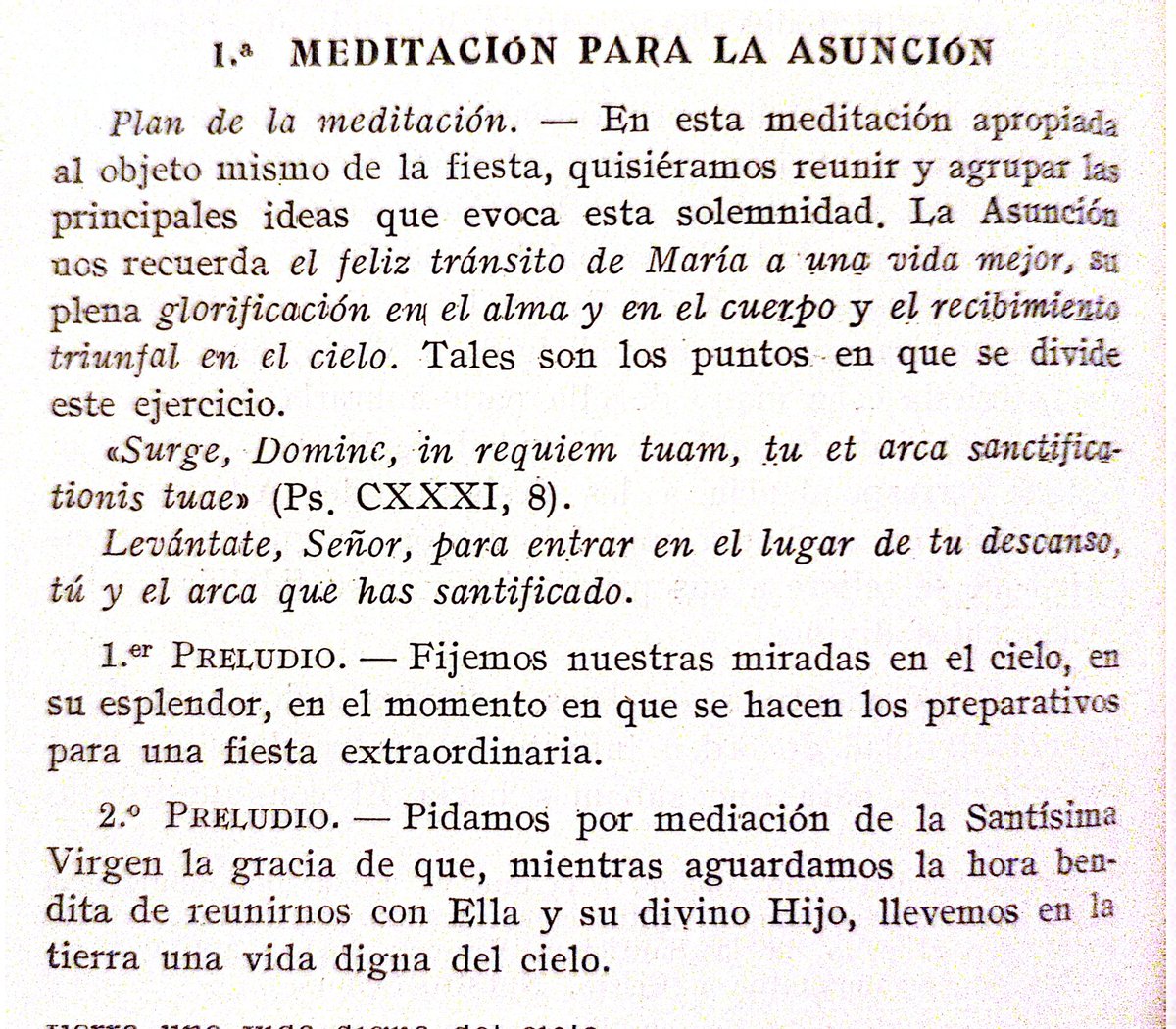
1ª Meditación sobre la Asunción de María, de la obra "Meditaciones sobre la Santísima Virgen", por Arthur Vermeersch S.J.
Aunque Vermeersch es más conocido por su obra de moral, también hizo esta obra de espiritualidad mariana (festividades, vida y gracias).
(Sigue abajo ↓)
Don't be ridiculous. Did St. Athanasius renounce the Catholic faith because the world had fallen into heresy and he was one of the few with the courage to resist? Did he abandon the Church to heretics and cowards because their then-apparent victory caused him personal suffering?