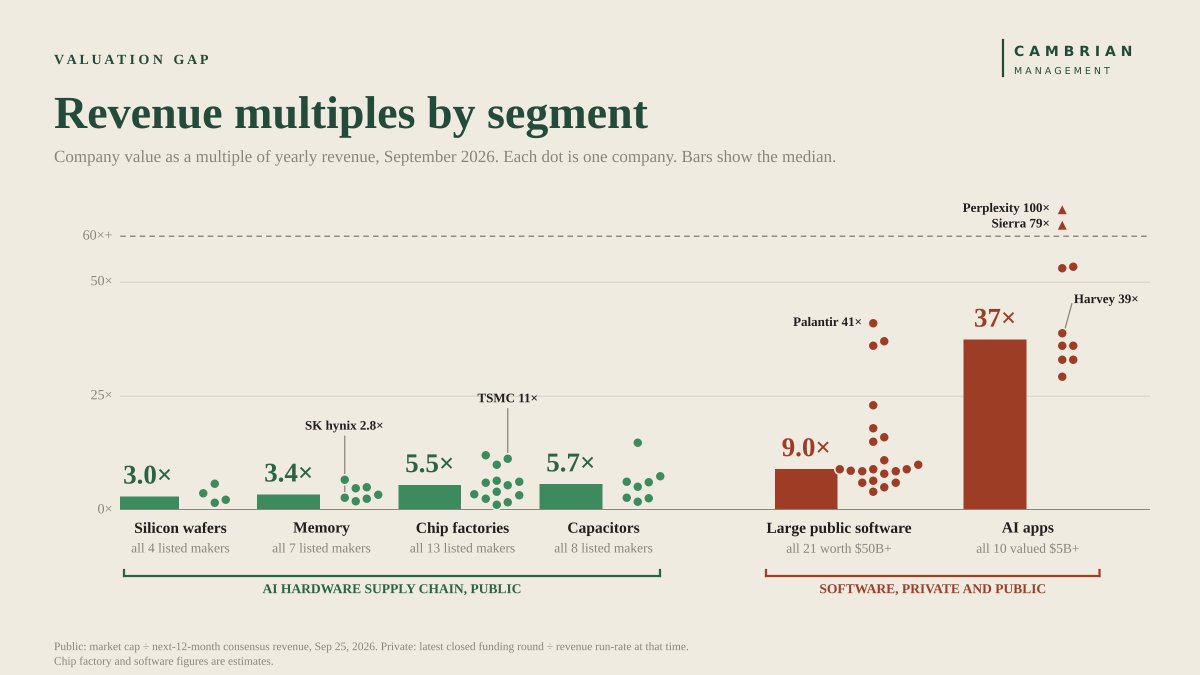
AGI is coming, and hundreds of AI supply chain oligopolies trade at only 1–5x revenue & 5–15x earnings
Short AI timelines could nuke software moats. Key physical chokepoints still remain
Launching Cambrian: an AI hedge fund seeded with ~$70M. Backed by Metaplanet & Jaan Tallinn
It’s crazy how rough the timing was for people entering memory in July: the same bet had 2–140x less upside than today, due to lower prices and IV
Each box shows how many times your money the call option returns if DRAM is at that price (left axis) on that date (top)
AI’s Physical Bottlenecks: GPU Markets and the Chip Investment Thesis
Join us this morning, Thursday, 22nd October:
• 9:30 AM PT — Evan Conrad, Co-founder & CEO, SF Compute (@evanjconrad)
• 10:15 AM PT — Lonis Hamaili, Managing Partner, Cambrian (@_Lonis_)
𝕏 Chat is Live on Screen, Come Join Us:
https://t.co/nHqCyYD7et
On short AI timelines, most portfolios (incl the S&P) could get nuked, as rising interest rates would compress multiples, and most gains would be concentrated in a few AI model and hardware companies.
Cambrian Capital's @_Lonis_ argues that most investors are unknowingly positioned to lose money if AGI arrives sooner than expected, even those holding the S&P 500:
"Most of the assets most people hold is actually not only not exposed to short AI timelines, but are actually negatively exposed."
"If AI comes very quickly, it will be very bad for a lot of venture portfolios. Obviously bonds will do very poorly. But also S&P might do quite poorly, because we expect interest rates to rise, and so multiples will come way down."
"Currently, multiples are around 20 times earnings, and that can easily go down to 10 or less."
"We’re trying to build a portfolio that takes this scenario seriously of short AI timelines, and figure out what are the assets that actually will do well in that world."
@NinaMinister@nhuber Yes exactly, primarily in relative value terms. Housing will probably do fine; commercial real estate less so. VC might get nuked, as most is software and wrappers
AGI is coming, and hundreds of AI supply chain oligopolies trade at only 1–5x revenue & 5–15x earnings
Short AI timelines could nuke software moats. Key physical chokepoints still remain
Launching Cambrian: an AI hedge fund seeded with ~$70M. Backed by Metaplanet & Jaan Tallinn
Cambrian Capital's @_Lonis_ explains why he's extremely bearish on software stocks, as AI labs develop internal models far more powerful than anything they release publicly:
"We’re super bearish. We’re hyper bearish. If you remove the memory companies, most of the enterprise value in AI currently is just software companies. Chip designers and networking designers. It’s just the first thing the labs will compete with."
"There will be this larger and larger chasm between the quality of the models they’re able to release externally and the ones they have internally. They will just have way better models internally that they’ll use to design better chips. It’s very hard to compete with that for any software company."
"These software companies are trading at way higher multiples than the physical parts companies. Going forward, we really don’t see that making sense. If you have physical inputs and you need to reinvest, at least you’re worth the higher multiples because you have some type of moat."
Cambrian Capital's @_Lonis_ explains why a $150 silicon wafer that turns into $22,000 worth of chips could be one of the biggest overlooked investment opportunities in AI:
"We’re somewhat less interested in energy because there’s so much latent energy and so much latent tooling you can pull in."
"The problem with the semi supply chain, the silicon, is that there’s no latent supply. Everything is almost in short supply. You have all these bidders for these very scarce inputs."
"We like to go really far up in the supply chain, so go to suppliers of the suppliers. It’s less priced in there and fewer people are looking. Silicon wafers is one example. A small oligopoly of makers that are making these $150 hyper-thin, hyper-smooth silicon wafers that make up the chips."
"They have the least price elastic customer base of any part of the supply chain, because they make a $150 product that turns into $22,000 worth of chip. So they can almost arbitrarily double, triple prices in theory, and it wouldn’t really matter to the end margin of the chip maker."
Cambrian Capital's @_Lonis_ argues that most investors are unknowingly positioned to lose money if AGI arrives sooner than expected, even those holding the S&P 500:
"Most of the assets most people hold is actually not only not exposed to short AI timelines, but are actually negatively exposed."
"If AI comes very quickly, it will be very bad for a lot of venture portfolios. Obviously bonds will do very poorly. But also S&P might do quite poorly, because we expect interest rates to rise, and so multiples will come way down."
"Currently, multiples are around 20 times earnings, and that can easily go down to 10 or less."
"We’re trying to build a portfolio that takes this scenario seriously of short AI timelines, and figure out what are the assets that actually will do well in that world."
@itsolelehmann Agreed. Also, if we end up with lots of automation over the medium/long term, European countries will struggle with proving basic support and UBI to its citizens
The whole free world should have access to AI’s equity upside, even in countries without their own AI companies.
For instance, European investors, retail and institutional, have been the least successful in the world at capturing AI equity gains
The whole free world should have access to AI’s equity upside, even in countries without their own AI companies.
For instance, European investors, retail and institutional, have been the least successful in the world at capturing AI equity gains