Good Morning
The first time I realised my brain was not built for trading, I was staring at a red candle that felt like it was staring back. My chest tightened. My mouse hand twitched. Somewhere inside, the old caveman who once ran from tigers started yanking at the steering wheel. Get out. Now. Survive.
That part of you is loud. It is ancient. It is ninety five percent emotional and it does not care that this is only a chart on a screen. Loss is loss. To your nervous system, money leaking from an account feels a lot like status leaking from a tribe. Power slipping away. Safety threatened. So the emotional brain floods the system. The rational voice gets pushed to the corner, hands up, pretending it is still in charge.
If you are a non trader trying to become profitable, this is the fight you are actually in. Not against the market. Against the wiring. You do not out argue that wiring. You retrain it.
Good news. Brains change. New connections start forming within hours of new practice. You can feel small shifts in four to six weeks. Give it three to nine months of repetition and those new routes start to feel like home. Give it one to three years of real work and you can become consistently profitable. Give it two to five and you can become the calm one in the storm, the trader people think was born with ice in their veins. You were not. You built it.
Here is the usual arc I see and lived
Zero to six months
You build the basics. Market structure. Risk. Position sizing. You learn why the stop goes where it goes. You discover that journaling is not homework. It is the mirror that keeps you honest. You still flinch at every flicker on the screen. That is fine. You are laying track.
Six to twelve months
You start to see patterns in your own behaviour. You catch yourself moving a stop and you write down exactly why you did it. You trade small or you trade demo because the point is not to make money yet. The point is to train responses. Reps over results. You begin to notice that some urges can be watched without being obeyed. That is neuroplasticity at work even if you never say the word.
One to three years
Consistency starts to show up. Not perfect days. Boring days. Rule following days. Days where you exit because the plan said exit, not because fear screamed and you obeyed. You size correctly. You skip the trade that does not fit. You lose and you do not spiral. Your identity shifts from outcome chaser to process keeper. That is when the equity curve quietly begins to bend.
Two to five years
Mastery is not fireworks. It is stability. You have a playbook and you keep it tight. You add slowly. You know which environments are yours and which ones you let pass like a bus you were never meant to catch. You can watch price run without you and feel nothing more than a note to self. You become the trader who looks lucky because their preparation is invisible.
How do you speed it up
Tell the truth on paper
Every trade. Entry. Exit. Emotions. Triggers. Lies you told yourself in the moment. The journal is where you see the wiring you are trying to change.
Use rehearsal like an athlete
Replay charts. Speak your rules out loud. Walk through the what ifs before the bell. Your brain needs thousands of stress free repetitions so it has somewhere safe to go when the heat turns up.
Trade small enough that you can think
If the size makes your heart rate climb, you are not training your rational brain. You are feeding the caveman.
Automate decisions that emotions love to hijack
Hard stops. Predefined risk per trade. A fixed number of trades per day. The more you can move from willpower to structure, the faster the rewiring sticks.
Study your own tilt
Everyone has a signature mistake. Revenge trading. Moving stops. Taking profits too early. Name it. Build a specific counter for it. One rule. One alarm. One accountability partner. Target the glitch.
Accept the timeline
You would not try to deadlift twice your body weight after four weeks in the gym. Treat trading with the same respect. Early wins happen. They do not mean you are done. Early losses happen. They do not mean you cannot do this. The brain is plastic but it is not instant.
If you are a non trader starting today, budget one to three years to become truly consistent. Some will do it faster. Many will need longer. The variable is not your intelligence. It is your willingness to practice the boring parts long after the excitement wears off.
Your caveman is not your enemy. He just needs a new job. Give him rules to guard. Give him a routine to enforce. Give him a journal to patrol. Over time he stops grabbing the wheel in panic and starts pointing at the dashboard, reminding you what the plan said.
You will know you are rewired the day you close a losing trade on plan, feel almost nothing, and quietly log it with the same care you give to your winners. That is not cold. That is freedom. That is the brain of a trader you built on purpose.
Chapter 2 of the Orderflow Series
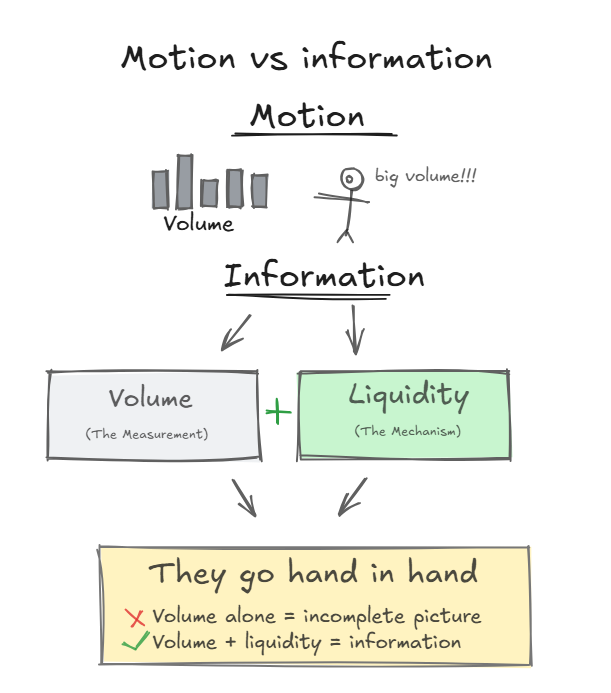
most traders confuse motion w/ information
they watch volume and think it tells them something meaningful
volume is just the measurement. liquidity is what allows or not the movement to happen
A thread: 👇
most traders:
- react to candles
- chase levels
- confuse motion with information
Auction Market Theory begins with a simple question:
"What is the market trying to do?"
let the arc begin: