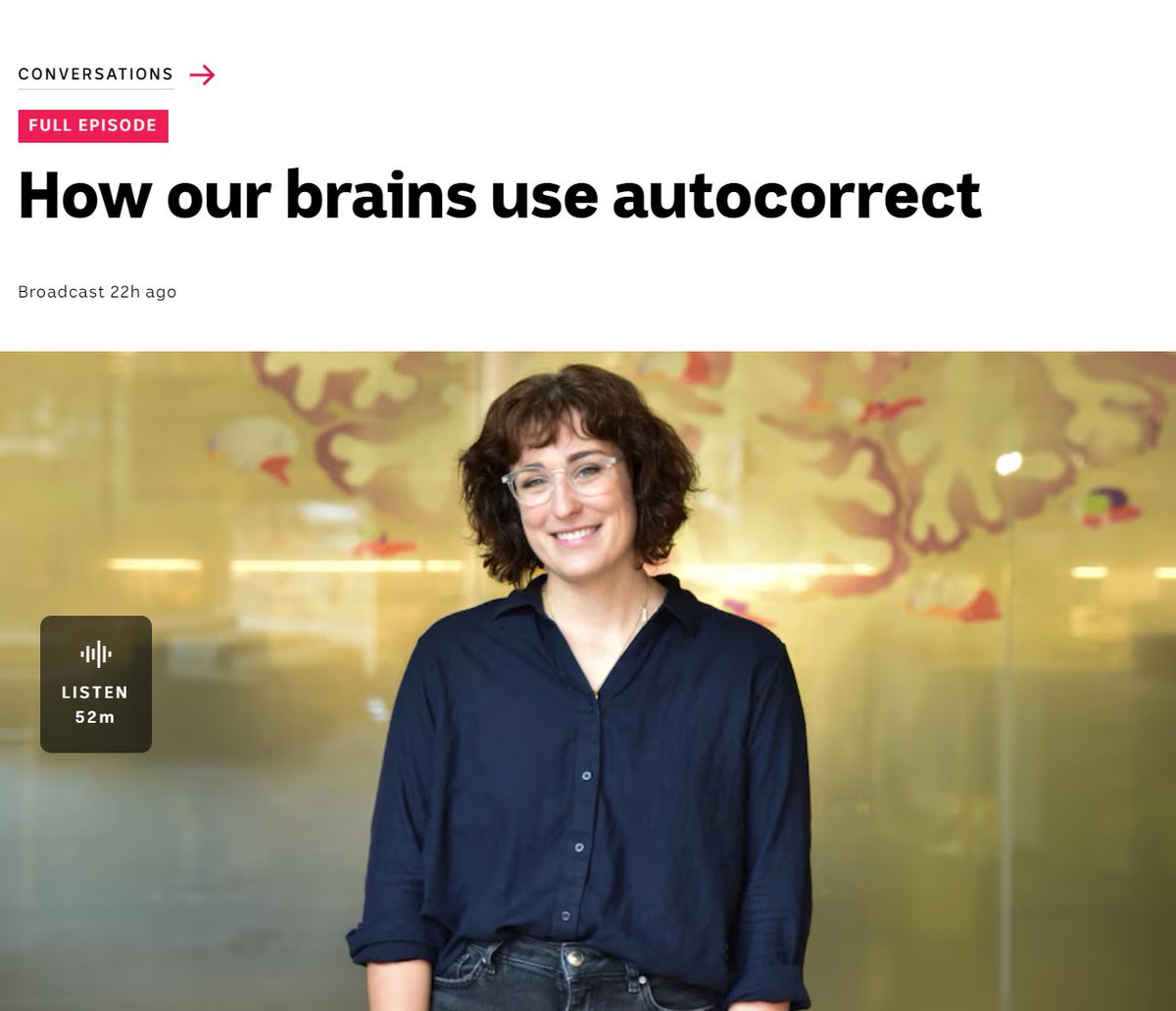
Ever wondered how strokes can alter not just our brains, but also our perception of reality?
#QBI researcher @_MJ_Moore_ joins @SarahKanowski on ABC listen to discuss the mysteries of #stroke and how our brain's predictions shape our experiences.
Listen:
https://t.co/mTHoipfdVS
@BrunoVanSwinder joined fellow #QBI researcher @_MJ_Moore_ at the @WSFBrisbane last week as they unravelled the brilliance of our minds, and how our #brains navigate a world of #prediction and surprise.
Outstanding work from both of these talented and engaging presenters!
Our brains are constantly making predictions based on our unique history.
Join @BrunoVanSwinder and @_MJ_Moore_ at @WSFBrisbane on 20 March 2024 as they unravel the brilliance of our minds, and how our brains navigate a world of prediction and surprise.
https://t.co/PZxCy9pTXS
New paper in Imaging Neuroscience by Margaret Jane Moore, Amanda K. Robinson and Jason B. Mattingley:
Expectation Modifies the Representational Fidelity of Complex Visual Objects
https://t.co/bTDkrnUOma
I'm pleased to announce I've received a Leadership Grant from the Stroke Foundation! 🎉 I'll be using this grant to collaborate with @NeleDemeyere to investigate how stroke disrupts neural representation of visual information.
@QldBrainInst
https://t.co/MKOACayGc8
Interested in lesion mapping, but don’t know where to start? Our new viewpoint paper outlines the pros/cons of this method and provides practical guidance for designing high quality studies.
Thanks to @NeleDemeyere, Chris Rorden, and @jbmattingley
https://t.co/jO74ksHG6g
You only have a few minutes to screen for neglect or visual inattention. What do you do? @CAOT_ACE@AOTAInc
Go for a cancellation task like the ❤️ one from the Oxford Cognitive Screen.
Read more: https://t.co/Aj1v4yORsE @_MJ_Moore_
OCS test: https://t.co/c2MCurqL0B @NeleDemeyere
Our recent project found that word-centred neglect dyslexia can be simulated in healthy readers. This provides novel insight into the causes of this condition and into the attentional processes supporting healthy reading:
https://t.co/ADqgVrfFyv
Our newest paper demonstrates that lesion-mapping analyses using CT and MR data do not reliably differ in accuracy. This suggests that routinely collected CT imaging can and should be used in future lesion-mapping studies:
https://t.co/8EhXtO60Qe
Amidst the sensory overload around us, the brain takes as many shortcuts as possible to process information.
In our latest podcast, QBI researcher Dr Margaret Moore discusses the fascinating and dynamic process of paying attention.
Listen here:
🔗https://t.co/orgjk5WWEH
Our newest word-centred neglect dyslexia case study is now published! 🎉 This case cannot be explained by the dominant model of ND and instead suggests that word-centred ND may involve a deficit of cognitive inhibition. @NeleDemeyere
https://t.co/5byjBFb4j9
Check out our new systematic review of lesion-mapping studies in neglect! 🧠 Past results vary widely and differences in lesion mapping methods may help explain why:
https://t.co/hs9j8Ei3lA
Our consensus recommendations for neglect screening are now available in the European Journal of Neurology! 🎉 Panel of experts recommends cancellation tests as first-line neglect screen based on systematic review.
https://t.co/6stdtDG8n8