After nearly 3.5 years running this account and over 6 years in the financial markets, I’m preparing to share one of my most important posts yet.
I recently revisited my X analytics, and it’s fascinating to see the breakdown of where you all come from, your age groups, and what topics truly resonate with you. At first, I was a bit disappointed by my absolute numbers. But when I looked closer, I realised something critical.
Since I started this journey with professional intentions from the start, these stats are the ultimate pulse check. They don’t just show growth: They prove whether or not I’m actually hitting the goals I set from day one.
I’ll be honest: When I first began my public journey, my goals were mainly centred on absolute numbers. I believed that high reach and massive impressions were the only true benchmarks of success on social media. While that may be the case for many, I realised very early on that I didn't want to produce the kind of content required to chase those empty numbers.
I have always aimed to provide genuine value and quality, though I didn’t always know the best way to deliver it. I am a firm believer in learning by doing. Looking back at my earliest posts, while far from perfect, I can proudly say that the core logic and principles are things I would still stand by today. Over the last few years, my market analysis has sharpened, my writing has become more concise, and my post structure has become far more intentional.
Looking back at some of my earliest posts, it’s clear that my entry into the financial markets wasn't my first encounter with high-consequence, high-reward probabilistic environments. Before I ever placed a trade, I was already navigating spaces where the margin for error was slim and the stakes were significant. These posts serve as a window into that foundation:
Emotions: https://t.co/o0P41rxcOx
The secret life of whales: https://t.co/hw6QD5Hkdp
Liquidity cycles: https://t.co/RUFAkvKFiz
My mental game has always been my greatest strength. Early on, I realised that in a probabilistic environment, analysis alone has limited utility. The true edge lies in execution. However, I also recognised that liquidity and the underlying mechanics of the market are what truly drive price action, so I committed to studying these elements intensively from the very beginning.
You might not believe me, but I’ve been profitable since I entered the market in 2020. I very slowly dipped my toe in, but went big into investments in 2022 after a lot of study. There are actually many great German financial education accounts, and with my integrated skills for detecting scams quite quickly, I never really got rekt by any of such.
Over the last 3.5 years, this account has become a deep repository of that knowledge and experience. It is a rabbit hole filled with the insights I've gathered along the way. While there are numerous gems buried in my post history, I recognise that not everyone has the time to sift through years of content to find them. More to that later.
Now, let’s look at my account data.
Generating 2.5 million impressions is a milestone I am incredibly proud of for an account of my size. But the more significant story is the engagement. My engagement rate is currently sitting at 7.9%, a figure that stands in stark contrast to the platform average of 0.12%.
The most important statistic to me, however, is the bookmarks. 10k bookmarks is exactly reflecting my core values. My content is not just a pump and dump one-hit wonder, people save it for later because they see enough value to return to it again. This is a huge honour, and I’m grateful that people value my content so highly.
Another interesting thing becomes obvious by simply looking at the engagement and bar diagrams. Last summer, I had very high traffic and interest, which has been stalling ever since. There are some clear and obvious reasons for that:
First, the market topped out late last year and I have been bearish ever since. Bearish content doesn't sell as much. But as I’ve said many times before, I’m not here to entertain the masses and their hopes and dreams with altcoins.
Second, I was bullish and long throughout Q2 and Q3. All the tourists that piled in around the top and on the way found bias validation in my content and so they interacted with it and enjoyed it more.
The good thing is, I have zero problems with the fact that it's dropping now. I choose high quality people over mass entertainment. My posts will not hit that dopamine button or validate group biases on a daily basis, that so many still chase. In this statement i even include the ones who think they are educating themselves by looking at 30 different opinions or setups for others a day.
From a professional perspective, my progress has been a huge success. I started monetising my personal brand last year, after two years of building, and I have made almost six figures in just over a year from my social media presence alone. I harvest all of these profits with my taxes legally optimised to 0% by taking the risk to move to a foreign country. Plan made. Plan executed.
Many with much bigger accounts need years to reach such numbers, and in this space, 90% of those who do reach them only do so by scamming their followers. I can stand tall and say proudly that I earned every penny honestly. Sure, the hourly rate is far beyond what you would earn in a traditional job, but that’s the whole idea of becoming financially free, isn't it?
None of this would be possible without the trust and support you give me. I am very glad to have you all as a community. Thank you for everything and below this post, a present is waiting for you.
Throughout my journey, I haven’t faced hate so far. Not even once. I did face disagreement and opposition when I first decided to monetize the knowledge I’ve built, but that is totally normal and it never really bothered me. In reality, most would do exactly the same if they could, and if they had spent the same amount of time and energy acquiring the skills I have now.
If you are thinking about starting social media, don’t let yourself be held back by fears of judgment or rejection. That said it might not for everyone, but in order to know you need to try it yourself, if you feel the urge to do so. Public pressure feels high sometimes, though it is often self-made. It can be a path through the fire, but after a walking through such a fire, that little flame of fear of judgment or simply the need to please people in daily life, becomes nothing.
It can be one of the most rewarding on both a spiritual and material level. To me, a thank you from someone I’ve helped is worth more than every dollar I make, but unfortunately, I haven't figured out how to live off sunlight alone, and the things I love, like freedom and skiing, are simply expensive.
A personal brand is leverage for everything you do or launch afterward. Once built and maintained with heart, it is yours forever.
I made many sacrifices along the way, many of which don’t even feel like real sacrifices looking back. Other sacrifices were more painful, but there is no such thing in this life as something for nothing. For everything you want, you must give something in return. If it is not now, you will pay later. This is simply a law of the universe that nobody can dodge.
The questions I found clear answers to over the past years are worth more than gold:
· What do I really want in life?
·How do I get it in the most rewarding and effective way?
· What am I really willing to pay for it?
Do you know these answers already? Let me know.
After seeing how many people are saving my posts with bookmarks, I’ve prepared the following replies as a present for all your support. I’ve categorised the most valuable content I’ve ever posted to make it as streamlined and time-efficient as possible for you to learn everything I know.
There is much more on my feed for those who have more time and seek a deeper look into how I perceive the markets and the world.
Check the replies below ⬇️
@NobodyonXI Might be. Time will tell. Just note that the algo on X often keeps you in your own bubble of bias. I'd rather base my assessment on the fact that the whole sector has seen a massive bull run already, yet I’m still preparing for more upside.
$SPCX aka SpaceX is launching publicly on June 12.
I’m not a fanboy, but I’ve got to say I have a huge interest in this company. I use #Starlink on a daily basis since my lifestyle involves wandering from remote place to remote place, and I'm a very happy customer overall.
This tech is a massive step toward space travel and already a fully functioning, revenue-generating product.
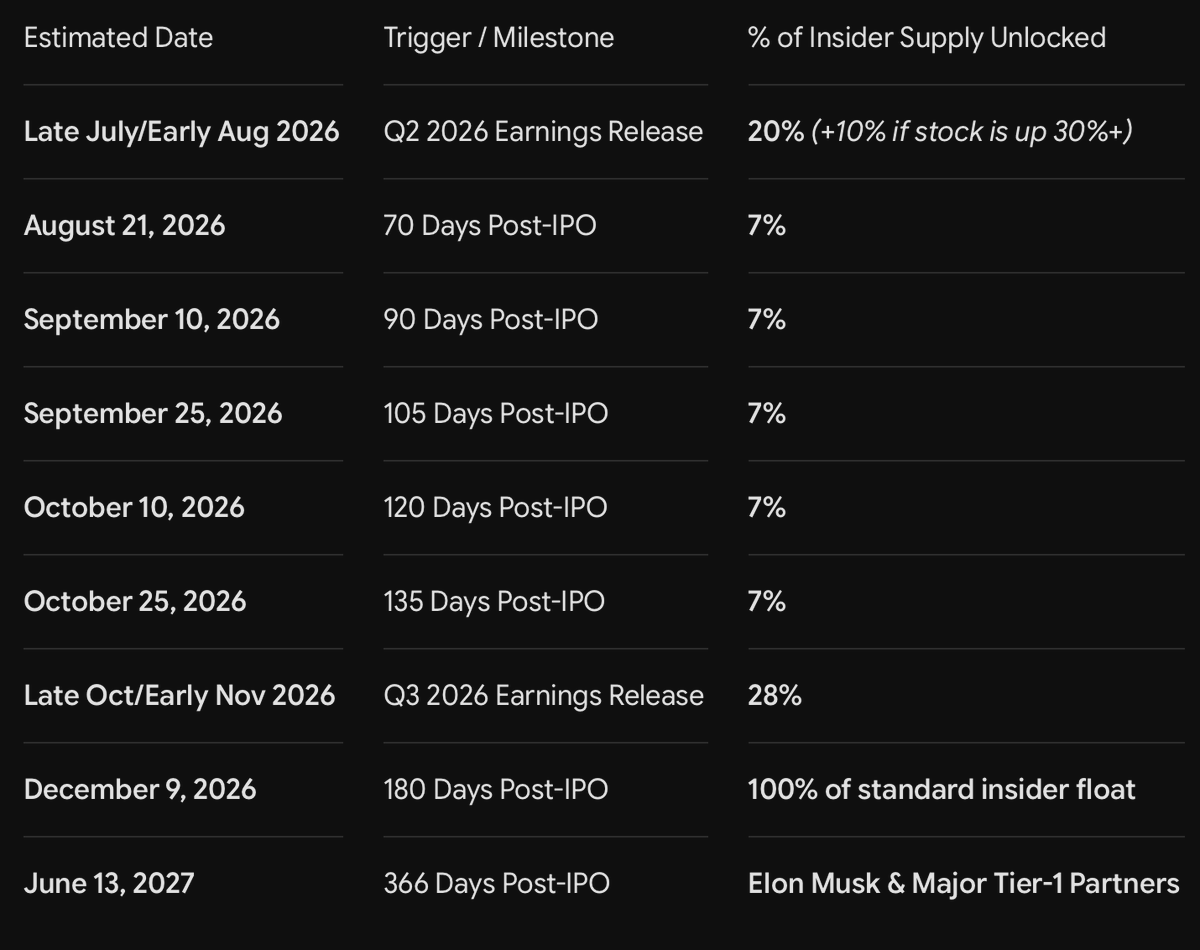
Overall, it's one of the most interesting IPOs in a long while. The valuation is crazy, though, so once those first lockup periods end, initial sell pressure from early investors might be incredibly high.
They target $135 per share with only around 5% available to trade publicly. Elon holds about 42% of the equity but maintains roughly 82% voting power over his baby due to his Class B stock.
It's most likely gonna get bought up by major ETFs, creating massive buying pressure in the beginning. With so little supply until the first lockup periods, we might see a significant artificial hype rally.
This is what a typical high tier listing looks like: Initial pump, followed by a dump that ultimately establishes the true public price over the coming weeks, months or even years.
I will use the IPO to gain some exposure, starting small. If it gives me the right entries, I'll add some momentum-based LTF positions that can be turned into long-term holds after hitting local TPs.
If you watch my videos, you know exactly what I mean by that.
Don't just fall for the hype and agendas that will go alongside the pumps and dumps on this one. It's gonna be a volatile ride. Look deeper.
Elon can't sell any of his shares until 2027. This is not some meme coin without value to him, it's his purpose, his mission, and its funding requires serious long-term stability. We are talking about a private company that built infrastructure previously only achieved by entire nation-states. While it's a tradable asset like anything else, it's undeniably unique.
Just look at prior IPOs where Elon or other tech elites are involved. It’s rarely a straight line up. As an early investor, your goal is to generate massive public buying pressure first so you have the liquidity to offload later.
Space Sector Momentum & The Macro Liquidity Shift
I bought $RKLB around $80 with my mentees in early May and just locked in massive gains after a clean 100% rally.
Let's see how the broader space sector performs leading up to June 12th. The hype is steadily building, and the SpaceX IPO is most likely going to completely dominate the market's attention and suck up major liquidity right after launch.
Don't just stare at the $SPCX ticker next week. Look deeper into the supply chains that back the entire infrastructure of SpaceX.
They don't build every single component themselves. For a massive venture like global satellite internet and interplanetary space travel, you need high-end suppliers and specialised contractors.
A rising tide lifts all ships.
If you want to play the "picks and shovels" of this historic IPO mania, keep a sharp eye on these secondary plays:
The Metals: Companies like Carpenter Technology ($CRS) and Materion ($MTRN) providing extreme-temp alloys for Starship engines.
The Silicon: STMicroelectronics ($STM), the massive semiconductor backbone pumping out the chips for Starlink terminals.
The Proxies: EchoStar ($SATS), which holds a massive equity stake in SpaceX from a prior spectrum deal.
The whole sector has been doing incredibly well over the past few months and years. This could be the final event for it, creating peak attention, massive hype, and ultimate exit liquidity. Pay attention and play the long game.
Many growth companies in this sector are highly overvalued right now, which doesn't mean they can't go higher, but from a rational perspective, it's better to let prices come to you instead of chasing into a potential top.
Time to put on the tinfoil hat for a second: Look at the broader markets. Crypto just exit-pumped across the board, and the public debut of Elon's crown jewel is happening immediately after. From a capital-rotation perspective, those two events are almost certainly connected. Big money is liquidating crap while real assets keep on rising. Coincidence? I think not.
As Elon famously said: "The final step of DOGE is to delete itself." I would mark July 4th on my calendar if I were you.⏳
https://t.co/yoNFDbS9EZ
Fun times ahead. My plan for the SpaceX IPO in short:
· Gain a very small amount of long-term exposure on day one. Just in case.
· Momentum scalp the potential initial hype pump using LTF and locking in local TPs, with the option to let a portion ride as a long-term hold.
· Go big on core long-term investments only after a potential repricing occurs following the expiration of the rolling lockup periods.
I recently shared an updated stock list built around my space travel and infrastructure narrative.
10 companies stand out. While some of them are still more narrative-driven growth stocks, others are already established global players or profitable businesses.
Space travel and the infrastructure required for it will be a major theme in the coming years. A lot of these companies are tied to U.S. government contracts, and huge amounts of capital are already flowing into the sector.
And it’s not just exploration driving this development, military and strategic interests will play a massive role as well.
The first country/company to build proper infrastructure up there will gain control over space.
Launch, fuel, software, shielding, satellites, antennas, life support, and manufacturing, these are the key pillars needed to make space travel work. A lot of companies are operating in this sector, and each one brings something important to the bigger picture. The key is to find the ones that either already have, or are aiming to build, a strong position in a critical part of the supply chain.
Some companies may have wild ideas and huge upside potential, but often it makes more sense to focus on the ones that already run profitable, proven business models, like LHX, NOC, BA, LMT, or AIR.
With companies like these, you can build relatively safe base exposure, because the more speculative “space” side of the business is often only a smaller piece of a much broader and already functioning operation. More speculative space names, on the other hand, are often betting almost everything on potential future dominance in one specific niche.
Companies like RKLB, ASTS, LUNR, and PL have very strong ideas, and some of them are already showing real progress. But there are still many variables involved, and space travel remains a dangerous, capital-intensive, and execution-heavy industry.
They are all interesting companies, ranging from established global players to highly speculative growth names. Many of them have already had strong runs over the last few years, but could still continue to perform well in the not-so-distant future.
The newer names especially look like they are in the up-leg of the typical pump-and-dump formation I’ve talked about many times before. And the reality is: These kinds of moves can last for years. If you wait for the “perfect entry” every single time, the entire narrative rotation might already be over by the time you finally decide to act. Adaptation is key.
That’s why it may be difficult to find clean, discount-based entries in this space right now. Regardless, there are still some names I want exposure to, so there will be a way.
The biggest hurdles for this sector remain:
- lowering costs
- reusability
- reliability
There are already rumors of SpaceX going public this year. And if that happens, it would be a major event for the entire sector. Because the truth is: SpaceX is the most advanced company in almost all of these categories.
They currently dominate in:
- Launch frequency
- Launch cost
- Rocket reusability
- Payload delivery
- Operational reliability
They are also the biggest satellite infrastructure company through Starlink, and one of the very few private companies already capable of sending humans into space.
For those reasons and given Elon’s history of taking tradable assets public, I suspect SpaceX would attract a massive share of the liquidity flowing into this sector if it were to launch publicly. That said, it’s important to also watch the supply chain.
For example, RKLB and SpaceX are already connected within the broader space ecosystem, and both could benefit from continued capital rotation into the sector. The same goes for parts of the semiconductor industry, because these ventures require huge amounts of advanced chips, communications hardware, and electronics.
These are just few examples out of many, so keep the supply chain in mind. It is often not just one company that builds an entirely new industry. Entire sectors are usually built by networks of companies, each one controlling a different but important piece of the puzzle.
This could become the modern equivalent of what the East India trading companies once were in the 1600s. But just like back then, the opportunity comes with major risk. This is likely one of the riskiest sectors out there.
Some companies will gain absolute dominance. Many others will fail.
But this does not automatically mean that SpaceX would go public and price is only move up from there. A lot of early private investors have likely been waiting for exactly that kind of event to offload profits from early-stage positions onto public buyers. So it makes sense to also study how other high-profile public launches behaved in the past.
Overall, it’s a company and sector in general that absolutely needs to stay on the radar.
If you are interested, this is my public watchlist of narrative-based stocks I’m watching:
https://t.co/EPGzlNNrbE
All setups and ideas can be found for free in my Discord.
https://t.co/2Nvvo9mLsa
When you publicly long or share something bullish, it usually gets at least 2x the engagement compared to when you share a stop or a sell.
No wonder the weak ones keep being pretenders and take the easy route of selling the dream.
As mentioned before, i was not going to let crypto positions go into negative from here so out at BE on the long term position and stops all sitting at BE on all other crypto longs.
Might add back on signs of strength. BVOL signalling a potential shift in program. We went up since the last hit.
If BTC keeps nuking into the next HTF key level, "deleting itself" could be taken literally. It could also simply mean that DOGE, the government department, will cease to exist and that's it.
With hints like this one, there is always a lot of room for interpretation, and I never base any trades on that. Most just slap their bias on it and call it analysis.
I'd rather use it like BVOL24h: Mark the date and expect volatility.
@Sento14519921 Hopeium usually comes from one sided exposure. Balance your plays with hedges and it will go away. Experience goes a long way here as well.
@Sento14519921 I did write July 4. Right now crypto only pumps into one direction and thats down. Not seeing a reason to doubt momentum here till majors reach their next big area of interest.
Stocks are the place to be right now, if you are looking for pumps.
@Sento14519921 Thanks.✌️ The post was about July 4th.
Crashing prices always means someone is selling sand only selling is freeing up capital. If you move millions to billions, its takes time.
The art of losing:
"If you want to be good in something, you have to admit that you are bad at it first."
You can learn everything, with enough patience, discipline and the right mindset. Some things will come easy for you, others don't. There are no limits in this world, besides the ones you make for yourself. (and the laws of physics of course).
Every beginning is hard. You don't know where to start. You don't know what to look for. The best thing that can happen is that you meet someone who is already good in what you want to learn, or you pay someone to teach you. With the right teacher you save a lot of time and mistakes, but without mistakes there is no progress and no learning. So the best thing you can do is to shut down your ego and admit you are bad at it.
Thats the fastest way to learn.
You made a mistake and what you do is to look at it, analyse it, learn and move on. If you try every time to convince yourself and others why it wasn't your fault and why you could be a little bit right anyway or it was just bad luck, you will never grow as fast as someone who is completely aware of his/her faults.
Ask yourself: Do i want to be right and comfortable all the time or do i want to get the best and fastest result?
19 Reasons Most Aspiring Traders Never Make It
Depending on personality, every trader faces different pitfalls.
1. Overrisking:
Very common. Taking too much risk due to the urge to make it fast. Boom and bust cycles follow. Accounts get blown. Losses become oversized. Stress rises. Performance collapses. These traders rarely reach consistency. They sometimes grow accounts fast, but they lose them even faster.
Solution:
Develop patience and discipline. Use strict risk management. Treat trading as a marathon, not a sprint.
2. Underrisking:
Common. Better than blowing accounts, but it creates its own problems. It leads to hesitation, overmanagement, overanalysis, and missing optimal moments due to fear of the need of being perfect. Once consistency is reached, scaling up becomes difficult for these traders because their mindset resists size.
Solution:
Increase risk within your predefined system once you found consistency and accept the trade once you commit. Build tolerance by taking non-dangerous risks in daily life to train decisiveness.
3. Not sticking to a system:
Very common. The perpetual seeker. Never committing to one strategy. Jumping from system to system. Never collecting enough data to understand any method deeply. A few losses trigger abandonment and the search for the “holy grail” begins again. This mindset avoids the reality of uncertainty and falls for every shiny new or recycled system on the market.
Solution:
Commit to one strategy for a long enough period. It does not need to be perfect. Consistent execution builds the skills that make a strategy powerful. Without those skills, even the best system fails.
4. Never looking for other systems:
Common. Committing to one system is useful for skill building, but refusing to explore other approaches can stall progress or block consistency. The system might be weak. Even if it is solid, it may not fit your thinking style or personality. Traders who never look beyond their system often fear the unknown. Some become rigid believers in a single“truth” about the market and turn their strategy into a religion.
Solution:
First commit long enough to one system to build skill and gather clean data. After that, explore alternatives to find approaches that may offer better fit or performance. This also shows you that there are thousands of valid ways to make money. The right system is the one you can execute for years and that aligns with your mind and life.
5. Neglecting the investment approach completely:
Very common. Many people get destroyed early when trying to invest. Often through altcoins, but traditional assets can hurt too. As a result they abandon investing and assume trading is the only path. In reality most of them will not outperform major assets like SPX, Gold, or BTC on a year-to-date basis.
Solution:
Do not neglect investing. Zoom out. Major established assets trend up most of the time. Use your trading skill to time entries and exits on these assets. You can outperform most participants while spending a fraction of the effort. Allocate large portions of capital to these core plays. Use the rest to enhance returns or hedge downside.
6. Putting 100% of the attention on one market:
Very common. Many traders enter the game through a single asset class. If that market also gave them their first wins they build emotional attachment. This blocks their potential to extract opportunity elsewhere. They often stack multiple correlated positions in the same direction which amplifies losses.
Solution:
Explore other markets. You may find one that fits your timezone, your thinking style, or simply carries no emotional bias. Diversifying your focus reduces correlation risk and expands opportunity.
7. Only playing the market in one direction:
Very common. Similar to the trader fixated on a single market. Early wins, usually on the long side, create emotional bias. The trader becomes a permanent bull. He searches for longs even when the market is setup for a clean downswing. This blocks opportunity and limits the ability to hedge.
Solution:
Practice shorting. Once you master it, you remove directional bias. You no longer depend on rising prices to make money. It becomes a core tool that expands your freedom and improves your edge by adding hedging to the equation.
8. Thinking that leverage exists to build bigger position size:
Very common. Traders with small accounts see leverage as a shortcut to size. These traders often overlap with the over-risking group. They view leverage as a way to “go big", not as a tool to manage capital effectively. This mindset is dangerous. Without skill and discipline it leads to blown accounts or even total wipeout.
Solution:
Learn how leveraged products work before touching them. Use leverage to reduce margin, not to increase size. With the right understanding it becomes a risk-management tool that helps you deploy capital efficiently, not recklessly.
9. Falling for the wrong figures:
Very common. Where money flows, pretenders appear. Markets are complex and probabilistic. This makes it easy for shady figures to speak in vague riddles, use smart-sounding language, and package uncertainty as wisdom. Their statements are open enough to be “right” no matter what happens. Traders who fall for them are often insecure or unsure of their own judgment, so they seek someone who sounds certain.
Solution:
Research before trusting anyone. Study their statements over long periods. Save their claims and compare them with actual outcomes. A person who speaks in certainties is a clear red flag. These figures attract beginners by offering the illusion of clarity. But its easy to see through because certain statements are easy to disprove in markets.
On the other side are those who also lack skill but hide behind riddles or intellectual fog. They appear deep but deliver nothing testable. Not everyone who talks vaguely or confidently is a pretender, yet both styles are common tools for pretending. The safest filter is data. Observe the person behind the mask. Track their calls. Watch for proof of execution. Only then decide if they are worth learning from.
10. Doing things you are not ready for:
Very common. Trading is hard but it does not need to be exhausting every day. Many new traders watch experienced traders and assume they must match that performance immediately. They drop to lower timeframes because “something is happening” or to chase higher RR. They do this while they still lack the discipline to follow their plan on higher timeframes. These traders are driven by restlessness and the belief that doing more produces more profit. In trading the opposite is often true.
Solution:
Fix your dopamine patterns and increase difficulty slowly. Same logic as training. You do not walk into the gym and squat 160 kg without progressive load. Trading works the same. Build capacity first. Trade less and earn more is not just a slogan.
11. Becoming a professional studier instead of a trader:
Common. Studying is useful. Building knowledge before risking money is smart. Yet theory alone does not create trading skill. You cannot learn to drive by reading a manual. Many fall in love with studying because it is safe. No stops. No losses. No discomfort. Dreaming about being a trader becomes easier than being one.
Solution:
Execute. Execute Then execute again. Trade on nano size if needed. The goal is exposure and feedback. Execute as many trades as your schedule and mental health allow. Skill comes from doing, not from reading.
12. Never taking the time to integrate things:
Common. The opposite of the professional studier. This trader executes nonstop but never reflects or journals. The boring work is avoided. Without reflection or structured review the same mistakes repeat for far too long.
Solution:
Journal. Reflect. Integrate new lessons. Slow down enough to process what you learn. This shortens the feedback loop and accelerates consistency.
13. Chasing high RR:
Very common. Once traders learn about RR and position management they try to squeeze out the biggest R every time. This produces a low win rate in the early stages. Low win rate creates frustration and emotional baggage. That baggage slows progress and must be undone later.
Solution:
Prioritise a higher win rate early on. Increase RR with your skill and experience.
14. Having unrealistic goals:
Very common. Applies to monthly, yearly, and trade-by-trade expectations. Most beginners want to get rich fast. This creates unrealistic targets. Unrealistic targets create frustration and push traders toward over-risking.
Solution:
Learn to read charts so you can set realistic targets for each trade. Study traders with transparent track records and adjust your percentage goals to levels that align with reality.
15. Always aiming for best-case targets:
Very common. The RR of a trade is calculated from the best-case scenario, but expecting that scenario to hit with full size is a mistake. Traders with this trait often roundtrip winning trades or worse.
Solution:
Read market structure without bias. A best-case target is optional, not guaranteed. Markets are rarely perfect. Build layered ideas with gradual take-profits.
16. Not having a plan:
Very common. Trades get entered on emotion instead of logic. Many start this way due to unrealistic goals, influence from shady figures, and a lack of discipline.
Solution:
Create a plan and follow it. You will be wrong often, but each failed plan gives data about the market and about yourself. Proper plans reduce randomness and speed up learning.
17. Trading other people’s plans:
Very common. It comes from lack of understanding. These traders jump from opinion to opinion. When one plan fails they have no plan B. They open X and wait for their preferred teacher to post a new idea. If no idea appears they freeze and fall into analysis paralysis.
Solution:
Build your own plans and stick to them. Copying someone early to learn a strategy is fine, but real learning starts when you take your own trades with your own logic. Self-accountability is the teacher. It is more valuable to make your own mistakes than to win from someone else’s plan.
18. Not being intentional:
Very common. These traders are unclear about what they want from trading or from life. They trade for many vague reasons but lack a core purpose. Without direction they drift. Motivation fades. Hardship feels pointless.
Solution:
Be intentional. Form a clear picture of where you want to go and who you want to become. That north star carries you through difficulty and anchors your decisions. With a defined destination you move with purpose. Without it you drift like a ship with no course.
19. Overcomplicating instead of simplifying:
Common. Many aspiring traders try to prove something. Their intelligence. Their skill. Their superiority. This pushes them toward complexity. They build convoluted ideas instead of clean ones. Discussions with them reveal the core issue. They are not looking for the best solution. They are looking to be right.
Solution:
Simplify. Ask yourself why you are here. To make money and build the life you want. Or to prove a point. If your answer is money and freedom then direct all intention toward that. Let go of the need to be right and smart. Focus on what works and remove what doesn’t.
Exactly. Crypto is made for puzzlers, gamblers, and tech ideologues who think they understand the future, but instead end up believing all the crap they are told because they are buying and selling their fundamental hopes and dreams instead of reality.
After that, instead of chasing a 10x, they start chasing a 10R. The game just traps them one layer deeper, without the core issue ever being resolved.
The Trap for an Entire Generation: bitcoin:native and #Altcoins
It was the more probable outcome, yet I missed executing another short at this S&R level. Lived outdoors in harmony with nature, so there is not a single regret. Still riding the short from the top, so no worries. Can't catch them all. Trailing stop loss of this short down above the recent HTF high.
All my recent crypto longs are stopped at BE and, as mentioned in videos, streams, and posts before, I was never letting them go into negative after this bounce. It never looked like a proper HTF reversal because there was simply too much liquidity forming below all these lows, and for a HTF reversal, it was very likely that we would take it out before.
If you understand the chart below, you will be prepared for everything crypto throws at you on the HTF. Don't overcomplicate it.
Now the question remains if we reverse from here again. I lean towards no for now until proven otherwise. If the market provides me with signs of strength, I can always add back, but to be honest, I don't care much about crypto right now.
My stock portfolio and plays are printing like crazy, which once again just confirms that crypto is simply the biggest trap of our time for the majority. For shitcoin "investors," it's not just about losing or paying it all back, they also miss, historically speaking, the biggest stock market rally of all time, while trying to prove they can make it with crypto instead, chasing a dream that was set as a trap from 2017 to 2021. Their plan still works just fine, and once the majority wakes up and piles into stocks, it will already be too late once again.
Your favourite market is nothing but a scam. The opportunity cost you pay for being solely engaged in this one, or seeing this game only through the lens of LTF high-frequency trading, costs you massive performance and passive income you could easily generate by investing in real-value companies or indexes at the right time.
Show me a trader who is currently outperforming a proper stock picker or refined investor on a %age basis, with proof and less than 10 hours of time effort per week, and I might change my mind. ROI might be high if someone knows how to use leverage, but this can be combined with swing trading as well and work just as effectively as you can see on my feed.
My 10% average return is technically a 100% ROI per month for my crypto account. I never see it like that since it's still just 10% on the size I trade, but if you understand what I'm saying here, your game will change forever. If you don't, search my feed, it's all there for free in the most spoon-fed format you can imagine.
Bitcoin is here to stay, I'm quite sure of that, but as said many times before, it's not the time to pull the trigger on big spot plays yet. The time will come, and it will feel like the worst idea ever. That's your signal. Altcoins can be your proxy to that once it's time, but they are much harder to play, as many of you might have already found out.
The World Cup is starting, and if you've followed me for a while, you know what I think about this event. Search my timeline, it's all there. Consistent outperformance with proof and the least time effort you will find among a crowd of pretenders, after the fact geniuses and screen addicts.
I will keep on printing with proof while building useful, real-world skills that actually bring fulfilment and add real value to this world.
I'm not your average addicted and dream selling trader.
Last High-Timeframe Preparation Moves: bitcoin:native
As stated in my previous video updates, I remain HTF bearish until proven otherwise. The slow grind higher, combined with the fact that we are leaving all lows untouched on the way up, is a clear sign that liquidity is forming beneath each of those levels. Traders are slowly stacking longs and moving their stops below technical barriers. This getting away unpunished cannot last forever.
The best HTF reversals always feel like the worst at the time, and we haven't seen a real punishment for longs since the last major liquidation event. Look at the best historic HTF reversals and you will see what i mean.
BTC has reached its first true obstacle: The 80k psychological key level, which also marks a significant HTF S&R level. For this reason, and the presence of those unprotected lows, I have executed another short here.
Before that, i took 60% at 18R profit from my top short from late 2025 and reallocated into this new short higher, with a defined invalidation of 1R for this new entry. I also executed this new one using USDC as collateral to diversify away from USDT.
Despite my BTC bias, I am still holding my spot like ethereum:native long as it has not yet reached my first target. I also recently took a public binancecoin:native long in the Discord to stay prepared for further upside.
With these two short positions running alongside my altcoin longs, I am ready for whatever the coin market throws at me. If invalidation hits of the new one, I will re-evaluate for a potential re-entry higher.
If longs fail, I will pay a 1R stop for BNB, which will be easily covered by the BTC shorts. ETH is already in such significant profit that the worst-case scenario is a break-even exit.
As this domesticated trader leaves his domus behind and enters a highly volatile period of life, I am preparing all moves and assess potential outcomes now. When my new life requires my time, I won't need to overthink. I will simply execute pre-defined plans at pre-defined levels when price action triggers my entries.
In between, there is nothing to do but wait. The market will move whether I stare at the candles or not.
Deep Dive into BVOL:
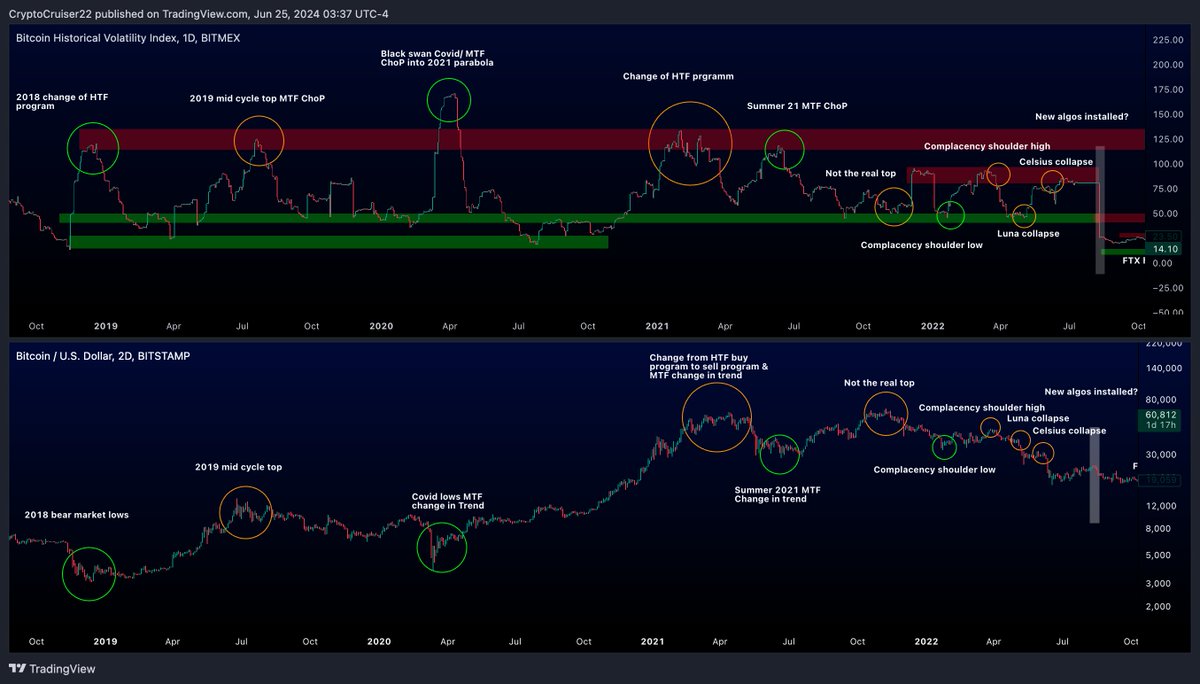
As you can see in the 2018 to 2021 bullrun, all major HTF pivot points happend at the "resistance" in BVOL. It's like a switch. Everytime BVOL reaches for the red box we see at least a MTF change in trend (notice that MTF means in that context several weeks to months, while HTF means months to years).
Its not very precise to the exact day, but its still a major tool to decide if its time to look for longs or shorts on the MTFs/HTFs. Even Luna seems like it was programmed to some degree. In our current cycle i go deeper into each points as i remember better how the sentiment, news and exact PA was.
The grey box marks out what i would call a complete change of program, because since then the structure of BVOL and BTC changed completely.
As you can see the structure of quite a lot. A lot less volatilty and BTC went from a more like ZickZick fractal to an exhausting range, drop, pump, range pattern.
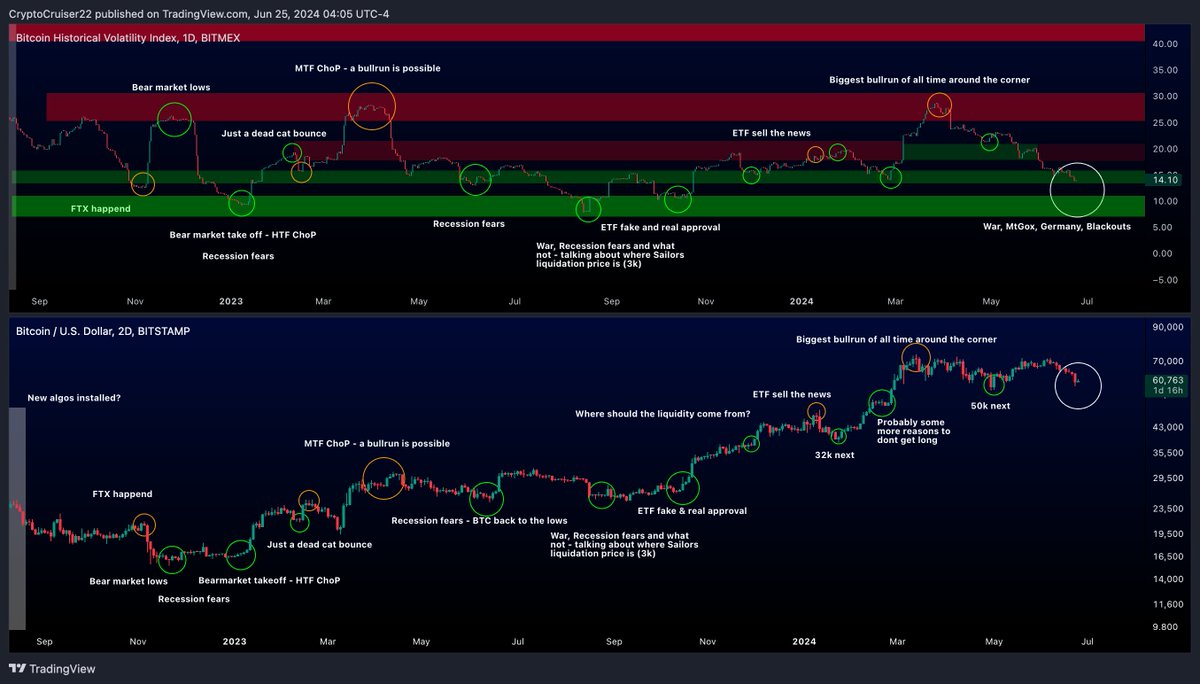
There is no clear instruction on this chart such as: "Wen green box you buying big!", but i found definitely something remarkable.
Most important seems the upper red and the lower green box, which i gave more density in colour. After we saw the HTF change in program, every touch at the upper red box was basically a top, with very intense bullish sentiment. Every touch with the green box was a nice buy area with a horrible looking PA, combined with even more horrible news. Recession, War, Liquidity fears and all these things only came up once we reached for that green boxes.
These sentiments intensified once we got closer to the lower green box. This chart seems to uncover the algos behind the BTC PA and the news sentiment, maybe even for the global markets as a whole. In the middle of the chart we were basically in no man's land. News were either neutral or countered each other from time to time.
Looking at this i have to admit that if i had just bought BTC in the green and sell in the red would have made me more money than with shitcoin chasing.
This chart has to be combined with other liquidity related or general charts and an understanding for TA. It should not act as trigger alone, but it's still a powerful confluence.
https://t.co/8rtobOc7IC
How to use Leverage like a Pro:
One of the most powerful ways to use perpetual futures in crypto is by removing your margin once a trade is in profit and trailing your stop loss. This approach minimises your capital exposure while letting your position run with reduced risk.
Many people label leverage as dangerous or equate it with gambling. But when used correctly, leverage is an incredibly effective risk management tool.
Now you might ask: How can I manage risk using leverage?
The answer is simple. Leverage allows you to keep less capital on risky exchanges. For example, instead of keeping your full trading capital on an exchange, you can leave only a fraction — say 1/10 — and still trade full size.
If your total account size is $100,000, you can leave just $10,000 on the exchange and still manage multiple trades without any issues. This significantly reduces your exposure to exchange risk ("hacks", outages, etc.).
That said, you should still calculate your risk properly. Use only 1–2% of your full account size per trade. In this example, you’d risk just $1,000–$2,000 per position, based on the full $100K portfolio, not just what’s on the exchange.
I shared a post last year on how to calculate your risk and adjust leverage accordingly, it breaks it all down clearly:
https://t.co/1MCZruktz7
Now, back to the idea of removing your margin.
For example, I recently built a low-leverage FTT spot position at the DHOB. Since then, price has bounced 13%, so I moved my stop loss to break even.
At this point, I have several options:
🔹I can leave the position as it is.
🔹I can trail my stop loss.
🔹I can adjust my leverage and remove part (or all) of the margin.
Removing margin unlocks that capital. I can now use it to build a new position (long or short), or simply withdraw it from the exchange and buy myself a lollipop. You see how powerful this is?
I now have a profitable, low-risk long running — and I used only 1/5 of the margin I’d normally need for this position size. By removing the freed-up margin, I can open a new trade or even hedge the current one. And I can repeat this process endlessly, stacking multiple secure positions with the same original capital.
This is how leverage should be used: as a capital efficiency tool, not a gambling chip.
Of course, there’s one drawback compared to spot: even if a position is margin-free, if the exchange rugs, the position’s gone. But hey — no risk, no reward.
How to do it: Using Leverage Like a Pro
Step 1: Secure the Trade
First, make sure your position is already in solid profit. Then move your stop loss — ideally into slight or decent profit.
In my example, I only moved it into slight profit since I treat this like a spot position and want to give it room to breathe.
Step 2: Adjust the Leverage
Now, crank the leverage up as high as the system allows + living your liquidation price a good chunk away from your stop. Yes, the % might look crazy — but remember, the overall position size and your PnL stay exactly the same. You’re just using less margin to hold the same position.
Also: Use isolated margin, not cross, this ensures the rest of your account isn't at risk.
Step 3: Remove the Margin
Next, click the pen icon next to the margin in your open position window. Reduce the margin until your liquidation price sits comfortably below your stop loss.
Don’t get greedy! With high leverage and volatile assets, you must give your trade room to breathe. Otherwise, you risk getting liquidated on a sudden spike.
Now you’ve freed up your margin and can do whatever you want with it, build another position, hedge, or even withdraw it.
Pretty great, right?
This method works on every crypto exchange I’ve used so far, and it’s now another powerful tool in your trading toolbox.
Now you know how to use leverage like a pro, not to gamble, but to trade smarter, more efficiently, and with reduced capital exposure.