We are excited to announce that the English translation of the esteemed scholar Al-Muhaqqiq Al-Yusi al-Maliki al-Ash‘ari (ق) (d. 1102 AH) in Fard al-‘Ayn by @AndaluciMaliki1 is currently in development. This seminal work, revered in classical Maliki scholarship, will soon be accessible to a wider audience.
Stay tuned, this long-awaited translation is expected to be available in the coming weeks. Expand your understanding of Maliki Fiqh with this essential text.
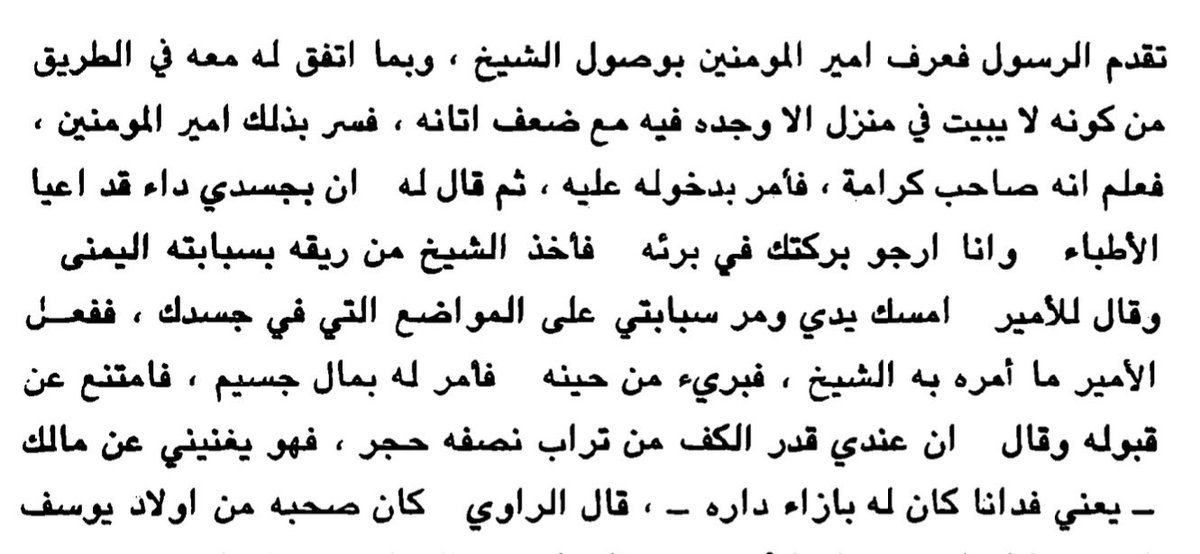
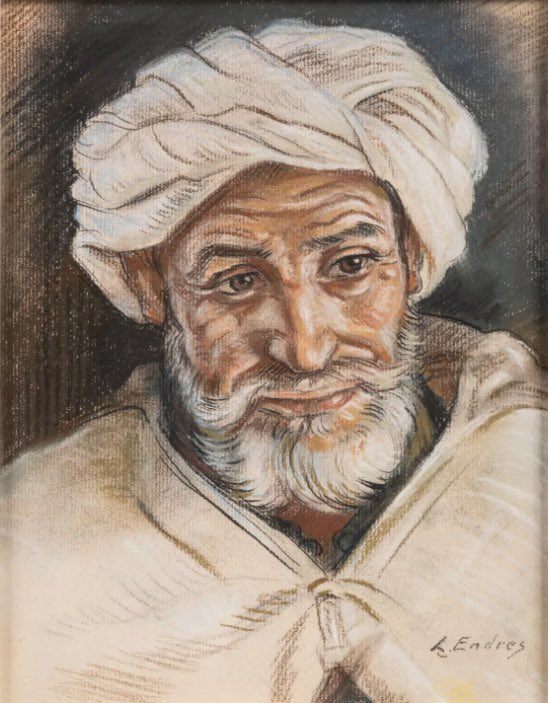
Imam ‘Abd al-Haqq al-Badisi al-Rifi al-Maliki al-Ash‘ari (ق) (d. ~722 AH) relates a remarkable, repeatedly manifested “karamah”, a miracle that recurred time and again, bestowed purely as a divine gift from Allah, granted to a saint renowned for numerous wonders: the great Wali, the Qutb and ‘Arif, and devoted disciple of Abu Madyan “al-Ghwath” al-Maliki al-Ash‘ari (ق) (d. 594 AH), Abu Dawud Muzahim ibn Yaslitan ibn Batwi al-Nakuri al-Mazmi al-Rifi al-Maliki al-Ash‘ari (ق) (d. 578 AH).
This repeatedly manifested “karamah” became so well known that he gained widespread recognition for it. People would seek him out for healing, as reports of his cures spread far and wide. It was through this divinely gifted grace that his name became associated with the relief of the afflicted and the restoration of the ill. It was a lasting sign of divine favor, through which Allah brought relief and healing by His servant.
Among the most famous instances was the healing of the the mighty Almohad Caliph, most likely Abu Ya‘qub Yusuf (I) al-Kumi (رحمه الله) (d. 580 AH), (son and successor of ‘Abd al-Mu’min al-Kumi, رحمه الله, d. 558 AH) when the Caliph was struck by a severe illness, thought to be leprosy. The physicians were baffled and exhausted every possible remedy, yet remained powerless before the disease.
In their distress, they turned to the righteous saint Abu Dawud Muzahim al-Rifi, whose reputation for healing was already well established. They asked him to travel from the region of Mazma (in present-day al-Hoceima) all the way to the Almohad imperial capital of Marrakesh. Through him, by Allah's permission, the prince was restored to health.
Imam ‘Abd al-Haqq al-Badisi al-Rifi states in his great work “Al-Maqsad al-Sharif wa al-Manza‘ al-Latif fi al-Ta‘rif bi Sulha al-Rif”:
“Abu ‘Aqil related to me:
‘‘Amir al-Mu’minin’ in Marrakesh, one of the sons of ‘Abd al-Mu’min ibn ‘Ali, was afflicted with an illness, which I believe was leprosy. His condition confounded the physicians and left them incapable of treating him. It was then mentioned to him that in the land of Batwiyah (today corresponding to the Ath Wayagher tribe in the Western Rif, in the region of Ajdir) there was a righteous shaykh who cured diseases and ailments. So he sent someone to bring him, dispatching for him a splendid horse.
When the messenger conveyed the order to him and presented the horse, the shaykh refused to ride it. He said, ‘My mount will carry me,’ and it was a she-donkey. The messenger replied, ‘I have been commanded to hasten the journey. You will not be able to keep up with me on this donkey, and I cannot leave you behind.’ The shaykh said to him, ‘Go on ahead. You will not spend a night in any lodging but that I will spend the night there with you.’
The messenger set off swiftly. Yet at every place where he stopped for the night, he found that Shaykh Abu Dawud had already arrived there before him.
When they reached Marrakesh, the messenger went ahead and informed the Commander of the Faithful of the shaykh's arrival, and of what had occurred on the journey, how he never spent a night at a stop without finding him already there, despite the weakness of his donkey. The Commander of the Faithful was delighted by this and realized that he was a man endowed with ‘karamah’. He ordered that he be admitted.
He then said to him, ‘There is an illness in my body which has exhausted the physicians, and I hope for your blessing in curing it.’ The shaykh took some of his saliva on the forefinger of his right hand and said to the prince, ‘Take my hand and pass my forefinger over the places on your body where the illness is.’ The ruler did as the shaykh instructed, and he was cured immediately.
He then ordered that a great sum of money be given to him, but the shaykh refused to accept it. He said, ‘I possess the measure of a palmful of earth, half of it stone, and it suffices me over your wealth.’ He meant a small plot of land he owned opposite his house…’”
Whoever Allah opened in insight and looked into their inward realities would find, except for a few, their intellects attached to Allah and His Messenger (ﷺ), seeking to attain their pleasure. Because of this, goodness was abundant among them, the light of Truth shone within them, and among them appeared knowledge and the attainment of the rank of independent legal reasoning (‘ijtihad’) in a manner beyond description and measure.
Thus, in those generations, formal ‘tarbiyah’ was not needed. Rather, the shaykh would simply meet his disciple, the bearer of his secret and inheritor of his light, speak a word into his ear, and spiritual opening would occur for the disciple immediately, due to the purity of souls, clarity of minds, and their yearning for the path of right guidance.
At other times, the removal of darkness from souls occurs through the active involvement of the shaykh, meaning that he assists in cutting away the darkness from the inner being.
This pertains to the period after the virtuous generations, when intentions became corrupt, spiritual states stagnated, and minds became attached to the worldly life, seeking the fulfillment of desires and the gratification of pleasures.
At this time, the shaykh, the one with insight, meets his disciple, the inheritor of his light, and observes him. He finds that the disciple's intellect is attached to falsehood and the pursuit of desires, and that his self follows the intellect, playing along with the heedless, being distracted with the inattentive, leaning toward the corrupt, and having the limbs act in ways that are blameworthy, because the intellect, which governs the self, is connected to falsehood rather than truth.
When the shaykh finds him in this state, he prescribes seclusion (‘khalwa’), remembrance of Allah (‘dhikr’), and reducing food intake. Through seclusion, the disciple separates from the corrupt, who are counted among the dead. Through ‘dhikr’, the false talk, amusement, and idle speech on his tongue vanish. Through reducing food, the heat in the blood decreases, and with it desire diminishes, so that the intellect returns to attachment to Allah and His Messenger (ﷺ).
When the disciple reaches this level of purity and clarity, his self becomes capable of bearing the secret. This is the aim of the shuyukh in training and introducing ‘khalwa’.
This state continued for a time, until truth became mixed with falsehood and light with darkness. At that point, people of falsehood began instructing those who came to them, offering seclusion and teaching names, with corrupt intentions and aims contrary to the truth. They might even add incantations or practices that lead to Allah's trial and gradual retribution. This became widespread in the ages witnessed by Shaykh Zarruq, radiallahu ‘anhu, and those witnessed by his teachers.
It was then made clear to them, through guidance from Allah and His Messenger (ﷺ), that they should advise people to abandon this corrupted form of training, in which falsehood had become prevalent, and instead keep them within the safe bounds where there is neither fear nor grief: following the Sunnah and the Book, which never misguides those who are rightly guided.
Thus, their words, radiallahu ‘anhum, were purely advisory and cautious. They did not intend, radiallahu ‘anhum, a total cessation of true spiritual training. Far be it from them, for the light of the Prophet ﷺ remains, his goodness is all-encompassing, and his blessings are general until the Day of Judgment.’”
Ahmad ibn al-Mubarak al-Lamati al-Sijilmasi al-Maliki (ق) (d. 1156 AH) in his lenghty work “al-Dhahab al-Ibriz min kalam Sayyidi al-Ghawth Abd al-‘Aziz al-Dabbagh” where he recorded the teachings of his teacher al-Sharif al-Qutb al-‘Arif al-Faqih Mawlay Sidi ‘Abd al-‘Aziz al-Dabbagh al-Fasi al-Maliki al-Ash‘ari (ق) (d. 1132 AH), who explains us that spiritual training (‘tarbiyah’) and its evolution across generations. In early times, corruption and turmoil were rare, making it easier to attain purity very fast, though guidance from a shaykh was still present and needed, while later seekers require even more structured training through dhikr, seclusion, and discipline under a shaykh.
He states:
“He (‘Abd al-‘Aziz al-Dabbagh) was asked, radiallahu ‘anhu, by some jurists about the claim that ‘tarbiyah’ has come to an end. ‘Is that true or not?’
The text of the question was:
‘Our master, the Imam, one whom Allah has opened with the openings granted to His noble saints and honored with affiliation to the House of Prophethood (‘Ahl al-Bayt’), upon its possessor be the best prayers and purest peace, teach us, may Allah teach you from His divinely granted knowledge, something that will remove confusion from the hearts of men and release their minds from their restraints so they may attain spiritual sciences through clear explanation and illustrative examples.
It has been reported from Him, ﷺ, that He (ﷺ) said: ‘Creation are the dependents of Allah, and the most beloved of creation to Allah are those most beneficial to His dependents.’
Among what has reached us, our master, is what is transmitted from Shaykh Zarruq (al-Barnousi al-Fasi al-Maliki al-Ash‘ari, ق, d. 899 AH), radiallahu ‘anhu, that formalized spiritual training has ceased, and nothing remains except ‘taribyah’ through spiritual aspiration and state (‘hal’), and that one must cling to the Book and the Sunnah without addition or subtraction.
Is this statement specific to his time, or has ‘tarbiyah’ ceased altogether until the descent of our master ‘Isa, ‘alaihi salam? If you say it has ceased, what caused its cessation? And if you say it remains, then who is the shaykh to whom the spirit of the disciple is given so that he may direct it in seclusion as he wills? Specify him for us, in which region and land, and mention someone who succeeded at his hands.’
This jurist (Ahmad Zarruq) is the same one previously referred to in the explanation of ‘Qaf’ and in the commentary on the hadith of the two books containing the names of the people of Paradise and Hell. [A matter discussed before in a different chapter]
He (‘Abd al-‘Aziz al-Dabbagh) replied, radiallahu ‘anhu:
‘The intent of ‘tarbiyah’ is the purification of the self and cleansing it of its recklessness and coarseness until it becomes capable of bearing the secret. This can only occur by removing darkness from it and cutting off false attachments from its direction.
At times, the removal of falsehood occurs through the soul's innate purity at its original creation, meaning Allah purifies it without any intermediary. This was the state of the three virtuous generations, who are the best of generations. In those generations, people were attached to the Truth, seeking it constantly: if they slept, they slept upon it; if they awoke, they awoke upon it; if they moved, they moved within it.
(What is meant here is not that they had no need of a shaykh in an absolute sense, but rather that they did not require extensive spiritual intervention or prolonged due to the relative absence of widespread fitna and the strength of their innate disposition.)
The scholars of the Maliki regions, such as the Maghreb, Egypt, and West Africa, were among the first and foremost to respond to the Wahhabi movement and its innovations and deviations. Their letters and responses have even been compiled into various books.
The famous historian, traveler, and scholar Abu al-Qasim al-Zayani al-Sanhaji al-Fasi al-Maliki al-Ash‘ari (ق) (d. 1249 AH) records the response and ‘takfir’ (excommunication) issued by the judge of Tunis, Abu al-Fadl Qasim al-Mahjub al-Maliki al-Ash‘ari (ق) (d. 1243 AH), against the founder of the Wahhabi movement, Muhammad ibn ‘Abd al-Wahhab (d. 1206 AH / 1792 CE), the cursed murderer, who, during his lifetime, sent letters to many regions of the Muslim world inviting people to follow his deviations and declaring mainstream Sunni beliefs and practices, including the honoring of saints, intercession, and established permissible acts, to be acts of kufr and shirk.
Among the points Imam Abu al-Fadl made in the longer letter were:
“…As for what follows: this opening statement, which has risen in the sky of this exchange, you wrote to us imagining that you are the one standing in defense of the religion, that you call people with clear insight to what the Master of the first and the last brought, urging adherence and following, forbidding opposition and innovation. In your letter you spoke of avoiding division and disagreement among Allah's servants. Yet you have become as Allah said: ‘And of people, there is one whose speech captivates you in the life of this world…’, up to His words about corruption. [al-Baqarah, Ayat 204-205]
You claimed that people have introduced innovations into Islam and have set up, alongside Allah, intermediaries from among the dead, by seeking help at the shrines of the saints in times of hardship, by asking their intercession in fulfilling needs, by making vows and offerings as acts of devotion, and other such forms of worship. You declared this to be associating partners with the Lord of the earth and the heavens, disbelief by which you have made lawful fighting them and violating their sanctities.
By Allah, you have gone astray and led others astray. You have mounted the steeds of tyranny by what you have permitted. You have exaggerated and made matters seem monstrous, relying upon the excommunication of the early and later Muslims alike.
Here we bring you to judgment before the clear Book of Allah and the established sayings of His Messenger ﷺ.
As for what you have undertaken, fighting the people of Islam, terrorizing the inhabitants of the Sacred City, overpowering those who hold fast to the two testimonies of faith, kindling the fire of war among Muslims, and casting off from your necks the bond of obedience and religion, Allah ta‘ala has said:
‘O you who believe, when you go forth in the path of Allah, investigate…’, up to His words, ‘You desire the provisions of worldly life. So, indeed Allah has an abundance of treasures.’ [an-Nisa, Ayat 94]
And He, ﷺ, said:
‘I have been commanded to fight the people until they say: ‘There is no god but Allah.’ When they say it, their blood and their property are protected from me except by its right, and their reckoning is with Allah.’
Since you claim to rely on the Book of Allah and to stand firmly upon the foundation of the Sunnah, how then, woe to you, do you permit the blood of people who utter this word, who openly affirm the message of the Prophet (ﷺ), who uphold the pillars of Islam, who defend the domain of faith, who fight the worshippers of idols and strive for the sake of pure monotheism?
How have you cast yourselves into the abysses of disbelief, splitting the unity and spreading corruption upon the earth?
As for what you said in declaring them disbelievers for visiting the righteous and the saints, and for making them a means between themselves and the Lord of the worlds, claiming that this is merely an old habit of ignorant people, we say to you regarding this matter…”
The Maliki Madhab stands unmatched in authority, grounded in the ‘Amal of the people of Medina, whose practice was closest to revelation and preserved through generations. Medina was the center of early Islamic scholarship, home to the Sahaba, the Tabi‘un, and jurists whose diligence ensured a consistent and reliable body of practice.
Imam Malik (ق) (d. 179 AH) emphasized this practice as decisive, warning against deviation and affirming that society looked to Medina for guidance on lawful and prohibited matters. The strength of the ‘Amal of Medina is such that it remains an enduring reference, respected and unrivaled across generations and schools of thought.
The major scholar al-Qadi ‘Iyad al-Maliki al-Ash‘ari (ق) (d. 544 AH) mentions in “Tartib al-Madarik wa Taqrib al-Masalik li Ma‘rifat A‘lam Madhab Malik”:
“Abu Nu‘aym (al-Fadl ibn Dukayn al-Kufi, a major Muhadith, ق, d. 219 AH) said: ‘I asked (Imam) Malik (ق, d. 179 AH) about a matter, and he said to me: “If you seek knowledge, then remain there”, meaning Madinah, “for the Qur’an was not revealed by the Euphrates (Iraq).”’”
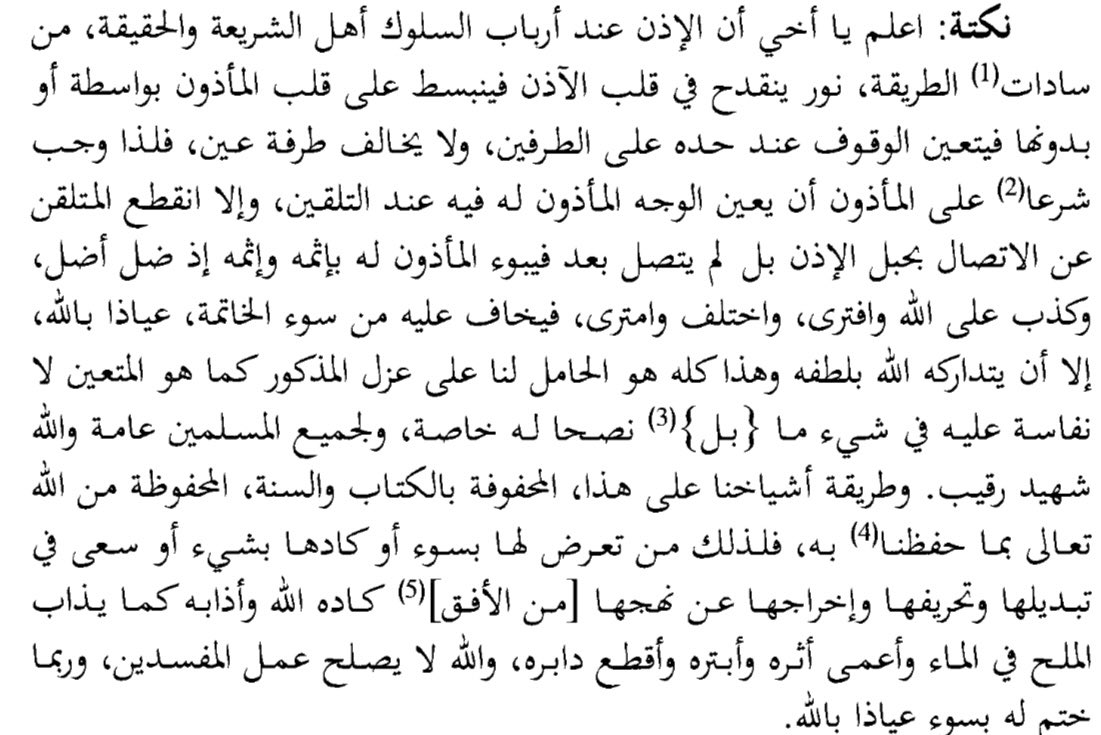
The eminent scholar and mujaddid of the Shadhili Tariqah, and founder of its famous “Nasiriyyah” branch based in the scholarly center Tamegroute, Morocco, which spread throughout the Maghrib in a very short time, al-‘Allamah al-Faqih al-Qutb al-‘Arif al-Sayyid Muhammad ibn Nasir al-Dar‘i al-Ash‘ari al-Maliki (ق) (d. 1085 AH) explains in his major work “al-Rihla al-Nasiriyyah” the concept of spiritual authorization (“al-idhn”) in the Sufi path / ‘tariqah’, its seriousness, its conditions, and the grave consequences of violating its limits according to the people of the Path.
He states:
“A reminder: Know, my brother, that the authorization among the masters of spiritual wayfaring (‘arbab al-suluk’), the people of the Shari‘ah and the Reality (‘al-haqiqa’), from the noble leaders of the Path, is a ‘nur’ (light) that flashes forth in the heart of the one who grants authorization. It then expands into the heart of the one authorized, whether through an intermediary or without one. Thus it becomes binding that both sides stop at its limit, and not deviate from it even for the blink of an eye.
Therefore it is legally obligatory upon the authorized person to specify the exact aspect for which he has been authorized at the time of transmission. Otherwise, the recipient becomes cut off from connection to the rope of authorization; rather, he was never truly connected in the first place. In that case, the one authorized bears his own sin and the sin of the one he misguides, for he went astray and led others astray, lied against Allah, fabricated, disputed, and fell into doubt. One then fears for him a bad ending, refuge is sought in Allah, unless Allah overtakes him with His gentleness.
All of this is what has compelled us to remove the aforementioned person from his position, as is required. There is no personal motive against him whatsoever; rather, it is sincere counsel (‘nasiha’) for him specifically and for all Muslims generally. And Allah is Witness and Watchful.
The way of our shaykhs is upon this principle, surrounded by the Book (Qur’an) and the Sunnah, protected by Allah Most High through that by which He has protected us. Therefore, whoever confronts it with harm, schemes against it, seeks to alter it, distort it, or remove it from its proper course, from the very horizon, Allah will counter his plot and dissolve him as salt is dissolved in water, erase his trace, cut him off, and sever his root. And Allah does not rectify the work of corrupters. It may even be that he is sealed with a bad end, refuge is sought in Allah.”
In the late 1800s, the French traveler and chronicler Auguste Moulieras (d. 1931 CE) explored the Rif region of northern Morocco, recording the daily life, customs, and social structures of its population. On this occasion, he observed the Iqer‘iyen tribe, noting both their communal and religious practices, as well as the roles of students, tailors, and wandering religious figures, such as dervishes. His account offers a detailed and vivid snapshot of Riffian life: the mixture of work, study, and devotion; the preparation of food and hospitality rituals; and the strong tribal identity that shaped their interactions and worldview. Through his narrative, Moulieras provides a unique lens on a society deeply rooted in tradition.
He states:
“…Men were sitting in front of the mosque, their black ‘djellabas’ (traditional Moroccan garment) tightly belted at the waist, rifles resting between their legs, talking about their affairs in a form of ‘Tamazight’ (the Berber language) slightly different from that spoken by the central Rif populations (it's the mid-eastern Riffian dialect of the ‘Iqer‘iyen’ / ‘Guelaya’ tribe). No one paid the least attention to the wanderer (wandering Sufi) who, after murmuring a quick ‘As salamu ‘alaikum’ (‘peace be upon you’) as he passed the group, entered the mosque. Inside he found about twenty young men: some reciting Qur’anic verses at the top of their voices, others sewing shirts, some darning socks, others mending ‘djellabas’.
In the Moroccan countryside and in the Rif, the trade of tailor is monopolized by the religious student. It is a welcome sideline added to income from funerals and from preparing amulets (‘hirz’ or ‘taweez’; talismans containing Qur’anic verses or supplications etc. for healing or protection). The local inhabitant does not merely feed the ‘talib’ (student of religious knowledge), house him, and clothe him; he has him carry out all the sewing and cutting needed in the household, pays him wages, and adds a few gifts on top of that. In ‘Guelaya’ (Latin wording for the Riffian ‘Iqer‘iyen’ tribe), the student-tailors all belong to the mountain tribe of the ‘R’mara’; the Guelayan schoolboys themselves never touch a needle. Outside class hours they practice marksmanship or help their parents with agricultural work.
The ‘dervish’ (a wandering Sufi) was naturally well received among these hearty eaters, whose main concern was to know in which tribe a student enjoyed the best feasts. Supper consisted of a mixed dish made up of ‘bijar’ (coarse couscous), fish, hard-boiled eggs, butter, and lentils. The barley bread, a cubit long and a handspan wide, deserves special mention on its own. The people of Guelaya call it ‘aneggoul’ (<-- right pronunciation is ‘angour’). At breakfast they ‘pass it down,’ as they say, with eggs cooked in oil, garlic, or raw peppers. In every home tea is consumed in excess and very sweet; the students drink large quantities of it in the mosques.
The ‘dervish’ left ‘Asammer’ (a village of the Iqer‘iyen tribe) after resting two or three days, sleeping each evening in a different village and, without haste, exploring this restless tribe, obsessed with the desire to drive the Spaniards of Melilla into the sea. (<-- Occupied City by the Spanish)
‘Guelaya’ (<-- the ‘Iqer‘iyen’ tribe territory) stretches about twenty kilometers (the French author from the late 1800s was wrong, it's actually ca. sixty kilometers) from north to south and some forty from east to west. It is divided into seven sections (tribal confederation of 5 sub-tribes, [corrected]):
- Ath Chicha [Ait Chiker; Beni Chiker]
- Ath Bouyafa [Ait Bouyafar; Beni Boughafer]
- Ath Sidar [Ait Sidal; Beni Sidal]
- Ath Buifroa [Ait Bou Ifrour; Beni Bou Ifrour]
- Imezzujen / Immezzuzen [Mazzuja / Mazzuza]…”
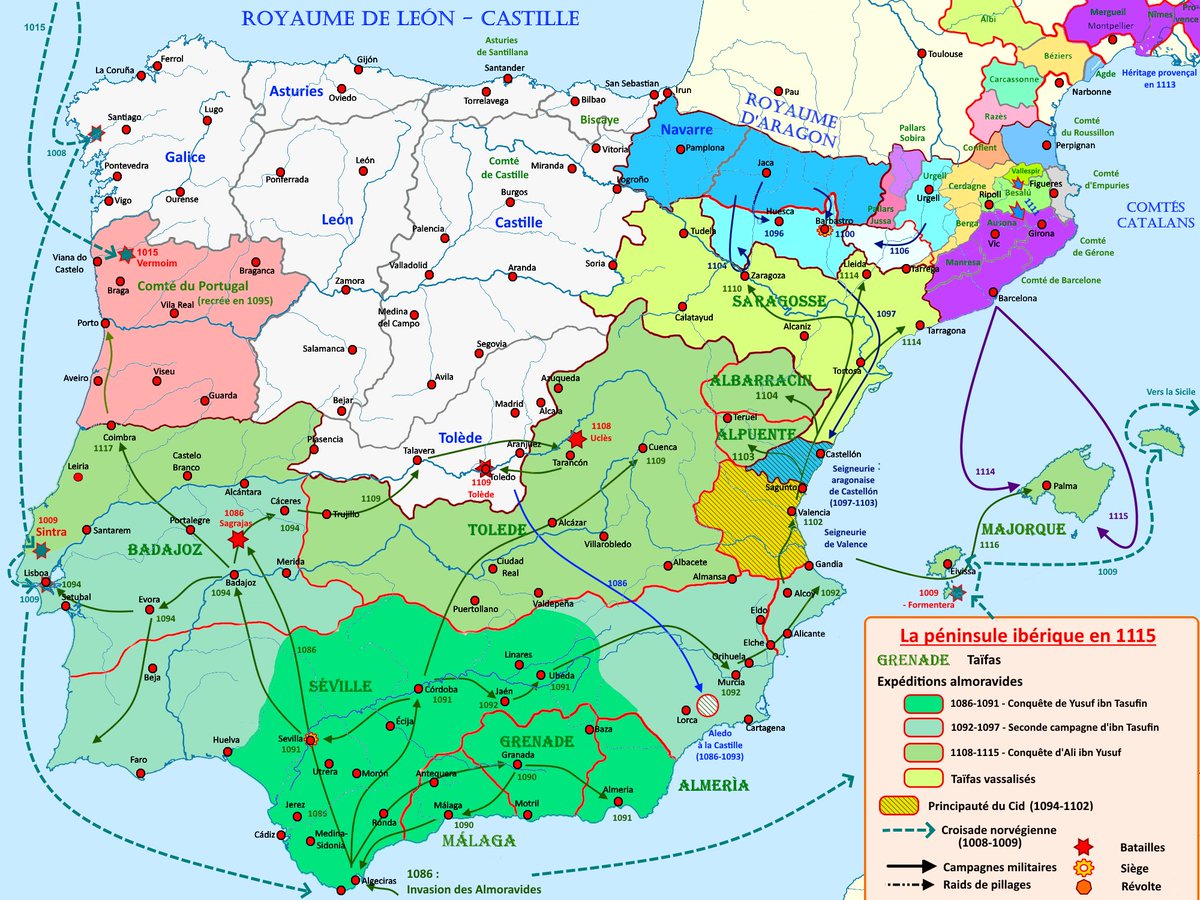
The Battle of “Zallaqa” (<-- “the slippery place”; according to historical sources, it was called this because the battlefield was slippery with blood, as the battle was extremely bloody) in 1086 CE, fought near Badajoz in modern-day Portugal, was a decisive clash in al-Andalus, where Yusuf ibn Tashfin al-Lamti al-Sanhaji al-Maliki al-Ash‘ari (ق) (d. 500 AH / 1106 CE) and the Almoravids, alongside unified Maghreb and Andalusian forces, confronted Alfonso VI of Castile (d. 1086 CE). With superior strategy and coordination, they achieved a crushing victory, killing thousands, capturing leaders, and securing Muslim dominance. This triumph marked Yusuf ibn Tashfin's rise, after which he gained the title “Amir of the Muslims” (“Amir al-Muslimin”), uniting al-Andalus and the Maghreb under Almoravid authority.
Ibn Abi Zar‘ al-Fasi al-Maliki al-Ash‘ari (ق) (d. 726 AH) states in his major work “Rawd al-Qirtas”:
“With the sword they killed them in every mountain pass and plain, seizing them as pigeons peck up scattered grains, until night fell with its darkness between them. The Muslims spent that night upon their horses, killing, capturing, taking spoils, and thanking Allah ta‘ala for what He had granted them, until morning came. They performed the dawn prayer in the midst of the slaughter.
This tremendous defeat inflicted upon the unbelieving enemies was among the greatest of battles. In it were killed the kings of polytheism, their supporters, their defenders, and their champions. None of them escaped except the accursed Alfonso VI, heavily wounded, with a small band of about five hundred horsemen likewise gravely injured. Of them, four hundred died, and he entered Toledo with only one hundred of his guards and men.
This blessed campaign took place on Friday, the eleventh of Rajab in the year 479 AH. Around three thousand Muslims were martyred in it, men for whom Allah had already decreed goodness and sealed their lives with martyrdom.
The Amir of the Muslims, Yusuf (ibn Tashfin al-Lamti al-Maliki al-Ash‘ari, ق), ordered that the heads of the slain Romans (Iberians) be cut off. They were severed and gathered before him like mountains. From them he sent ten thousand heads to Seville, ten thousand to Cordoba, and likewise to Valencia, Zaragoza, and Murcia. He sent forty thousand heads to the lands across the strait (the Maghrib), and they were distributed among its cities so that people might see them and give thanks to Allah ta‘ala for the victory and goodness He had granted them.
It is reported that the Romans (Iberians) numbered one hundred and eighty thousand cavalry and two hundred thousand infantry. They were all killed, and none escaped except Alfonso with one hundred horsemen. On that day Allah humbled disbelief in the lands of al-Andalus, and for nearly sixty years they were unable to recover their strength.
On that day (Sultan) Yusuf ibn Tashfin took the title ‘Amir of the Muslims,’ which he had not been called before. Allah exalted Islam and strengthened its people. The Amir of the Muslims wrote announcing the victory to the lands across the strait and to Tamim, ruler of al-Mahdiyya. Celebrations were held throughout Ifriqiya, the lands of the Maghrib, and al-Andalus. The word of Islam was united. People gave charity and freed slaves in gratitude to Allah ta‘ala for His beautiful favor and bounty.”
The Imam continues with the Pillars of ‘Qiyas’:
“The pillars of ‘qiyas’ are four:
- ‘Al-Far‘,’ the new case
- ‘Al-Asl’, the original case
- ‘Al-‘Illah’, the effective cause
- ‘Hukm al-Asl’, the ruling of the original case
Each of these has conditions.
(1) Conditions of the ‘Far‘’ (the New Case)
The ‘far‘’ must be appropriate to the ‘asl’ in the matter that connects them for the ruling.
This can be:
- Through identical causes, such as analogizing ‘nabidh’ (fermented drink) to wine due to intoxication.
- Or through the same genus of cause, such as analogizing retaliation in bodily injury to retaliation in murder, based on the shared element of criminal aggression.
Some say this condition is already included in the definition of ‘qiyas’ itself: “Returning the ‘far‘’ to the ‘asl’ due to a cause that unites them in ruling.”
(2) Conditions of the ‘Asl’ (the Original Case)
The ruling of the ‘asl’ must be established by evidence agreed upon by the disputing parties.
They must agree on the cause of its ruling for the analogy to be binding upon the opponent.
If they agree on the ruling but assign different causes to it, the analogy is invalid.
If there is no opponent in debate, then it suffices that the ruling be established by evidence recognized by the one making ‘qiyas’.
(3) Conditions of the ‘‘Illah’ (the Cause)
The ‘‘illah’ must be consistent in its applications.
That is: Whenever the descriptive qualities that express it are present, the ruling must also be present.
It must not be invalidated:
- In wording: meaning the defined descriptive elements are present, but the ruling is absent.
- Nor in meaning: meaning the underlying rationale exists, but the ruling does not.
If such inconsistency occurs, the ‘qiyas’ collapses.
Example of invalidation in wording:
If one argues that killing with a heavy object constitutes intentional aggression requiring retaliation, like killing with a sharp weapon, this is contradicted by the case of a father killing his child, which is intentional aggression but does not incur retaliation.
Example of invalidation in meaning:
If one says ‘zakah’ is obligatory on livestock in order to meet the needs of the poor, this rationale is contradicted by precious stones, where the same meaning exists but ‘zakah’ is not obligatory.
The distinction between invalidation in wording and in meaning ultimately goes back to the presence of the ‘‘illah’ without the ruling. The differentiation is somewhat terminological:
- In the first case, the cause consists of multiple descriptors, so attention is given to its verbal formulation.
- In the second, the cause is a single underlying meaning, so attention is given to its conceptual content.
And Allah knows best.
(4) Condition of the Ruling (‘Hukm’ / Judgement)
The ruling must follow the cause in both affirmation and negation.
Meaning:
- If the ‘‘illah’ exists, the ruling exists.
- If it is absent, the ruling is absent.
This applies when a ruling is based on a single cause, such as the prohibition of wine, which is based on intoxication. Wherever intoxication exists, prohibition exists; wherever it is absent, prohibition is absent.
However, if a ruling is based on multiple causes, then the absence of one cause does not necessitate the absence of the ruling.
For example, execution may be warranted for:
- Apostasy
- Adultery after marriage
- Killing a protected life,
- Abandoning prayer,
and other causes.
Thus, the ruling does not depend on a single ‘‘illah’ alone.
And Allah knows best.”
The eminent faqih and usuli, al-Imam al-Hattab al-Ru‘ayni al-Tarabulusi al-Maliki al-Ash‘ari (ق) (d. 954 AH), authored “Qurrat al-‘Ayn li-Sharh Waraqat Imam al-Haramayn”, a concise commentary elucidating “al-Waraqat” of “Imam al-Haramayn” al-Juwayni al-Shafi‘i al-Ash‘ari (ق) (d. 478 AH), a foundational text in usul al-fiqh. In this work, al-Hattab discusses the foundations of “qiyas” (analogical reasoning), explaining its three types:
- “qiyas al-‘illah”,
- “qiyas al-dalalah”,
- and “qiyas al-shabah”,
along with its pillars and conditions.
(🧵)
He (رضي الله عنه) explains:
“(1) ‘Qiyas al-‘Illah’ (Analogy Based on an Effective Cause)
This is the first and strongest type.
It is when the ‘‘illah’, the operative legal cause, is such that it necessitates the ruling, meaning: it is rationally inappropriate for the ruling to be absent when the cause is present. However, this does not mean rational necessity in the strict philosophical sense, where the absence of the ruling would be logically impossible.
Rather, it is like the nature of legal causes: their presence strongly entails the ruling, even though, in pure logic, separation would not constitute a contradiction.
An example is the analogy of prohibiting striking one's parents based on the prohibition of even saying ‘uff’ (a word of annoyance), due to the shared cause of harm. It is not fitting in reason to permit striking while prohibiting mere verbal annoyance.
Scholars differed regarding this type:
- Some considered the indication of the ruling here to be genuinely analogical.
- Others argued that it is not really ‘qiyas’, but rather part of the textual indication itself.
(2) ‘Qiyas al-Dalalah’ (Analogy of Indication)
This is the second type.
It is defined as: inferring from one counterpart to another.
Here, the ‘‘illah’ merely indicates the ruling but does not necessitate it in the strong sense found in ‘qiyas al-‘Illah’. The ruling may follow from it, but it may also not.
This is the most common type of analogy. The ruling here is based on an inferred cause, such that it is possible for the ruling to attach to the derived case, and also possible for it not to.
This type is weaker than the first, because the cause does not display such clarity that it would be improper for the ruling to be absent.
An example: Analogizing the wealth of a minor to the wealth of an adult regarding the obligation of ‘zakah’, based on the shared attribute that it is productive wealth.
Yet one could argue that ‘zakah’ is not obligatory upon a minor's wealth as held by (Imam) Abu Hanifah (ق, d. 150 AH).
(3) ‘Qiyas al-Shabah’ (Analogy of Resemblance)
This is when a new case resembles two different established cases, and is therefore attached to whichever it resembles more closely.
Example: a slave who is killed.
He resembles:
- A free human being, insofar as he is human.
- Property, insofar as he is owned wealth.
Since he resembles property more strongly, evidenced by the fact that he is bought and sold, inherited, endowed, and that his limbs are compensated according to depreciation in value, he is treated as property. Thus, compensation is his market value, even if that exceeds the blood money of a free man.
This type is weaker than the previous one. For that reason, scholars differed regarding its acceptability, and it is not resorted to when stronger forms of ‘qiyas’ are available.
And Allah knows best.”
Al-Faqih al-Imam Ibn ‘Abd al-Barr al-Qurtubi al-Maliki (ق) (d. 463 AH) explains, clarifies, and elaborates in his work “al-Kafi fi Fiqh Ahl al-Madinah al-Maliki” on what (Imam “Dar al-Hijrah”) Malik (ق) (d. 179 AH) stated regarding the times in which voluntary prayers, the greeting of the mosque (‘Tahiyyat al-Masjid’), and the prostration of recitation (‘Sujood al-Tilawah’) are permitted or disliked, setting out their precise limits.
He states:
“As for the recommended prayers, and all other ‘Nawafil’ (supererogatory prayers), and voluntary prayers, none of these should be prayed at sunrise, nor at sunset. It is permissible according to (Imam “Dar al-Hijrah”) Malik to pray when the sun is at its zenith on Friday or other days.
No one should perform a voluntary prayer after Fajr until the sun has risen, nor after ‘Asr until the sun sets. There is no disliked time at night for prayer. There is no supererogatory prayer after Fajr except the two rak‘ahs of Fajr.
Whoever enters the mosque after ‘Asr having already prayed it, or after Fajr having already prayed it, should not perform the two rak‘ahs of ‘Tahiyyat al-Masjid’ (the two rak‘ahs when entering the mosque) before sunset or before sunrise. If he entered the mosque and missed ‘Asr or Fajr, it is permissible for him, if there is enough time, to pray them before performing the obligatory prayer. If he prays the obligatory prayer first, he should not perform any voluntary prayer afterwards.
Whoever comes to the mosque and has prayed the two rak‘ahs of Fajr at home may, if he wishes, pray the two rak‘ahs of ‘Tahiyyat al-Masjid’, or may sit; both are permissible. It has been said: he should not pray them. Both positions are reported from (Imam) Malik, though the first is preferable, Allah willing.
No one should pray when the Imam is delivering the Friday sermon (<-- Haram). In any time in which voluntary prayer is disliked, one should not pray the two rak‘ahs of ‘Tawaf’ (circumambulating the Ka‘bah) according to (Imam) Malik, nor perform the prostration of recitation (‘Sujood al-Tilawah’).
Whoever performs ‘Tawaf’ after ‘Asr or Fajr should, according to (Imam) Malik, delay the rak‘ahs until the sun rises or sets, then pray them before Maghrib if he wishes, or afterwards; he should not perform voluntary prayers before that.
As for ‘Sujood al-Tilawah’, it should not be performed at that time, and nothing is held against him. It has been said that if the forbidden time passes, he may return to the recitation, perform the prostration, and prostrate for it…”
In the late 1500s CE, Morocco, under the independent Sa‘dian Caliphate, faced its greatest external threat not from the Ottoman Empire, whose political and military influence did not extend into the far Maghreb, but from Portugal. Determined to revive crusading ambitions and protect Portuguese Atlantic interests, Sebastião I of Portugal (d. 1578 CE) launched a bold invasion of northern Morocco in 1578 CE, confident of a swift victory.
Instead, he encountered a larger and better-prepared Moroccan army under Sultan ‘Abd al-Malik (d. 986 AH / 1578 CE). The two forces clashed at the Battle of Alcácer Quibir (Ksar al-Kabir / Qasr al-Kabir), also known as the “Battle of the Three Kings”. The outcome was catastrophic for Portugal: thousands of soldiers were killed, much of the Portuguese nobility was captured for ransom, and King Sebastião himself disappeared on the battlefield, his body never conclusively identified.
The defeat marked a decisive turning point. It ended European land invasions along Morocco's Atlantic coast, shifted western Mediterranean rivalry increasingly toward naval conflict, and plunged Portugal into a dynastic crisis that reshaped Iberian politics.
Al-Qutb al-Wali al-Salih al-Sharif al-Imam al-Darqawi al-Zerwali al-Shadhili al-Ash‘ari al-Maliki (ق) (d. 1239 AH) in his “Majmu‘ Rasa’il” speaks in this passage about true nearness to Allah (ﷻ), a nearness not gained through outward display, but through a heart freed from worldly attachment and devoted sincerely to the path of the Prophet ﷺ.
Imam al-Darqawi (رَضِيَ اللهُ عَنْهُ وَقَدَّسَ اللهُ سِرَّهُ) says:
‘Concerning the urging not to be deluded by this world, nor by its people, nor by knowledge, nor by deeds’;
“Among them: Whoever wants the path to be shortened for him, and to be granted the kind of special closeness that others have been given, then let him not take from this world except what comes to him easily, without strain or toil.
Let him not be deceived by the knowledge of someone who loves this world, nor by that person's deeds, whoever he may be. Such a person possesses nothing but ignorance. As for true knowledge, he has no share in it. True knowledge belongs only to the Sunni scholar who harbors aversion toward worldly attachment and takes from it only what comes with ease, following the example of our Prophet ﷺ.
But the one whose heart is crammed with love of this world, and whose limbs are busy gathering it, he has no knowledge and no real action. What he has is only ignorance.
[Reported by Abu Hurayrah (رضي الله عنه), Rasulullah ﷺ said]: ‘Indeed, Allah does not look at your outward forms nor at your bodies, but He looks at your hearts.’ [Narrated by Muslim (ق, d. 261 AH) and Ibn Majah (ق, d. 273 AH]
And as it is stated in the Book of Allah ta‘ala, [Surah al-Hajj, Ayat 46; the whole Ayat cited for context]: ‘So did these people not explore the earth that may possess hearts with which they hear? So eyes do not become blind which are within chests.’”
Imam al-Qurtubi had previously explained the devotional implication of “al-Batin” when discussing the Name of Allah (ﷻ), “al-Zahir.” He said:
“(Abu Bakr) Ibn al-‘Arabi (al-Maliki al-Ash‘ari, ق, d. 543 AH) enumerated the statements of the scholars concerning these two Names, and they are very numerous. Regarding ‘al-Zahir’, he mentioned five interpretations:
First: al-Zahir, meaning His proofs are manifest.
Second: al Zahir, meaning the One who is manifest through worship.
Third: al-Zahir, meaning manifest by His power.
Fourth: That He is the Manifest, the Most High.
Fifth: That He is the One who brings all outward things into manifestation.
I say: A sixth expression is: al-Zahir, meaning the One who has risen above those who appear outwardly, by His subjugation of the arrogant.
And a seventh expression: al-Zahir, the One who knows what is outward and what is inward.
Concerning al-Batin, six expressions were transmitted:
First: That He is the One who is veiled from the sight of creation.
Second: That He is the One who cannot be conceived (by imagination).
Third: That He is the One who is fully aware of inward realities.
Fourth: That He is the Watchful (‘al-Raqib’).
Fifth: That He is the All-Knowing (‘al-‘Alim’).
Sixth: That He is the Creator of inward realities.
I say: And a seventh expression is that He is ‘al-Khabir’ (the All-Aware), and this will come later (will be explained later).”
The Andalusian Polymath Imam Abu ‘Abdullah al-Qurtubi al-Maliki al-Ash‘ari (ق) (d. 671 AH) explains in this passage the Divine Name “al-Batin” (The Hidden / The Inward), affirming that Allah (ﷻ) is hidden from sensory perception yet known through His signs. It negates resemblance, spatiality, and corporeality, upholding His absolute transcendence.
He states in “Al-Asna fi Sharh Asma’ Allah al-Husna wa-Sifatihi” in the section “On the collective chapters concerning the Names that entail the negation of resemblance (‘tashbih’) from Allah, Exalted is His Majesty”:
[Al-Batin]
“Exalted is His Majesty, and sanctified are His Names.
This Name has been mentioned in the Qur’an, has come in the Sunnah, and the Ummah has reached consensus upon it. It is derived from the root ‘batana’, ‘to be hidden’ or ‘to be inward,’ meaning: a thing becomes concealed. From this root the word ‘batn’ (belly or interior) is also derived. The scholarly statements concerning it have already been mentioned under His Name ‘al-Zahir’ (The Manifest).
He, Glorified and Exalted, is ‘al-Batin’ because He is not perceived by the senses, unlike created things which are apprehended through the senses such as touch, physical sensation, sight, observation, and similar means.
Rather, He, Glorified and Exalted, is known through His ‘Athar’ (effects, signs) and His actions.
‘Al-Batin’ is the opposite of ‘al-Zahir’. In Arabic usage, ‘al-batin’ may also mean: the one who is knowledgeable and aware of the inner realities of the one who accompanies or interacts with him. For example, one says: “So-and-so has batana the affair of so-and-so,” meaning he has examined his inner state and come to know what others have not come to know.
Al-Khattabi (al-Shafi‘i al-Ash‘ari, ق, d. 388 AH) said: ‘It may carry the meaning that He manifests Himself in the inward illumination of the hearts of those who reflect, while He veils Himself from the sight of those who merely look. It may also mean: the One who knows what is outward of affairs and is fully aware of what is inward of hidden faults.’
It has also been said: ‘al-Batin’ is the One from whose knowledge nothing escapes, and from whom nothing is distant when He wills it.
In Arabic, it is said: “So-and-so batana the animal,” meaning he struck its belly. Batn is known (as the belly), and batn also refers to a low-lying area of land. The inward part (‘batin’) of anything is the opposite of its outward part (‘zahir’).
The devotional implication (‘ta‘abbud’) of this Name has already been discussed under His Name ‘al-Zahir’, so reflect upon it there…”
[Summary: Allah, ta‘ala, being described as “al-Batin” does not mean that He is “inside” something, nor that He occupies an inner space, nor that He is hidden by physical concealment. Such meanings would imply corporeality, spatial location, and direction, all of which are impossible for Allah according to definitive proof. + “Al-Zahir” does not mean physical visibility, form, direction, elevation in space, or resemblance to creation; rather, He is manifest through His proofs, His power, and His dominion, while remaining absolutely transcendent beyond modality, limitation, and likeness, without tashbih, without tajsim, and without kayf.]
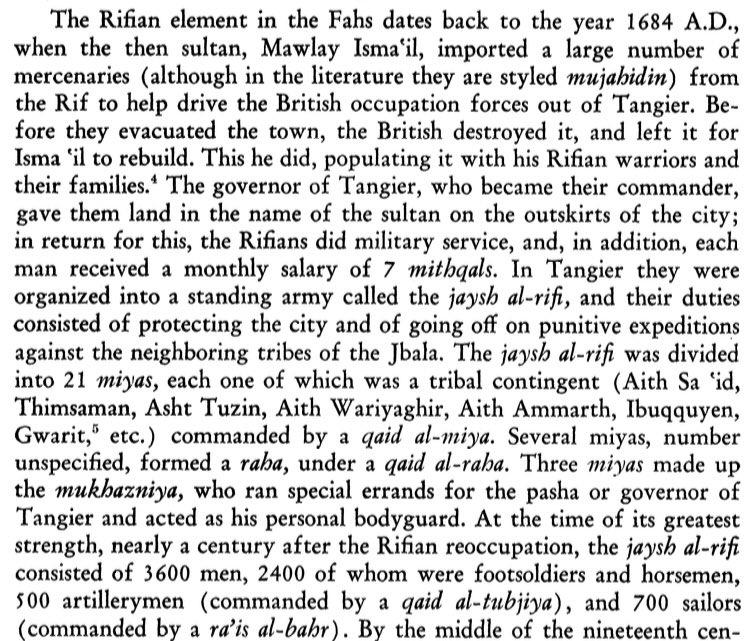
Long renowned as a warrior nation, the Rifians played a decisive role in restoring northwestern coastal regions of Morocco to Muslim rule in the late 1600s CE. Under the rising authority of Mawlay Isma‘il (d. 1139 AH / 1727 CE), they were mobilized to confront the remaining European footholds along the northwestern coast, most notably in Tangier, which had been under English occupation from 1662 CE to 1684 CE.
Following their defeat by the Rifians, the English evacuated Tangier in 1684 CE, destroying its fortifications and much of the city before leaving. In response, Mawlay Isma‘il reorganized his military power by establishing the “Jaysh al-Rifi”, the renowned standing Rifian army. This force not only secured Tangier but also extended the Sultan's authority across northern Morocco, reinforcing central control over the northwestern coastal regions and projecting power throughout the Rif and beyond.
Sidi ‘Ali ibn ‘Abd Allah al-Rifi al-Temsamani (d. 1125/1126 AH / 1713 CE) subsequently became the Pasha of the region, and the office remained in the hands of his descendants.
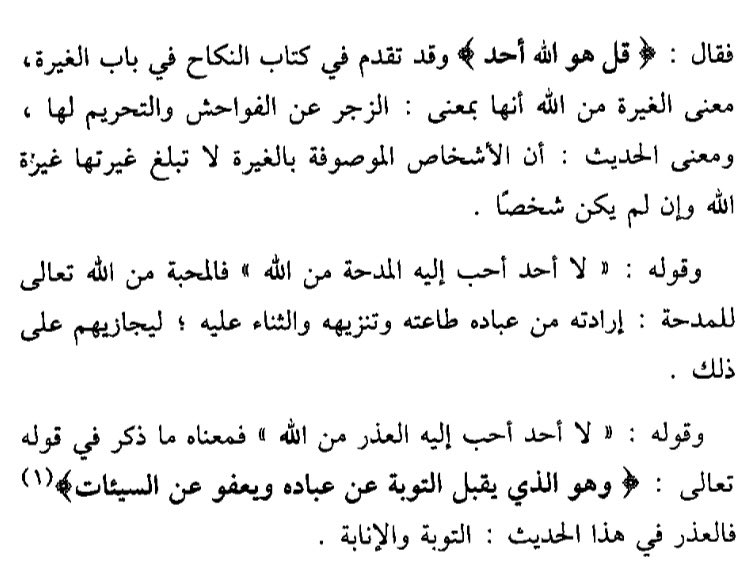
Al-Faqih al-Muhadith al-Zahid al-Imam ‘Abd al-Rahman al-Waghlisi al-Maliki al-Ash‘ari (ق) (d. 786 AH) outlines in this passage of his “al-Muqaddimah” the binding duty of immediate ‘tawbah’ (repentance) after every sin, whether by neglecting a command or committing a prohibition. It defines its conditions, clarifies the restoration of rights, and affirms that guidance lies with ‘Ahl al-‘Ilm’ (People of knowledge), not ignorance.
“The Obligation of Prompt Repentance”:
“The commanded matters and the prohibited matters are many. So whoever falls into a sin, either by leaving something that Allah has commanded, or by doing something that Allah has forbidden, it is obligatory upon him to repent immediately and not to delay. Delaying repentance is another sin.
‘Tawbah’ is: abandoning sins at once, feeling remorse for what has passed, resolving never to return to them, restoring wrongs and rights to their people, and seeking from them absolution in matters that one is unable to return, whether wealth, honor, physical harm, or other than that.
He must also make up what is due in his liability from the rights of Allah, such as prayer, fasting, zakah, expiation of oaths, and other than that, and he must ask about the way of his deliverance in all his affairs so that he may remain upon uprightness.
It is not lawful for anyone to do anything until he knows the ruling of the Sacred Law regarding it, and ignorance is not an excuse. Allah, ta‘ala, said:
“So ask the People of Knowledge (‘Ahl al-Dhikr’) if you do not know.” (Surah an-Nahl, Ayat 43)
And ‘Ahl al-Dhikr’ are the People of Knowledge (‘Ahl al-‘Ilm’).”
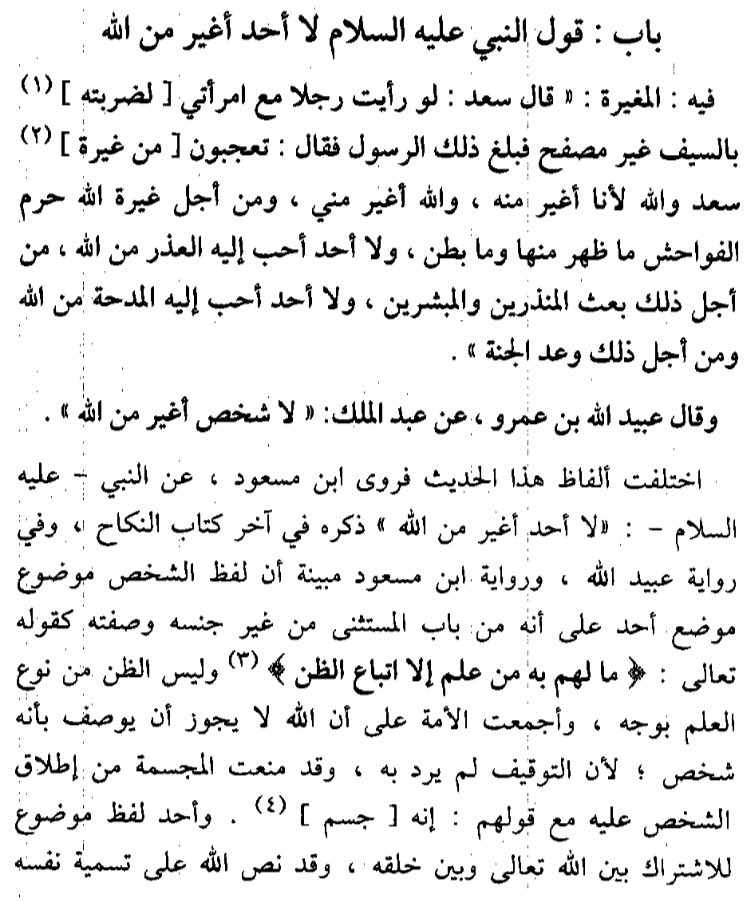
The major Muhadith and Musharih Ibn Battal al-Qurtubi al-Maliki al-Ash‘ari (ق) (d. 449 AH) in his Commentary on the Sahih of Imam al-Bukhari (ق) (d. 256 AH):
“Chapter: The Saying of the Prophet ﷺ, ‘No one is more jealous (protectively concerned) than Allah.’”
“In it is the report of al-Mughirah:
Sa‘d said, ‘If I were to see a man with my wife, I would strike him with the sword without hesitation.’ That reached Rasulullah ﷺ, and he said: ‘Are you amazed at the jealousy of Sa‘d? By Allah, I am more jealous than he is, and Allah is more jealous than I. And because of Allah's jealousy, He has forbidden indecencies, those that are outward and those that are inward. No one loves that excuses be accepted more than Allah; for that reason He sent the warners and the bringers of glad tidings. And no one loves praise more than Allah; for that reason He promised Paradise.’
‘Ubaydullah ibn ‘Amr narrated from ‘Abd al-Malik: ‘There is no ‘shakhs’ more jealous than Allah.’
And from the Prophet ﷺ: ‘No one is more jealous than Allah.’ He mentioned it at the end of the Book of Marriage. In the narration of ‘Ubaydullah and in the narration of Ibn Mas‘ud, it is clarified that the word ‘shakhs’ (“person”) is used in place of ‘ahad’ (“one”), in the sense of something excluded from a different category and description, like His saying, Exalted is He: ‘They have no knowledge of it except the ittiba‘ of conjecture’ (Surah An-Nisa, Ayat 157). Conjecture is not, in any way, a kind of knowledge.
The entire community has agreed that Allah is not to be described as a ‘shakhs’ / ‘person,’ because no revealed text has established that term for Him. Even the anthropomorphists forbade applying the word ‘person’ to Him, despite their saying that He is a body. (<-- Disbelievers)
The word ‘ahad’ (‘one’) is a term shared in usage between Allah, ta‘ala, and His creation. Allah has explicitly named Himself with it in His saying: ‘Say: He is Allah, One.’ (<-- Surah al-Ikhlas, Ayat 01)
The wording of this hadith the one above has come with variations; Ibn Mas‘ud narrated it…
It has already preceded in the Book of Marriage, in the chapter on jealousy, that the meaning of jealousy in relation to Allah is His restraining from indecencies and His forbidding of them.
The meaning of the hadith is that those beings described with jealousy do not reach the jealousy of Allah, even though He is not a ‘person.’
As for his (ﷺ) saying, ‘No one loves praise more than Allah,’ then Allah's love of praise means His will that His servants obey Him, declare Him transcendent, and extol Him, so that He may reward them for that.
And his (ﷺ) saying, ‘No one loves that excuses be accepted more than Allah,’ its meaning is what is mentioned in His, Exalted, saying: ‘And He is the One who accepts repentance from His servants and pardons misdeeds.’ (<-- Surah Ash-Shura, Ayat 25) Thus the ‘excuse’ in this hadith means repentance and turning back (to Him, ﷻ).”




![_Mazouz_'s tweet photo. Ahmad ibn al-Mubarak al-Lamati al-Sijilmasi al-Maliki (ق) (d. 1156 AH) in his lenghty work “al-Dhahab al-Ibriz min kalam Sayyidi al-Ghawth Abd al-‘Aziz al-Dabbagh” where he recorded the teachings of his teacher al-Sharif al-Qutb al-‘Arif al-Faqih Mawlay Sidi ‘Abd al-‘Aziz al-Dabbagh al-Fasi al-Maliki al-Ash‘ari (ق) (d. 1132 AH), who explains us that spiritual training (‘tarbiyah’) and its evolution across generations. In early times, corruption and turmoil were rare, making it easier to attain purity very fast, though guidance from a shaykh was still present and needed, while later seekers require even more structured training through dhikr, seclusion, and discipline under a shaykh.
He states:
“He (‘Abd al-‘Aziz al-Dabbagh) was asked, radiallahu ‘anhu, by some jurists about the claim that ‘tarbiyah’ has come to an end. ‘Is that true or not?’
The text of the question was:
‘Our master, the Imam, one whom Allah has opened with the openings granted to His noble saints and honored with affiliation to the House of Prophethood (‘Ahl al-Bayt’), upon its possessor be the best prayers and purest peace, teach us, may Allah teach you from His divinely granted knowledge, something that will remove confusion from the hearts of men and release their minds from their restraints so they may attain spiritual sciences through clear explanation and illustrative examples.
It has been reported from Him, ﷺ, that He (ﷺ) said: ‘Creation are the dependents of Allah, and the most beloved of creation to Allah are those most beneficial to His dependents.’
Among what has reached us, our master, is what is transmitted from Shaykh Zarruq (al-Barnousi al-Fasi al-Maliki al-Ash‘ari, ق, d. 899 AH), radiallahu ‘anhu, that formalized spiritual training has ceased, and nothing remains except ‘taribyah’ through spiritual aspiration and state (‘hal’), and that one must cling to the Book and the Sunnah without addition or subtraction.
Is this statement specific to his time, or has ‘tarbiyah’ ceased altogether until the descent of our master ‘Isa, ‘alaihi salam? If you say it has ceased, what caused its cessation? And if you say it remains, then who is the shaykh to whom the spirit of the disciple is given so that he may direct it in seclusion as he wills? Specify him for us, in which region and land, and mention someone who succeeded at his hands.’
This jurist (Ahmad Zarruq) is the same one previously referred to in the explanation of ‘Qaf’ and in the commentary on the hadith of the two books containing the names of the people of Paradise and Hell. [A matter discussed before in a different chapter]
He (‘Abd al-‘Aziz al-Dabbagh) replied, radiallahu ‘anhu:
‘The intent of ‘tarbiyah’ is the purification of the self and cleansing it of its recklessness and coarseness until it becomes capable of bearing the secret. This can only occur by removing darkness from it and cutting off false attachments from its direction.
At times, the removal of falsehood occurs through the soul's innate purity at its original creation, meaning Allah purifies it without any intermediary. This was the state of the three virtuous generations, who are the best of generations. In those generations, people were attached to the Truth, seeking it constantly: if they slept, they slept upon it; if they awoke, they awoke upon it; if they moved, they moved within it.
(What is meant here is not that they had no need of a shaykh in an absolute sense, but rather that they did not require extensive spiritual intervention or prolonged due to the relative absence of widespread fitna and the strength of their innate disposition.)](https://pbs.twimg.com/media/HCHIcF2WwAA1-eW.jpg)
![_Mazouz_'s tweet photo. The scholars of the Maliki regions, such as the Maghreb, Egypt, and West Africa, were among the first and foremost to respond to the Wahhabi movement and its innovations and deviations. Their letters and responses have even been compiled into various books.
The famous historian, traveler, and scholar Abu al-Qasim al-Zayani al-Sanhaji al-Fasi al-Maliki al-Ash‘ari (ق) (d. 1249 AH) records the response and ‘takfir’ (excommunication) issued by the judge of Tunis, Abu al-Fadl Qasim al-Mahjub al-Maliki al-Ash‘ari (ق) (d. 1243 AH), against the founder of the Wahhabi movement, Muhammad ibn ‘Abd al-Wahhab (d. 1206 AH / 1792 CE), the cursed murderer, who, during his lifetime, sent letters to many regions of the Muslim world inviting people to follow his deviations and declaring mainstream Sunni beliefs and practices, including the honoring of saints, intercession, and established permissible acts, to be acts of kufr and shirk.
Among the points Imam Abu al-Fadl made in the longer letter were:
“…As for what follows: this opening statement, which has risen in the sky of this exchange, you wrote to us imagining that you are the one standing in defense of the religion, that you call people with clear insight to what the Master of the first and the last brought, urging adherence and following, forbidding opposition and innovation. In your letter you spoke of avoiding division and disagreement among Allah's servants. Yet you have become as Allah said: ‘And of people, there is one whose speech captivates you in the life of this world…’, up to His words about corruption. [al-Baqarah, Ayat 204-205]
You claimed that people have introduced innovations into Islam and have set up, alongside Allah, intermediaries from among the dead, by seeking help at the shrines of the saints in times of hardship, by asking their intercession in fulfilling needs, by making vows and offerings as acts of devotion, and other such forms of worship. You declared this to be associating partners with the Lord of the earth and the heavens, disbelief by which you have made lawful fighting them and violating their sanctities.
By Allah, you have gone astray and led others astray. You have mounted the steeds of tyranny by what you have permitted. You have exaggerated and made matters seem monstrous, relying upon the excommunication of the early and later Muslims alike.
Here we bring you to judgment before the clear Book of Allah and the established sayings of His Messenger ﷺ.
As for what you have undertaken, fighting the people of Islam, terrorizing the inhabitants of the Sacred City, overpowering those who hold fast to the two testimonies of faith, kindling the fire of war among Muslims, and casting off from your necks the bond of obedience and religion, Allah ta‘ala has said:
‘O you who believe, when you go forth in the path of Allah, investigate…’, up to His words, ‘You desire the provisions of worldly life. So, indeed Allah has an abundance of treasures.’ [an-Nisa, Ayat 94]
And He, ﷺ, said:
‘I have been commanded to fight the people until they say: ‘There is no god but Allah.’ When they say it, their blood and their property are protected from me except by its right, and their reckoning is with Allah.’
Since you claim to rely on the Book of Allah and to stand firmly upon the foundation of the Sunnah, how then, woe to you, do you permit the blood of people who utter this word, who openly affirm the message of the Prophet (ﷺ), who uphold the pillars of Islam, who defend the domain of faith, who fight the worshippers of idols and strive for the sake of pure monotheism?
How have you cast yourselves into the abysses of disbelief, splitting the unity and spreading corruption upon the earth?
As for what you said in declaring them disbelievers for visiting the righteous and the saints, and for making them a means between themselves and the Lord of the worlds, claiming that this is merely an old habit of ignorant people, we say to you regarding this matter…”](https://pbs.twimg.com/media/HB36XbmWIAAa2Md.jpg)


![_Mazouz_'s tweet photo. In the late 1800s, the French traveler and chronicler Auguste Moulieras (d. 1931 CE) explored the Rif region of northern Morocco, recording the daily life, customs, and social structures of its population. On this occasion, he observed the Iqer‘iyen tribe, noting both their communal and religious practices, as well as the roles of students, tailors, and wandering religious figures, such as dervishes. His account offers a detailed and vivid snapshot of Riffian life: the mixture of work, study, and devotion; the preparation of food and hospitality rituals; and the strong tribal identity that shaped their interactions and worldview. Through his narrative, Moulieras provides a unique lens on a society deeply rooted in tradition.
He states:
“…Men were sitting in front of the mosque, their black ‘djellabas’ (traditional Moroccan garment) tightly belted at the waist, rifles resting between their legs, talking about their affairs in a form of ‘Tamazight’ (the Berber language) slightly different from that spoken by the central Rif populations (it's the mid-eastern Riffian dialect of the ‘Iqer‘iyen’ / ‘Guelaya’ tribe). No one paid the least attention to the wanderer (wandering Sufi) who, after murmuring a quick ‘As salamu ‘alaikum’ (‘peace be upon you’) as he passed the group, entered the mosque. Inside he found about twenty young men: some reciting Qur’anic verses at the top of their voices, others sewing shirts, some darning socks, others mending ‘djellabas’.
In the Moroccan countryside and in the Rif, the trade of tailor is monopolized by the religious student. It is a welcome sideline added to income from funerals and from preparing amulets (‘hirz’ or ‘taweez’; talismans containing Qur’anic verses or supplications etc. for healing or protection). The local inhabitant does not merely feed the ‘talib’ (student of religious knowledge), house him, and clothe him; he has him carry out all the sewing and cutting needed in the household, pays him wages, and adds a few gifts on top of that. In ‘Guelaya’ (Latin wording for the Riffian ‘Iqer‘iyen’ tribe), the student-tailors all belong to the mountain tribe of the ‘R’mara’; the Guelayan schoolboys themselves never touch a needle. Outside class hours they practice marksmanship or help their parents with agricultural work.
The ‘dervish’ (a wandering Sufi) was naturally well received among these hearty eaters, whose main concern was to know in which tribe a student enjoyed the best feasts. Supper consisted of a mixed dish made up of ‘bijar’ (coarse couscous), fish, hard-boiled eggs, butter, and lentils. The barley bread, a cubit long and a handspan wide, deserves special mention on its own. The people of Guelaya call it ‘aneggoul’ (<-- right pronunciation is ‘angour’). At breakfast they ‘pass it down,’ as they say, with eggs cooked in oil, garlic, or raw peppers. In every home tea is consumed in excess and very sweet; the students drink large quantities of it in the mosques.
The ‘dervish’ left ‘Asammer’ (a village of the Iqer‘iyen tribe) after resting two or three days, sleeping each evening in a different village and, without haste, exploring this restless tribe, obsessed with the desire to drive the Spaniards of Melilla into the sea. (<-- Occupied City by the Spanish)
‘Guelaya’ (<-- the ‘Iqer‘iyen’ tribe territory) stretches about twenty kilometers (the French author from the late 1800s was wrong, it's actually ca. sixty kilometers) from north to south and some forty from east to west. It is divided into seven sections (tribal confederation of 5 sub-tribes, [corrected]):
- Ath Chicha [Ait Chiker; Beni Chiker]
- Ath Bouyafa [Ait Bouyafar; Beni Boughafer]
- Ath Sidar [Ait Sidal; Beni Sidal]
- Ath Buifroa [Ait Bou Ifrour; Beni Bou Ifrour]
- Imezzujen / Immezzuzen [Mazzuja / Mazzuza]…”](https://pbs.twimg.com/media/HBuqiECWIAAh4i3.jpg)
![_Mazouz_'s tweet photo. In the late 1800s, the French traveler and chronicler Auguste Moulieras (d. 1931 CE) explored the Rif region of northern Morocco, recording the daily life, customs, and social structures of its population. On this occasion, he observed the Iqer‘iyen tribe, noting both their communal and religious practices, as well as the roles of students, tailors, and wandering religious figures, such as dervishes. His account offers a detailed and vivid snapshot of Riffian life: the mixture of work, study, and devotion; the preparation of food and hospitality rituals; and the strong tribal identity that shaped their interactions and worldview. Through his narrative, Moulieras provides a unique lens on a society deeply rooted in tradition.
He states:
“…Men were sitting in front of the mosque, their black ‘djellabas’ (traditional Moroccan garment) tightly belted at the waist, rifles resting between their legs, talking about their affairs in a form of ‘Tamazight’ (the Berber language) slightly different from that spoken by the central Rif populations (it's the mid-eastern Riffian dialect of the ‘Iqer‘iyen’ / ‘Guelaya’ tribe). No one paid the least attention to the wanderer (wandering Sufi) who, after murmuring a quick ‘As salamu ‘alaikum’ (‘peace be upon you’) as he passed the group, entered the mosque. Inside he found about twenty young men: some reciting Qur’anic verses at the top of their voices, others sewing shirts, some darning socks, others mending ‘djellabas’.
In the Moroccan countryside and in the Rif, the trade of tailor is monopolized by the religious student. It is a welcome sideline added to income from funerals and from preparing amulets (‘hirz’ or ‘taweez’; talismans containing Qur’anic verses or supplications etc. for healing or protection). The local inhabitant does not merely feed the ‘talib’ (student of religious knowledge), house him, and clothe him; he has him carry out all the sewing and cutting needed in the household, pays him wages, and adds a few gifts on top of that. In ‘Guelaya’ (Latin wording for the Riffian ‘Iqer‘iyen’ tribe), the student-tailors all belong to the mountain tribe of the ‘R’mara’; the Guelayan schoolboys themselves never touch a needle. Outside class hours they practice marksmanship or help their parents with agricultural work.
The ‘dervish’ (a wandering Sufi) was naturally well received among these hearty eaters, whose main concern was to know in which tribe a student enjoyed the best feasts. Supper consisted of a mixed dish made up of ‘bijar’ (coarse couscous), fish, hard-boiled eggs, butter, and lentils. The barley bread, a cubit long and a handspan wide, deserves special mention on its own. The people of Guelaya call it ‘aneggoul’ (<-- right pronunciation is ‘angour’). At breakfast they ‘pass it down,’ as they say, with eggs cooked in oil, garlic, or raw peppers. In every home tea is consumed in excess and very sweet; the students drink large quantities of it in the mosques.
The ‘dervish’ left ‘Asammer’ (a village of the Iqer‘iyen tribe) after resting two or three days, sleeping each evening in a different village and, without haste, exploring this restless tribe, obsessed with the desire to drive the Spaniards of Melilla into the sea. (<-- Occupied City by the Spanish)
‘Guelaya’ (<-- the ‘Iqer‘iyen’ tribe territory) stretches about twenty kilometers (the French author from the late 1800s was wrong, it's actually ca. sixty kilometers) from north to south and some forty from east to west. It is divided into seven sections (tribal confederation of 5 sub-tribes, [corrected]):
- Ath Chicha [Ait Chiker; Beni Chiker]
- Ath Bouyafa [Ait Bouyafar; Beni Boughafer]
- Ath Sidar [Ait Sidal; Beni Sidal]
- Ath Buifroa [Ait Bou Ifrour; Beni Bou Ifrour]
- Imezzujen / Immezzuzen [Mazzuja / Mazzuza]…”](https://pbs.twimg.com/media/HBuqiEAXUAAIDeL.jpg)


![_Mazouz_'s tweet photo. The Andalusian Polymath Imam Abu ‘Abdullah al-Qurtubi al-Maliki al-Ash‘ari (ق) (d. 671 AH) explains in this passage the Divine Name “al-Batin” (The Hidden / The Inward), affirming that Allah (ﷻ) is hidden from sensory perception yet known through His signs. It negates resemblance, spatiality, and corporeality, upholding His absolute transcendence.
He states in “Al-Asna fi Sharh Asma’ Allah al-Husna wa-Sifatihi” in the section “On the collective chapters concerning the Names that entail the negation of resemblance (‘tashbih’) from Allah, Exalted is His Majesty”:
[Al-Batin]
“Exalted is His Majesty, and sanctified are His Names.
This Name has been mentioned in the Qur’an, has come in the Sunnah, and the Ummah has reached consensus upon it. It is derived from the root ‘batana’, ‘to be hidden’ or ‘to be inward,’ meaning: a thing becomes concealed. From this root the word ‘batn’ (belly or interior) is also derived. The scholarly statements concerning it have already been mentioned under His Name ‘al-Zahir’ (The Manifest).
He, Glorified and Exalted, is ‘al-Batin’ because He is not perceived by the senses, unlike created things which are apprehended through the senses such as touch, physical sensation, sight, observation, and similar means.
Rather, He, Glorified and Exalted, is known through His ‘Athar’ (effects, signs) and His actions.
‘Al-Batin’ is the opposite of ‘al-Zahir’. In Arabic usage, ‘al-batin’ may also mean: the one who is knowledgeable and aware of the inner realities of the one who accompanies or interacts with him. For example, one says: “So-and-so has batana the affair of so-and-so,” meaning he has examined his inner state and come to know what others have not come to know.
Al-Khattabi (al-Shafi‘i al-Ash‘ari, ق, d. 388 AH) said: ‘It may carry the meaning that He manifests Himself in the inward illumination of the hearts of those who reflect, while He veils Himself from the sight of those who merely look. It may also mean: the One who knows what is outward of affairs and is fully aware of what is inward of hidden faults.’
It has also been said: ‘al-Batin’ is the One from whose knowledge nothing escapes, and from whom nothing is distant when He wills it.
In Arabic, it is said: “So-and-so batana the animal,” meaning he struck its belly. Batn is known (as the belly), and batn also refers to a low-lying area of land. The inward part (‘batin’) of anything is the opposite of its outward part (‘zahir’).
The devotional implication (‘ta‘abbud’) of this Name has already been discussed under His Name ‘al-Zahir’, so reflect upon it there…”
[Summary: Allah, ta‘ala, being described as “al-Batin” does not mean that He is “inside” something, nor that He occupies an inner space, nor that He is hidden by physical concealment. Such meanings would imply corporeality, spatial location, and direction, all of which are impossible for Allah according to definitive proof. + “Al-Zahir” does not mean physical visibility, form, direction, elevation in space, or resemblance to creation; rather, He is manifest through His proofs, His power, and His dominion, while remaining absolutely transcendent beyond modality, limitation, and likeness, without tashbih, without tajsim, and without kayf.]](https://pbs.twimg.com/media/HBTNzjyWQAANvVa.jpg)







![_Mazouz_'s tweet photo. Ahmad ibn al-Mubarak al-Lamati al-Sijilmasi al-Maliki (ق) (d. 1156 AH) in his lenghty work “al-Dhahab al-Ibriz min kalam Sayyidi al-Ghawth Abd al-‘Aziz al-Dabbagh” where he recorded the teachings of his teacher al-Sharif al-Qutb al-‘Arif al-Faqih Mawlay Sidi ‘Abd al-‘Aziz al-Dabbagh al-Fasi al-Maliki al-Ash‘ari (ق) (d. 1132 AH), who explains us that spiritual training (‘tarbiyah’) and its evolution across generations. In early times, corruption and turmoil were rare, making it easier to attain purity very fast, though guidance from a shaykh was still present and needed, while later seekers require even more structured training through dhikr, seclusion, and discipline under a shaykh.
He states:
“He (‘Abd al-‘Aziz al-Dabbagh) was asked, radiallahu ‘anhu, by some jurists about the claim that ‘tarbiyah’ has come to an end. ‘Is that true or not?’
The text of the question was:
‘Our master, the Imam, one whom Allah has opened with the openings granted to His noble saints and honored with affiliation to the House of Prophethood (‘Ahl al-Bayt’), upon its possessor be the best prayers and purest peace, teach us, may Allah teach you from His divinely granted knowledge, something that will remove confusion from the hearts of men and release their minds from their restraints so they may attain spiritual sciences through clear explanation and illustrative examples.
It has been reported from Him, ﷺ, that He (ﷺ) said: ‘Creation are the dependents of Allah, and the most beloved of creation to Allah are those most beneficial to His dependents.’
Among what has reached us, our master, is what is transmitted from Shaykh Zarruq (al-Barnousi al-Fasi al-Maliki al-Ash‘ari, ق, d. 899 AH), radiallahu ‘anhu, that formalized spiritual training has ceased, and nothing remains except ‘taribyah’ through spiritual aspiration and state (‘hal’), and that one must cling to the Book and the Sunnah without addition or subtraction.
Is this statement specific to his time, or has ‘tarbiyah’ ceased altogether until the descent of our master ‘Isa, ‘alaihi salam? If you say it has ceased, what caused its cessation? And if you say it remains, then who is the shaykh to whom the spirit of the disciple is given so that he may direct it in seclusion as he wills? Specify him for us, in which region and land, and mention someone who succeeded at his hands.’
This jurist (Ahmad Zarruq) is the same one previously referred to in the explanation of ‘Qaf’ and in the commentary on the hadith of the two books containing the names of the people of Paradise and Hell. [A matter discussed before in a different chapter]
He (‘Abd al-‘Aziz al-Dabbagh) replied, radiallahu ‘anhu:
‘The intent of ‘tarbiyah’ is the purification of the self and cleansing it of its recklessness and coarseness until it becomes capable of bearing the secret. This can only occur by removing darkness from it and cutting off false attachments from its direction.
At times, the removal of falsehood occurs through the soul's innate purity at its original creation, meaning Allah purifies it without any intermediary. This was the state of the three virtuous generations, who are the best of generations. In those generations, people were attached to the Truth, seeking it constantly: if they slept, they slept upon it; if they awoke, they awoke upon it; if they moved, they moved within it.
(What is meant here is not that they had no need of a shaykh in an absolute sense, but rather that they did not require extensive spiritual intervention or prolonged due to the relative absence of widespread fitna and the strength of their innate disposition.)](https://pbs.twimg.com/media/HCHIcGybcAA6M_H.jpg)
![_Mazouz_'s tweet photo. The scholars of the Maliki regions, such as the Maghreb, Egypt, and West Africa, were among the first and foremost to respond to the Wahhabi movement and its innovations and deviations. Their letters and responses have even been compiled into various books.
The famous historian, traveler, and scholar Abu al-Qasim al-Zayani al-Sanhaji al-Fasi al-Maliki al-Ash‘ari (ق) (d. 1249 AH) records the response and ‘takfir’ (excommunication) issued by the judge of Tunis, Abu al-Fadl Qasim al-Mahjub al-Maliki al-Ash‘ari (ق) (d. 1243 AH), against the founder of the Wahhabi movement, Muhammad ibn ‘Abd al-Wahhab (d. 1206 AH / 1792 CE), the cursed murderer, who, during his lifetime, sent letters to many regions of the Muslim world inviting people to follow his deviations and declaring mainstream Sunni beliefs and practices, including the honoring of saints, intercession, and established permissible acts, to be acts of kufr and shirk.
Among the points Imam Abu al-Fadl made in the longer letter were:
“…As for what follows: this opening statement, which has risen in the sky of this exchange, you wrote to us imagining that you are the one standing in defense of the religion, that you call people with clear insight to what the Master of the first and the last brought, urging adherence and following, forbidding opposition and innovation. In your letter you spoke of avoiding division and disagreement among Allah's servants. Yet you have become as Allah said: ‘And of people, there is one whose speech captivates you in the life of this world…’, up to His words about corruption. [al-Baqarah, Ayat 204-205]
You claimed that people have introduced innovations into Islam and have set up, alongside Allah, intermediaries from among the dead, by seeking help at the shrines of the saints in times of hardship, by asking their intercession in fulfilling needs, by making vows and offerings as acts of devotion, and other such forms of worship. You declared this to be associating partners with the Lord of the earth and the heavens, disbelief by which you have made lawful fighting them and violating their sanctities.
By Allah, you have gone astray and led others astray. You have mounted the steeds of tyranny by what you have permitted. You have exaggerated and made matters seem monstrous, relying upon the excommunication of the early and later Muslims alike.
Here we bring you to judgment before the clear Book of Allah and the established sayings of His Messenger ﷺ.
As for what you have undertaken, fighting the people of Islam, terrorizing the inhabitants of the Sacred City, overpowering those who hold fast to the two testimonies of faith, kindling the fire of war among Muslims, and casting off from your necks the bond of obedience and religion, Allah ta‘ala has said:
‘O you who believe, when you go forth in the path of Allah, investigate…’, up to His words, ‘You desire the provisions of worldly life. So, indeed Allah has an abundance of treasures.’ [an-Nisa, Ayat 94]
And He, ﷺ, said:
‘I have been commanded to fight the people until they say: ‘There is no god but Allah.’ When they say it, their blood and their property are protected from me except by its right, and their reckoning is with Allah.’
Since you claim to rely on the Book of Allah and to stand firmly upon the foundation of the Sunnah, how then, woe to you, do you permit the blood of people who utter this word, who openly affirm the message of the Prophet (ﷺ), who uphold the pillars of Islam, who defend the domain of faith, who fight the worshippers of idols and strive for the sake of pure monotheism?
How have you cast yourselves into the abysses of disbelief, splitting the unity and spreading corruption upon the earth?
As for what you said in declaring them disbelievers for visiting the righteous and the saints, and for making them a means between themselves and the Lord of the worlds, claiming that this is merely an old habit of ignorant people, we say to you regarding this matter…”](https://pbs.twimg.com/media/HB36XbpWQAAe7IL.jpg)


![_Mazouz_'s tweet photo. In the late 1800s, the French traveler and chronicler Auguste Moulieras (d. 1931 CE) explored the Rif region of northern Morocco, recording the daily life, customs, and social structures of its population. On this occasion, he observed the Iqer‘iyen tribe, noting both their communal and religious practices, as well as the roles of students, tailors, and wandering religious figures, such as dervishes. His account offers a detailed and vivid snapshot of Riffian life: the mixture of work, study, and devotion; the preparation of food and hospitality rituals; and the strong tribal identity that shaped their interactions and worldview. Through his narrative, Moulieras provides a unique lens on a society deeply rooted in tradition.
He states:
“…Men were sitting in front of the mosque, their black ‘djellabas’ (traditional Moroccan garment) tightly belted at the waist, rifles resting between their legs, talking about their affairs in a form of ‘Tamazight’ (the Berber language) slightly different from that spoken by the central Rif populations (it's the mid-eastern Riffian dialect of the ‘Iqer‘iyen’ / ‘Guelaya’ tribe). No one paid the least attention to the wanderer (wandering Sufi) who, after murmuring a quick ‘As salamu ‘alaikum’ (‘peace be upon you’) as he passed the group, entered the mosque. Inside he found about twenty young men: some reciting Qur’anic verses at the top of their voices, others sewing shirts, some darning socks, others mending ‘djellabas’.
In the Moroccan countryside and in the Rif, the trade of tailor is monopolized by the religious student. It is a welcome sideline added to income from funerals and from preparing amulets (‘hirz’ or ‘taweez’; talismans containing Qur’anic verses or supplications etc. for healing or protection). The local inhabitant does not merely feed the ‘talib’ (student of religious knowledge), house him, and clothe him; he has him carry out all the sewing and cutting needed in the household, pays him wages, and adds a few gifts on top of that. In ‘Guelaya’ (Latin wording for the Riffian ‘Iqer‘iyen’ tribe), the student-tailors all belong to the mountain tribe of the ‘R’mara’; the Guelayan schoolboys themselves never touch a needle. Outside class hours they practice marksmanship or help their parents with agricultural work.
The ‘dervish’ (a wandering Sufi) was naturally well received among these hearty eaters, whose main concern was to know in which tribe a student enjoyed the best feasts. Supper consisted of a mixed dish made up of ‘bijar’ (coarse couscous), fish, hard-boiled eggs, butter, and lentils. The barley bread, a cubit long and a handspan wide, deserves special mention on its own. The people of Guelaya call it ‘aneggoul’ (<-- right pronunciation is ‘angour’). At breakfast they ‘pass it down,’ as they say, with eggs cooked in oil, garlic, or raw peppers. In every home tea is consumed in excess and very sweet; the students drink large quantities of it in the mosques.
The ‘dervish’ left ‘Asammer’ (a village of the Iqer‘iyen tribe) after resting two or three days, sleeping each evening in a different village and, without haste, exploring this restless tribe, obsessed with the desire to drive the Spaniards of Melilla into the sea. (<-- Occupied City by the Spanish)
‘Guelaya’ (<-- the ‘Iqer‘iyen’ tribe territory) stretches about twenty kilometers (the French author from the late 1800s was wrong, it's actually ca. sixty kilometers) from north to south and some forty from east to west. It is divided into seven sections (tribal confederation of 5 sub-tribes, [corrected]):
- Ath Chicha [Ait Chiker; Beni Chiker]
- Ath Bouyafa [Ait Bouyafar; Beni Boughafer]
- Ath Sidar [Ait Sidal; Beni Sidal]
- Ath Buifroa [Ait Bou Ifrour; Beni Bou Ifrour]
- Imezzujen / Immezzuzen [Mazzuja / Mazzuza]…”](https://pbs.twimg.com/media/HBuqiEDXEAE_viC.jpg)


![_Mazouz_'s tweet photo. Al-Qutb al-Wali al-Salih al-Sharif al-Imam al-Darqawi al-Zerwali al-Shadhili al-Ash‘ari al-Maliki (ق) (d. 1239 AH) in his “Majmu‘ Rasa’il” speaks in this passage about true nearness to Allah (ﷻ), a nearness not gained through outward display, but through a heart freed from worldly attachment and devoted sincerely to the path of the Prophet ﷺ.
Imam al-Darqawi (رَضِيَ اللهُ عَنْهُ وَقَدَّسَ اللهُ سِرَّهُ) says:
‘Concerning the urging not to be deluded by this world, nor by its people, nor by knowledge, nor by deeds’;
“Among them: Whoever wants the path to be shortened for him, and to be granted the kind of special closeness that others have been given, then let him not take from this world except what comes to him easily, without strain or toil.
Let him not be deceived by the knowledge of someone who loves this world, nor by that person's deeds, whoever he may be. Such a person possesses nothing but ignorance. As for true knowledge, he has no share in it. True knowledge belongs only to the Sunni scholar who harbors aversion toward worldly attachment and takes from it only what comes with ease, following the example of our Prophet ﷺ.
But the one whose heart is crammed with love of this world, and whose limbs are busy gathering it, he has no knowledge and no real action. What he has is only ignorance.
[Reported by Abu Hurayrah (رضي الله عنه), Rasulullah ﷺ said]: ‘Indeed, Allah does not look at your outward forms nor at your bodies, but He looks at your hearts.’ [Narrated by Muslim (ق, d. 261 AH) and Ibn Majah (ق, d. 273 AH]
And as it is stated in the Book of Allah ta‘ala, [Surah al-Hajj, Ayat 46; the whole Ayat cited for context]: ‘So did these people not explore the earth that may possess hearts with which they hear? So eyes do not become blind which are within chests.’”](https://pbs.twimg.com/media/HBYEbswXoAAYd6f.jpg)

![_Mazouz_'s tweet photo. The Andalusian Polymath Imam Abu ‘Abdullah al-Qurtubi al-Maliki al-Ash‘ari (ق) (d. 671 AH) explains in this passage the Divine Name “al-Batin” (The Hidden / The Inward), affirming that Allah (ﷻ) is hidden from sensory perception yet known through His signs. It negates resemblance, spatiality, and corporeality, upholding His absolute transcendence.
He states in “Al-Asna fi Sharh Asma’ Allah al-Husna wa-Sifatihi” in the section “On the collective chapters concerning the Names that entail the negation of resemblance (‘tashbih’) from Allah, Exalted is His Majesty”:
[Al-Batin]
“Exalted is His Majesty, and sanctified are His Names.
This Name has been mentioned in the Qur’an, has come in the Sunnah, and the Ummah has reached consensus upon it. It is derived from the root ‘batana’, ‘to be hidden’ or ‘to be inward,’ meaning: a thing becomes concealed. From this root the word ‘batn’ (belly or interior) is also derived. The scholarly statements concerning it have already been mentioned under His Name ‘al-Zahir’ (The Manifest).
He, Glorified and Exalted, is ‘al-Batin’ because He is not perceived by the senses, unlike created things which are apprehended through the senses such as touch, physical sensation, sight, observation, and similar means.
Rather, He, Glorified and Exalted, is known through His ‘Athar’ (effects, signs) and His actions.
‘Al-Batin’ is the opposite of ‘al-Zahir’. In Arabic usage, ‘al-batin’ may also mean: the one who is knowledgeable and aware of the inner realities of the one who accompanies or interacts with him. For example, one says: “So-and-so has batana the affair of so-and-so,” meaning he has examined his inner state and come to know what others have not come to know.
Al-Khattabi (al-Shafi‘i al-Ash‘ari, ق, d. 388 AH) said: ‘It may carry the meaning that He manifests Himself in the inward illumination of the hearts of those who reflect, while He veils Himself from the sight of those who merely look. It may also mean: the One who knows what is outward of affairs and is fully aware of what is inward of hidden faults.’
It has also been said: ‘al-Batin’ is the One from whose knowledge nothing escapes, and from whom nothing is distant when He wills it.
In Arabic, it is said: “So-and-so batana the animal,” meaning he struck its belly. Batn is known (as the belly), and batn also refers to a low-lying area of land. The inward part (‘batin’) of anything is the opposite of its outward part (‘zahir’).
The devotional implication (‘ta‘abbud’) of this Name has already been discussed under His Name ‘al-Zahir’, so reflect upon it there…”
[Summary: Allah, ta‘ala, being described as “al-Batin” does not mean that He is “inside” something, nor that He occupies an inner space, nor that He is hidden by physical concealment. Such meanings would imply corporeality, spatial location, and direction, all of which are impossible for Allah according to definitive proof. + “Al-Zahir” does not mean physical visibility, form, direction, elevation in space, or resemblance to creation; rather, He is manifest through His proofs, His power, and His dominion, while remaining absolutely transcendent beyond modality, limitation, and likeness, without tashbih, without tajsim, and without kayf.]](https://pbs.twimg.com/media/HBTNzkIa8AA6Rce.jpg)