This is just bad because there’s so much that data doesn’t show which becomes the context.
- who did Pritchard play?
- is his scouting report as heavy seeing that he’s not the star player
- how many of those games without brown did Pritchard play along side Tatum and what were those stats?
There’s more I could go into but at the end of the day Tatum was hurt, brown put up mvp numbers and let what was supposed to be a wash of a season to a 2nd or 3rd seed for yall. Tatum came back and shit crumbled. So if you’re going to trade em, get more than an old PG back
As we celebrate Black Heritage Day at Busch Stadium, we're proud to celebrate the artist who design this year's Black Heritage Day jersey: Corry Rogers!
Rogers, also known as RottenCorr, is a St. Louis artist known for his bold and colorful pop art murals and custom artwork that he has created throughout the St. Louis region!
Throwback to 2024 and the amazing #Viper50 event Edwards Air Force Base held to celebrate the F-16s 50th first flight birthday! From the incredible display of F-16s to the USAF Thunderbirds performing to the F-16 Demo Team in an EAFB F-16, it was an awesome day! The F-16 is amazing and Edwards AFB did a fantastic job celebrating it!
@_sammytruelove Help naw we need a major reset .! Kick everyone in congress who’s over 70 out and replace them with the next generation of politicians.
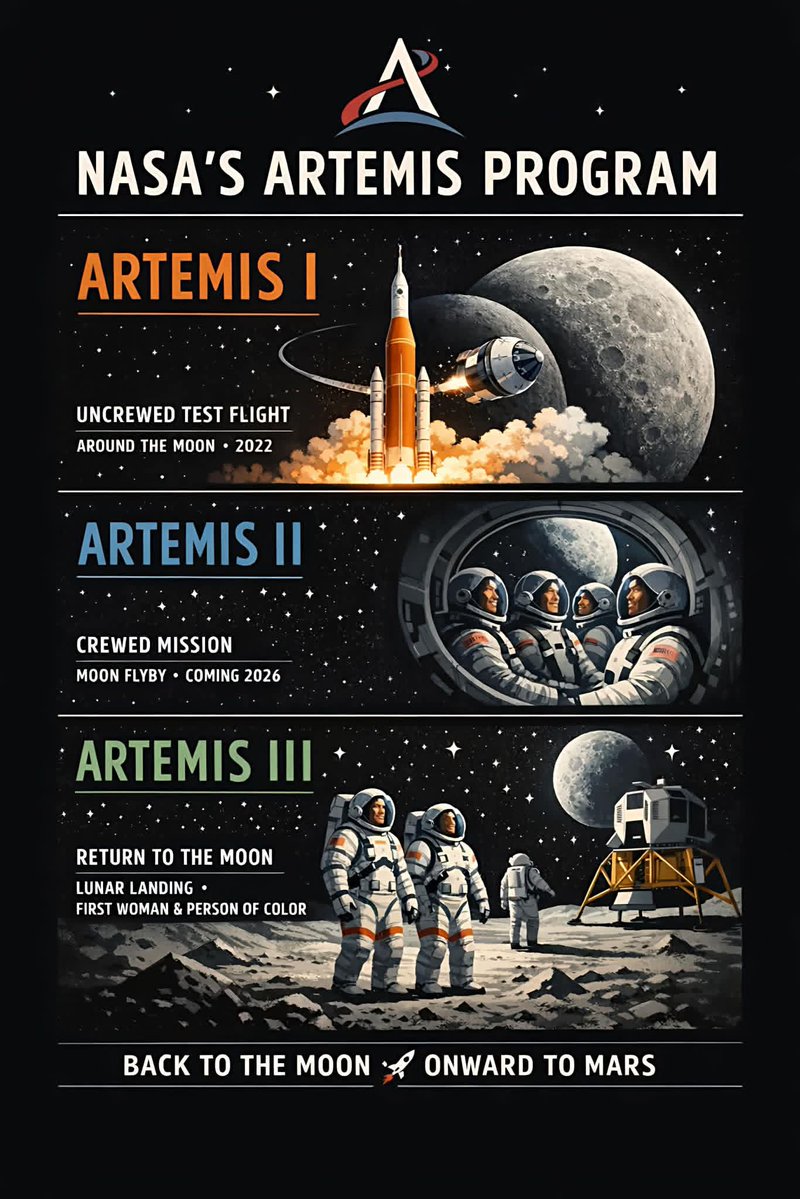
The Artemis program isn't just NASA's next chapter—it's humanity's bold return to the Moon and the first real steps toward making Mars our next frontier. Here's the thrilling progression, mission by mission:Artemis I (November 2022)
The roar that restarted deep-space dreams.
Uncrewed but carrying the hopes of a generation, NASA's mighty Space Launch System (SLS) thundered off the pad, propelling the Orion spacecraft on an audacious 25-day odyssey: a distant lunar orbit farther than any human-rated vehicle had gone in half a century, then a fiery plunge back through Earth's atmosphere.
Orion's heat shield endured blistering reentry temperatures, the SLS proved its raw power, and every critical deep-space system—from life support precursors to navigation—passed with flying colors. No crew, but the hardware screamed: We're ready for humans again.
Artemis II (target: 2026)
The first humans back beyond low Earth orbit since Apollo 17.
Four astronauts—two Americans, one Canadian, one European—will strap into Orion for a heart-pounding lunar flyby. No landing, but they'll streak past the Moon at blistering speed, venturing farther from Earth than any crew in over 50 years.
This mission is the ultimate shakedown cruise: proving humans can live, eat, sleep, navigate, and work safely in the harsh radiation and isolation of cislunar space. Every heartbeat, every maneuver, every comms check is data for the landings to come.
The crew will see the Moon up close, Earth as a fragile blue marble—and feel the weight of history as they push the boundary of human exploration farther than ever before.Artemis III (target: late this decade)
Boots on the lunar surface. Again. But better. Different. Inclusive.
At the lunar south pole—a region of eternal shadows hiding water ice and scientific treasures—NASA will land the first woman and the first person of color on another world.
This isn't a flags-and-footprints repeat of Apollo. It's the dawn of sustained presence: testing habitats, rovers, power systems, and in-situ resource utilization to extract oxygen, water, and fuel from the Moon itself.
Every step, every sample, every experiment builds the infrastructure for permanent lunar bases—and crucially, hones the technologies, operations, and international partnerships needed to send humans safely to Mars in the 2030s and beyond.From uncrewed proof-of-concept to crewed flyby to boots-on-the-ground exploration, Artemis is rewriting the story of human spaceflight—one audacious leap at a time. The Moon is no longer a destination... it's our proving ground for the stars.