Some news! I'm joining @a16zcrypto as Communications Partner.
Crypto was an unlikely place to start building a comms career in 2014. More than a decade later across exchanges, institutions, defi, L1s/L2s, and more the work still feels early.
That path makes this next step particularly meaningful to me.
I've admired the a16z team for a long time, and I'm grateful for the chance to work with partners & founders building what comes next.
Mathematicians thought solving the Riemann hypothesis would require entirely new kinds of mathematics.
Harvard Prof. @skominers explains why the AI-assisted breakthrough surprised them, describing it as "the perfect tool-assisted speed run":
"I am not an expert, but my friends who do were expecting a really, really long time."
"Many people believed that the proof of the Riemann hypothesis would fundamentally need completely novel types of math."
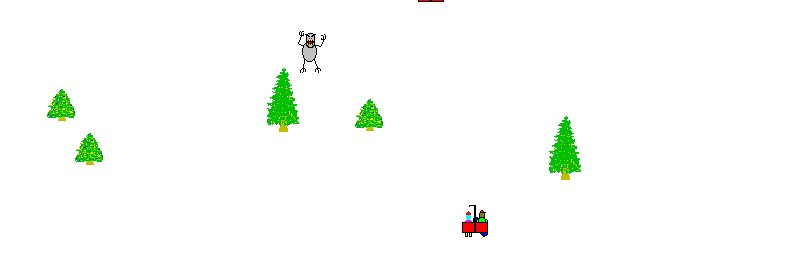
"You're going to the final boss in a video game, and you collect your weapons dungeon by dungeon, and it's like we're on dungeon seven and there were actually 200 dungeons."
"Instead of taking us through another 193 dungeons, it takes all the tools from dungeons one through seven and assembles them in this incredibly intricate and majestic array with lots of new pieces along the way."
"Somebody said it's proof by everything. It's like the perfect tool-assisted speed run. You found exactly the right frame-perfect skip to do each step with the maximum efficiency possible with the tools you have."
@Harvard@a16zfrontier
We compiled and curated every reading list we've published since 2022 — 300+ reads covering fiction, nonfiction, and topics ranging from AI and semiconductors to Polynesian navigators and time-traveling spies.
Full list: https://t.co/MjZcoUeaMB
And a preview of what's inside 🧵↓
P=NP or P!=NP? Here's a wild and optimistic idea: could we get the best of both worlds?
In the language of Impagliazzo's famous "five worlds" [1], could we live simultaneously in Algorithmica (or, similarly, Heuristica) and Cryptomania?
Impagliazzo calls the world in which P=NP "Algorithmica." Here's how he describes (in 1995) this computational utopia:
-"Programming languages would not need to involve instructions on how the computation should be performed Instead one would just specify the properties that a desired output should have in relation to the input."
-"Inductive learning systems would replace our feeble attempts at expert systems."
-"Computer assisted mathematicswould be a redundant phrase since computers couldfind proofs for any theorem in time roughly the length of the proof."
-"...the capacity of computers will become that currently depicted inscience fiction."
What's striking about the above quotes is that, while we don't know whether P=NP or not, we have achieved these positive *consequences* of P=NP that Impagliazzo dreamed about 30+ years ago. In this sense, it is *as if* we live in Algorithmica.
But then Impagliazzo discusses the implications of P=NP for cryptography, such as " There would be no way to allow some people access to information without making it available to everyone." And, while currently under sustained attack from the latest AI models, cryptography is not yet broken. Impagliazzo's "Cryptomania" is the world in which public-key cryptography is possible. In this sense, it is also as if we currently live in Cryptomania.
Will we live in Cryptomania forever? The story is still playing out. With the refutation of the Exponential Time Hypothesis (co-proposed by Impagliazzo!) and a number of new cryptanalysis results over the past few weeks, several experts' previously strong beliefs in Cryptomania have been shaken. But the latest chapter in the story, VP != VNP [2,3], is a push in the other direction, suggesting (without implying) that perhaps at least P!=NP holds (which is a prerequisite for Impagliazzo's Minicrypt and Cryptomania worlds).
Perhaps the computational utopia we should hope for isn't P=NP. It's a world that feels like P=NP everywhere except where we desperately need P!=NP.
[1] https://t.co/os6hIKKCpI
[2] https://t.co/GoEUDSQMHZ
[3] https://t.co/vHq94oCQq9
Some conferences are seeing twice as many submissions. Is academia on the brink of collapse, or is this what a productivity boom looks like?
@danboneh and @skominers on how AI is changing what it takes to write a math paper and what it takes to check the proof.
If a proof runs to a billion pages, who’s going to explain it to the rest of us?
Earlier this week, @danboneh and @skominers imagined AI solving another Millennium Prize Problem.
Each word you say is planned by a small patch of brain above your left ear, about a quarter of a second before you say it. It sits in a temporal lobe region textbooks describe as only for listening. Our paper today in @ScienceMagazine: https://t.co/EXOgl3YsNI
@UCSF@NeurosurgUCSF
ARTEX and hacking agents more generally are a plague at the moment, but they also feel like soft targets. Venture with me into experiments trying to turn ARTEX back on itself.
Ittai Abraham says AI could push the discovery frontier of mathematics ahead of human understanding:
"It's kind of surprising that AI can solve a Millennium problem and provide a Lean proof, but cannot provide a human understandable explanation."
"Writing something that is human understandable requires you to have a mental model... what the reader understands, what are their intuitions, how it learns."
"It is much easier to give a reinforcement task where you have a proof and you have to say, 'Is that a correct proof or an incorrect proof?' It is much harder to show an explanation of, let's say, a proof or a lemma and ask, 'Is this a good explanation or is this better than the previous explanation?'"
"My short-term prediction is that this might take a while where we'll have AI be very, very good at pushing the discovery frontier, but we'll still have humans do a lot of work on kind of pushing the human understanding frontier."
"Now, obviously, AI is going to help that task. But a lot of the work will have to actually be done by humans."
@ittaia
"In just 26 hours, Rockstar’s latest Grand Theft Auto installment has already broken records, becoming the most popular game in both Twitch & Kick history with a combined 1.28 M hours of broadcast time."
GTA6 Online numbers will be even bigger.
https://t.co/GDfs20oDYH
Wait until they find out that not only is streaming a mass market, but @Kalshi hired @CliffSavage to research GTA's in-game economy.
Still too much focus on how many copies sold, rather than the attention value that will be vacuumed up by GTA.
Well that got timely fast! 🥲
Earlier this week, @ittaia, @danboneh, @SuccinctJT, @rhackett, and I discussed what happens if AI produces a proof of a Millennium Prize problem so long that it's effectively unreadable.
Skip to 31:45: https://t.co/3Ew8ABGPE0
"The way to get to the cutting edge is by thinking about problems yourself and figuring things out for yourself."
Stanford cryptographer Dan Boneh on why he'll keep doing the math, even when AI does the math.
Wait until they find out that not only is streaming a mass market, but @Kalshi hired @CliffSavage to research GTA's in-game economy.
Still too much focus on how many copies sold, rather than the attention value that will be vacuumed up by GTA.
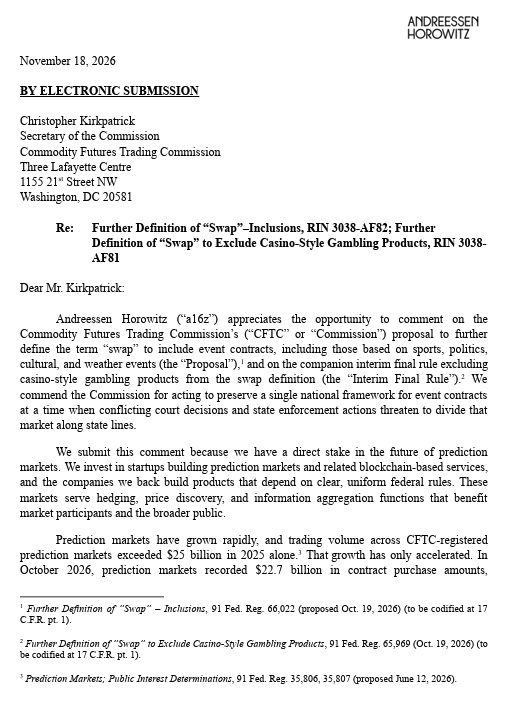
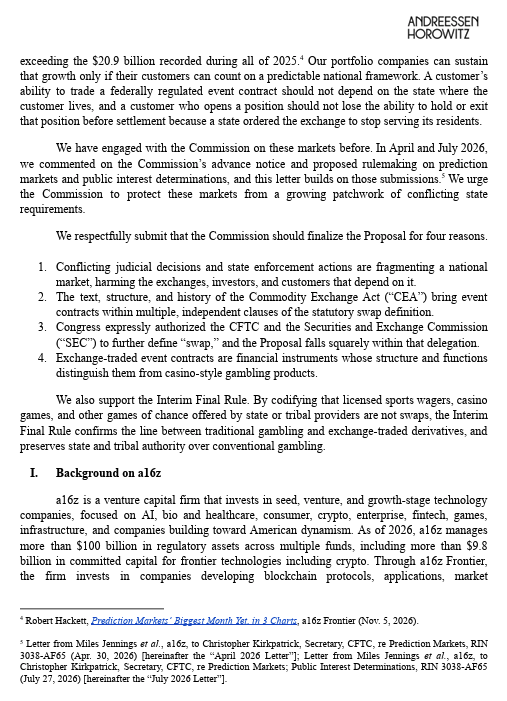
Four circuits, eight opinions, no agreement on why prediction markets are or aren’t swaps.
@a16zfrontier supports the CFTC's rule confirming that event contracts traded on federally regulated exchanges are swaps under the CEA.
One national market, not fifty.
If AI can do the math, what's left for the mathematicians to do? And what’s it like to watch AI solve a math problem you’ve spent years on?
We brought together a16z Frontier researchers — @ittaia, @danboneh, @skominers, and @SuccinctJT — to talk about the shifting role of mathematicians, what it means for the next generation, and where math goes from here, now that AI has gotten so good at solving hard problems.
00:00 – So are mathematicians cooked?
05:39 – Can mathematical discovery outpace human understanding?
10:38 – When AI made progress a human couldn’t
13:56 – What’s worth publishing when you can produce papers this fast?
18:40 – How Lean checks a mathematical proof
22:10 – The limits of AI: Too much work on an easy step, not enough on a hard one
27:54 – Could math become more like astronomy?
31:45 – What good is a proof if it runs to a billion pages?
41:15 – What this moment feels like for a young mathematician
56:29 – Does discovery feel different when AI helps?
1:10:29 – What should math professors teach now?
1:26:22 – The case for more mathematicians