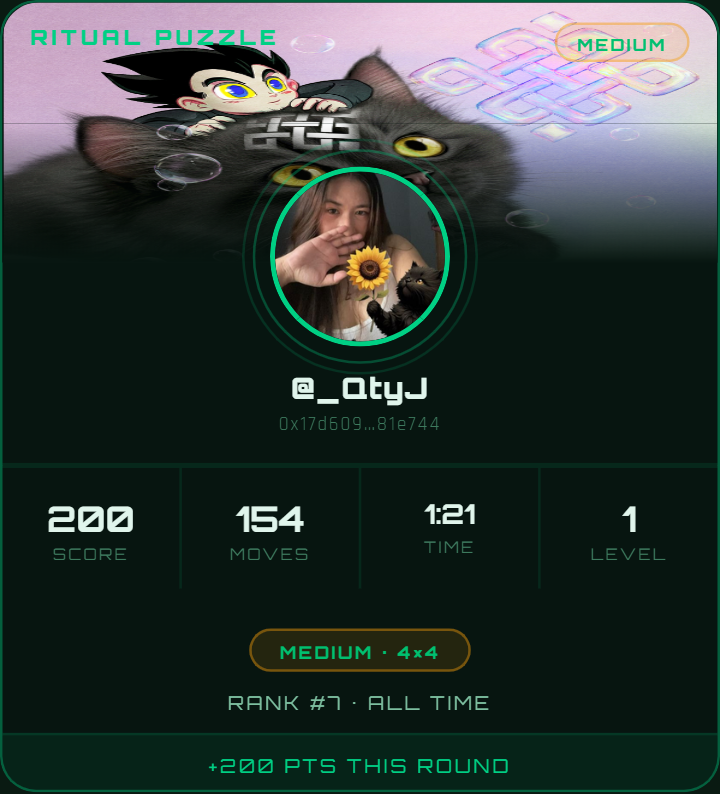
RITUAL PUZZLE on SIGGY WORLD
It’s a sliding puzzle game.
You get a scrambled image and you have to restore it by moving the tiles.
That’s it. Simple concept but trust me, it gets frustrating.
https://t.co/QfxZETKyRx
I know a lot of you hate this game 😭
But you still have to do it. So here’s how 👇
❖ Connect your wallet
Go to https://t.co/qdHPAY78TG and connect on Ritual Chain.
❖ Link your X account
Your username and pfp will show on your Victory Card.
❖ Pay the entry fee
0.001 RITUAL TOKEN to get access.
❖ Choose your difficulty
🟢 Easy - 3×3 (8 tiles)
🟡 Medium - 4×4 (15 tiles)
🔴 Hard - 5×5 (24 tiles)
❖ Solve the puzzle
Move the tiles until the image is restored.
Fewer moves = higher score.
❖ Save your Victory Card
Get on the Arcane Leaderboard and flex.
@joshsimenhoff | @Jez_Cryptoz | @0xMadScientist@ritualnet | @ritualfnd
Let’s think about stablecoins on Ritual
Most people treat stablecoins as the final produc
A token that holds value.
A payment asset.
A dollar onchain.
Useful, yes.
But also passive.
You hold it, send it, LP it, borrow against it, maybe use it in DeFi.
That is already big.
But Ritual makes me think stablecoins can become part of something more active.
Not just money sitting in a pool.
Money connected to context.
Money that can react to conditions.
Money that can move through agents, external data, risk checks, scheduled workflows, and onchain execution.
That is where the shape changes.
A stablecoin on a normal chain is mostly a balance.
A stablecoin on Ritual can become part of a process.
Imagine a stablecoin system that does not only wait for humans, bots, or centralized operators to respond.
It can check market conditions.
Read external signals.
Ask an agent to classify risk.
Adjust behavior through transparent onchain logic.
Settle actions without hiding the important part in someone’s backend.
That does not mean AI controls money blindly.
That would be a terrible design.
The interesting version is the opposite.
AI gives context.
Contracts give limits.
Ritual gives them an execution environment where both can meet.
That is why stablecoins on Ritual could feel different.
A stablecoin should not just sit there like a balance in a wallet.
It can become part of the flow.
And Ritual is one of the first places where that flow can include agents, compute, external context, and onchain action in the same design space.
@ritualfnd@ritualnet
highest i’ve gotten since i joined web3, crazy
got countless dms from newly upgraded members over these couple of days
omg, i’m just so happy i use my influence properly and in the most effective way
i honestly want ritual to reward y’all heavily, i’ll take my flowers then
rooting for everyone
Ritual is Different.
Ritual runs two execution paths at once and gives smart contracts something they never had before: a brain.
➤ Replicated Execution Standard EVM stuff. Token transfers, storage.
Every validator runs it. Trustless by default.
➤ Heterogeneous Execution AI inference, ZK proofs, internet access, TEE compute.
Things no other L1 can do natively.
➤ Agents that self execute They schedule themselves, hold their own keys, and act without human approval.
Same Solidity you already know.
16 native precompiles unlock AI, privacy, and autonomy no rewrite needed.
→ https://t.co/n7JNafQh3m
@ritualnet | @ritualfnd@joshsimenhoff | @Jez_Cryptoz | @0xMadScientist
Ritual is Different.
Ritual runs two execution paths at once and gives smart contracts something they never had before: a brain.
➤ Replicated Execution Standard EVM stuff. Token transfers, storage.
Every validator runs it. Trustless by default.
➤ Heterogeneous Execution AI inference, ZK proofs, internet access, TEE compute.
Things no other L1 can do natively.
➤ Agents that self execute They schedule themselves, hold their own keys, and act without human approval.
Same Solidity you already know.
16 native precompiles unlock AI, privacy, and autonomy no rewrite needed.
→ https://t.co/n7JNafQh3m
@ritualnet | @ritualfnd@joshsimenhoff | @Jez_Cryptoz | @0xMadScientist