Shareholders,
Over the last week the NetNet Capital Management Treasury has grown by an average of $650,000 per day. The $4,550,000 in weekly revenue makes us a top 10 earning protocol in the entire sector over the last week.
Extended over a year, this weekly rate would lead to over Treasury surpassing $250,000,000.
However we do not expect this rate to stay this low, we will find ways to make our Treasury grow faster as the days go on.
More Soon.
Shareholders,
NetNet Capital Management has entered a strategic partnership with @OlympusDAO and @origami_fi .
Olympus is adding wsNET/hOHM liquidity. NetNet will open hOHM bonding, hold hOHM in the treasury alongside USDG, and route unloop exits through the pool.
More Soon
Shareholders,
The NetNet Capital Management Treasury now sits over $22,000,000. NetNet Predict and THE BOOK, the first ever no-loss sports book, are helping our treasury climb faster than ever before. We will continue to innovate, deliver new and exciting products, and make the backing per NET grow at a high rate.
More Soon.
Every cycle, DeFi reinvents itself.
20/21 taught us how to earn yield. DeFi summer showed millions of people that their money could work for them onchain, and yield farming kicked off everything that came after.
24/25 taught us how to stack it. Liquid staking, restaking, LRTs, Pendle, yield-bearing stablecoins, points on top of points. We found every possible way to squeeze more yield out of the same dollar.
But here's the thing: all that yield mostly just sat there. It got compounded, looped, restaked, and farmed again. We got incredibly good at generating yield and never really figured out what to do with it.
I feel like this cycle the big narrative/meta will be about putting that yield to use.
And @NetNetCap is building exactly this.
Pendle showed that principal and yield can live separate lives. NetNet takes that same idea and makes it fun.
They started with the no-loss lottery. Everyone deposits into a shared pool, that pool earns yield, and the yield becomes the prize. One person wins big, and everyone else walks away with their full deposit. Your money isn't the bet. Your yield is. The worst case is you break even.
Now they took that same idea and applied it to sportsbetting.
You pick your team, place a bet and make the game more fun to watch, but if they lose you still have your deposit. The only thing you're actually risking is the yield.
Think about what that means. Traditional betting is designed so the house wins and most players lose over time. Lotteries are even worse. NetNet completely flips that model. The excitement stays, the downside disappears, and your capital keeps working the whole time.
It's also the kind of product that could blow up outside the crypto-bubble and bring people in who would never touch a lending protocol (or crypto).
We learned how to earn yield. We learned how to stack it. Now we get to use it.
Next cycle, we'll all point back to @NetNetCap as the moment DeFi found its next use case.
Al Dunlap is making history again, creating a whole new meta just like he did when he built NBA Top Shot.
(🥅,🥅)
Shareholders,
For the first time ever, you can now place no-loss sports bets via THE BOOK, our newest Game Desk.
The Book is the first ever sports betting platform where your deposit is never at risk. With The Book, We are flipping the prediction market industry on its head.
https://t.co/nAMOODKk74
Shareholders,
Our ZAP router for NET/USDG is now officially live and tax exempt. You can add liquidity directly to our V2 pair with only USDG from our homepage on the liquidity tab.
The trailing 7D fee APR on our V2 pools is 94.5%.
More Soon.
Shareholders,
After 1 Day of NetNet Predict, the APR for the HOUSE vault sits at 600%. We will continue to extend into new markets, with more liquidity, and turn predict into a formal part of FY-HI.
More dollars to the treasury, more value to $NET.
(🥅,🥅)
So $NET has over 1M in $NVDA + 16M in all of this other shit
$AI only has 2.3M in $NVDA in their pool
$NET circ mcap: 3.7M
$AI circ mcap; 273M
Do I have this math right?
NetNet Capital Management has launched NetNet Credit, a curated credit layer built on @Morpho , on Robinhood Chain. It brings isolated lending markets for tokenized equities to the chain, each with its own collateral, oracle, and risk parameters.
Shareholders,
$NET is our first product. Every desk, every cabinet and every bond we have shipped exists to move two numbers, backing per NET and USDG per NET.
Starting today, we are putting the Manager's own balance sheet behind those numbers.
NetNet will keep a standing bid for NET at 2x NAV.
The NET we buy goes into the Real World Bonds desk as inventory which closes the loop. Real World Bonds fund the treasury by via bought NET instead of minted NET, the fund keeps buying equities with no new supply behind it, so backing per token rises on every fill.
We are bidding at 2x because we know where are headed.
More Soon.
I had a phone call to get to know the @NetNetCap boss Al briefly, and tldr I walked away much more confident in my $net bags than I already was. Super sharp fella, extremely creative, and shipping at lightning speed. more people should realize eventually how cool the project is
Shareholders,
Sharing some internal modeling we've run around when we expect the treasury to cross $100,000,000 in total assets.
This is a base case not including projected RW-Play expansion or FY-HI increases.
More Soon.
Very cool distribution mechanic for $net and a good chance for people to potentially make some cash while having fun!
@NetNetCap remains one of the coolest projects in the rh eco. Some ask "why don't you have it on your fomo then?" and the reason is that you should stake your net token - you get 1.4%/day for doing so!
Shareholders,
The NetNet Capital Management Treasury is now the largest $GOOGL holder on @RobinhoodCrypto .
We are now the largest holder of NVDA, AAPL, SPCX, and GOOGL.
This isn't just a vanity metric. The entire chain will soon flow through NetNet rails.
More Soon.
Dial Up is a 60 second trade against a real token or equity. You pick a ticker, choose long or short, and take on leverage.
As the trade is one million times your stake, it can only end one of two ways: you make money, or you get liquidated.
This game is played through wsNET. When you deposit USDG into your trading account, it market buys, stakes, and wraps the net for you. When you win, you win wsNET.
A portion of losing trades feeds the progressive jackpot, The house will periodically burn its wsNET share that it receives from liquidated trades.
There is a 1/1 ARTIFACT hidden in the game desk along with a progressive jackpot reserved for the most successful trades.
If you are new to $NET
Here is probably the easiest way to understand the entire ecosystem from zero:
NetNet is basically an attempt to build an onchain reserve-backed fund directly on Robinhood Chain.
There is an entire financial system built around it:
- Treasury
- Staking
- Bonds
- Buybacks
- Tokenized stocks
- Lending
- Yield markets
- Multiple ecosystem products
But everything starts with $NET.
The easiest way to think about it is:
$NET = the liquid asset
sNET = the staked version of $NET
And the treasury is what sits underneath the entire system.
NetNet currently uses USDG as its reserve asset, the treasury holds USDG directly and also deploys part of it into Morpho.
At the moment the dashboard shows $9M RFV
With approximately:
- $2.88M liquid USDG
- $6.23M USDG deployed into Morpho
This reserve value is then used to calculate something extremely important: NAV.
NAV basically represents the reserve value backing each $NET.
Right now NAV is 130 USDG.
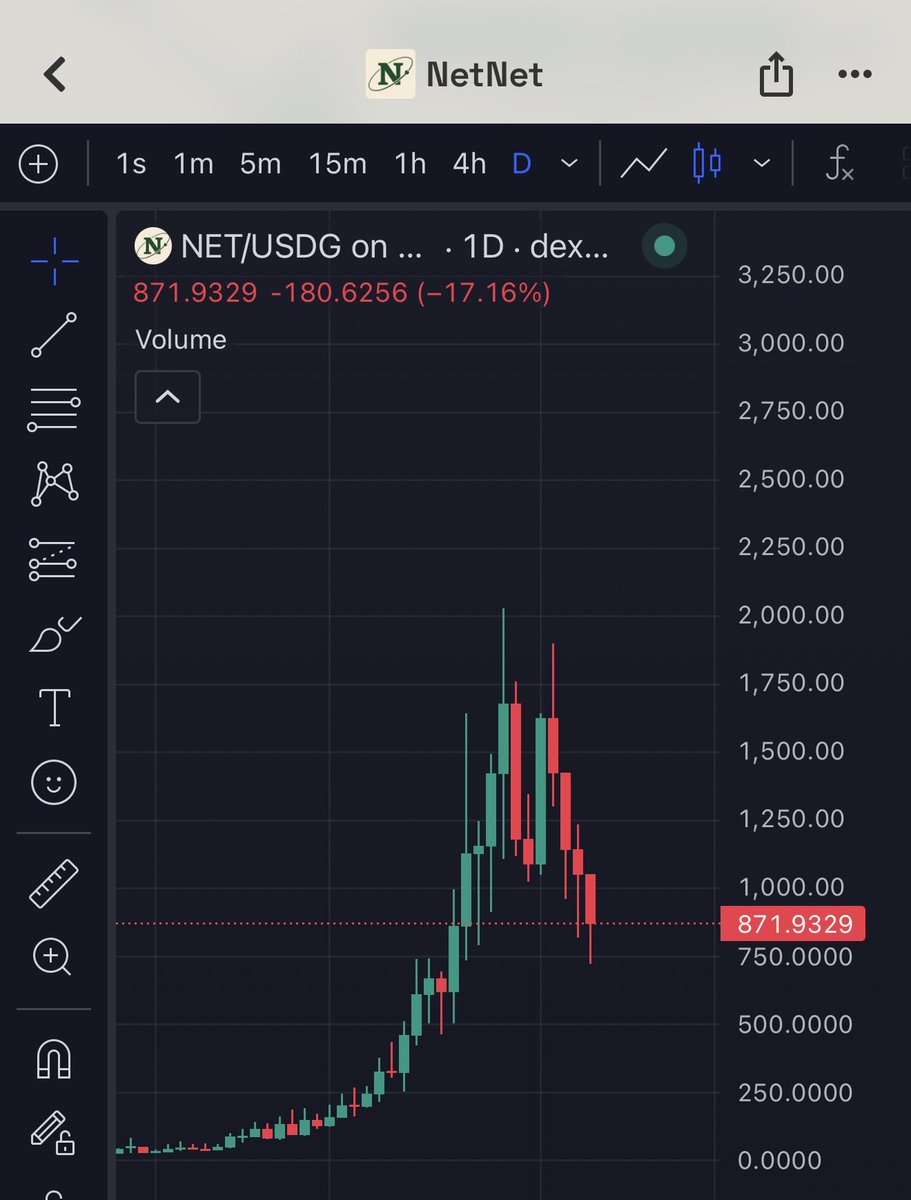
Meanwhile $NET is trading at 923 USDG TWAP.
Meaning $NET is currently trading at 7x NAV.
This premium is extremely important because a huge part of the NetNet machine reacts directly to it.
Now let’s understand staking.
If you stake $NET, You receive sNET, sNET is a rebasing token.
There is one epoch every 8 hours.
So: 3 rebases per day.
But the protocol does NOT just print the same yield regardless of market conditions.
The rebase depends on how far $NET trades above NAV.
If $NET trades at NAV or below it:
No yield.
As the premium increases the rebase increases.
And once the premium reaches 1.75x NAV or higher
The maximum rebase becomes: 0.45% per epoch.
Right now $NET is 7x NAV.
So the maximum rate is already active.
And currently 89.5% of the entire $NET supply is staked.
There are 69,000 NET total and 62,000 NET are currently staked.
Meaning the actually liquid supply is much smaller than the headline supply.
Now we get to probably the most interesting part of NetNet:
The protocol actively reacts to where $NET trades relative to NAV.
Think about it like this:
Below NAV = buy
Far above NAV = sell
The protocol has an inverse bond mechanism that can buy $NET around:
NAV - 1.5%
And burn the purchased tokens.
So there is effectively a protocol bid below NAV.
On the other side
NetNet can sell newly issued NET through bonds but those bonds cannot sell NET below NAV.
And there is another mechanism called PremiumSeller.
If $NET trades above 2x NAV
The protocol can gradually sell small amounts of newly created NET into the market.
So the system is basically designed with two forces:
When NET gets too cheap relative to reserves: Buy and burn.
When NET gets extremely expensive relative to reserves: Issue and sell.
And right now we are VERY far into the second zone.
Also NetNet applies a 5% transfer fee on mapped liquidity pairs.
Part of the idea is to capture economic activity around the token and redirect value back into the system.
Now we get to the part that makes NetNet much more interesting than a normal Olympus fork:
RWAs.
NetNet has something called the Real World Bonds desk.
Users can deposit USDG and receive vested $NET.
NetNet then uses that capital to accumulate tokenized equities on Robinhood Chain.
NetNet now claims more than $2M in tokenized equities
And more than $1M in tokenized Nvidia alone.
This is basically where the broader thesis starts becoming obvious.
NetNet is trying to use Robinhood Chain as an onchain balance sheet.
So if you want to follow $NET
There are basically three numbers I would watch:
- NAV vs $NET price
- Treasury growth
- How much external liquidity and integration sNET / NET gets across Robinhood Chain
Because if the treasury keeps growing
And Robinhood Chain keeps expanding
NetNet could become one of the most interesting financial experiments on the chain.