Melanchthon explains that philosophy can only teach you abstract facts about God. Philosophy can tell you that God created the world. It can even tell you that God is generally merciful and wise.
But Melanchthon asks an important question:
What Good Does That Do You?
Abstract facts do not bring peace to a terrified conscience. True faith, Melanchthon argues, is not about knowing God exists; it is about trusting that God is merciful to you, just to you, and wise to you.
This is why Melanchthon prefers the Psalms above all other books. The Psalms are not cold philosophy; they are raw, emotional poetry. They take the massive, terrifying concepts of God’s justice and mercy and apply them directly and personally to the human heart.
Melanchthon isn’t just recommending Martin Luther’s new book on the Psalms. He is handing young students the keys to a completely new way of experiencing God—not as an abstract philosophical concept to be debated, but as a loving Savior to be trusted.
Read the previously untranslated letter:
https://t.co/naw0koPFlt
Martin Luther rejected the friendship of a highly prominent German lawyer.
Christoph Scheurl wrote to Luther in 1517 offering immense praise and an alliance.
Instead of accepting the honor, Luther warned that this praise was a spiritual trap.
Scheurl admired Luther's intellect and wanted to attach his name to Luther's rising academic star.
Most young professuionals would have jumped at the networking opportunity.
But Luther saw human flattery not as a compliment, but as a profound danger.
In a newly translated January 1517 letter, Luther completely dismantled the lawyer's praise.
He warned Scheurl that if they became close friends, Scheurl would inherit only Luther's "sins, foolishness, and ignominy."
Luther argued that human favor actively drives away the favor of God.
He wrote that hatred is a peril only once, but love and praise are a peril twice over.
To Luther, a true Christian doesn't seek out the erudite, the famous, or the successful.
A true Christian seeks the poor, the needy, and the miserable.
He practically begged Scheurl to stop polluting the reality of Christ with the name of Martin Luther.
We live in a culture obsessed with networking, platform building, and adjacent prestige.
We constantly seek out the successful to elevate our own status and personal brands.
But faith demands a total rejection of status-seeking.
How do you navigate the tension between professional networking and Christian humility?
https://t.co/QMEI0FaCUP
Ever felt completely paralyzed by the fear that God is just waiting to strike you down?
Read the five-words that a Pastor spoke to Martin Luther during a public panic attack to instantly stop his anxiety in this newly translated Table Talk (been untranslated for 500 years):
https://t.co/Sszj6aTjyc
What does trauma and 16th-century German sausages have in common?
Pull up a chair and read this newly translated Table Talk (been untranslated for 500 years) and see exactly how Luther explained our subconscious urge to reject unconditional love:
https://t.co/bY9WJpLewu
What caused Martin Luther to suffer absolute terror while walking through a massive parade?
Dive into his anxiety in this newly translated Table Talk where Luther realized the angry God in his head was completely fake:
https://t.co/bY9WJpLewu
Why are we so terrified of unearned grace?
Martin Luther realized that when heaven offers total forgiveness, we immediately run in the opposite direction.
Why? Uncover the 16th-century dinner conversation that diagnoses our addiction to spiritual guilt in this newly translated Table Talk:
https://t.co/Sszj6aTjyc
How do you cure crippling anxiety?
When Martin Luther suffered a paralyzing panic attack over an angry God, a trusted Pastor spoke a five-word sentence that changed his life forever.
Find out what those words were:
https://t.co/bY9WJpLMm2
Are you trying to build a career on clout?
Find out why Martin Luther warned that seeking fame is exactly like plunging bare hands into a fiery oven to grab burning coals:
https://t.co/bY9WJpLewu
Why did Martin Luther compare our deep, psychological fear of God to running away screaming from a neighbor holding two sausages?
Read the bizarre childhood story that perfectly explains why we instinctively sabotage free gifts:
https://t.co/bY9WJpLewu
What did a mentor say to stop Martin Luther from having a full-blown panic attack during a medieval street festival?
Read the five-word cure that shattered his toxic way of thinking forever in this newly translated Table Talk:
https://t.co/bY9WJpLMm2
Surrounded by a massive crowd at a public street festival, Martin Luther suffered a crippling panic attack.
Walking in full priestly vestments during a Corpus Christi procession, Luther was suddenly paralyzed by the sheer terror that an angry, punishing God was right there, waiting for an excuse to strike.
We do this constantly.
We are so hardwired to expect wrath and punishment that we instinctively sabotage grace. Luther later diagnosed this exact spiritual paranoia using a hilarious childhood story about running away in absolute terror... from a neighbor offering free sausages.
Because we expect to be yelled at, we assume the free gift is actually a trap.
But how do you actually stop that kind of religious panic once it starts?
After the festival, Luther confessed this terrifying episode to a trusted Pastor. The Pastor didn't offer a heavy theological lecture or demand more discipline. Instead, the Pastor delivered a five-word sentence that completely turned this paranoia upside-down and redefined who God actually is for Luther.
Find out exactly what those five words were in this newly translated Table Talk of Luther’s here... 👇
https://t.co/Sszj6aSLIE
Modern networking says to "fake it till you make it."
In 1519, Melanchthon did the exact opposite: "I am ashamed even to be greeted by such great men."
Discover why exercising extreme imposter syndrome was the ultimate Renaissance cheat code in this newly translated letter of Philip Melanchthon:
https://t.co/iJariTrcae
#LutherVox #PhilipMelanchthon #Lutheran #MartinLuther #Reformation
"I wish to be perpetually recorded and spoken of as your bondsman."
In 1519, the Protestant Reformation survived because theologians like Melanchthon knew how to network with ruthless efficiency.
Offering a literal blank check of academic loyalty to a billionaire VIP?
A brilliant survival tactic.
READ THE NEWLY TRANSLATED LETTER HERE 👇
https://t.co/iJariTqEkG
Why do great poems break strict grammar rules? During a recorded dinner conversation, Martin Luther argued that bending the rules of grammar is the literal definition of grace. Read why demanding absolute perfection ruins art and life:
https://t.co/GFOAb2pCkg
Stop assuming Martin Luther just wanted to destroy medieval traditions. When Luther discovered that a beloved title for Mary was actually a scribal typo, Luther used the mistake to craft a beautiful, forgotten metaphor about human nature being a bitter, toxic ocean.
https://t.co/KlORH6aC8H
For over a thousand years, Christians sang hymns to Mary as the "Star of the Sea." But the entire tradition was based on a medieval spelling error.
Read how Luther traced a single copied letter back to its original Hebrew roots to find the real meaning in this newly translated sermon:
https://t.co/KlORH6aC8H
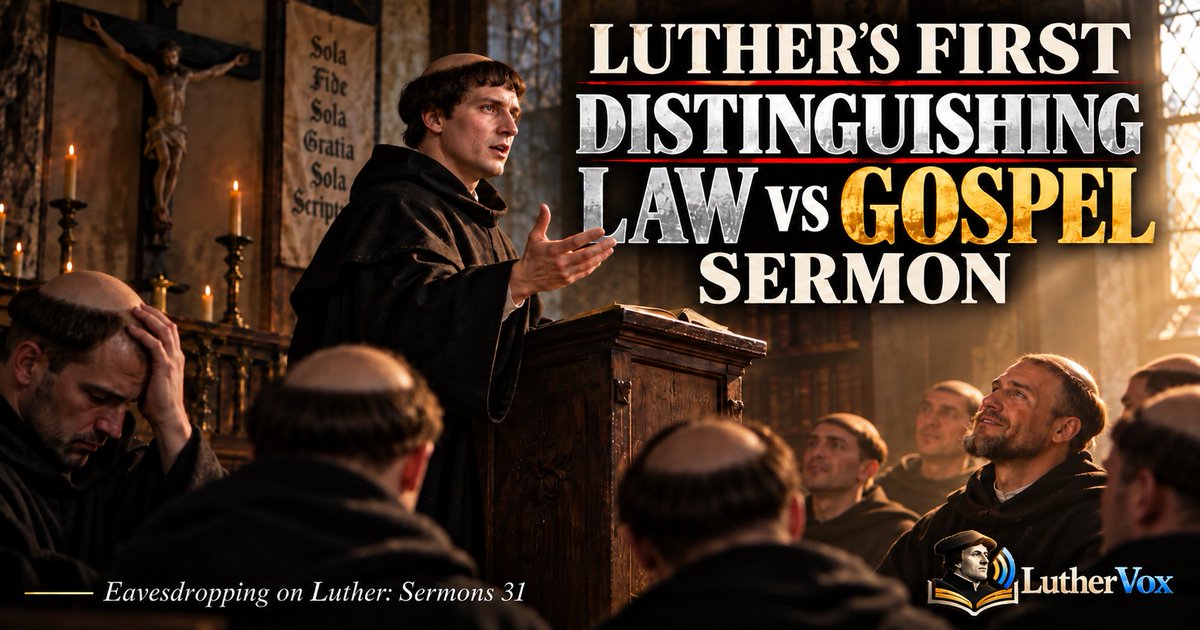
For centuries, medieval theologians taught that the Gospel was simply a stricter set of moral rules. That changed in one specific Advent sermon.
Read the newly translated sermon where Martin Luther first rejected the "New Law" and publicly severed God's crushing demands and preached how we are saved by the Gospel, God's rescuing grace. 👇
https://t.co/N7OGcELcGV
For centuries, medieval theologians taught that the Gospel was simply a stricter set of moral rules.
Read the exact sermon where Martin Luther first rejected the "New Law" and publicly severed God's crushing demands from God's rescuing grace. 👇
https://t.co/EcsCfQlMid