I recommend dancing.
Randomly, intermittently, uncoordinatedly.
You grossly underestimate how psychologically rigid you’re becoming as you age - until suddenly you are 47, and a spitting image of your grumpy father.
OCTOBER IS FOR FREEDOM
And we’re starting right where the fight often begins: our desires.
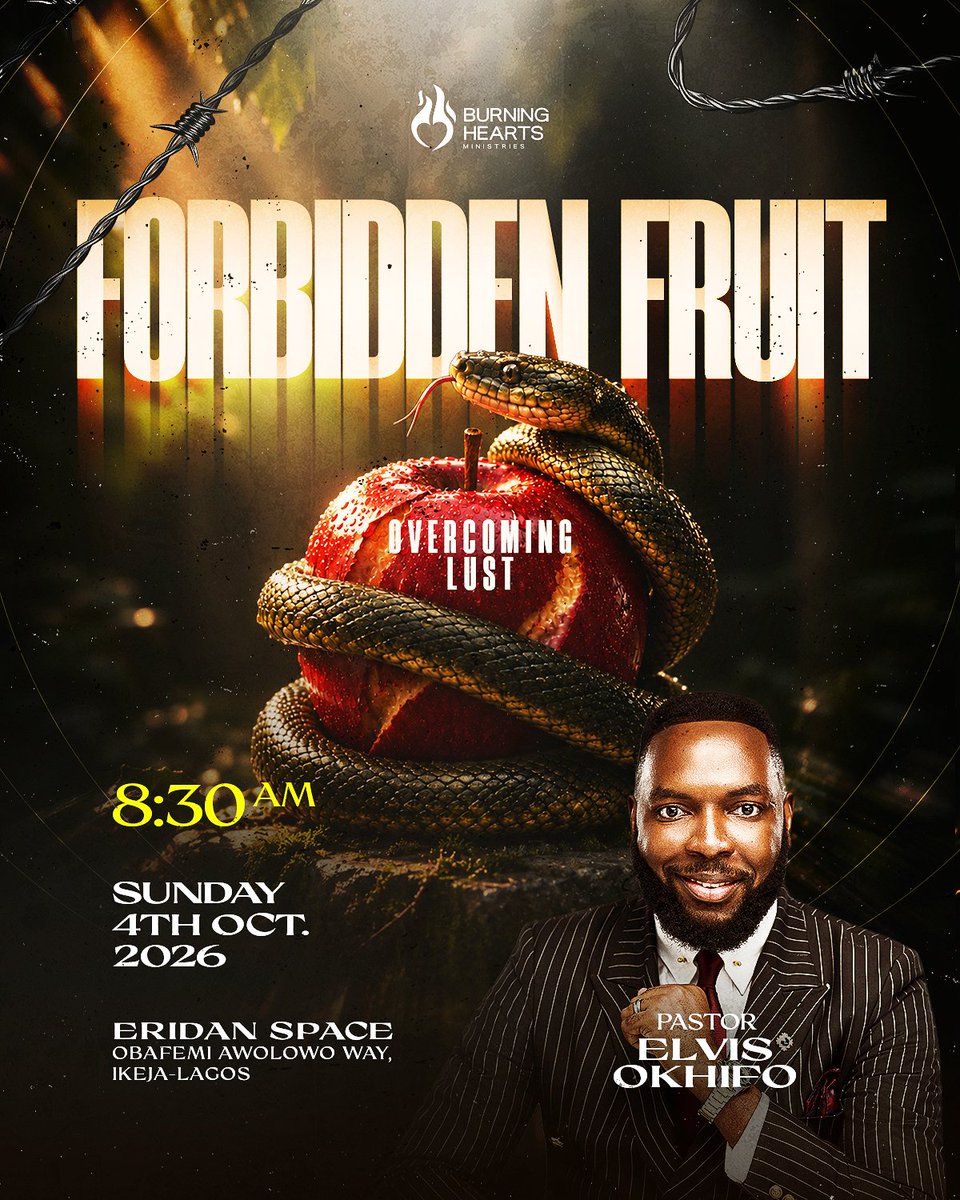
This Sunday, we start with Forbidden Fruit: Overcoming Lust
Sunday, 4 October 2026
8:30 AM
Eridan Space, Obafemi Awolowo Way, Ikeja, Lagos.
I wonder why this has drawn such a backlash.
But I will attempt to offer some explanations.
The poster is a pastor who labors immensely for Christ to be formed in people.
But that's not all.
He doesn't preach a sermon without rigorously studying the theology surrounding the topic.
I can say this because I know him personally. I know his ethics regarding theology.
He labors intensely to ensure that his sermons align with received orthodoxy.
2.
This post's subject matter is not theology, but edification.
He is trying to answer what is responsible for edifying Christians under a pastor.
He distinguishes between the efficient and instrumental causes of edification.
For example, the efficient cause of a chair is the carpenter.
But the instrumental cause of the chair is the hammer.
While the hammer is instrumental in creating the chair, it is not the creator or efficient cause of the chair.
Similarly, theology is an instrumental cause of edification.
But it is not necessarily the efficient cause. God is the efficient cause of edification.
And that's why the post says that the pastor who teaches God's Word must be theologically accurate.
Just as God is the efficient cause of edification through the instrument of theology, the pastor must ensure that the theology he teaches is accurate.
That's why Pastor Elvis says the pastor must be theologically accurate.
3.
This is important because an apostate can be fluent in theology.
An atheist or even a Muslim can be fluent in theology.
But even if he dispenses that theology to God's people, it does not guarantee their edification.
That is sound because ministry in the New Testament does not ultimately come from theology; it comes from God.
Paul says:
“Not that we are sufficient of ourselves to think anything as of ourselves;
but our sufficiency is of God; who also hath made us able ministers of the new testament.” ��� 2 Corinthians 3:5–6
Additionally, Paul makes us understand that even theologically competent ministers still need utterance enabled by the Spirit in order to dispense edifying words.
He asks the believers:
“Praying always with all prayer and supplication in the Spirit... and for me;
that utterance may be given unto me, that I may open my mouth boldly, to make known the mystery of the gospel.” - Ephesians 6:18–19
Paul understood that possessing the gospel was not the same thing as being sufficient to minister it effectively.
He depended upon God for the ability and utterance required for ministry.
It is God who builds the people.
Paul can plant the Word, and Apollos can water the Word, but the increase remains with God:
“...So then neither is he that planteth any thing, neither he that watereth; but God that giveth the increase.”
— 1 Corinthians 3:6–7
That is why the New Testament minister must do ministry in holiness.
For if he is in rebellion against God and living in sin, who then edifies through his theology?
The power of ministry ultimately does not reside in the minister's intellectual competence. It resides in God.
Finally, everyone can agree that there are both textual and spiritual dimensions to edification.
The Spirit of God is needed so that the eyes of our understanding might be opened, and so that the Spirit of wisdom and revelation may be given:
“The God of our Lord Jesus Christ, the Father of glory, may give unto you the spirit of wisdom and revelation in the knowledge of him: the eyes of your understanding being enlightened.” — Ephesians 1:17–18
The Word must be accurately taught, but the Spirit must also illuminate the hearts of those who hear it.
This means that theology, no matter how accurate, does not automatically guarantee edification if God's Spirit is not at work in both the preacher and the laity.
This synergism was what Pastor Elvis was pointing out.
I pray God gives all of us patience. Amen.
The narrative of John 10 is a continuum of the conversation Jesus had with the Pharisees in the previous chapter after he healed the man who was born blind and the Pharisees cast him out of the synagogue.
A Jew who was being cast out of the synagogue was going to lose a whole lot as his life revolved around that community, so in casting him out, they exercised authority over the people, an authority that was illegitimate.
Jesus ended that chapter by telling them they too were victims of spiritual blindness, but theirs was worse because they claimed they were not blind.
It’s against this background that chapter 10 should be read, even though in this chapter Jesus was clearly pointing out to them the fact that he fulfils the prophecy of Ezekiel 34, where the Lord was coming to save his own sheep amidst the failures of the shepherds of Israel.
So at the end of chapter 9 into chapter 10, Jesus uses metaphors to explain spiritual realities; these metaphors must be understood not just contextually but prophetically, as the teaching itself is the fulfilment of prophecy: Jesus is essentially saying I am Yahweh, the good shepherd. Little wonder some amongst them called him demon-possessed.
The error of many is that they either understand it only contextually and ignore the prophetic side of the passage or understand it only prophetically and ignore the contextual side of the passage. Both should be put side-by-side while interpreting the passage.
In context, the thief is the religious leaders Jesus is addressing directly; in prophecy, the thief is the devil himself. We know this because Jesus presents his job as contradicting the job of the thief.
John would later tell us that the Son of Man was made manifest to destroy the works of the devil.
This is not a method that is alien to scripture itself; we see in scripture times when in order to prophetically apply a text, the text itself is interpreted beyond its original context by the New Testament writers.
When someone is saying the thief in John 10 is the devil, they’re not wrong, because we know that stealing, killing, and destroying is still going on today, and we don’t have the Pharisees of Jesus’s day with us. We also know that Jesus is still giving abundant life today.
In Jesus’s day, the devil used the Pharisees; in our day, he is using false apostles and teachers, but it’s still that old serpent.
It is, however, important to remember that application should come after proper exegesis, and exegesis is not useful if what has been exegeted cannot be applied.
@EntinaSamuel@ElvisOkhifo Hi 🤭
Eridan Space, Obafemi Awolowo Way, Ikeja, Lagos.
Nearest Bus stop: Testing ground, Ikeja. busstop.
Nearest landmark: Coca Cola/LTV
Sunday service starts by 8:30am.
Midweek service is Thursdays by 6:00pm.
See you around.
You start in a new company and the first thing you're taught is the culture of the company.
Dress code, how to communicate, the software and tools being used in that company.
You won't say, "this is how we used to do in my former company, so I prefer...."
You’ve been eating voraciously since January,
Where has that brought you? 🤭
Oya,
For the rest of the year,
Declare a fast, and pray longer than usual, daily.
Leave food and touch God!
Your future self will thank you for this decision.
Happy new month 😒
If I were to counsel the average young Christian today, I will say just 3 things
1. Go back to your BIBLE. Read. Study. Obey.
2. Go back to PRAYER. Ask. Seek. Knock.
3. Go back to CHURCH. Belong. Submit. Serve.
If you think you have JESUS, know Jesus, and love Jesus, and lack any of these THREE.
You are DECEIVED.
I know we want to sing and say that God is all we have, but that's not fully accurate.
You have me, I have you, we are His body. One Spirit, One body, One Lord, One Faith.
Study 1 Corinthians 12 and Ephesians 4.
Shalom
I used to think that the gifts we received from Jesus were just eternal life and the Holy Spirit (and all that stems from Him, both gifts and fruits).
But I've come to see that Jesus' left us with another gift – each other.
John 15:12,17-18
He knew that this world would not love His own, because it did not love Him, so He commanded His own to love one another.
We might differ in opinions but let us be bound by love.