I have been advised to let everyone know that this account is my personal X account & represents only my own opinions & not that of any other Board members or the District. Please ask school related questions to my school email or PM me here. 😊
🚨#BREAKING: A 28-year-old confirms he has spent the last 10 YEARS of his life interviewing World War II combat veterans to keep their stories alive...
...in fact, for the last 10 years, he has interviewed World War 2 veterans EVERY SINGLE DAY
He started as a teenager, ditching school to ride his BIKE to the local retirement home, walking up to the front desk and asking to, "meet some World War II heroes."
His name is Rishi Sharma.
He's crossed all 50 states and half the world.
He's slept in his car and lived on gas-station food to afford it.
He asks these men for hours of their memories, and then he hands the entire recording to their families...
...FOR FREE
So that 200 years from now, a great-great-grandchild will know not just their hero's name, but how he laughed, how he cried, and what he sacrificed.
Rishi has no military family, his parents immigrated here from India.
He does it out of pure gratitude.
In his words:
"My parents were given the opportunity to immigrate and raise a family because of veterans like these. It's a debt of love I'll spend my entire life trying to repay..."
As one 100-year-old Marine who stormed Iwo Jima told him, remembering the flag going up:
"The hair on my arms still stands up when I think about how beautiful it was."
THAT is America.
250 years of ordinary people doing extraordinary things...
God bless our veterans. 🇺🇸🇺🇸
I had no idea..
"This man was born in 1809.
In 1816, at age 7, he was forced to work because his family was expelled.
In 1818, he lost his mother.
In 1828, he lost his sister.
In 1831, he opened his first business and went bankrupt.
In 1832, he stood in the legislative elections and lost.
In 1833, he borrowed money to open another business and went bankrupt again.
In 1835, he met a wonderful woman. He falls in love with her, they get engaged, and she dies.
In 1836, he entered a dark period of his life: deep depression.
He remains bedridden for 6 consecutive months. But he gets up.
He gets up and in that same year of 1836 he runs in the legislative elections and loses again.
In 1840 he presented himself as an elector; he loses.
In 1842, he met the woman he would end his life with.
They fall in love, get engaged, get married and she gives him 4 children and they lose 3 (three).
In 1843, he appeared at the congresses and lost.
In 1845, he appeared again at the congresses and lost again.
In 1850, his son died.
In 1854, he ran for the Senate and lost.
In 1856, he ran for Vice President, he didn't even have 100 votes.
In '58, he ran again for the Senate and lost again.
And in 1860 ABRAHAM LINCOLN was elected President of the United States of America 🇺🇸.
He was elected for two exceptional terms (he was assassinated in beginning of the second term.) He was one of the most respected and impactful Presidents in the history of the United States 🇺🇸.
It's important to tell this story of perseverance because we see the hero, but we don't see the backstage of the afflictions. "
Wow. ...
I think this is a great example of Never Never Never Give Up! 🇺🇸🇺🇸
In 1982, Robin Williams did a routine as the American Flag for the Norman Lear produced tv special "I Love Liberty" created to bridge political divides - and it's one of the greatest pieces you'll see 🇺🇸
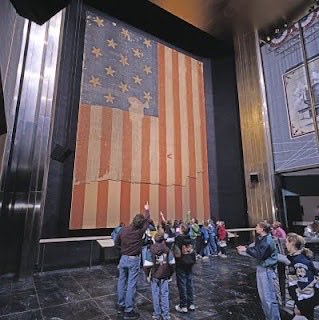
The fascinating story of our Star Spangled Banner is rarely, & erroneously, not taught anymore. Read this brief story & pass it along to others so we can re-learn the incredible lengths & sufferings our forefathers went through to give us this nation 🥰🇺🇸
In September of 1814, America was once again in trouble.
The young republic was only thirty-eight years old. The War of 1812 had gone badly. British troops had marched into Washington, burned the Capitol, set the White House ablaze, and now turned their sights toward Baltimore. If Fort McHenry fell, the harbor would be open, the city would likely follow, and another devastating blow would be dealt to the fragile nation.
Amid this uncertainty, a young American lawyer named Francis Scott Key sailed under a flag of truce to the British fleet. He had come to negotiate the release of a friend, a physician the British had captured.
He succeeded.
The British agreed to free the doctor.
But there was a catch.
Because Key and his companions had seen too much of the British fleet and learned too much about its plans, they were not allowed to return to shore. Instead, they were detained aboard a ship in the harbor and forced to watch the coming battle from behind enemy lines.
On the morning of September 13, the bombardment began.
For the next twenty-five hours, British warships unleashed somewhere between 1,500 and 1,800 bombs and rockets upon Fort McHenry. These were the “bombs bursting in air” and the “rockets’ red glare” of the song—not poetic embellishments, but terrible realities.
Key stood on the deck through the endless day and the long, terrifying night. Every explosion lit the darkness for a fleeting instant before the smoke swallowed everything again. Somewhere beyond that wall of fire stood the fort. Somewhere beyond it flew an American flag if it still flew at all.
He could not see.
He could only listen.
As long as the guns continued firing, there was reason to hope. The British would not waste ammunition on a fort that had already surrendered.
Then, just before dawn…
The guns fell silent.
For the first time all night, there was only stillness.
It was the most frightening sound of all.
Had the fort finally fallen? Had the defenders surrendered? Had the flag been torn down in the darkness while no one could see?
There was nothing to do but wait.
As the first light of September 14 slowly pushed back the smoke, Francis Scott Key strained his eyes toward the distant fort.
Then he saw it. Not a British flag.
The American flag. Still there. Still flying.
That flag was no ordinary banner. Months earlier, the fort’s commander had commissioned a Baltimore flagmaker, Mary Pickersgill, to sew a flag so enormous “that the British would have no difficulty seeing it from a distance.” It measured roughly thirty by forty-two feet, carried fifteen stars and fifteen stripes, and was so large it had to be assembled on the floor of a brewery because no ordinary room could contain it.
That was the Star-Spangled Banner.
The very flag Key saw through the morning mist.
The very flag that still survives today in the Smithsonian.
Overcome by what he had witnessed, Key reached into his pocket, pulled out an envelope, and began writing. The words came from a heart that had spent an entire night fearing his country might disappear with the dawn.
He first titled the poem Defence of Fort M’Henry.
Within days it was printed and circulating throughout the country. Before long, people began singing it to a melody they already knew—an old British tune called “To Anacreon in Heaven,” originally written for a London social club. There is something beautifully ironic in that: America’s most beloved patriotic song borrowed the melody of the very nation it had just survived. It also explains why the anthem is so notoriously difficult to sing. It was never written for ordinary voices gathered in stadiums or school assemblies.
The song spread quickly and became one of America’s favorite patriotic hymns, but it would wait more than a century before receiving official recognition. Not until 1931 did Congress declare “The Star-Spangled Banner” the national anthem of the United States.
HAPPY 250TH BIRTHDAY AMERICA!! 🎉🎆
Tokyo Bay is going INSANE tonight!!
A samurai and President Trump just shook hands in the SKY above Rainbow Bridge!!
Made of pure light!!
The whole crowd is screaming!!
Phones flashing everywhere!!
Japan came to PARTY with you tonight!!
This is what real allies look like!! 🇺🇸🤝🇯🇵
God bless the USA!! God bless Japan!!
LET'S GOOOOOOOOOOOOOOO!!
🔥 Japan just flew drones in the sky forming the figures of PRESIDENT TRUMP and PM SANAE TAKAICHI — when she was jumping on stage with 47 in front of the troops
ABSOLUTELY EPIC!
🇺🇸🇯🇵
@MattiTravelling@Hazalizy@nntaleb I agree. Is this to scale? That’s important to know as the individual squares don’t match so they should have differing values then, right?
An 11-year-old boy. One crochet hook. 60 skeins of yarn. No pattern. Two weeks. 🇺🇸
While juggling tennis camps and baseball games, Grayson poured his heart into crocheting this stunning American flag blanket—just in time to celebrate America’s 250th Independence Day. 🧨
No fancy instructions, just pure determination and love for his country. The result is a beautiful family heirloom that proves some of life’s greatest treasures are still made by hand. 🇺🇸✨
Proud of this kid and the quiet power of creativity in the next generation.
What an inspiration! 👏