🔥🚨BREAKING: Aftoman just released a new song after defeating the Adams county Ohio police department by himself and singlehandedly motivating millions of Americas to defend their 1st Amendment Rights.
I found my father in his old recliner, a warm soda still in his hand and his police scanner buzzing loud static that shook the whole room.
I did not cry. I just reached over and finally turned the scanner off.
For most of my life, that noise was the sound of my anger.
My dad was a retired firefighter named Robert Hale. He was tough, quiet, and stubborn in a way that made every argument feel like pushing a wall. After my mom died, he became even quieter. He stayed in that chair every day, listening to the county radio like he still worked the job.
I work in a big architectural firm in Chicago. I spend my days drawing shiny buildings and clean lines that touch the sky. Everything in my world is planned, silent, and perfect.
Coming home felt messy. Seeing him stuck in the past felt worse.
"I just wish he would move on," I once told my wife. "He cannot accept that his career is over."
I understand now that I was wrong.
Three days after the funeral, I was cleaning out my childhood home. The place smelled like dust, pine cleaner, and my dad’s old flannel shirts. When I picked up the police scanner to throw it into a donation box, I saw a notebook sitting under it.
It was not a diary. It was a log.
Nov 3, 2022. 11:15 PM. 18 Willow Lane. Ms. Parker. Heater not working. Code 4.
Jan 7, 2023. 9:00 AM. The Ramirez boy. Flat bicycle tire. Code 4.
Sep 14, 2023. 2:30 PM. Mr. Dalton. Tree branch blocking driveway. Code 4.
I remembered that in our county, Code 4 means Everything under control.
But my dad was retired. Why was he writing these down?
I drove to Willow Lane to ask. Ms. Parker answered the door, leaning on a cane. When I told her who I was, she covered her mouth with her hands and tears filled her eyes.
"Oh, sweetheart," she said. "Your father saved me."
"Saved you?" I asked.
She nodded. "My heater broke during a snowstorm. I called 911 because I was scared. They told me it was not an emergency. Ten minutes later your dad showed up with his toolbox. He worked for hours in the cold until the heat turned back on. He told me he was sent by the department so I would not feel embarrassed. But I knew better. He was just kind."
My chest got tight. I went to the next address. And the next.
Every story was the same. Dad was not stuck in the past. He was listening for the people who slipped through the cracks.
Small problems that still broke someone’s day.
Things the city ignored or could not handle.
A tree in a driveway that would take days for the city to remove. Dad came with a chainsaw after dinner.
A child’s bike bent by a careless driver. Dad fixed it in his garage and left it on the porch without saying a word.
He did not listen to the radio to remember the job.
He listened because he wanted to help the people nobody else noticed.
When we held his funeral, I expected a few firefighters, a folded flag, and the traditional bell for the Last Call.
I did not expect the crowd.
The church was packed wall to wall. People I had never seen stood shoulder to shoulder. A young father with oil on his hands from his job at the garage. An older woman with a baby on her hip. A veteran in a wheelchair.
They did not know Captain Hale.
They knew the man in the flannel shirt who showed up when life got too heavy to lift alone.
That night, after everyone went home, I returned to the empty house. I sat in my father’s recliner and held the notebook again. A small yellow note slipped out.
In his shaky handwriting, it said:
"Leo, if you found this, I did not finish everything. Mrs. Carter on 5th Street has loose porch steps. Fix them for me. You always had steady hands."
I stared at the quiet room. Then I looked at the police scanner.
I turned it on.
The static filled the air. Then a voice said, "Minor flooding reported on Elm Street. Assistance requested."
I stood up. I took off my watch. I rolled up my sleeves. I grabbed his old toolbox.
"Thanks, Dad," I whispered. "I hear you. I am going."
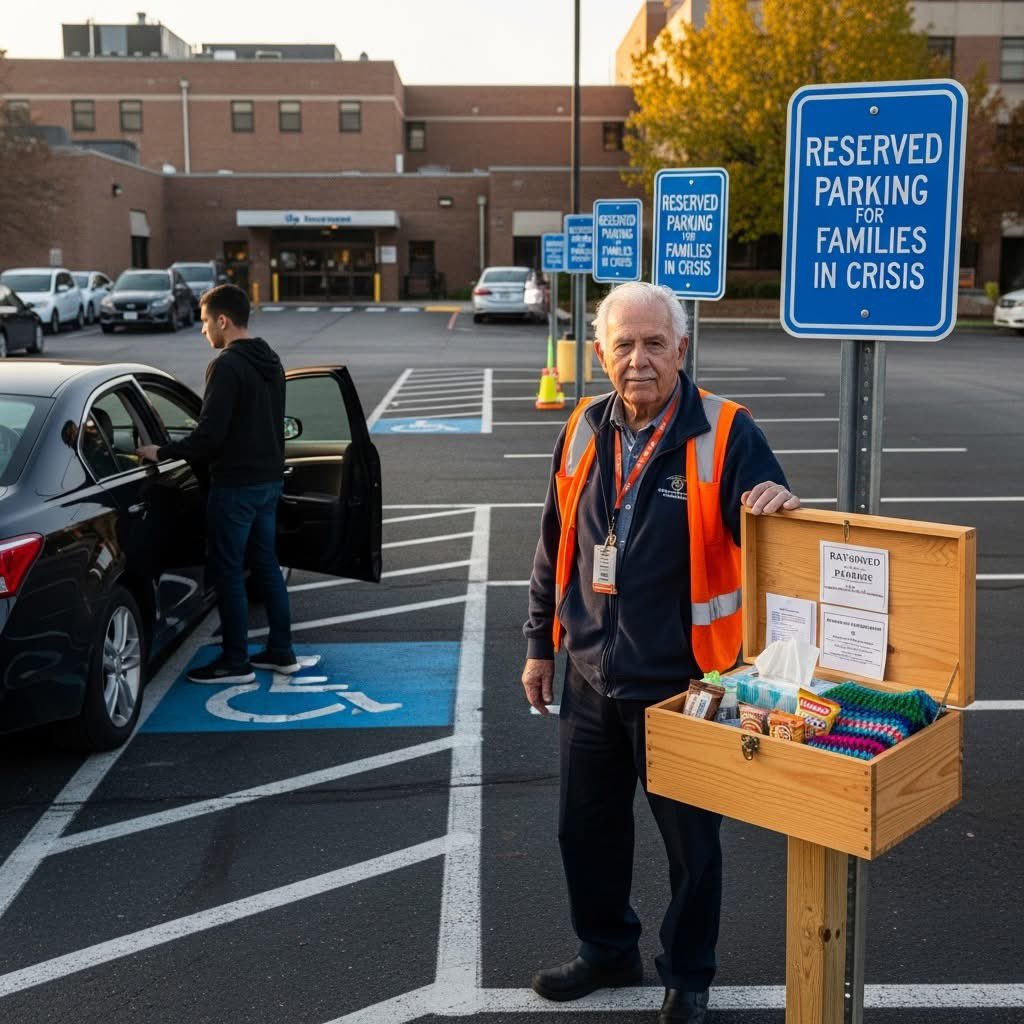
"My name's Raymond. I'm 73. I work the parking lot at St. Joseph's Hospital. Minimum wage, orange vest, a whistle I barely use. Most people don't even look at me. I'm just the old man waving cars into spaces.
But I see everything.
Like the black sedan that circled the lot every morning at 6 a.m. for three weeks. Young man driving, grandmother in the passenger seat. Chemotherapy, I figured. He'd drop her at the entrance, then spend 20 minutes hunting for parking, missing her appointments.
One morning, I stopped him. "What time tomorrow?"
"6:15," he said, confused.
"Space A-7 will be empty. I'll save it."
He blinked. "You... you can do that?"
"I can now," I said.
Next morning, I stood in A-7, holding my ground as cars circled angrily. When his sedan pulled up, I moved. He rolled down his window, speechless. "Why?"
"Because she needs you in there with her," I said. "Not out here stressing."
He cried. Right there in the parking lot.
Word spread quietly. A father with a sick baby asked if I could help. A woman visiting her dying husband. I started arriving at 5 a.m., notebook in hand, tracking who needed what. Saved spots became sacred. People stopped honking. They waited. Because they knew someone else was fighting something bigger than traffic.
But here's what changed everything, A businessman in a Mercedes screamed at me one morning. "I'm not sick! I need that spot for a meeting!"
"Then walk," I said calmly. "That space is for someone whose hands are shaking too hard to grip a steering wheel."
He sped off, furious. But a woman behind him got out of her car and hugged me. "My son has leukemia," she sobbed. "Thank you for seeing us."
The hospital tried to stop me. "Liability issues," they said. But then families started writing letters. Dozens. "Raymond made the worst days bearable." "He gave us one less thing to break over."
Last month, they made it official. "Reserved Parking for Families in Crisis." Ten spots, marked with blue signs. And they asked me to manage it.
But the best part? A man I'd helped two years ago, his mother survived, came back. He's a carpenter. Built a small wooden box, mounted it by the reserved spaces. Inside? Prayer cards, tissues, breath mints, and a note,
"Take what you need. You're not alone. -Raymond & Friends"
People leave things now. Granola bars. Phone chargers. Yesterday, someone left a hand-knitted blanket.
I'm 73. I direct traffic in a hospital parking lot. But I've learned this: Healing doesn't just happen in operating rooms. Sometimes it starts in a parking space. When someone says, "I see your crisis. Let me carry this one small piece."
So pay attention. At the grocery checkout, the coffee line, wherever you are. Someone's drowning in the little things while fighting the big ones.
Hold a door. Save a spot. Carry the weight no one else sees.
It's not glamorous. But it's everything."
Let this story reach more hearts....
Credit: Mary Nelson