We need to waste tokens.
We even need to waste the most expensive tokens.
We need to try things that might not work, explore approaches that might be inefficient, and burn tokens along the way. Because that’s how we learn where tokens are actually being wasted — and where they create real value.
You don’t learn the boundaries without hitting them.
Waste some tokens. Make some mistakes. That’s how we move forward.
When the CFO becomes too dominant, companies often optimize what’s easiest to measure: cost.
But the most important long-term investments are often the hardest to quantify.
Saving money on better AI models may look great on a spreadsheet. But if a better model makes every engineer slightly more productive, improves code quality, and compounds across the organization, the “expensive” option may actually be the cheaper one.
Cost discipline is necessary. But when cost optimization becomes the strategy, companies start saving dollars while losing leverage.
The best companies don’t ask only, “How much does this cost?”
They ask, “What does this make possible?”
AI is making organizational design more important, not less.
AI is reducing execution cost much faster than coordination cost. Coding might become 5–10x faster, but cross-team alignment, ownership, dependencies, and decision-making don’t.
The bottleneck moves from implementation to the organization itself.
The solution isn’t better coordination. It’s less coordination.
Small, autonomous teams with end-to-end ownership. Platforms that remove dependencies rather than create them. Organize around products and outcomes, not technical layers.
AI makes this increasingly possible: a team of 5–8 great people + AI agents + self-service infrastructure may soon achieve what once required 20+ people across multiple teams.
You can accelerate coding with AI, but you can’t tool your way out of an organizational topology problem.
The AI-native company may not have fewer people. It may simply operate as many small, autonomous teams — with stronger ownership and fewer dependencies.
Lately I’ve been looking at DeepSeek’s agent harness, and one thing keeps standing out: AI agents are starting to look increasingly similar.
Tools, skills, ReAct, context management, tool loops — the core patterns are converging. What increasingly differentiates systems is not the basic agent pattern, but the engineering behind it: architecture, reliability, efficiency, and how well everything works together.
It reminds me of database design. The fundamentals are learnable, and with enough effort, most engineers can reach a solid level fairly quickly. The real long-term differentiators are learning ability and engineering ability.
If you’re strong at both, the specific technology almost matters less. You can get good at almost anything.
A good AI agent platform should grow out of real products, not the other way around.
Build agents for real business problems first. As patterns repeat, you learn what is truly worth abstracting into shared infrastructure.
If you start with a generic platform and ask every product team to integrate with it, you usually end up optimizing for the lowest common denominator — locking in abstractions too early and putting a low ceiling on what the platform can become.
The best platforms are discovered through usage, not designed in isolation.
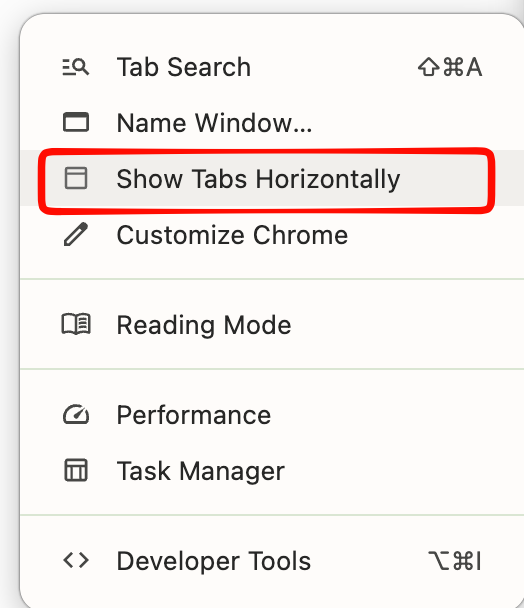
Chrome is finally rolling out Vertical Tabs.
I've been waiting for this for N years😭.
You can enable it now:
Go to chrome://flags
Search for vertical tab and enable it
Restart Chrome
Open the top-right ⋮ menu → More Tools → Vertical Tabs
Already feels much better if you keep lots of tabs open.
Our internal AI platform lets you choose between Standard mode and Advanced mode.
Advanced mode is slower and more expensive, but I almost always choose it.
The reason is simple: I don't use AI to get an answer faster. I use AI to get to the right answer faster.
If Standard mode takes three rounds of prompting while Advanced mode gets it right the first time, the latter is actually the faster option.
The more I use AI, the more I believe the priority for AI products should be:
Quality > Cost > Speed
If the quality is high enough, most users are happy to wait a little longer and even pay a bit more.
Speed and cost will continue to improve with better engineering. Quality is what makes people come back.
Many AI projects start as a single prompt.
The prompt becomes a design.
The design becomes code.
The code becomes a system.
The system becomes a product.
Like a seed growing into a tree, or a fertilized egg becoming a human, every split matters.
The challenge is that AI systems don't have the same self-correction mechanisms that biology does. An early mistake can propagate through the entire chain, getting amplified at every step.
The same is true for loop engineering: the earlier the error, the more expensive the recovery.
That's why the earliest stages deserve the highest quality thinking, the strongest validation, and often the best models available. The first few decisions shape everything that follows.
Once the structure is sound and the work becomes more localized, optimization and cost efficiency matter far more. Many peripheral nodes can be handled perfectly well by smaller, cheaper models.
In AI systems, quality compounds just as much as errors do.
The path to effectively infinite codebases in the AI era:
Keep every module smaller than the model’s context window.
Enforce strict cohesion and minimal coupling.
Require strong test coverage and performance validation.
Scale by composing modules into a tree.
A model doesn’t need to understand the entire system. It only needs to understand the current node and its contracts.
Unlimited software emerges from bounded contexts.
inklet is A macOS AI writing popover for transforming and inserting text with your preferred LLM provider. demo https://t.co/zheyqH6HtX via @YouTube
github https://t.co/GUWRpRjnwe
OpenClaw-style setups are great because they keep long-lived context and feel like a persistent assistant, which makes them very useful for exploratory work, debugging, and multi-step reasoning. The downside is that they’re harder to isolate, audit, and control, and over time you can run into environment drift and higher costs at scale. Runner-style execution (like CI/CD) is more engineering-friendly: each task runs in an isolated, reproducible environment, which makes it easier to scale, secure, and audit. The tradeoff is that you lose long-term context and flexibility for open-ended tasks. In practice, for production and enterprise use, runners are usually the better default, with OpenClaw-style environments used selectively when persistent context really matters.
Another observation recently: tools like Anything Cli are a good example.
They highlight both the promise and the limits of the “AI skills” approach. On one hand, skills can quickly expose capabilities through natural language and lightweight integrations. But on the other hand, they often run into constraints around context, determinism, and output quality.
When tasks become more complex or reliability really matters, people tend to fall back to code. Code is still the most stable interface: explicit, testable, and composable.
Maybe the real direction isn’t replacing code with skills, but letting skills sit on top of code — where AI helps discover and orchestrate capabilities, while the underlying logic remains robust and programmable.
AI “skills” today feel a lot like the early days of low-code.
At first, everyone is excited:
with a bit of configuration, workflows, or prompts, you can quickly build new capabilities.
But soon the same challenges appear:
poor maintainability, fragmented abilities, and for anything complex you still need real code.
In the long run, the real value isn’t the skills themselves, but the platform, abstractions, and ecosystem behind them.