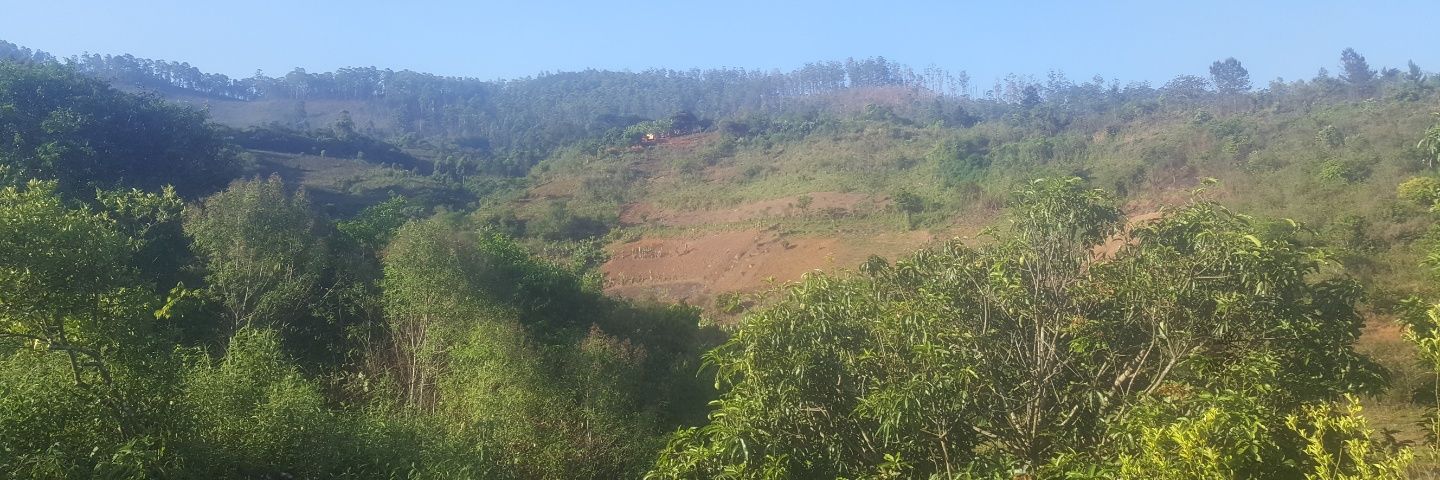
This road leading to Zimbabwe's biggest Thermal Power Plant - Hwange Power Station was once tarred. A decade ago, one of the local companies offered to refurbish it and was engaging a private company to do the work. The responsible Ministry gave a directive to stop the planned work as the road is designated as a state road. The company was instead directed to handover the funding it had budgeted for the road to the Ministry which would then fix the road. A few months later a dozen workers from the Ministry turned up with shovels and gravel to fill potholes. That road has never been the same since then, it has become a permanent dust road.
A group of options traders in Gaza joking about how finance influencers on social media are surrounded by Lamborghinis, waterfront mansions, luxury vacations, and six-figure trading accounts, while they’re trading from a rooftop with slow internet, post-war destruction in the background, and accounts so small they celebrate single digit gain. Funny, self-deprecating, and unexpectedly moving. A reminder that resilience isn’t about perfect conditions. It’s about showing up anyway.
Yhoo. I am busy reading Ndlozi's PhD and I must admit I am struggling to understand how this opening chapter survived rigorous academic scrutiny. The chapter is structured almost entirely around Ndlozi's personal encounter with his estranged father. For lengthy stretches it reads less like a doctoral thesis and more like a memoir of childhood abandonment.
Yes, auto ethnography is a legitimate research methodology. The issue is not the use of personal experience. The issue is what is done with it. Personal narrative must illuminate the research problem not substitute for its analysis. A researcher cannot simply recount a deeply personal experience and then declare it theoretically significant. The analytical bridge must be built not assumed.
What I find troubling is that the connection between Ndlozi's one experience of father absence and the broader claim of colonial "permanent juniority" is repeatedly asserted but insufficiently demonstrated. The reader is expected to accept an enormous conceptual leap that should have been painstakingly justified through evidence, argumentation and engagement with competing explanations.
I am equally concerned about the methodology. Humanities scholars may disagree with me and I am open to correction but from the perspective of someone trained in scientific research, this approach would struggle to pass muster even in many undergraduate research projects. Reflexivity requires a researcher to acknowledge their positionality and potential biases. It does not require the researcher to become the dominant subject of the thesis itself.
A strict examiner might reasonably ask “Is this a PhD about black youth politics in the Vaal or is it a PhD about Mbuyiseni Ndlozi's relationship with his father?” When that question can be asked with a straight face after reading the opening chapter, there is a serious issue of focus.
What makes the situation even more disappointing is that Ndlozi appears not to have produced peer reviewed journal articles arising from this work. That matters. The value of a PhD is not merely that it is completed and archived. Its value lies in its contribution to the broader body of knowledge through scholarly circulation, criticism, replication, engagement and debate.
A thesis that remains largely confined to an institutional repository is a contribution that never fully enters the marketplace of ideas. Concepts remain underdeveloped, arguments remain insufficiently challenged and theoretical claims remain untested by the discipline of peer review. For a project making such ambitious claims, that is a significant missed opportunity.
The tragedy is not that the work exists. The tragedy is that it seems never to have been pushed through the crucible of open scholarly contestation where strong ideas are refined, weak ideas are exposed and genuine contributions are forged. If there was a significant theoretical contribution here, academia may never fully benefit from it. That is a loss not only for the field, but for Ndlozi's own scholarly legacy.