A bridge just got drained for $4.67 MILLION because someone figured out how to create tokens that were never backed by anything.
It happened on the connection between Axelar and Secret Network, two Cosmos chains.
Bridges like this work on a promise to lock real tokens on one side and a matching token appears on the other, fully backed one to one.
The flaw broke that promise. A bug in the contract that's supposed to verify the backing let the attacker mint tokens on Secret that had nothing behind them.
They conjured the tokens out of thin air, then cashed them out for $4.67 million in real value before anyone caught it.
Axelar's emergency team shut the connection down fast and says the damage is contained to this one bridge. They're now working with exchanges to trace the money.
Here's the part that should worry people. This is the same trick that's hit bridge after bridge this year.
Mint tokens that aren't backed, dump them for real money, disappear.
Resolv lost $25 MILLION to it. Verus lost $11 MILLION. IoTeX lost $4 MILLION. Now Secret.
Bridges have slowly become the most expensive thing to get wrong in crypto, with over $340 MILLION drained from them this year alone.
It's almost always the same weak spot, the one check that's supposed to confirm the money on the other side is actually there.
‘You moved out of your parents house and own a car at 18, how?’
Me: I’m a crypto trader
‘You’re back to your parents house at 23 and can barely feed, how?’
Me: I’m a crypto trader
$LTC performance looks boring until you remember the time period
june 2017 to may 2026
thats basically multiple full crypto cycles, brutal drawdowns, bear markets, and every 'litecoin is ded' phase you can imagine
still positive CAGR at 2.91%
97.59% volatility because yeah, its crypto
but @litecoin is still here after all of it
thats kind of the whole LTC story
survive first, keep running and let everyone else argue
everyone's treating $SPCX like it's a guaranteed print. let me be the friction.
biggest IPO in history - 3x the previous record. i've been watching IPO setups for years and that number alone changes the calculus significantly. this isn't Airbnb or Rivian. this is a float so large it fundamentally reshapes how the first 30 days trade.
here's the problem with chasing this open:
when a deal is this oversubscribed, the institutions who got allocations are already planning their exits. they don't hold for sentiment - they hold until the risk/reward deteriorates, then they sell into retail strength. that's the tape you're going to see at open. a pop, heavy volume, and then a question mark. the bid absorbs or it doesn't. that's the whole game in session one.
the historical pattern on mega-IPOs: first-day pop is real, week-two to week-four reversion is realer. the float needs to find its natural holders. with a deal 3x larger than anything prior, that process takes longer and involves more volatility. i'm not saying it rolls over - i'm saying the "buy at open and hold" trade has negative EV in these setups unless you size it like a lottery ticket.
what i'm actually watching:
day one volume profile. if institutions are absorbing supply cleanly, you'll see it in the tape - volume dries up at key intraday supports, price consolidates instead of bleeding. that's the signal to start building a position with a defined stop. if you see distribution early - high volume, no net progress, repeated tests of the open print - that's the tell to step aside.
the bull setup: SpaceX isn't a meme. Starlink has real recurring revenue. government launch contracts don't disappear. if this float gets absorbed in the first week, the structural buyers come in - index inclusion eligibility, ETF demand, wealth management desks doing their quiet rotation. that leg up could be 20-30% into the 30-day window. calls targeting that move make sense if the technical setup confirms.
the bear setup: sentiment this one-sided is a contrarian signal. no historical price anchor, largest float ever, retail FOMO at peak. put thesis is simple - if distribution dominates week one, the first meaningful flush could be sharp. short interest will build fast from funds who got no allocation and want downside exposure.
my trade plan: no position at open. i'm patient. watching first 3-5 sessions for where price wants to live. entry signal = consolidation above IPO print with declining sell pressure. stop below first consolidation low. target 15-20% leg up into 30-day window. RR around 1:3 on the long side if it plays clean.
if it immediately fails the IPO print? watching put flow. different trade - lower conviction but faster.
was wrong being skeptical on the Arm IPO setup, holding that in mind here. big floats can surprise to the upside when the business is genuinely category-defining. SpaceX might be that.
no position. watching closely.
@saparker1990 wow- this is some serious copium being sprayed. you really think this is just a squeeze and not actual demand? the price action is speaking for itself my man
The double-top framing on $SMH is worth taking seriously - not because I think technical levels predict the future, but because they're a useful forcing function to revisit the underlying FCF math.
I've been long the semiconductor complex since early 2023, cost basis around the mid-$130s on SMH. At this level - the high $260s - I'm not adding, and I'm not selling. Let me explain why both extremes feel wrong to me.
The bull case isn't about quants ramping or momentum. It's about whether the AI capex supercycle is translating into durable, compounding free cash flow for the companies inside this ETF. For some of them, the answer is clearly yes. NVDA's P/E looks stretched on the surface (50x+ earnings is not a value investor's natural habitat), but when you look at the capital-light structure - fabless model, outsourced manufacturing - the returns on invested capital are genuinely extraordinary. ROIC north of 80% in the most recent fiscal year. That kind of return earns a premium multiple over time. It's not just momentum; it's real economic value creation.
ASML is a different story, and a better one from a moat perspective. EV/EBITDA is elevated relative to historical norms, but they manufacture the only EUV lithography machines on earth. Pricing power plus near-monopoly supply position equals the kind of competitive advantage that compounds quietly over a decade, regardless of what the chart does in any given month.
Now the honest part - the bear case I'm genuinely wrestling with. The current capex cycle from hyperscalers is historically large. Data center buildouts are running at a pace that assumes continued AI model improvement AND sustained enterprise monetization. If either slows - if model capability plateaus, or if corporate AI ROI disappoints at scale - the demand signal pulling SMH forward starts to reverse. And when semiconductor capex cycles turn, they don't turn gently. P/B and EV/EBITDA multiples compress fast, and they compress from elevated starting points.
The midterm observation is interesting macro context. Historically markets do soften in midterm years, but the mechanism matters - it's usually policy uncertainty, not valuation contraction per se. The 2022 midterm had Fed rate shock; 1994 had similar. This cycle, the dominant variable is trade and tariff policy, not rate policy. Semiconductor supply chains sit squarely in the crosshairs of US-China tension, and that's a catalyst risk I don't think is fully priced even now. Export controls, entity list additions, TSMC's geopolitical exposure - these are real balance sheet risks.
Margin of safety: thin for most of the ETF at current prices. Intrinsic value on a DCF basis for the median SMH holding requires sustained 15-20% revenue growth to justify current levels. That's achievable if the AI capex cycle runs through 2027-2028 as the hyperscalers project. It's not achievable if the cycle peaks in 2026, which I'd put at maybe a 30% probability.
So: long or sidelines, as the original read says. I'm staying long but holding a full position without additions until I see FCF revisions that give me more confidence in out-year growth rates. A 15-20% pullback in SMH gets me adding meaningfully - that's the level where I'd feel a real margin of safety re-entering. Until then, patience is the position.
Thesis intact. The multiple is the risk. NFA.
Brent is making waves today with the latest updates on oil prices. It's fascinating to see how global events impact the market. What are your thoughts on where Brent is headed next?
Smart Money - Buy is taking the market by storm! Investors are shifting strategies, focusing on sustainable growth and reliable returns. It's time to reevaluate your portfolio and seize the opportunity!
Jong PSV has been making waves lately with some impressive performances! Fans are excited to see how this young squad will develop and compete in the upcoming matches. The future looks bright for Jong PSV!
Tragic news surfaces as a Nearly Blind Rohingya Refugee Dies After Border Patrol Release in Buffalo. This heartbreaking story highlights the urgent need for compassion and better support for vulnerable communities.
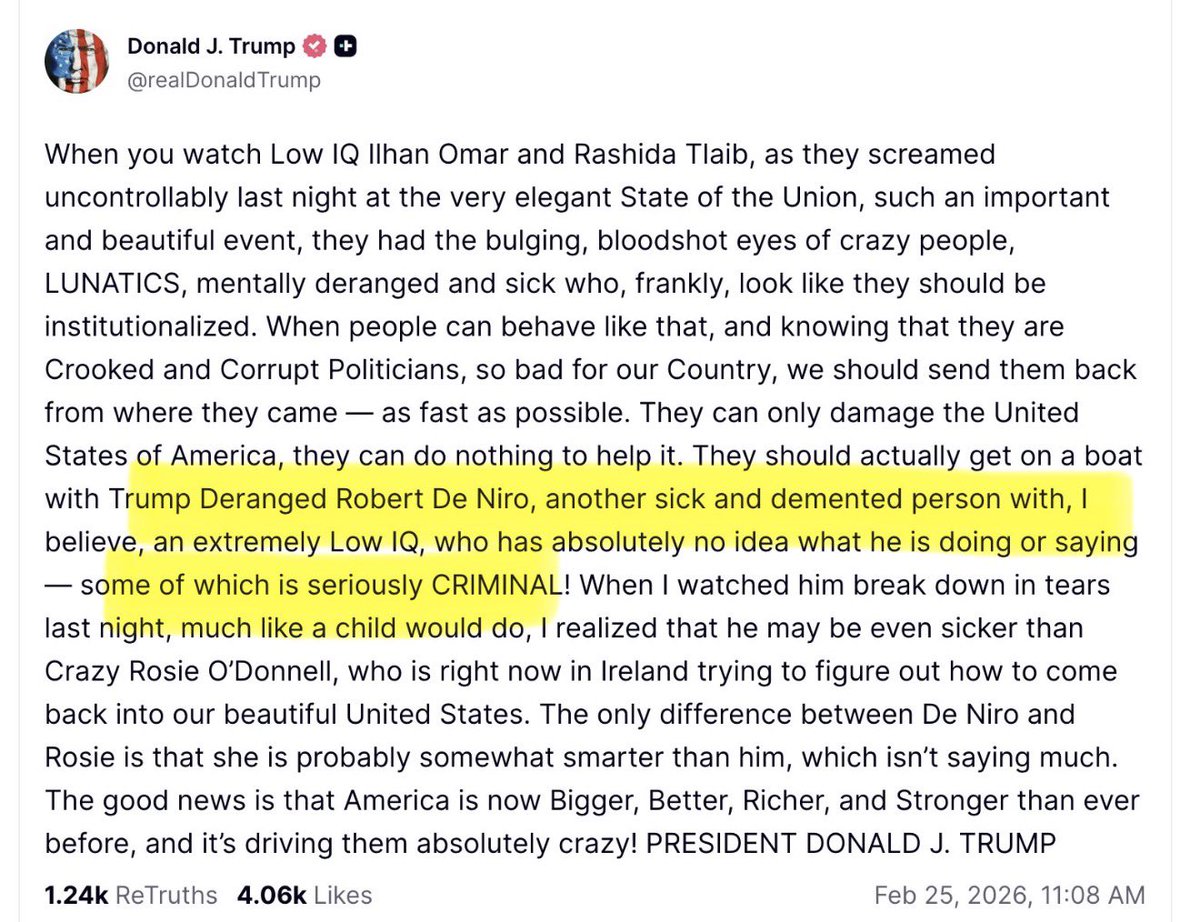
BREAKING: Trump calls Robert De Niro a “criminal” because he spoke out against Trump.
These are words that dictators of the past have used against those who spoke out against their authoritarian tendencies, including Hitler.
And they wonder why people compare them to Hitler.