this is so embarrassing. here, spain's ruling party (the socialist party, PSOE) is boasting that the social security reserve fund ("la hucha de las pensiones") has grown from €5bn in 2018 to €20bn in 2026. that would be good news if it wasn't for the fact that the pension system has been running a deficit since 2010, so every euro that goes into the fund is a euro the state has to cover with taxes or debt!
the fund was established in the late 1990s with the idea of storing the system's surpluses in good years to then draw on them when contributions fall short in bad years. it peaked at around €67bn in 2011 (about €85bn in today's euros, or 6.2% of gdp). then the crisis hit, the system went into deficit, and between 2012 and 2019 governments used the fund to pay pensions, which is (surprise) precisely what it was designed for. so this is what the picture is telling you: on the left, the popular party (PP), which left office in 2018 having drawn down a large part of the fund. on the right, the PSOE, taking credit for having refilled it. the problem is that today the size of the fund tells you nothing about the health of the system, and selling its recent growth as an achievement only works if you assume people are stupid
spain has a contributory, fully pay-as-you-go pension system: the social contributions of today's workers pay for the pensions of today's retirees, and what you pay in is not saved for you anywhere. since 2010 the system has run a contributory deficit, meaning the contributions being paid into the system are not enough to pay the pensions of current retirees. the exact size of this deficit depends on how you measure it (what counts as contributory revenue and spending is a bit of a technical discussion), but roughly speaking, contributions cover about three quarters of contributory spending (which is mostly pensions). the remaining quarter is the deficit: more than €60bn a year, around 3.8% of gdp, covered mostly with transfers and loans from the state, that is, with general taxes and debt. social security already owes the state more than €135bn
so where the hell does the recovery of the reserve fund come from? since 2023 workers have been paying an extra social contribution, the so-called intergenerational equity mechanism (MEI, after its spanish initials). it is an earmarked contribution that generates no pension rights (that is, paying it does not add a single euro to your future old-age pension). by law, its revenue can only go straight into the reserve fund, which cannot use it to pay pensions before 2033
now, we've already established that the system runs a contributory deficit, so every year it needs transfers and loans from the state just to pay pensions. do you see how stupid this is? if the system is running a deficit, putting the MEI money into the reserve fund is like having credit card debt and, when some extra money comes in, putting it in a savings account instead of paying down the card. meanwhile, you keep putting your bills on the card, the debt keeps growing, and you go around showing everyone your savings balance. that is pretty much what is happening: since the end of 2022 the fund has grown by about €12bn, while social security's debt to the state has grown by about €30bn. and it gets more absurd, because the fund invests almost all of its money in spanish government bonds (in other words, the state is lending money to itself)
anyone who can do basic maths can see this isn't saving under any reasonable definition of the term. the system can't pay the pension bill without the state bailing it out every year, and the governing party's big idea is to celebrate that it has taxed workers to lend money to itself. it is honestly sad that this is the level of spanish politics
En el comité federal de 2016, el equipo de Sánchez metió votos falsos en la urna. Luego, votaron a mano alzada y lo echaron. Está todo documentado.
Y Sánchez manipuló el comité de su tesis doctoral para lo que saliera en el acta no fuera lo que decidió el tribunal.
Y han puesto todos los medios de Exteriores para tramitar los expedientes de la ley de nietos (testimonio directo de un funcionario encargado). Y eso no es inocente, ni ingenuo.
📍Barcelona | “Para que un inmigrante tenga una contribución neta positiva al Estado debe cobrar 45.150€ anuales ininterrumpidamente".
Miguel Rovira en la presentación del informe "La inmigración y su impacto económico negativo en el estado de bienestar".
Lyn Alden: "The best product Coca-Cola ever sold was their bonds, not their Coke."
Coca-Cola borrows at 2-3% while the money supply grows at 7%. They then use that cheap debt to buy scarcer assets.
Governments do it. Corporations do it. Wealthy individuals do it. Everyone is shorting the currency...
Except the people at the bottom.
They can't access cheap debt and "are getting the full damage of the inflation" on their wages and savings.
FT @LynAldenContact@PeterMcCormack.
Our system is designed to protect the Government from ever defaulting.
What this means is that we sacrifice the “purchasing power” of the Currency, in order to protect the “credit worthiness” of Treasuries.
https://t.co/Hl5dxHkGwG
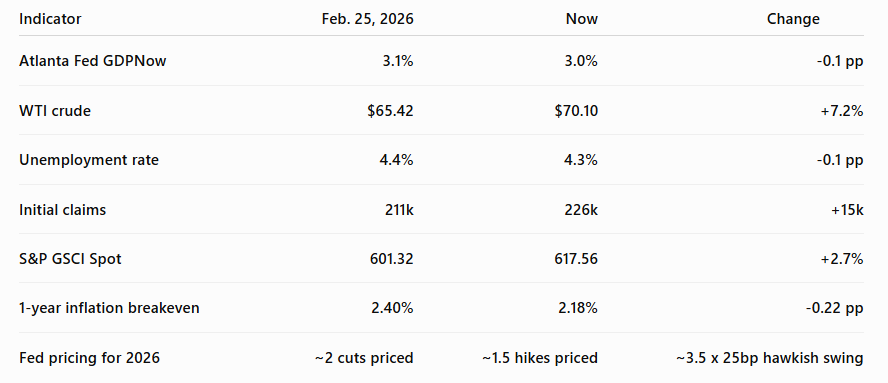
Comparing now to pre-war, there is no reason for the Fed to hike unless Warsh just wants to take a stand to reestablish Fed credibility. I know he says he will but I don't believe him. I'm long 2s and call spreads in 2s. Not investment advice. If you get through July FOMC with no hike, you're probably making money.
No existe correlación entre recortes de tipos de FED (verde) y éxodo de saldos FMM (azul) hacia activos de riesgo. Los saldos de efectivo solo crecen, sin importar el nivel de tipos FED.
En conclusión: saldos efectivo no son pólvora seca lista para impulsar precios de activos.
For years now, the actual rate change announced at every FOMC meeting did not matter. By the time the meeting occurred, the move was priced into the SOFR curve weeks in advance. The only exception to this was in September 2024 when Powell surprised the rates market and cut 50bps. This was one of the only times where we went into a meeting with 50/50 odds priced into the market (either 25bps or 50bps). This meant that the market reaction was largely driven by the change in pricing once it was announced, not the future reaction function.
Before the ZIRP era, this was the common way to do things. However, under Yellen and Powell, and pioneered by Bernanke, the Fed mandate was to never surprise the rates market and ensure their move gets priced into markets well-ahead of time.
This is why for so many years casual Fed observers would be confused on days when for example we would cut rates and markets would sell off, or we held rates steady and rallied. The market reaction function was entirely dependent on forward guidance and forward expectations, not the announced change that day.
We are now going to enter a regime where what the Fed actually decides to do each meeting will be the marginal market driver again and that is by design.
In practice, I expect the next few meetings to be priced at 50/50 odds moving forward and that's by design. It is now up to rates speculators to analyze the economic data and come to their own analysis on where rates should be, the Fed will not be spelling it out for us any longer.
Overall, I think this is a good thing. Forward guidance was a tool from the ZIRP era pioneered by Bernanke as a way to ease monetary policy without going into negative rates. We are no longer in a ZIRP world and it was time to change this.
On net, expect higher rate volatility, more sensitivity to changes in SOFR in the economy, less smoothening of business cycles, and a return to a more pure Taylor rule-like reaction function.
This is a big shift and in my opinion a welcome one, despite my podcast being named Forward Guidance!
Propongo un 20% de IRPF para todo el mundo y exención total del Impuesto sobre el ahorro. Reducimos el estado y recortamos el gasto hasta igualar el déficit al 0% y cadena perpetua para aquellos políticos que generen inflación u otro tipo de robos explícitos e implícitos.
I want it. But I don't like it.
New article on Panoptica.
My phone, my adversary.
This isn’t another ‘smartphones are bad’ article … I mean, they are and it is … but living in the world-as-it-is means minimizing our smartphone ‘dark flow states’, not eliminating them. This is my reckoning with the relationship, and practical strategies for managing it.
https://t.co/ORmNEnB0QJ
@EpsilonTheory
@LynAldenContact@BitcoinMagazine "To the extent that governments are threatened by this, they can’t just impose restrictions on thousands of banks anymore; they have to impose restrictions on millions of end-users and developers."
@LynAldenContact@BitcoinMagazine "Thus, most people didn’t see any direct threats to their financial liberty. After Bitcoin, people can run open-source code, can transact without permission, and can hold liquid savings in their own custody."
Este post de apoyo a @Jongonzlz está escrito y publicado conjuntamente con @lugaricano.
El sistema público de pensiones contributivas en España se encuentra en una situación muy complicada.
El sistema actual ofrece a los cotizantes una rentabilidad real implícita anual del 3,63 %. Dado el crecimiento de los cotizantes y de la productividad en España, esta tasa está al menos dos puntos porcentuales por encima de la que garantiza la sostenibilidad del sistema a largo plazo. De manera más sencilla: el valor presente descontado de las pensiones contributivas es aproximadamente un 60 % mayor que el valor presente descontado de las cotizaciones. Los jubilados contributivos en España están recibiendo mucho más de lo que pagaron.
Esta rentabilidad excesiva ha generado un problema fundamental: un déficit del sistema contributivo de unos 61.000 millones de euros (el de verdad, no el de las cuentas del Gran Capitán que incluyen las transferencias del Estado) y que no deja de crecer. Este déficit genera presiones sobre las cuentas públicas que limitan la capacidad de las administraciones públicas para implementar muchas políticas necesarias, desde la educación hasta la infraestructura. Y desde el punto de vista de la equidad intergeneracional, esta rentabilidad excesiva nos ha colocado en la paradójica situación de que las personas de 65 a 85 años tienen la renta disponible más alta de todos los grupos de edad en España.
El sistema necesita una reforma profunda. Por ejemplo, es clave reintroducir un factor de sostenibilidad en el valor de las pensiones que considere el crecimiento de los cotizantes, la productividad y la esperanza de vida. Muchas economías avanzadas han introducido estos factores e incluso España avanzó en esa dirección hasta la reforma Escrivá de 2021-2023.
Jon González, @Jongonzlz, de manera casi solitaria, ha acometido una labor impagable de documentar esta situación (y otros temas clave de nuestra economía), y ha conseguido poner a la sociedad frente al espejo de la insostenibilidad de la situación actual.
Desgraciadamente, el sistema político no tiene ninguna gana de enfrentarse a este problema. La edad mediana del votante español está en torno a los 51 años. Uno de cada tres electores tiene 60 años o más; uno de cada cuatro ha cumplido 65 años. Si se suman a los 15 millones de inactivos en edad de votar los casi 3 millones de empleados públicos, el resultado es que más de la mitad del censo electoral residente en España vive de una transferencia o de una nómina pagada con impuestos. La aritmética básica de cualquier elección en España descansa, por tanto, sobre un electorado en el que la minoría la constituyen los asalariados del sector privado en edad activa.
Pedir a un partido con vocación de gobierno que recorte la rentabilidad implícita de las pensiones contributivas es pedirle que confronte directamente a su votante mediano. Ningún sistema político hace eso voluntariamente y el español no es la excepción.
Por eso, en lugar de hablar de números, se busca descalificar al mensajero. Desafortunadamente, las narrativas maniqueas de buenos y malos—si eres bueno, prefieres pensiones altas; si no eres malo o estás a sueldo de los malos, tienen éxito en España porque nuestra conversación nacional se centra siempre en la “justicia” o la “moralidad” y nunca en los números.
Es normal: somos un país con poca tradición de análisis riguroso y, menos aún, de análisis basado en los números. “Mi abuela merece una pensión más alta” siempre es más fácil de explicar que “la rentabilidad real implícita del sistema está por encima de lo que nos podemos permitir”, y, además, le coloca a uno en el “lado bueno”: el de los que quieren dar más dinero, no menos, como los malvados economistas.
Pero lo realmente preocupante no es que se intente descalificar al mensajero en lugar de analizar sus argumentos. Lo que se busca es poner en riesgo su situación profesional. Ante las órdenes de la Moncloa, cualquier trabajo en España es precario. Nosotros mismos lo experimentamos en carne propia cuando, en 2012, se nos despidió de FEDEA, una fundación con la que colaborábamos, por orden directa y explícita de Moncloa.
Ya no es una cuestión de si uno está de acuerdo o no con Jon. Es algo mucho más importante. ¿Se puede analizar la realidad económica de España sin que las jaurías mediáticas busquen tu “cancelación” profesional?
Es este el momento de decir las cosas claras y mostrar nuestro apoyo absoluto y total a Jon. Por eso hemos tomado la decisión inusual de publicar este post simultáneamente.
Jon, te agradecemos profundamente lo que haces.
@YouTube - Money supply creation ~7% yoy
- Inflation metrics count also the increase in efficiency in production. (IR = money supply creation - increase in efficiency)
- be short the currency via owning scarce assets/assets that do not increase their efficiency/output