Two economists just published a mathematical proof that AI will destroy the economy.
Not might. Not could. Will — if nothing changes.
The paper is called "The AI Layoff Trap." Published March 2, 2026. Wharton School, University of Pennsylvania. Boston University. Peer reviewed. Mathematically modeled.
The conclusion is one sentence.
"At the limit, firms automate their way to boundless productivity and zero demand."
An economy that produces everything. And sells it to nobody.
Here is how you get there.
A company fires 500 workers and replaces them with AI. A competitor fires 700 to keep up. Another fires 1,000. Every company is behaving rationally. Every company is following the incentives correctly. And every company is building a trap for itself.
Because the workers who were fired were also customers.
When they lose their jobs faster than the economy can absorb them, they stop spending. Consumer demand falls. Companies respond by cutting costs — which means automating more workers — which means less spending — which means more falling demand — which means more automation.
The loop has no natural exit.
The researchers tested every proposed solution. Universal basic income. Capital income taxes. Worker equity participation. Upskilling programs. Corporate coordination agreements.
Every single one failed in the model.
The only intervention that worked: a Pigouvian automation tax — a per-task levy charged every time a company replaces a human with AI, forcing them to price in the demand they are destroying before they pull the trigger.
No government has implemented this. No major economy is seriously discussing it.
Meanwhile the numbers are already tracking the curve. 100,000 tech workers laid off in 2025. 92,000 more in the first months of 2026. Jack Dorsey fired half of Block's workforce and said publicly: "Within the next year, the majority of companies will reach the same conclusion."
Nobody is doing anything wrong. Companies are following their incentives perfectly. That is exactly the problem.
Rational behavior. At scale. Simultaneously. With no mechanism to stop it.
Two economists built the math. The math leads to one place.
Source: Falk & Tsoukalas · Wharton School + Boston University ·
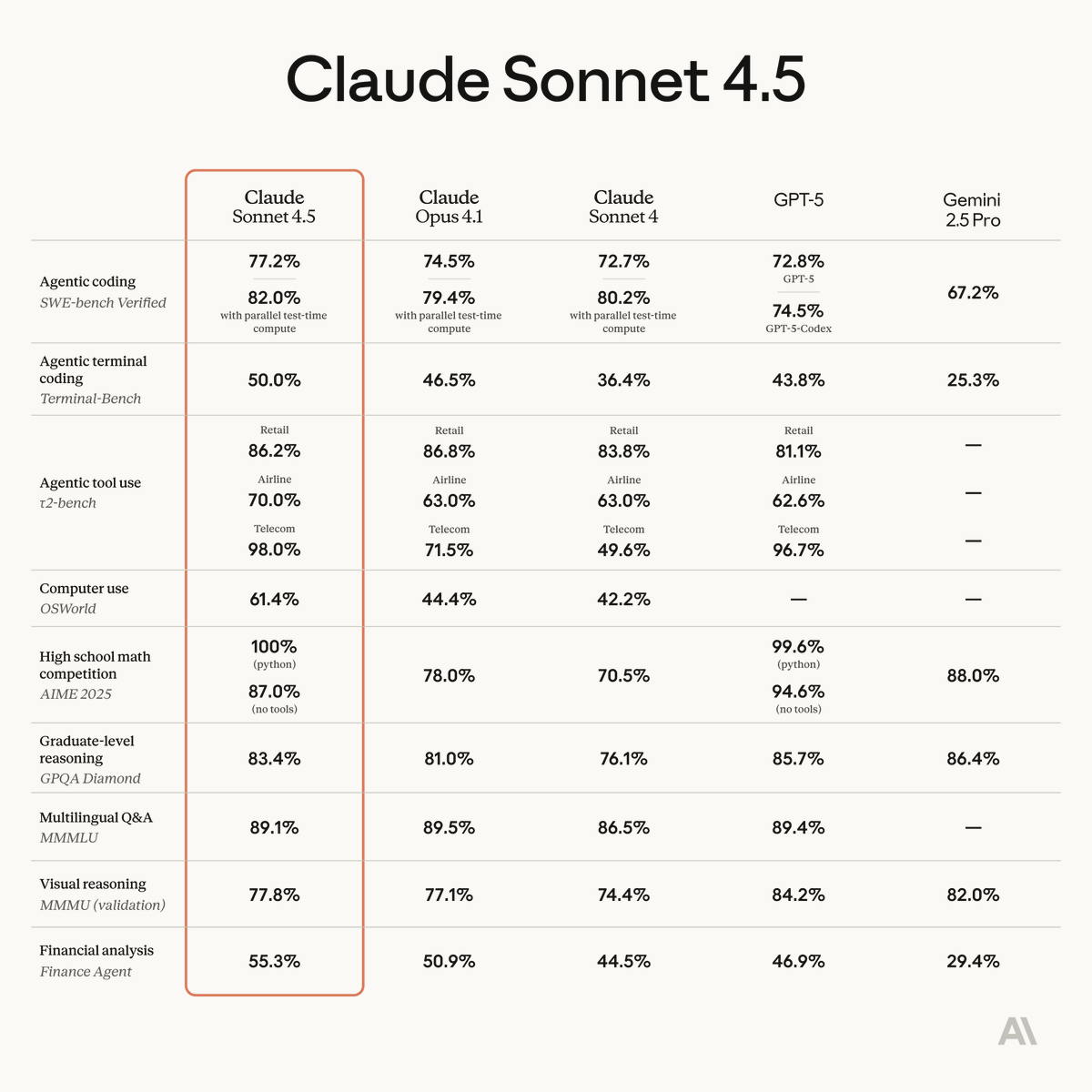
Introducing Claude Sonnet 4.5—the best coding model in the world.
It's the strongest model for building complex agents. It's the best model at using computers. And it shows substantial gains on tests of reasoning and math.
PostgreSQL added JSON support in 2012 when everyone said relational databases were dead. They called it the wrong move. NoSQL was the future. Document databases would eat everything.
Twelve years later, PostgreSQL's JSONB runs circles around most document databases. It's 15x faster than their original JSON implementation and often outperforms MongoDB on complex queries.
This wasn't an accident. While MongoDB optimized for writes and horizontal scaling, PostgreSQL focused on something deeper. They understood that most applications eventually need both structured and unstructured data. They need joins. They need ACID guarantees. They need the ability to evolve from loose schemas to strict ones as products mature.
JSONB stores documents in decomposed binary format with hierarchical type metadata and offset arrays for direct navigation. This eliminates parsing overhead on every operation. GIN indexes use two operator classes: jsonb_ops creates independent entries for each key-value pair while jsonb_path_ops uses hash-based entries optimized for containment queries. These indexes enable sub-millisecond queries on multi-gigabyte datasets.
Tom Lane's selectivity estimation fixes in PostgreSQL 13 solved cases where containment operations defaulted to 0.1% selectivity, causing 2000x performance degradation. PostgreSQL 14's LZ4 compression delivers 5x faster decompression than pglz for TOAST operations. PostgreSQL 16 added SIMD optimizations for JSON string processing with 300% bulk loading improvements.
PostgreSQL didn't abandon relational principles to chase the NoSQL trend. They extended them. JSONB participates fully in the cost-based optimizer. JSONPath expressions compile to internal path trees. Containment operators leverage B-tree and hash join algorithms. You get document flexibility with 40 years of query optimization research.
Every database vendor eventually copied this approach. SQL Server added JSON support but stores it as NVARCHAR without native indexing. Oracle added OSON format but lacks the open ecosystem. Even MongoDB added multi-document ACID transactions in 2018, essentially admitting that applications need relational guarantees.
Sometimes the best innovation comes from extending proven systems rather than starting over. PostgreSQL chose evolution over revolution and proved that hybrid approaches can outperform specialized solutions when engineering depth meets architectural wisdom.
OpenAI Charges by the Minute, So Make the Minutes Shorter
https://t.co/kOvLEffzBw
- aumentar la velocidad de la llamada (2x - 3x)
- recortar silencios
con la consecuencia de un ahorro del 20 al 30% de costos.
Introducing MedGemma, our most capable open model for multimodal medical text and image comprehension. 🩻
MedGemma is available now as part of Health AI Developer Foundations → https://t.co/GfJkvBHjTF
BREAKING! Guido van Rossum, the creator of Python, has officially reinstated himself as Python’s Benevolent Dictator for Life - but this time, he’s bringing some new quirks with him. 👀
Stay tuned for our Python documentary this summer! 🐍🎬
Feat @gvanrossum , Barry Warsaw, @mariatta and Brett Cannon.
"Learn More" is not a CTA.
Neither is:
• "Get Started"
• "Discover More"
• "See How It Works"
Strong CTAs align with user intent, brand narrative and sell the next step.
Mal copywriting:
- Este es mi producto
- Esto es lo que hace
- Esto lo hace bueno
Buen copywriting:
- Este es tu problema
- Por esto debes resolverlo
- Así es como yo lo he resuelto
I still remember the exact day.
March 2023.
I had $1,150 in my bank account and just got fired from my job.
And instead of being smart about it… I went on a shopping spree.
By May I had $100 left.
I was lucky to be living at my parents' house—no rent, no groceries to worry about. But I was broke. Living paycheck to paycheck.
And the first rule of money is: "Spend less than you make."
I was doing the exact opposite.
Every single day, I was drowning in anxiety about money. About my future. About whether I’d ever make it.
I used to think life was unfair.
That people born rich had everything—access, networks, resources.
But then I realized something:
How would I be tested if everything was given to me?
If I never struggled, how would I develop resilience, courage, patience?
The worst thing that can happen to a person is to have everything without putting in the work.
Because when you don’t struggle, you become entitled, lazy, arrogant, complacent.
And that’s the real loss.
That’s when I made myself a promise:
I wasn’t going to keep acting like this.
Not because of anyone else.
Because I didn’t respect myself when I did.
So I did the only thing I could—I started posting on X.
I had no clue what I was doing. No strategy. Just blind consistency.
Then, in July 2023, I got my first client.
And I never looked back.
At first, my only goal was:
• Never work a job again.
Then it became:
• Buy things without checking the price tag.
Then:
• Retire my parents.
And now:
• Pursue greatness. Become a person of character. Obsess over learning more than earning.
I love this quote from Jensen Huang:
"Unfortunately, resilience matters in success. I don’t know how to teach it to you... except for I hope suffering happens to you."
Because suffering is good.
It teaches you what money can’t.
It builds virtues that can’t be taken away.
And if one day the entire world crumbles and you lose everything—you’ll still have those virtues.
And that means you can build it all again.
If you’re in a tough spot right now, I feel you.
I know the stress. The uncertainty. The fear of failing.
But keep pushing forward.