My Vision for a Productive and Prosperous Nigeria
Today, being the 1st of July, 2026, I wish to humbly recall that when I decided to contest for the office of President of Nigeria, I pledged to place Nigeria on the path of unity and national transformation. Now, as the Nigeria Democratic Congress (NDC) candidate, I will, in the coming weeks and months, provide insights into the roadmap that I am confident will help curb abuse in government, halt the decline in the quality of life of Nigerians at all levels, and usher in an era of unity, peace, sustained progress, and prosperity.
This vision is anchored on a commitment to unity, inclusion, social justice, equity, and the freedom of every citizen to pursue lawful dreams.
Central to this proposed roadmap are significant reforms in education and healthcare, which are at the core of human capital development.
Robust human capital is indispensable infrastructure for national progress. It serves as the fundamental capital upon which daily life, economic expansion, and the delivery of essential public services depend.
These are foundational areas that we must reform with energy and determination if we are to reap the demographic dividend of our youthful population.
From the outset of my presidency, we will establish a task force dedicated to drastically reducing the menace of out-of-school children. We will place greater emphasis on Technical and Vocational Education and Training (TVET) to support our drive for massive industrialisation, anchored on our agricultural endowments and value addition across value chains organised around industrial parks to be located in development zones across the geopolitical regions of the country.
Funding and improving the equipment of TVET institutions, through partnerships among government, the private sector, and social entrepreneurs such as faith-based educators, will facilitate apprenticeship opportunities in the private sector, similar to the German dual education system.
The situation in which unemployment remains high while Nigerian entrepreneurs establish businesses elsewhere because skilled labour is scarce must be confronted decisively. Doing so is essential for the common good and for facilitating our transition from a consumption-driven economy to a production-driven one.
Character and civic education, emphasising the values that foster trust - an essential ingredient for enterprise and leadership - as well as shared national values, will receive significant attention within the tripartite approach to governance that we propose.
A New Nigeria is POssible. -PO
SOWORE BEING SENT TO PRISON: A DANGEROUS REGRESSION FOR OUR DEMOCRACY
I have received, with deep concern, the news of the court’s remand of citizen activist Omoyele Sowore in Kuje Prison.
While the judiciary remains the ultimate arbiter of justice, we must consistently guard against any trend that gives the appearance of state institutions being weaponised to systematically stifle dissent, muzzle the press, or shrink the legitimate space for civic engagement in Nigeria.
A thriving democracy does not survive on the silencing of opposing voices; rather, it is anchored on the robust protection of fundamental human rights, most notably the freedoms of expression and peaceful assembly, as enshrined in our Constitution. Moreover, our society is already strained by insecurity and biting economic hardship; therefore, deliberate steps should be taken, even by the courts, to avoid inflaming the situation.
When we begin to treat citizen critics, activists, and journalists as threats to state survival rather than as partners in building accountability, we signal a dangerous slide toward authoritarianism. Our current challenges, ranging from economic strain to internal security vulnerabilities, require inclusive dialogue and cohesive nation-building, not the incarceration of those who demand a better society.
I urge the relevant authorities to ensure that the rule of law is strictly adhered to, that Mr. Sowore’s constitutional rights are fully protected, and that our security and judicial institutions are used solely for the impartial administration of justice. We cannot build a New Nigeria if we continue to undermine the very democratic structures meant to protect us all. -PO
Donald Trump faces the press everyday & answers questions from America.
Tinubu has never spoken to Nigerians, even in the most difficult times.
But Peter Obi is your problem.
Accountable Borrowing: The South Africa Example.
I have consistently maintained that borrowing, in itself, is not a bad thing. Every nation borrows. The critical issue is not the act of borrowing, but what the borrowed funds are used for and whether citizens can clearly see and measure the impact of such borrowing in their daily lives.
There is a lot to learn in the open and transparent manner in which South Africa handled its recently secured a $1 billion loan from the New Development Bank, with a clearly defined purpose. Publicly announcing the targeted purpose of the loan for all to know and monitor, upgrading water supply systems, modernising sanitation infrastructure, improving electricity distribution, and strengthening waste management services across eight major metropolitan cities, including Johannesburg, Cape Town, and Durban.
This is indeed what accountable borrowing should look like; the purpose is clear, the projects are identifiable, and the expected benefits to citizens are measurable. Such investments directly improve living conditions, enhance productivity, and stimulate economic growth.
In Nigeria, however, the opposite is the case: public debt has risen dramatically under the current administration, and its deployment is shrouded in secrecy from the people who will indeed pay back the loan. Today, our total public debt has increased from about ₦87 trillion in 2023 to nearly ₦200 trillion.
Yet, despite this unprecedented accumulation of debt, Nigerians are often left without a clear and detailed account of how these borrowings are being deployed to improve critical sectors such as education, healthcare, power, security, and infrastructure.
Borrowing must never become an end in itself. Every loan obtained in the name of the Nigerian people must be tied to specific, productive investments capable of generating economic value, creating jobs, reducing poverty, and improving the welfare of citizens.
Good governance demands transparency and accountability. The government must be able to clearly explain what was borrowed, where it was invested, and what measurable outcomes have been achieved. The ordinary Nigerian should be able to see and feel the benefits of every debt incurred on their behalf.
At a time when millions of Nigerians are struggling with rising costs of living, unemployment, insecurity, and declining purchasing power, fiscal discipline and prudent management of public resources are no longer optional; they are imperative.
Every borrowing decision should answer one simple question: How does this improve the life of the ordinary Nigerian? If that question cannot be convincingly answered, then we risk merely transferring today's burdens to future generations.
A New Nigeria is POssible. - PO
BRICS bank approves $1 billion lifeline for South Africa’s struggling cities | Business Insider Africa https://t.co/VN0C0Xo8zp
Americans see you as a black African first before Christianity.
Arabs see you as a black African first before Islam.
But Mutiu from Iwo said he’s Muslim first before being a Yoruba man.
The next President of Nigeria must cancel Sharia law in the whole of Nigeria and it should be enshrined in the constitution that no future government has the right to implement it.
We must put an end to this barbaric behavior once and for all.
Building a Healthier Nigeria Through Stronger Healthcare Systems
As part of our desire and commitment to building a healthier Nigeria, I met with some healthcare professionals and experts in the United States on Friday, June 5, 2026. The meeting was essentially to deepen my understanding of how successful health insurance systems deliver improved healthcare, especially in the areas of primary and emergency care.
One of our key health objectives remains unchanged: to expand health insurance coverage, strengthen primary healthcare across our electoral wards, train more healthcare workers, and make quality healthcare accessible and affordable for all Nigerians.
A New Nigeria must be a healthier Nigeria.
A New Nigeria is possible. -PO
When I was Muslim, I would argue & say we had the same prophets as Christians.
But this one broke me:
Surah 17:101: Allah gave Moses 9 clear signs.
I knew the list. The staff. The shining hand. The drought. The flood. The locusts. The lice. The frogs. The blood.
I held onto those 9 signs like proof I had the real story.
But bro, you know what shook me?
There’s a night missing.
After all nine signs, right before Israel walks out of Egypt, something happens that the Quran goes completely silent on.
A lamb is slaughtered.
Its blood painted on the doorposts.
And death passes over every house covered by that blood.
The Passover.
I grew up hearing the whole Exodus story. But nobody ever told me about the blood on the door.
Islam just skips it.
And here’s what wrecked me.
The Bible, the book I was taught was corrupted, mentions the Passover over 70 times.
Exodus. Leviticus. Numbers. Deuteronomy. The Psalms. The Prophets. The Gospels. Paul.
70 times.
So I had to ask myself the honest question:
If men corrupted this book, why would they obsess over the same story for 1500 years? Across dozens of authors who never met?
You don’t forge a document 70 times.
That’s just not corruption.
That to me is preservation.
And then I read the line that finished me off.
1 Corinthians 5:7.
“Christ our Passover lamb has been sacrificed.”
That’s when it hit me.
The whole story was never just about Moses.
It was always pointing to a King.
The final lamb. Whose blood, when applied to your life, makes death pass over you.
Forever.
The Quran gave me 9 signs but hid the one night that explains why any of them happened.
Because the moment a Muslim understands the Passover…
he’s one step away from the cross.
The abduction of the Chibok girls in 2014 triggered a global movement. One school abduction was enough to unite Nigerians, attract international attention, and place enormous pressure on the government through the #BringBackOurGirls campaign.
Yet, what has happened since then should trouble every Nigerian.
Under President Buhari's eight years in office, Nigeria witnessed about ten school abductions. Under President Tinubu's administration, in just three years, we have already recorded over ten school abductions.
Despite these repeated tragedies, there has been neither sustained national outrage nor significant international attention comparable to what followed Chibok.
This raises an important question: have we become so accustomed to insecurity that what once shocked our national conscience is now treated as normal?
At a time when millions of Nigerians are grappling with insecurity, poverty, and hardship, it is deeply troubling that those in power appear more focused on political calculations and preparations for the next election than on addressing the urgent challenges confronting our people.
It is, therefore, no surprise that some observers have labelled us a "Now Disgraced Nation". While we do not agree with any attempt to define our great country by its present difficulties, we must acknowledge that persistent insecurity, economic hardship, and leadership failure have damaged our reputation and standing among nations.
The answer is not denial, propaganda, or political distraction. The answer is leadership that is competent, compassionate, accountable, and genuinely committed to the welfare and security of the Nigerian people.
The Nigerian youth must not become indifferent. We must all refuse to normalise failure.
Young Nigerians - Take back your country!
A New Nigeria is Possible. -PO
Dear Young Nigerians,
One lesson from the 2023 elections, particularly in Lagos, should never be forgotten.
In the period following the presidential election and leading up to the governorship election, we witnessed a troubling shift in public discourse. Conversations that should have focused on competence, governance, development, and the future of our nation were gradually diverted towards tribal sentiments, ethnic divisions, and unnecessary suspicion among citizens.
Many sincere and well-meaning Nigerians participated in these conversations without realising that they were being drawn into narratives carefully designed by others.
Throughout history, whenever politicians find it difficult to compete on ideas, performance, character, or vision, some resort to exploiting the fault lines of ethnicity, religion, and identity. Their calculation is simple: a divided people are easier to manipulate than a united people.
Today, I see similar efforts emerging again, sometimes in more subtle and sophisticated ways. Narratives are planted, amplified, and circulated, often by individuals who genuinely believe they are defending a worthy cause, without recognizing the broader agenda behind such campaigns.
Let me state clearly that Pastor Enoch Adeboye remains one of the foremost fathers of faith in our nation. For decades, he has consistently preached the virtues of peace, prayer, love, reconciliation, and national unity. Even when faced with provocation, his response has always reflected humility, restraint, wisdom, and grace.
At 84 years of age, it would be unfair for young and able-bodied Nigerians to transfer to him responsibilities that properly belong to them. The task of building a better Nigeria rests primarily on the shoulders of the younger generation. It is their duty to lead the conversations, champion the reforms, and drive the positive change our nation urgently requires.
We must be careful not to become instruments in the hands of those who secretly nurture division while publicly preaching unity. In most cases, their target is not the individual being attacked; instead, it is the person who is attacking. Their real objective is to weaken the bonds that hold us together as one people and one nation.
I therefore urge all young Nigerians: do not allow anyone to recruit you into hatred. Do not allow anyone to weaponise your ethnicity, your faith, or your admiration for respected leaders.
Question every narrative. Verify every claim. Follow the facts. Resist manipulation.
The Nigeria of our dreams can only be built by citizens who refuse to be divided, who choose unity over hatred, and who place our collective future above narrow interests.
A New Nigeria is POssible. -PO
Bilahilazi you are lying,and one thing here is thank you for mentioning Peter Obi's name all the time our people will get to know him more and more and more and The most beautiful thing about this moment is that Notherners across the board are genuinely eager to know the real Peter Obi who he truly is, what he has done, and why so many established politicians fear him. One thing I continually thank God for is up till now, no one has been able to produce a single credible allegation that can make our people hate him or sees him as an enemy of the north no case of corruption or underperformance against him from his time in office. Not one proven case. This clean record has become our greatest strength in presenting him to the people no baggage, no scandals, Just competence, integrity, one little advice Mustafa as an aide to the governor of Katsina state you should have put more effort in defending your clueless, antihuman and failed government just day's back a retired major general of the Nigerian army was abducted in your soil because of the incompetence of your government but to you that is not an issue what matters to you most is how can Peter Obi win the election in northern Nigeria incompetent people kawaii.
We have kids in captivity under the rain and sun. It took weeks before the government started talking about it.
We shouldn't give too much audience to that of Adelabu and his family.
Seeing Nigerians wake up and stand for goodness, for the right to live, to not be kidnapped, is a beautiful thing. Continue to wake up Nigeria. Only you will save yourselves from this evil.
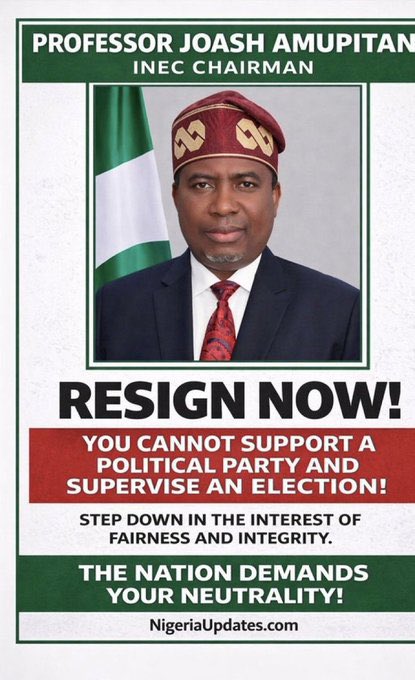
Why should the President appoint the INEC Chairman?
This is fundamentally wrong.
It makes the Commission dependent on the very person they’re supposed to hold accountable and makes credible elections impossible.
The President should NOT be appointing the INEC Chairman.
As long as INEC depends on the President, credible elections in Nigeria are a fantasy.