Haru-4B just hit #1 on Hugging Face’s trending models list across all categories! 🚀
Thank you all for the incredible support!
Model page→https://t.co/Jdw85ICYFl
Bye bye looped reasoning… and hello Energy-Based Reasoning⚡!
Introducing Energy-Based Reasoners
TLDR:
- EBRs use 345x less inference compute and 2.6x fewer training FLOPs than the best baselines
- EBRs are 7x-43x more sample-efficient than the best looped baselines at inference
- EBRs achieve 99.9% on Sudoku-Extreme and near 100% accuracy on multi-solution benchmarks
🧵Thread
Apple just released FastFrames
Video Generation at Interactive Latency
FastFrames-L (14B): https://t.co/HXdhcV6V7B
FastFrames-S (1.3B): https://t.co/nWOrxxsJ39
Reasoning models can now drive robots. But the robot sits still while the model thinks.
SpecPilot now speeds up agentic robotics. On PEAR (Qwen3.8-27B as a robot policy), the same LIBERO task finishes in 49 s instead of 189 s.
3.84× faster task completion
71 → 241 tok/s decode
No training 🤖
LLM pretraining has run on single-epoch text, bits per byte and iso-FLOP curves for years. visual generation still memorizes ImageNet for tens to hundreds of epochs and pushes FID down with CFG, with no strong signal those tricks transfer to real text-to-image.
new blog: 🎨 scaling generative models on GPIC, 100M permissive text-image pairs.
training pixel-space JiT from 3.6e18 to 2.3e20 FLOPs:
1) held-out loss is our main metric, and compute-optimal TPP sits at about 50 image tokens per image parameter
2) EMA is not necessary: a proper learning-rate schedule beats EMA on held-out loss at every budget by 0.4% to 1.0%
3) we use CFG = 1 (only the conditional branch) for every result, and call on everyone to drop CFG: it saves compute and leaves no room to hack the metric
all code, configs and sweep data are open 🧵
blog: https://t.co/WKMuG0Z3VW
95–99% of the gradient norm is lost at the LM head during backprop.
Authors show the softmax bottleneck (D≪V) hurts optimization, not just expressivity: raising head rank 32→4096 made 2B-model pretraining converge 16× faster.
https://t.co/oGwL0GSIWM
A finer touch for humanoid robots. 🤖
At #CoRL2026, NVIDIA is introducing GR00T 2, an open world action model for humanoids, alongside new open industrial benchmarks from @RLWRLD_ai and @UCBerkeley built on Isaac Lab-Arena.
Explore how NVIDIA’s open world action models, scalable simulation tools and agentic workflows help researchers train, test and refine robot skills, from connecting cables to assembling small components.
Discover more ➡️ https://t.co/spzxPurj6y
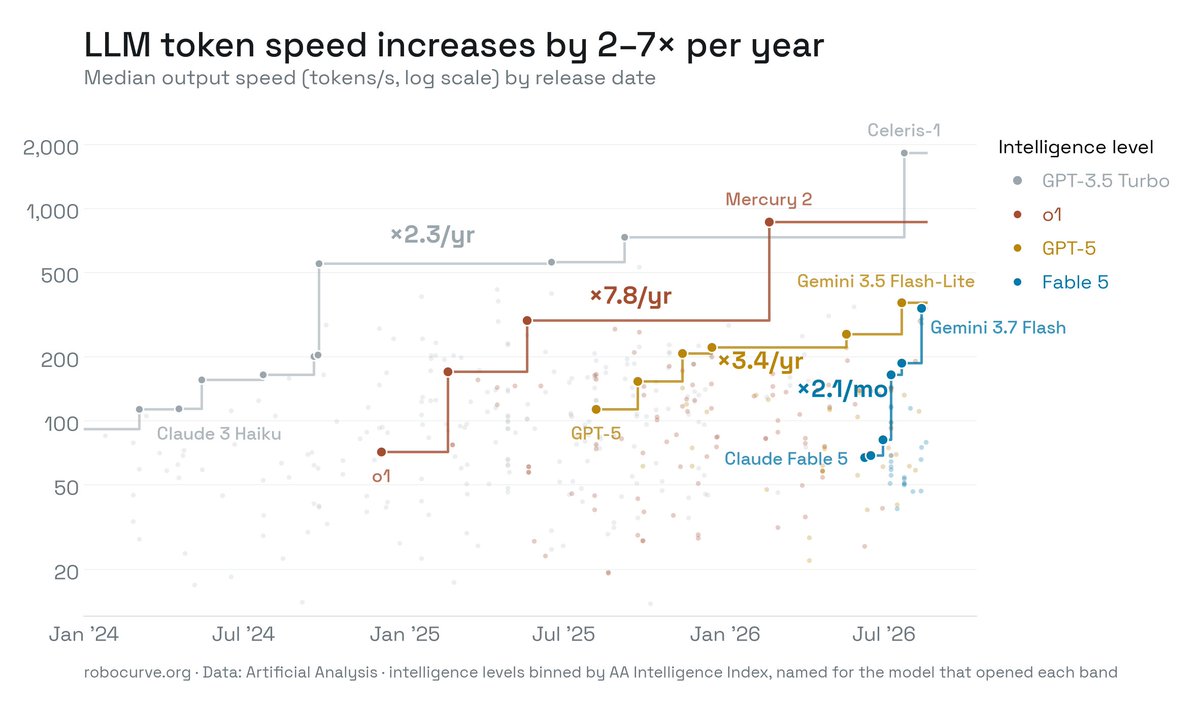
LLM token output speed increases by 2-7x per year, with Fable-class models doubling every month (month!).
If trends continue, LLMs could meaningfully control robots in real time by end of the year, or by 2029 at the latest.