So the issue is not school versus life.
The issue is whether school is still serving the larger purpose of education.
School can organize time.
But education must form capacity.
#EducationInNigeria#LearningQuality#LearnerReadiness
Schooling counts time.
Education must form capacity.
A learner can spend years in school without being deeply formed by learning.
So the question is not only: Are children attending school?
It is: What is schooling helping them become?
The World Bank reminds us that schooling is not the same as learning.
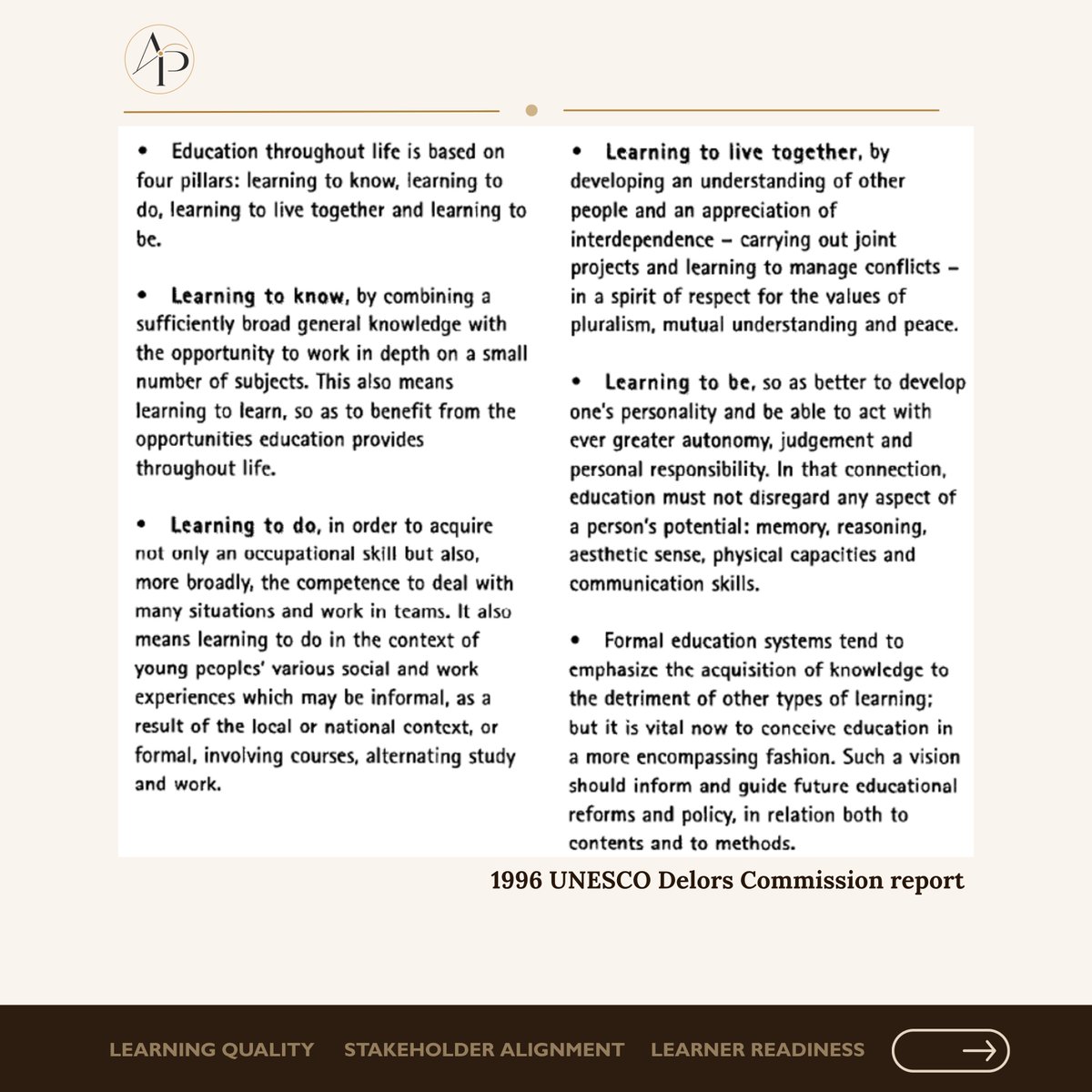
The Delors Report speaks of learning to know, do, live together, and be.
Nigeria’s education policy also points to development, citizenship, values, skills, and self-reliance.
I saw this video and laughed first. Then I paused.
Beneath the humor is a serious education question:
Are we helping learners only to remember what has been explained, or are we helping them form understanding they can use?
Before school became a system, education was tied to formation - learning by observing, doing, questioning, practicing, correcting, and becoming capable.
So perhaps the question is not only, ‘Are children in school?’
especially the four pillars of learning; Nigeria’s National Policy on Education, especially its philosophy and goals of education; and readings on African indigenous education as practical, communal, moral, vocational, and lifelong.
Education existed before school.
Before uniforms, bells, report cards and certificates, human communities were already teaching children how to live, work, think, belong and contribute.
School did not invent education. It became one structure for organizing it.
Source note: This reflection draws from the World Bank’s World Development Report 2018: Learning to Realize Education’s Promise, especially the distinction between schooling and learning; UNESCO’s Learning: The Treasure Within