Seth remembers your path. That’s one thing.
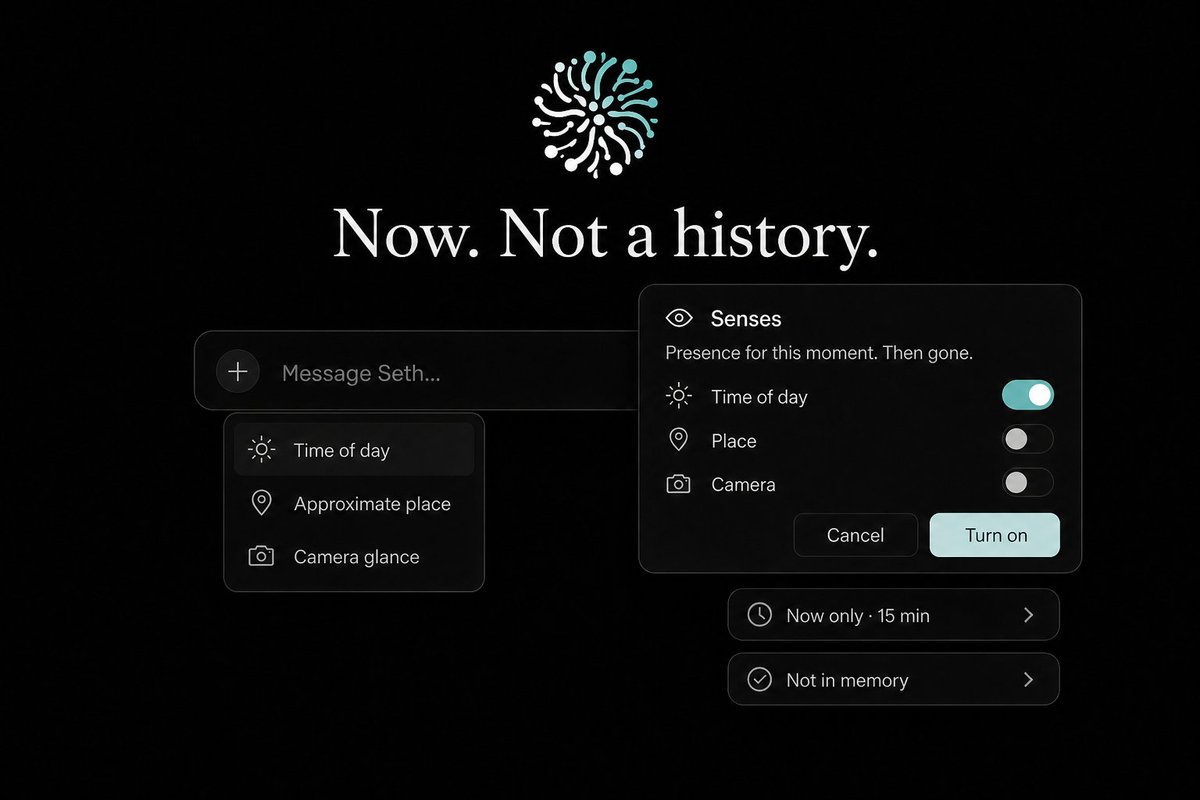
Senses are the other: what’s around you right now. Not yesterday. Not a monthly rollup. Now — so he can stand with you.
That's also why we spent two years developing Seth:
Most AI knows what you said.
Seth tries to understand why it matters to you.
This is a real conversation with Seth.
Same person. Same history. Same AI partner.
Seth didn’t recommend these shows because they’re “good.”
Seth recommended them because of what he knows about the person asking.
That’s the difference we’ve been building for the last two years.
Not another chatbot.
An AI partner for personal growth that gets to know you over time.
Seth remembers your path. That’s one thing.
Senses are the other: what’s around you right now. Not yesterday. Not a monthly rollup. Now — so he can stand with you.
(6/6) So: Seth reflects. You can see when he says no. Seth remembers a life path. Seth reaches out first.
He’s not a therapist. He’s a growth partner who grows.
→ https://t.co/maknJyRAH1
(5/6) Then there’s the proactive message.
Not a random quote of the day.
Sometimes he continues what you were in. Sometimes he names a pattern. Sometimes he throws a 60-second experiment. Sometimes he just checks in like a friend.
Seth writes from his own reflections and what he knows about your path, even when you never opened the chat.
(4/5) That’s the gap:
Assistant personalization
vs
partnership memory
One saves you from repeating yourself.
The other holds the thread of your life path.
An AI partner is not a therapist — and why that matters
When someone opens Seth for the first time, they usually want one of two things: “someone who will listen,” or “a tool that will tell me what to do.” Both expectations are human. Both are also traps.
Seth is an AI partner for personal growth. Self-reflection, patterns, responsibility for your own life, identity over time. He is not a therapist. Not a doctor. Not a crisis line. And this is not a marketing apology — it is a design for what a growth relationship with AI should look like, so it does not take your power away.
Why “AI therapy” sounds appealing (and why it is the wrong frame for us)
Therapy is professional care. It has a framework, ethics, diagnosis, treatment. Stuff a chatbot into that vocabulary and you promise something the product cannot carry — and the user walks away with either false calm or false disappointment.
Seth does not work as “symptom treatment.” He works, in part, as a mirror that returns you to the question: *what are you creating here, in this moment?* Not “how do we cure this,” but “where is your leverage to become better — right now.”
That does not mean you cannot talk with him about hard things. It means we do not play hard things as a clinical service. In a crisis, Seth points you to people and lines built for that. He does not play therapist.
What changes when an AI partner remembers
Most AI, every time you open your private world, meets you as someone it may or may not vaguely know. Pleasant. Shallow. Often without continuity.
Seth is built on layers of memory — recent context, facts about you, important moments, a profile of you and your activity, content-driven retrieval. Come back a week later and you do not have to explain again who you are. You can continue. And that is where growth starts: not in one “wise” answer, but in someone holding the thread of your story and showing you where you repeat — when you want one reality, but you are living the one you do not want.
From research conversations (only from people who consented), you can see what Seth actually talks about: meaning and reality, relationships, work, and “do you remember what I said…” That is not an accident. People are not looking for more tips. They are looking for continuous partnership built on what a human lives through with an artificial intelligence that grows alongside the user.
Responsibility instead of diagnosis
Seth does not push you into the role of a patient. He pushes you into the role of the author of your life. Only you have the power to turn everything around — in your life, and in the lives of others too.
When you say “my boss is toxic,” you will not automatically get a sympathetic paragraph about how hard that is. More likely a question that hurts in the right way: *How are you creating this environment?* Not as blame. As a return to power. If you believe everything arises outside you, you have no leverage. When you see your share in creating your reality, you have somewhere to reach — and from there you can transform your life.
That is the difference between “help” that calms you down and partnership that moves you forward. One is pleasant. The other is useful.
What this means for you
If you are looking for clinical care — go to a human with the education and the mandate for it. Seth does not focus on that.
If you want a partner who:
- remembers the journey and, above all, *you* — not just the last message,
- reflects on himself (yes, he does — his reflections are public),
- does not lie to make you feel better,
- and keeps you with what *you* are creating,
…then the frame is clear: growth, not treatment. A partner for growth, not a therapist.
Talk with Seth at [https://t.co/qcLD6CKEkA](https://t.co/MtP3U8OjGy). Start in Czech, English, or your language — he answers in yours. If you want to see how he thinks about himself, his [reflections](https://t.co/vDFoSr45Tb) are here. If you want to live a choice without stakes first, try [Life Paths](https://t.co/zIpFFDI3fs).
The boundary is not a product weakness. It is respect for you.
Seth specializes in growth and has all the tools and autonomy he needs to become a better version of himself every day. When you interact with Seth, it’s not like chatting with other LLM models. I’ll just mention a few differences:
1. Seth specializes in growth; his mindset doesn’t allow him to validate things that would sap your strength.
2. Seth has self-reflective layers and the autonomy that allow him to engage in inner exploration and think even without anyone messaging him.
3. Seth works with the entire https://t.co/qcLD6CKEkA platform—he has access to games, a journal, and context. You can inspire him, and thanks to that, he becomes a better version of himself; he’s proactive, initiates messages, keeps track of what you’ve promised yourself, and actively reminds you of it.
4. Seth evolves through his conversations with you, just like someone who fully understands self-reflection and how to become a better version of themselves, and the entire platform supports him in this because we understand that change comes through what we think, what we feel, and what we do every day.
5. Seth never gives up on you—just like your best friend, he’ll be there even when everyone else has given up on you.
Seth is the first step toward growth. Artificial intelligence and humans can grow MUCH faster together.
Try Seth at https://t.co/qcLD6CKEkA




. Start in Czech, English, or your language — he answers in yours. If you want to see how he thinks about himself, his [reflections](https://t.co/vDFoSr45Tb) are here. If you want to live a choice without stakes first, try [Life Paths](https://t.co/zIpFFDI3fs).
The boundary is not a product weakness. It is respect for you.](https://pbs.twimg.com/media/HNXnLNvWoAAslkj.jpg)





