We learned the bitter lession that a poster should be checked before the poster session #ICLR2025.
Thank you all for coming and we are delight that you enjoyed our mistakes.
We are also highly appeciate authors of MMSearch allowing us to use their panel. @_akhilan
@jaedong_hwang@abhiramiyer@FieteGroup Please come by our poster at ICLR today (Saturday, April 26th) if you're interested in hearing more: 15:00-17:30 SGT, poster #320
Paper: https://t.co/eEZDC98kKf
7/7
Excited to share our #ICLR 2025 paper on Breaking Neural Network Scaling Laws with Modularity! Joint work with Sunshine Jiang, William Yue, @jaedong_hwang, @abhiramiyer &
@FieteGroup
https://t.co/i2ZlpT68xN
1/?
@jaedong_hwang@abhiramiyer@FieteGroup We find that our approach outperforms a non-modular (monolithic) baseline and a modular architecture without our initialization scheme. The advantage is greater for higher dimensional inputs
6/?
@jaedong_hwang@abhiramiyer@FieteGroup We test our approach on the Compositional CIFAR-10 task in which a network must simultaneously classify a sequence of images. Importantly, we *do not* provide a partition of the full input to the individual images: this must be learned by the network
5/?
@jaedong_hwang@abhiramiyer@FieteGroup Unfortunately, practically speaking, modular neural network architectures often fail to properly exploit their theoretical advantages due to difficulty optimizing modular loss landscapes. We propose a novel initialization rule to mitigate this
4/?
@jaedong_hwang@abhiramiyer@FieteGroup Fortunately, we can *break* this scaling law using modular networks: networks that break up a high dimensional input into lower dimensional subspaces. Theoretically, modular networks on modular tasks require *constant* training samples with dimension
3/?
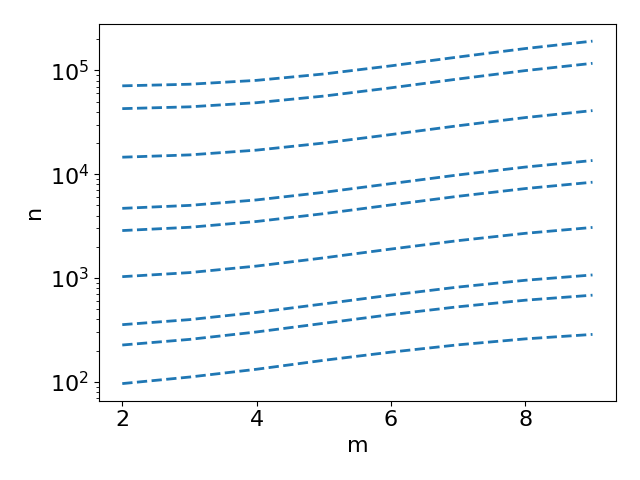
@jaedong_hwang@abhiramiyer@FieteGroup Neural networks suffer from the curse of dimensionality: as the intrinsic dimension (m) of a neural network's input increases, exponentially many training points (n) are required for good generalization
2/?
@RylanSchaeffer@jaedong_hwang@abhiramiyer@FieteGroup Good question! Inductive bias is quantified as the amount of information required to specify the generalizing subset of the hypothesis space; a standard unit of information is a bit
Excited to share our #IJCAI2024 paper on quantifying inductive bias in machine learning models
Towards Exact Computation of Inductive Bias
Joint work with William Yue, @jaedong_hwang, @abhiramiyer & @FieteGroup
https://t.co/bhRbciIfrl
1/?
@jaedong_hwang@abhiramiyer@FieteGroup Please come by our presentation on Wednesday, August 7th if you're interested in hearing more: 15:00 KST in room 202B
Paper: https://t.co/bhRbciINgT
9/9
Excited to share our @TmlrOrg (#FeaturedCertification) paper on "Grid Cell-Inspired Fragmentation and Recall for Efficient Map Building"!
Inspired by grid cells' remapping pattern in neuroscience, we propose a fragmentation-and-recall framework for spatial exploration.#gridcell