The new App Planning Phase feature in Pi App Studio allows creators to develop their ideas with the help of AI before App Studio generates the app.
For example, App Studio may ask for more detail about the app’s:
- Main idea
- Goal
- Design
- User experience
This helps guide creators from an initial idea toward a more complete app concept in a more interactive and dynamic way.
Watch the video walkthrough to learn how the planning process works!
Pi App Studio backend support has been enabled!
Backend capabilities begin with persistent storage for newly created App Studio apps, allowing apps to save and retrieve user-specific data across sessions.
Creators can now build App Studio apps with user experiences that continue even after users leave and return.
For example:
- Game apps can remember a user’s high scores
- Productivity apps can remember a user’s to-do lists
- Note-taking apps can preserve notes automatically
Before, Pi App Studio apps were largely limited to frontend-only, single-session experiences, where app data such as preferences or progress would disappear if users left the app.
Adding backend support is a significant App Studio platform milestone because it expands what AI-created apps can practically do on Pi Network. Persistent storage is the first capability built on this foundation, enabling a broader range of useful, everyday applications.
Learn more and create apps with this new feature in Pi App Studio today!
https://t.co/UlKKz3ZcjG
Take on the Pi2Day Ecosystem Quest to celebrate new feature releases and receive a special in-app badge!
The Ecosystem Quest guides Pioneers to complete activities to discover new apps, test ecosystem features, and understand how Pi’s infrastructure supports utility creation across compute, AI, and identity.
Certain steps in the Quest require completing a quiz, so remember to pay attention to the updates! You can show-off your in-app badge in Pi Chats, Fireside Forum, and Pi Social Profiles.
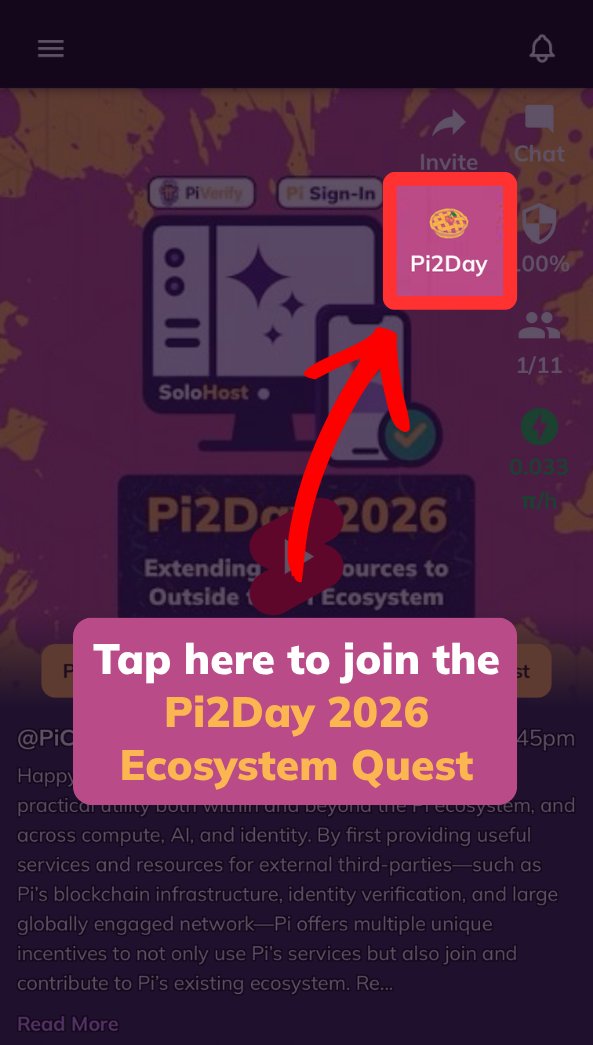
Participate in the Ecosystem Quest by tapping the “Pi2Day” icon on the top right of the Pi mining app home screen. The event will end on July 13.
New to Pi? Download the Pi mining app and get started here https://t.co/sHTvwa8Vt7
Pi2Day 2026 reflects how Pi’s utility continues to grow through infrastructure and participation.
- Through SoloHost, Pi Desktop and Nodes can support new local AI app and compute use cases
- Pi Sign-in can help connect those experiences across users, devices, and services
- PiVerify can extend Pi’s real-human verification capabilities to third-party clients.
Together, these releases point to a broader direction for the ecosystem: Pi products are built both for the Pi ecosystem and to extend Pi services and resources to the external world. This, in turn, enriches and strengthens the Pi ecosystem.
Pi’s practical utility is built not only by product releases but by the Pioneers, Node operators, developers, KYC validators, app teams, merchants, and third-party services that use them, test them, and build on them.
Read the Pi2Day 2026 blog to learn more
https://t.co/5hkl8TAxxQ
Europe, we’re all in. 🇪🇺
With both MiCA and PI licenses now in place, Gate is building one of the strongest compliant foundations in Europe.
Fully licensed. Fully committed.
And we’re only getting started.
The stablecoin race just entered a new phase.
Yesterday, @openstandard announced Open USD (OUSD) , a dollar-backed stablecoin backed by a consortium of 140+ global companies spanning payments, banking, fintech, crypto, and enterprise technology.
The founding members include Visa, Mastercard, American Express, Stripe, Coinbase, BlackRock, Google, Shopify, BNY Mellon, DBS, Standard Chartered, BBVA, Fireblocks, and many more.
But the announcement isn't significant because it's "another stablecoin."
It's significant because it challenges the business model behind today's largest stablecoins.
Instead of concentrating reserve income with a single issuer, Open USD proposes a different approach:
✅ Zero mint and redeem fees
✅ No artificial volume limits
✅ Reserve yield shared with ecosystem partners (after a management fee)
✅ Independent consortium governance instead of a single controlling issuer
The goal is simple: align incentives across the entire ecosystem so businesses have a reason to build, integrate, and distribute the stablecoin, not just use it.
Even before launch, Stripe has announced plans to make OUSD its default stablecoin for businesses, while Coinbase confirmed support across Base and other chains. The initial rollout is expected later this year, including Solana.
The market reacted immediately. Shares of Circle (USDC issuer) fell sharply as investors weighed how a consortium-led model could reshape stablecoin economics.
Why this matters?
Stablecoins are increasingly becoming payments infrastructure, not just trading assets.
For businesses moving money globally, the questions are evolving from:
Which stablecoin has the largest market cap?
to:
Which ecosystem offers the strongest distribution?
Which network provides the best economics for partners?
Which infrastructure scales seamlessly across payments, remittances, commerce, and settlements?
At Onramp Money, we see this as another signal that the industry is moving toward more interoperable, incentive-aligned financial infrastructure. As adoption grows, what will matter most isn't just the stablecoin itself, but how easily businesses and users can move between fiat and digital assets across markets.
The next chapter of stablecoin adoption won't be won by technology alone.
It will be won by distribution, accessibility, and seamless on/off-ramp experiences.
What do you think—does a consortium-led model have what it takes to accelerate global stablecoin adoption?
Pi Sign-in allows supported third-party websites and apps to offer Pi accounts as a sign-in or sign-up option.
It helps provide the infrastructure that allows applications and services to recognize, connect, and serve users across and outside the ecosystem.
This means Pioneers can access supported services with their Pi account instead of creating a new account or password for every app.
Why would third-party services or websites want to integrate Pi Sign-in? Pi Sign-in creates a simpler way to connect them with Pi’s large user base and bring Pi users into their own product experiences. It also gives Pi more presence in third-party contexts while offering a way to tap into the additional benefits and resources of Pi Network, besides user traffic.
Learn more about the Pi2Day 2026 release at https://t.co/lMgJBEMbYj
Happy Pi2Day 2026 Pioneers!
Pi Network is celebrating Pi2Day with new releases advancing Pi’s practical utility both within and beyond the Pi ecosystem, and across compute, AI, and identity.
By first providing useful services and resources for external third-parties—such as Pi’s blockchain infrastructure, identity verification, and large globally engaged network—Pi offers multiple unique incentives to not only use Pi’s services but also join and contribute to Pi’s existing ecosystem.
Head to the Pi mining app and read the Pi2Day announcement to learn more about the new SoloHost, Pi Sign-in, and PiVerify releases today!
Also, take part in the Pi2Day Ecosystem Quest to learn more about the new releases, test features, and earn a special in-app badge to commemorate Pi2Day 2026—and show it off!
As Pi2Day 2026 approaches on Sunday, June 28, Pioneers have four days left to participate in the Vibe Coder campaign with a raffle and the Pi Launchpad Testnet Token SLICE.
Both initiatives help contribute to the growth, development, and use of the Pi ecosystem and its utilities.
Pi2Day has historically been an important moment for Pi Network ecosystem milestones, updates, and feature releases. Participate in the two initiatives now, and stay tuned for Pi2day!
Learn more https://t.co/CCff3IuRQv
Join Pi’s vibe coder campaign ahead of Pi2Day (June 28)!
Pioneers can participate by joining relevant creator or developer communities and sharing why Pi may be useful for builders who already have prototypes or working apps built through AI platforms. Then submit your public post link in the Pi app for a chance to win Pi Network merchandise!
Wondering how to introduce Pi to vibe coder communities?
Posts introducing Pi can point vibe coders to Pi App Studio, explain how externally created apps can connect with Pi, and highlight the users, payments, ads platform, and broader infrastructure available through the Pi ecosystem.
Pi’s value proposition should be clear:
In the Pi ecosystem, vibe coders building web apps with AI can make their app accessible to 60M+ engaged users, and run their app on built-in payments, identity and ads infrastructure, by simply plugging their service or product into Pi Network.
You can also:
- Introduce Pi opportunities to creator communities;
- Describe how Pi App Studio makes it simple for vibe coders to integrate with Pi;
- Share statistics of organic traction Pi apps have received from the Pi ecosystem;
- Explain why developers and creators should explore Pi.
Learn more https://t.co/euwz9BMwll
Pi2Day (June 28) has historically been a time for ecosystem milestones, updates, and feature releases.
Last year Pi released:
- Pi App Studio
- Pi’s vision and solution to address AI-era challenges
- Ecosystem Directory Staking
- Node updates and Node ranking page
- And more!
Stay tuned on June 28 for what’s to come!
Pi Network has over 60 million Engaged Pioneers.
For developers, that creates an important opportunity: How do useful apps get discovered by these millions of people on Pi?
Ecosystem Directory Staking was built to help answer that.
It is a decentralized way for Pioneers and businesses to actively support and promote the ranking of Pi apps and utilities in the Ecosystem Interface. Staking through this feature increases an app’s exposure to the Pi community, helping boost visibility within the ecosystem.
This feature provides a self-service avenue for developers and creators to use Pi to tap into the attention resource of Pi Network to acquire users.
As AI makes app creation easier and easier, the challenge shifts from building products to getting them in front of people.
Ecosystem Directory Staking improves ecosystem discovery, making it easier for developers and creators to connect with users, and easier for users to discover new apps.
https://t.co/EpsNc81gOv
Reminder for all Pi Mainnet Node operators: The majority of Mainnet node operators have already successfully upgraded to Protocol v25. If you have not yet upgraded your node, please do so at your earliest convenience to remain connected to the network.
As with previous upgrades, the process is straightforward and should take only a few minutes to complete.
Details: https://t.co/ENIm1nuEHz
Pi2Day (June 28) is approaching, and Pi’s vibe coder campaign will continue until that date! What exciting apps are you building ahead of Pi2Day?
Vibe coders (app creators using AI) can use Pi App Studio to easily convert their apps built through platforms such as Codex, Claude Code, Replit, Cursor, Lovable or other AI-assisted coding tools, into Pi Apps.
Pi can connect your AI-created apps with millions of engaged Pioneers, identity verification and Pi’s utility ecosystem.
Learn more and deploy vibe coded apps on Pi today!
https://t.co/x3mI1DqjfR
If Pi Network pulls this off
$PI could become one of the biggest comeback stories in crypto history
Most people won’t pay attention until it’s too late
Building used to be the hard part until AI changed that.
Now it's distribution, and @PiCoreTeam is solving it for an entirely new wave of creators.
When those apps are ready to handle real payments across borders, we'll be here 👋