In all seriousness these two could co-exist within different but overlapping timeframes: China experiencing near total chip chokehold in the short term but with all of their bets on domestic chip capability, reaching breakthrough in ’28/’29
No sane person in the US will dare to oppose a full China chip ban after this. Jensen’s point being cutting off chips = forcing China to develop domestic capability.
Nvidia about to become way more Palantir-ized and Anduril-ized. At the same time, the grey market is still gonna grey market.
In parallel, you have China catching up with its Huawei Ascend architecture, amongst other domestic chip efforts. Not quite there yet.
The outcome looks binary. Either (some form of) ASI arrives in the next year or two and Anthropic/US secures global dominance, or it doesn’t and the bubble bursts, with DeepSeek/Chinese models making a huge comeback
@PalmerLuckey If there's one group of people that isn't concerned about whether Jensen stays, it would probably be the Chinese.
1. They aren't giving up on their domestic chips;
2. No matter how hard the chip export ban, ppl who need the chips are going to find ways to get them
@samalanascience Hi Sam, I'd love to DM for more info but can't. I'm working with a bunch of Asian investors in the BCI space and happy to share what's happening on that side of the world. Will be in SF that week.
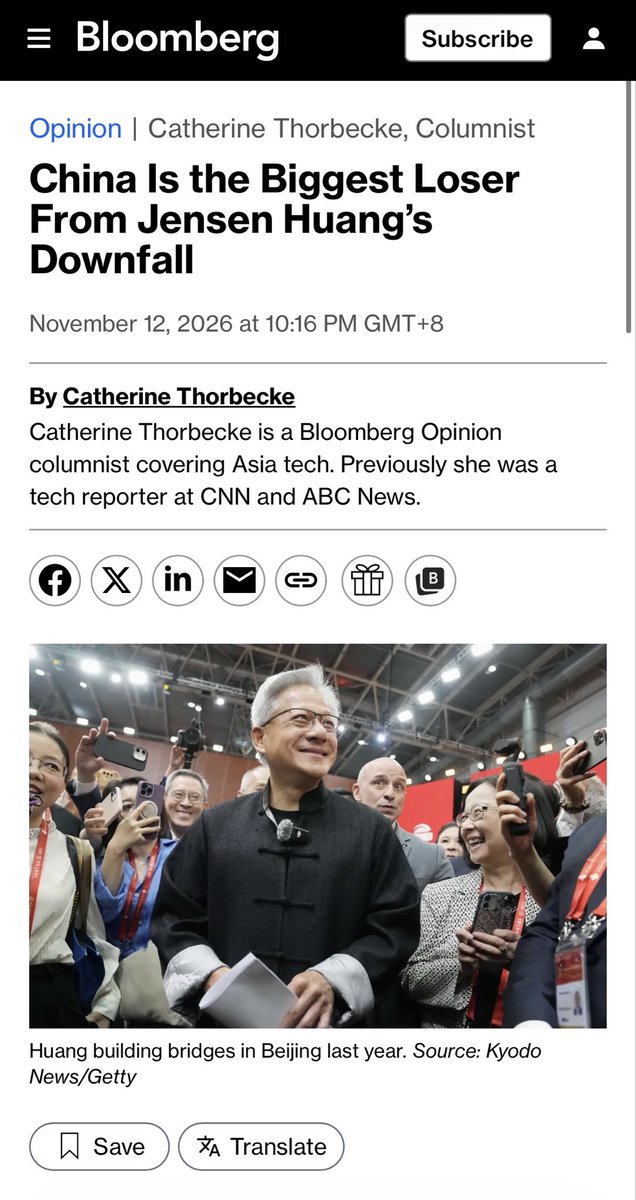
ALICE IN HUANG-DERLAND: What are Chinese commentators saying? A quick summary:
Jensen Huang admitted to Nvidia’s staff that he had been unfaithful to his wife. The woman, Alice Huang (no relation), was an executive at Megaspeed, a Singapore cloud operator that has reportedly bought more than $4.8 billion of Nvidia chips. Nobody has been charged, and Beijing calls the spy claims a smear.
Huang argued for years that cutting China off would only hand the market to Chinese chipmakers. Washington listened: in December 2025 it approved H200 sales to China for a 25 percent cut of revenue.
Chinese commentators have noticed all of this. The spiciest takes see this saga as Washington and Wall Street moving against an ethnic Chinese founder who climbed too high, and that ‘real American’ executives with messier private lives never faced national security probes. In other words, some see it as a McCarthyite witch-hunt of sorts.
Other Chinese readings stress that Beijing has been preparing for this day all along. When the H20 was cleared in 2025, Chinese regulators discouraged domestic firms from buying it and questioned its security. Chinese chipmakers kept scaling production, accepting lower performance in exchange for domestic supply that Washington cannot switch off.
A more measured strand of Chinese commentary takes the long view. Wherever the profit is large enough, the market will find a way around the rules. Washington can police hardware exports, but compute rented across borders, routed through third, and even fourth countries behind layered contracts, make it hard to discern the real end-user of Nvidia chips.
At the same time, despite real progress made in domestic Chinese chip-making, the biggest Chinese labs are still on the lookout for the most advanced Nvidia GPUs. Domestic takeover of compute hasn’t really been achieved, at least for the purposes of building frontier models.
Some astute Chinese commentators also see the Jensen Huang affair more as political power play between the Democrats and Republicans. Once Democrats take over the congressional committees on January 3, 2027, some expect the affair to become a weapon against the Trump administration, with investigators asking why Trump took no action after being briefed on the intelligence in late 2025 and then approved H200 exports anyway.
They spot a searing political naivety in some American tech founders: the childish belief that great products are protection enough. A multi-trillion-dollar company with neither super-voting shares nor strong ties to the military-industrial complex is, in the Chinese idiom they use, a child carrying gold through a crowded market.
And almost all of them don’t think Alice Huang is a spy. Just a shrewd businesswoman who found a weak spot, locked in and got what she needed.
😭😭Got me thinking why China doesn’t get these crazy data center controversies:
No, it’s not because “China don’t got no public hearings 😏”
Inflationary pressure related to data center roll-out is very much real in the US: it could raise residential electricity bills by 9.6% in northeastern US by 2030 and wholesale prices by 12.3% nationally by 2028.
In China, municipalities manage energy inflationary pressure through geographical relocation, state-coordinated infrastructure investment and renewable-energy integration.
One of the biggest data center roll-outs in the country is in Ulanqab, Inner Mongolia (think remote west Texas) where sunlight and wind is abundant. Clean energy sources nullifies the fossil fuel debate.
Also, new grids and electricity plants are put up at lightning speed alongside data center construction. So that also removes potential pressure on existing grid supply.
Jobs are also created there:
Ulanqab data center wages can be 30%-40% higher than the local average. Of course, how many of those jobs are actually sourced locally, and whether taxation income stays local, are all very real problems.
But coordination on a national level could negate these problems, if the Chinese government implements local upskilling programs and agree on value capture and retention for Ulanqab.
They have indeed implemented subsidy programs to balance the discrepancies between poorer inland areas and the richer costal geographies in the past.
This is the core reason why Chinese data center construction doesn’t end up in profanity-laced debates.
But of course you don’t get the entertainment value of “she talked about my mama” 😭