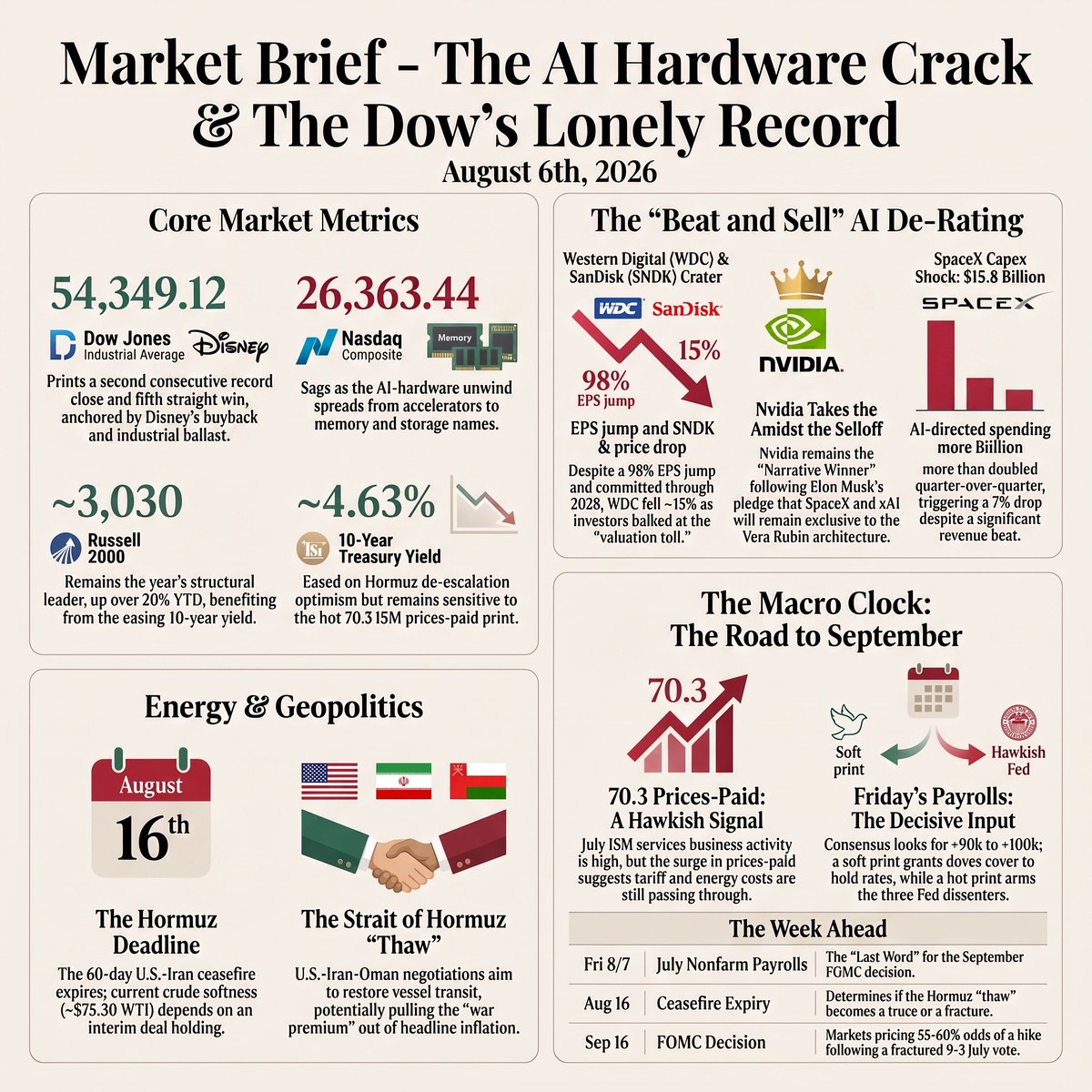
The Dow Jones Industrial Average set a second consecutive record close at 54,349.12 (+5 wins straight), driven by strong media buybacks and industrial momentum. However, the tech-heavy Nasdaq slipped to 26,363.44 as the AI-hardware unwind spread to memory and storage, while the small-cap Russell 2000 held near 3,030.
$WDC plunged 15% after investors balked at valuations despite a 98% EPS surge.
$NVDA remains the primary narrative leader following Jensen Huang's confirmation that next-gen AI and space computing initiatives will stay exclusive to its GPU architecture.
$SPCX plunged 7% post-market after reporting a massive $15.8B capex bill that doubled its AI-directed infrastructure spending quarter-over-quarter.
Services Prices-Paid printed hot at 70.3, warning that tariff and freight expenses are still trickling into consumer metrics.
WTI Crude dropped to $75.30 as multi-nation talks try to cement a permanent transit deal ahead of the August 16 ceasefire expiration.
The 10-year Treasury yield eased to 4.63%, while interest rate futures price in 55-60% odds of a September 16 rate hike ahead of tomorrow's July Nonfarm Payrolls report.
If tomorrow's July payrolls report prints above 100k alongside sticky services inflation, bond desks will rapidly price September rate hike odds past 75%, causing a sharp retreat in small-cap valuations. Furthermore, the massive $15.8B capex shock from $SPCX will likely trigger a broader multi-day tech de-risking, dragging $BTC down through its local support to test $60,500 over the weekend.
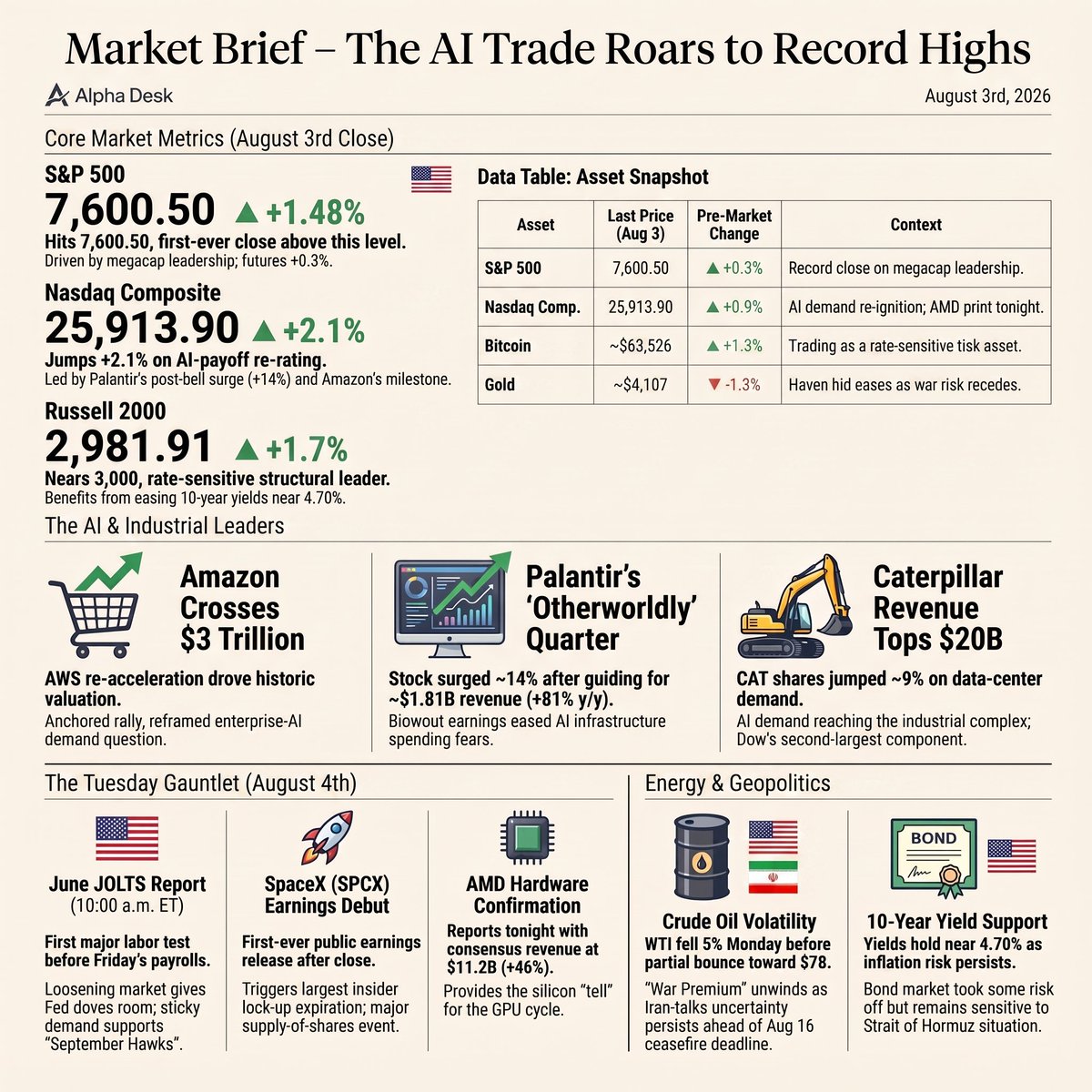
S&P 500 to its first-ever close above 7,600.50 (+1.48%), while the tech-heavy Nasdaq jumped 2.1% to 25,913.90 and the small-cap Russell 2000 gained 1.7% to 2,981.91 as 10-year Treasury yields eased near 4.70%.
$AMZN officially crossed the $3 Trillion market cap threshold as AWS re-acceleration reignited broad confidence in enterprise AI adoption.
$PLTR surged 14% post-market after raising full-year revenue guidance to $1.81B (+81% YoY), squashing near-term AI spending fears.
$CAT jumped 9% as quarterly revenue topped $20B, proving that physical data center power buildouts are feeding directly into industrial blue chips.
June JOLTS data drops at 10:00 AM ET to test labor market tightness before Friday's nonfarm payrolls.
$AMD reports tonight with consensus revenue pegged at $11.2B (+46% YoY), offering a crucial litmus test for the ongoing GPU cycle.
$SPCX releases its first-ever quarterly earnings report after the close, triggering a massive insider share lock-up expiration.
WTI crude fell 5% to hover near $78 as Persian Gulf war premiums unwind ahead of the August 16 Strait of Hormuz deadline, while gold dropped 1.3% to $4,107 and $BTC gained 1.3% to $63,526.
If $AMD beats its $11.2B revenue consensus tonight alongside a soft JOLTS labor print, the Nasdaq will easily clear 26,200 as institutional capital rushes to front-run Friday's payroll numbers. However, the massive share supply hitting the market from $SPCX's insider lock-up expiration could temporarily drag high-multiple tech liquidity, pulling $BTC back below $62,000 before the weekend.
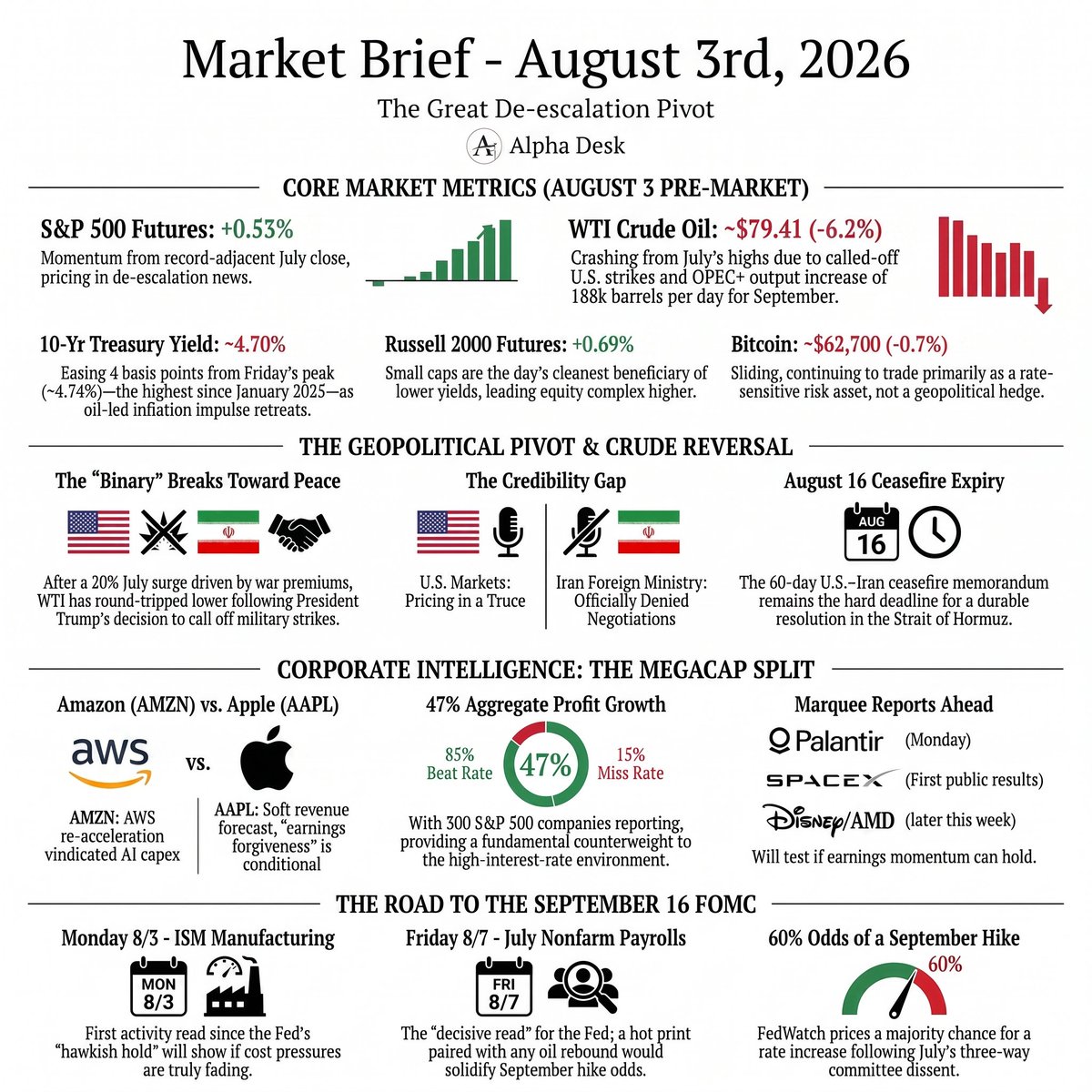
Global indices are carrying strong positive momentum into the new month as a massive unwinding of the Middle East war premium triggers a sharp relief bid across risk assets. Equity futures are pushing higher with large-caps advancing 0.53% and yield-sensitive small-caps leading the tape up 0.69%, capitalizing on a cool-down in long-duration fixed income.
Global oil benchmarks collapsed over 6.2% pre-market to hover near $79.41 after the administration officially called off its planned military strikes in the Persian Gulf.
The diplomatic relief is amplified by a confirmed 188,000 barrel-per-day production increase set to hit the market for September. While foreign ministries publicly deny formal talks, trading desks are front-running a structural truce ahead of the critical August 16 Strait of Hormuz ceasefire deadline.
The 10-year Treasury yield gave back 4 basis points from its Friday peak to settle near 4.70% as the immediate energy-driven inflation shock deflated. $BTC continued its pattern as a rate-sensitive risk asset rather than a geopolitical hedge, drifting slightly lower by 0.7% to trade at $62,700.
Out of 300 major corporations already reporting Q2 results, aggregate profit growth has printed at a stellar 47% with an 85% estimate beat rate, providing a massive fundamental buffer against restrictive macro conditions.
Institutional positioning reveals a stark divergence; accelerating cloud software platforms are fully validating their massive AI capex infrastructure budgets, while legacy consumer hardware players are being heavily penalized for soft forward revenue guidance.
Wall Street faces a fresh batch of tracking catalysts this week, highlighted by $PLTR print tonight, $SPCX, $DIS, $WBD, $ON and $MCHP dropping metrics later in the week.
Today's Manufacturing ISM report offers the first real economic activity update since July's policy hold to see if factory cost inputs are genuinely fading.
Friday's marquee nonfarm payrolls report remains the absolute make-or-break data point for fixed-income desks. Following a highly vocal, three-way committee dissent at July's meeting, rate monitoring tools are currently locking in a heavy 60% probability of a formal interest rate hike at the September 16 committee session.
If this Friday's July payrolls print comes in hotter than expected alongside a slight bounce in energy, bond desks will aggressively price September rate hike odds past 80%, instantly crushing the small-cap yield rally and forcing a deep retest of its recent support floor. Consequently, this hawkish macro shift will choke off high-beta risk appetites, dragging $BTC down through its immediate $62,000 stabilization zone to trigger a swift automated flush toward $58,500.
Tech is staging a historic turnaround today. After its worst month since 2002, the semi complex is triggering a massive short squeeze, with memory names ripping 18% to 26% higher after warnings of a supply crunch lasting into 2028. Nasdaq futures snapped a 6-session losing streak, surging 2.78% to 25,122.18, while the S&P 500 jumped 1.66% to 7,437.83 for its best session in a month.
$MSFT printed the largest single-day market cap gain in history, adding an astonishing $450B in value as shares spiked 16% on a disciplined capex outlook and a massive 43% acceleration in Azure cloud growth.
$AMZN surged double-digits after hours as AWS blew past the 31% consensus estimate to hit 37% growth, marking its fastest expansion in 18 quarters and vindicating enterprise AI demand.
Breaking ranks with the large-cap rally, Apple $AAPL slid 7% after hours as weak supply forecasts and East Asian regional softness completely overshadowed a 22% jump in iPhone sales.
Cooler June inflation data fueled the broad reversal, helping the 10-year Treasury yield ease 5 basis points to 4.56%. The macro relief kept safe-haven gold down 1.1% to $4,057 and crude oil at $82.72 despite fresh shipping disruptions from a drone attack near Damietta, Egypt, while $BTC traded flat as a pure risk asset at $63,902.
The record-breaking institutional inflows into $MSFT and $AMZN will force systematic index rebalancing over the next few sessions, draining liquidity out of consumer-sensitive tech like $AAPL and driving the Nasdaq up another 3% to completely erase July's losses. However, because the fixed-income curve is still maintaining high 63% odds of a September rate hike due to Suez Canal transit risks, $BTC will likely remain pinned under its rigid $65,500 technical resistance ceiling until the central bank formally pivots.
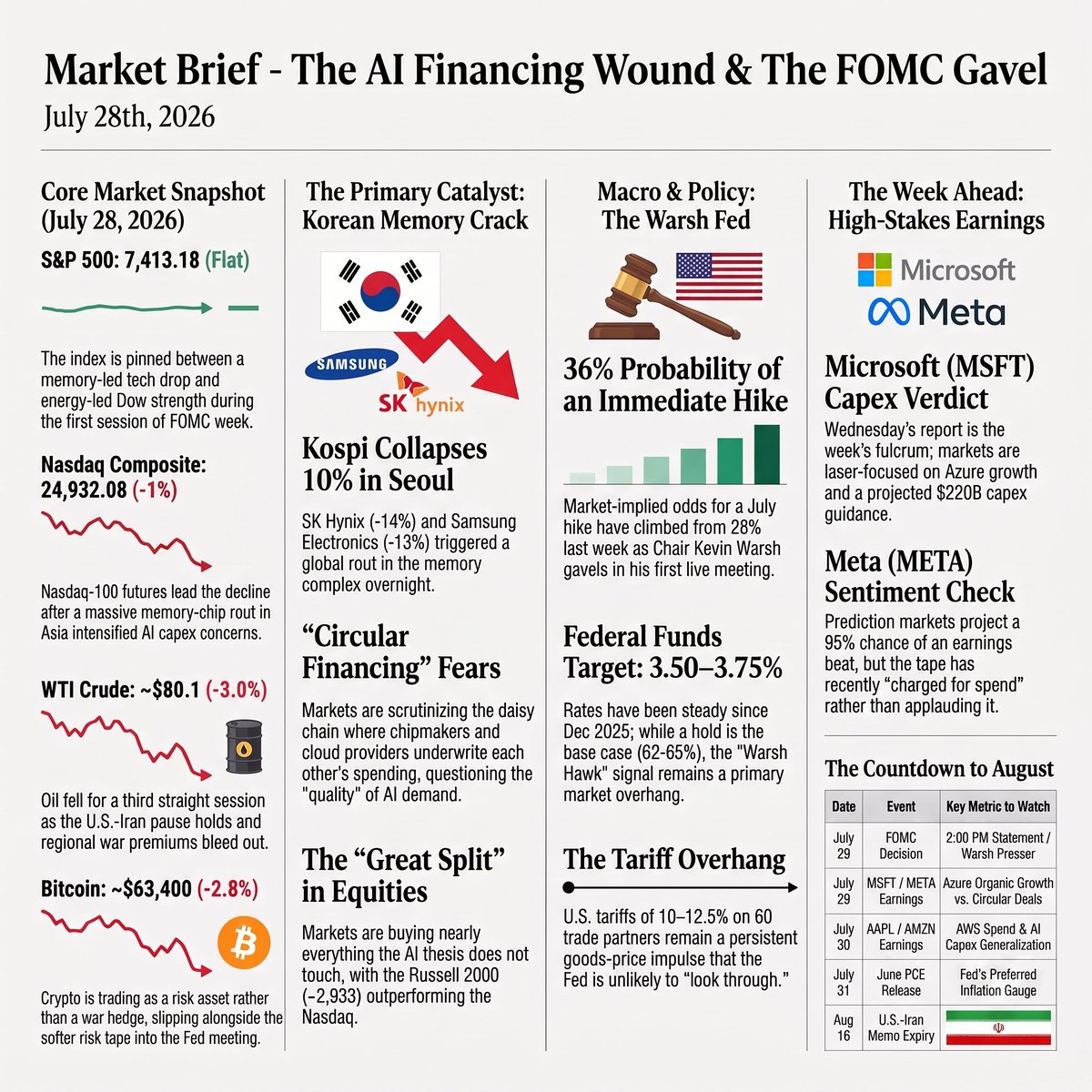
Desks are trading an incredibly unusual tape today. While a welcome pause in Middle East hostilities has dragged crude lower to provide broad inflation relief, the respite is being entirely erased by a brutal, cross-border liquidation across the high-flying semiconductor sector.
Tech indices are taking the brunt of the damage, with the Nasdaq falling 1.0% to 24,932.08. The broader S&P 500 is holding flat at 7,413.18 as non-AI industrial value and small-caps step in to stabilize the tape.
Seoul's Kospi collapsed nearly 10% overnight. Memory giants Samsung and SK Hynix sparked a global hardware de-rating, plunging 14% and 13% respectively.
Long positions are facing a deep credibility test following reports that $NVDA is discussing up to $250 billion in financing guarantees for an @OpenAI data center project. Analysts are aggressively scrutinizing this cross-underwriting loop, questioning whether hyperscaler chip demand is organic or structurally manufactured.
Federal Open Market Committee kicks off its highly anticipated two-day policy session today. Fixed-income desks have aggressively pushed the market-implied odds of an immediate, surprise interest rate hike up to 36% (up from 28% last week) as newly seated Fed Chair Kevin Warsh presides over his first live meeting.
The baseline target range remains frozen at 3.50% to 3.75%, but the central bank faces a structural dilemma. Aggressive 10% to 12.5% import tariffs across 60 global trading partners are acting as a permanent cost-push goods inflation vector that policymakers cannot afford to ignore.
Crude oil sliding a third straight day to cross below the $80.10 handle on regional diplomacy, safe-haven gold is idling, while $BTC has completely shed its safe-haven narrative to trade as a pure high-beta risk asset, falling 2.8% to break local support at $63,400.
If Kevin Warsh delivers a sternly hawkish warning today or if Microsoft’s cloud revenue fails to justify its massive capex run rate, institutional de-risking will accelerate, sending the tech-heavy index down an additional 3.5% to break its summer lows. Consequently, this double macroeconomic shock will likely cause $BTC to break its immediate $63,000 stabilization zone, triggering a swift automated margin flush down to test structural support at the $59,500 baseline.
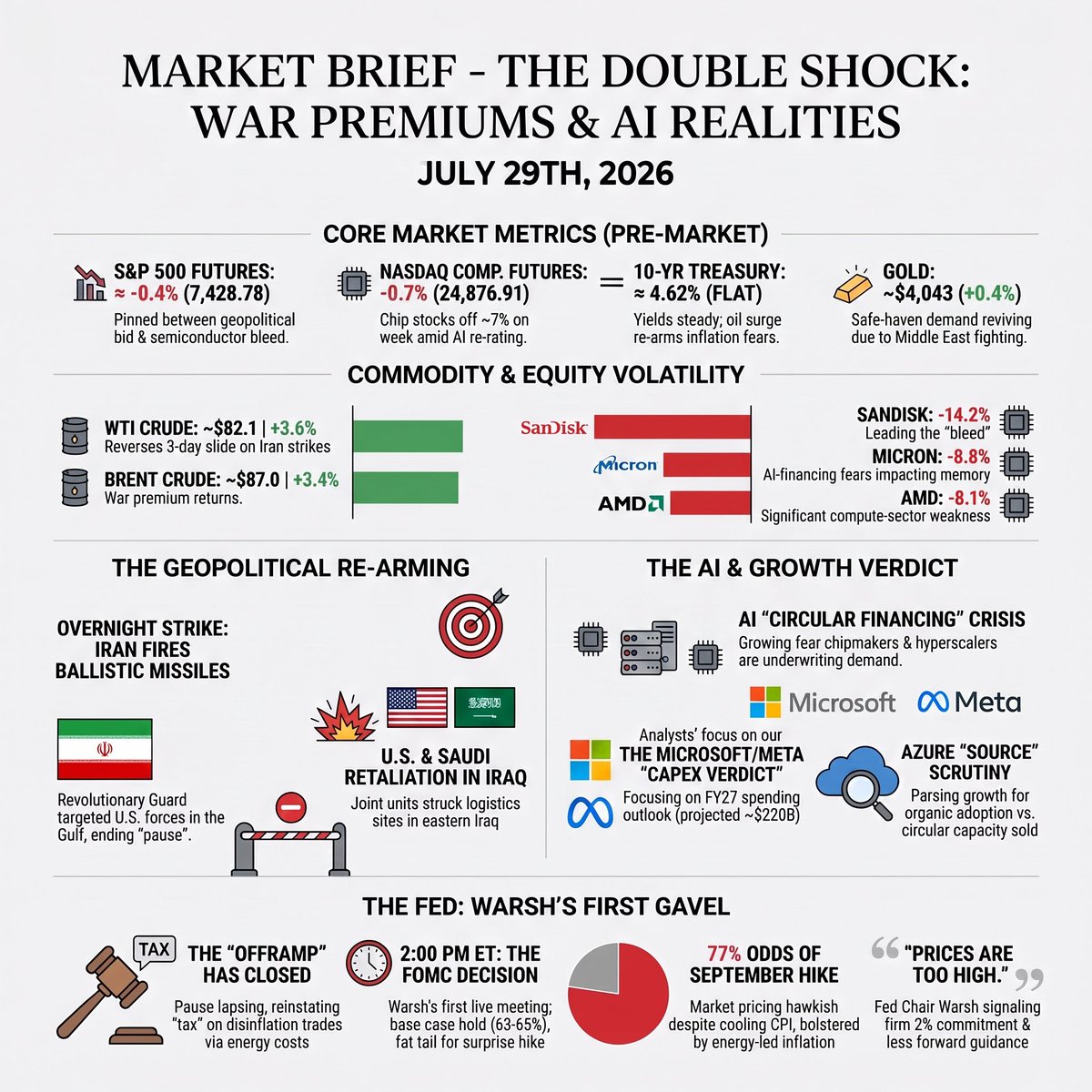
Global macro desks are trading an incredibly unusual tape today. While a welcome pause in Middle East hostilities has dragged crude lower to provide broad inflation relief, the respite is being entirely erased by a brutal, cross-border liquidation across the high-flying semiconductor sector.
Tech indices are taking the brunt of the damage, with the Nasdaq falling 1.0% to 24,932.08. The broader S&P 500 is holding flat at 7,413.18 as non-AI industrial value and small-caps step in to stabilize the tape.
Overseas tech hubs suffered a historic shock as Seoul's KOSPI collapsed nearly 10% overnight. Memory giants Samsung and SK Hynix sparked a global hardware de-rating, plunging 14% and 13% respectively.
Long positions are facing a deep credibility test following reports that $NVDA is discussing up to $250 billion in financing guarantees for an @OpenAI data center project. Analysts are aggressively scrutinizing this cross-underwriting loop, questioning whether hyperscaler chip demand is organic or structurally manufactured.
The Federal Open Market Committee kicks off its highly anticipated two-day policy session today. Fixed-income desks have aggressively pushed the market-implied odds of an immediate, surprise interest rate hike up to 36% (up from 28% last week) as newly seated Fed Chair Kevin Warsh presides over his first live meeting.
The baseline target range remains frozen at 3.50% to 3.75%, but the central bank faces a structural dilemma. Aggressive 10% to 12.5% import tariffs across 60 global trading partners are acting as a permanent cost-push goods inflation vector that policymakers cannot afford to ignore.
With crude oil sliding a third straight day to cross below the $80.10 handle on regional diplomacy, safe-haven gold is idling, while $BTC has completely shed its safe-haven narrative to trade as a pure high-beta risk asset, falling 2.8% to break local support at $63,400.
The monumental 2:00 PM ET tomorrow Fed rate decision lands simultaneously with high-stakes Microsoft and Meta earnings, where desks will demand real cloud revenue translation over massive $220B capex guidance.
Apple and Amazon prints drop ahead of the core PCE deflator—the Fed's absolute preferred inflation gauge.
If Kevin Warsh delivers a sternly hawkish warning tomorrow or if Microsoft’s cloud revenue fails to justify its massive capex run rate, institutional de-risking will accelerate, sending the tech-heavy index down an additional 3.5% to break its summer lows. Consequently, this double macroeconomic shock will likely cause $BTC to break its immediate $63,000 stabilization zone, triggering a swift automated margin flush down to test structural support at the $59,500 baseline.
Global equity futures are staging a forceful pre-market rebound, with Nasdaq futures ripping 1.4% and the S&P 500 up 0.9%. Capital is aggressively probing a broader relief trade as a massive 7% plunge in global energy benchmarks takes the near-term pressure off bond yields.
Oil benchmarks plummeted 7% pre-market—with WTI sinking toward $83.40 and Brent hitting $89.40—following concrete signals of a conditional pause in regional shipping lane attacks.
Wall Street is aggressively pricing in a diplomatic window faster than a formal treaty, dragging major energy producers down 2.5% to 3.2% pre-bell. Long-term risk remains sticky as macro desks note a critical 60-day international ceasefire memorandum officially expires on August 16.
The 10-year U.S. Treasury yield eased 4 basis points off its six-month highs to rest at 4.64%, providing immediate valuation breathing room across the tape.
Recent fund flows reveal that institutional capital isn't fleeing the equity market entirely; instead, desks are structurally rotating out of crowded AI capex plays and moving directly into real estate and high-yielding financials.
The structural AI trade is facing a heavy breadth penalty. A leading memory semiconductor manufacturer plunged 11% pre-market, dragging global chip peers lower after Morgan Stanley issued a sharp warning that global memory contract prices will officially peak by late 2026.
Mega-cap tech giants and EV makers are being severely penalized for massive infrastructure spending plans. Wall Street has completely shifted its posture, shifting from applauding capital investments to demanding direct profit translation.
To validate these massive infrastructure expenditures, major cloud platforms face a steep, mandatory 36% revenue growth target this week.
The central bank interest rate decision drops July 28–29, marking the newly confirmed chair's very first live policy meeting. While a July hold is the consensus base case, interest rate futures are currently pricing in an 82% probability of a September interest rate hike to combat above-target inflation.
The disinflationary relief from falling energy costs has allowed $BTC to stabilize its recent defensive posture, holding firm at the $64,200 level.
The final AI verdict arrives this week, with $MSFT and $GOOG dropping marquee cloud and infrastructure metrics on July 29, followed by $AMZN and $AAPL consumer guidance on July 30.
If Microsoft fails to clear its 36% Azure growth milestone on Wednesday, the localized tech rotation will accelerate into a full-scale growth liquidation, dragging the Nasdaq down another 3.5% by the weekend. Furthermore, with bond desks locking in an 82% chance of a September rate hike, any brief geopolitical relief bounce in $BTC will likely hit a rigid ceiling at $66,500 before structural margin pressures force a retest of the $61,000 baseline.
Wall Street is leaning defensive this morning as a relentless surge in global energy prices triggers fresh cost-push inflation fears. Tech futures are leading the pre-market retreat, sliding 0.7% to 25,837.21, while large-caps lose 0.3% to trade at 7,509.20 as the high-flying semiconductor sector continues to exhale ahead of key marquee earnings.
The semiconductor liquidation is widening as institutional desks demand hard earnings data over AI hype, dragging $NVDA down 2.7%, $AMD down 1.8%, and $AVGO down 0.9% pre-bell.
$MSFT faces an incredibly elevated bar tonight after its recent 2.9% run on proprietary AI silicon rumors, dropping concurrently with $TSLA critical Q2 earnings print, which will act as the ultimate litmus test for global EV consumer demand.
Global Brent crude exploded 4.0% to clear $94.00 for its fourth consecutive positive session, while domestic WTI crude surged 3.9% to touch $88.00.
The energy spike comes as the U.S. launches its 11th consecutive night of retaliatory military strikes inside Iran, with the strategic Strait of Hormuz chokepoint marking its 137th day of a continuous maritime shipping closure.
MFixed-income desks are aggressively adjusting to the energy shock, pricing in a 46% probability of a quarter-point central bank rate hike. The 10-year Treasury yield firmed up at a high 4.63% baseline.
Surging energy costs forced a sharp divergence between alternative assets. Safe-haven gold jumped 1.9% to trade firmly above $4,082, while $BTC continued to act as a pure high-beta risk asset, drifting lower with equity futures to sit at $65,858.
If Microsoft misses its cloud and AI revenue targets tonight, the semiconductor pullback will turn into a full-scale panic, flushing the tech-heavy index down another 3% by tomorrow's close. Concurrently, the combination of $94 oil and a 4.63% Treasury yield will likely break $BTC out of its current drift, triggering a swift liquidation down toward the $62,500 support zone.
Global indices are opening higher, with the tech benchmark bouncing 0.87% to 25,520.24 and large-caps up 0.56% to 7,475.69. Equity markets are staging a needed morning recovery from a heavy tech liquidation cycle, even as the semiconductor sector sinks into formal bear territory.
The SOXX semiconductor index has officially plunged over 20% below its late-June all-time high, confirming a textbook bear market. The sharp macro divergence continues: while TSMC guided 2026 growth above 40%, market sentiment has completely decoupled, triggering a brutal 20% to 35% month-to-date wipeout across memory heavyweights like $MU.
Wall Street faces a high-stakes earnings gauntlet this week with marquee tech and hardware reports dropping, which analysts view as the ultimate referee to decide if the AI infrastructure trade has finally bottomed.
The Middle East conflict enters its 9th day of direct military strikes following heavy regional retaliation. Global Brent crude firmed to $88.54 as commodity desks frantically price in expensive, alternative rail and land routes to bypass the blocked Strait of Hormuz before an August 16 ceasefire memorandum expires.
Macro desks are tracking a fresh cost-push inflation threat as a mandatory 25% import tariff on cross-border sugar, steel, and apparel shipments officially takes effect this Wednesday, July 22.
Short-duration fixed-income desks are aggressively pricing in an 80% probability of a year-end central bank interest rate hike following a hawkish regional president speech. The 10-year Treasury yield held at 4.55% and the 2-year sat at 4.18%, frozen ahead of the late-July policy meeting.
Easing yield momentum allowed safe-haven gold to reclaim ground at $4,027.20, while $BTC caught a slight macro-relief bid to tick up 0.49% to $64,741, anchoring key support near the $63,000 level.
If this week's mega-cap tech earnings fail to deliver immaculate forward guidance, the semiconductor liquidation will intensify, dragging the Nasdaq down another 4% to test its spring support levels. Concurrently, the combination of Wednesday's new 25% import tariffs and persistent Hormuz shipping blockades will trigger a harsh stagflation scare, forcing $BTC out of its recent defensive consolidation and down toward the $59,000 technical floor.
Global indices are pausing their post-disinflation run as a stellar semiconductor earnings report triggers a surprise "sell-the-news" event. Tech futures are cooling slightly to 26,269.23, while large-caps edge up 0.38% to 7,572.40 to balance the macro scales.
Contract manufacturing king $TSM delivered an absolute masterclass for Q2, printing a record-breaking net profit of NT$706.56 billion ($21.96 billion)—representing a massive 77.4% year-over-year surge—while operating on a stellar 67.7% gross margin.
Despite high-performance computing driving a dominant 66% of total company revenues, the ADR collapsed 3.2% in pre-market trading. Institutional desks are aggressively pricing in a cyclical peak, focusing on a massive capital expenditure hike to $60B–$64B and near-term margin headwinds rather than long-term growth potential.
Defying the broad semiconductor drag, $AAPL shares hit fresh all-time highs following formal regulatory approval to deploy its generative AI features across a massive international market.
June retail sales (excluding volatile gasoline lines) jumped a hot 0.7%, proving that consumer demand remains remarkably resilient and inflation-adjusted spending is still climbing.
Shipping networks are facing severe strain as regional actors prepare to halt transit across the Red Sea and the Strait of Hormuz simultaneously. The dual blockade threats are keeping WTI crude holding steady near one-month highs at $79.45.
The 10-year U.S. Treasury yield is holding flat at 4.56% as bond traders await the upcoming central bank rate decision. Safe-haven gold slipped 0.6% to $4,041, while $BTC consolidated its three-week rally by backing down slightly to $64,066.
If TSMC's heavy capital spending triggers a broader institutional tech de-risking cycle over the next 48 hours, $NVDA and other high-beta semiconductor names will quickly break their 50-day moving averages and drag the tech-heavy index down another 2.5%. Concurrently, the dual shipping chokepoint threat will likely push crude oil past $84 by next week, sparking a sudden cost-push inflation scare that will drop $BTC to test key technical support at $61,500.
A massive disinflation wave is reshaping the macro tape this morning. Back-to-back cooling data prints have completely broken the July rate hike scare, sparking a violent risk-on rotation into tech infrastructure and digital assets while investors largely brush off persistent Persian Gulf energy friction.
The June Producer Price Index (PPI) dropped a sharp -0.3% month-over-month, undercutting consensus expectations and confirming that significant cost relief is filtering down to production layers.
Combined with last week's soft CPI data, the tamer wholesale report has successfully crushed the implied probability of a late July interest rate increase down to a minor coin-flip, despite cautious commentary from the central bank chair.
Nasdaq futures jumped 0.90% to 26,107.01 to lead the major averages, while S&P 500 futures added 0.38% to hit 7,543.59. The small-cap Russell style index firmed up 0.39% to 2,964.76, finding immediate breathing room given that roughly 40% of its constituents are tied to floating-rate corporate debt lines.
The 10-year U.S. Treasury yield held flat at 4.58% as traders balanced disinflation relief against rising energy costs. WTI crude firmed near $79.85—with international Brent hitting $85—as a high-stakes naval transit fee dispute in the Strait of Hormuz enters its third active day.
The rapid retreat in global tightening expectations prompted a massive risk-on rotation, launching $BTC up 3.3% to reclaim the $64,630 technical threshold. Conversely, safe-haven gold slipped 0.5% to $4,035, proving that capital is heavily prioritizing macro data over geopolitical headline noise.
European semiconductor lithography giant $ASML supercharged the global AI trade, officially hiking its full-year net revenue outlook to a massive €43B–€45B range to satisfy insatiable AI chip packaging demand.
$GS turned in an absolute record-breaking performance, posting a staggering 69% surge in equities-trading revenue to deliver an all-time high quarterly revenue print of $21.3 billion.
Financial technology consolidation reached a fever pitch following an explosive, joint $53 billion cash-and-debt buyout offer from Stripe and Advent International to acquire $PYPL at $60.50 per share, sending the legacy payment processor up 20% pre-market.
The record-shattering $53 billion Stripe bid for $PYPL will likely trigger a massive, industry-wide structural re-rating across the entire digital payments ecosystem, sending beaten-down peers like $SQ climbing 8% higher by the week's end. Furthermore, with $ASML confirming an explosive 30% capacity expansion plan for high-bandwidth memory lithography tools, expect $BTC to confidently breach the $66,000 technical resistance ceiling as institutional liquidity pivots aggressively back into high-beta tech plays.
Wall Street is processing a massive macro tug-of-war this morning as a historically dovish domestic inflation print collides directly with an explosive geopolitical escalation in the Persian Gulf.
The Headline Consumer Price Index plummeted -0.4% month-over-month, marking the sharpest one-month inflation drop since April 2020. Annual CPI retreated heavily to 3.5%, while Core CPI printed completely flat at 0.0%, entirely undercutting the central bank's "sticky services" narrative.
Fixed-income traders aggressively unwound tightening bets, pricing the odds of any future central bank interest rate increases down below a 50/50 toss-up.
The 10-year Treasury yield cooled 5 basis points to 4.56%, while the policy-sensitive 2-year yield dipped 7 basis points to 4.19%.
Large-cap financial earnings outpaced expectations, with $GS reporting a massive $58B in total revenue and $JPM posting an EPS beat of $2.00 vs. a $1.72 estimate, powered by a 5% year-over-year expansion in net interest income.
President Trump shattered the fragile regional ceasefire by reinstating the naval blockade on Iranian ports and introducing a mandatory 20% cargo protection fee on all non-Iranian shipping transiting the Strait of Hormuz.
The unprecedented cargo levy adds roughly $16 per barrel—amounting to a staggering $32 million structural cost increase per supertanker—sending crude benchmarks up over 10% on the week to clear $85. Domestic WTI crude futures gained 2.0% to hit a four-week high at $79.50.
Nasdaq futures jumped 1.3% to 25,874.0 on structural growth relief, while S&P 500 futures rose 0.7% to 7,515.6. Gold stabilized flat at $4,065, while bitcoin:native caught an immediate risk-on relief bid to pick up 2.0% and trade back at $63,400.
The Russell is coiled for an aggressive short squeeze. Despite 81% of morning small-cap gappers fading below their volume-weighted average price (VWAP) due to systemic seller suppression, underlying data indicates heavy short-seller complacency that is highly vulnerable to a sharp reversal.
If the technical short suppression on small-caps breaks during the cash session, the combination of a flat Core CPI and collapsing rate yields will trigger a violent, multi-day short squeeze that launches the Russell indices 4% higher. However, the multi-million dollar shipping "oil tax" through Hormuz will inevitably filter into domestic retail gasoline metrics by next month, meaning any near-term relief rally in bitcoin:native will likely stall out at the $66,000 resistance ceiling as cost-push stagflation fears resurface.
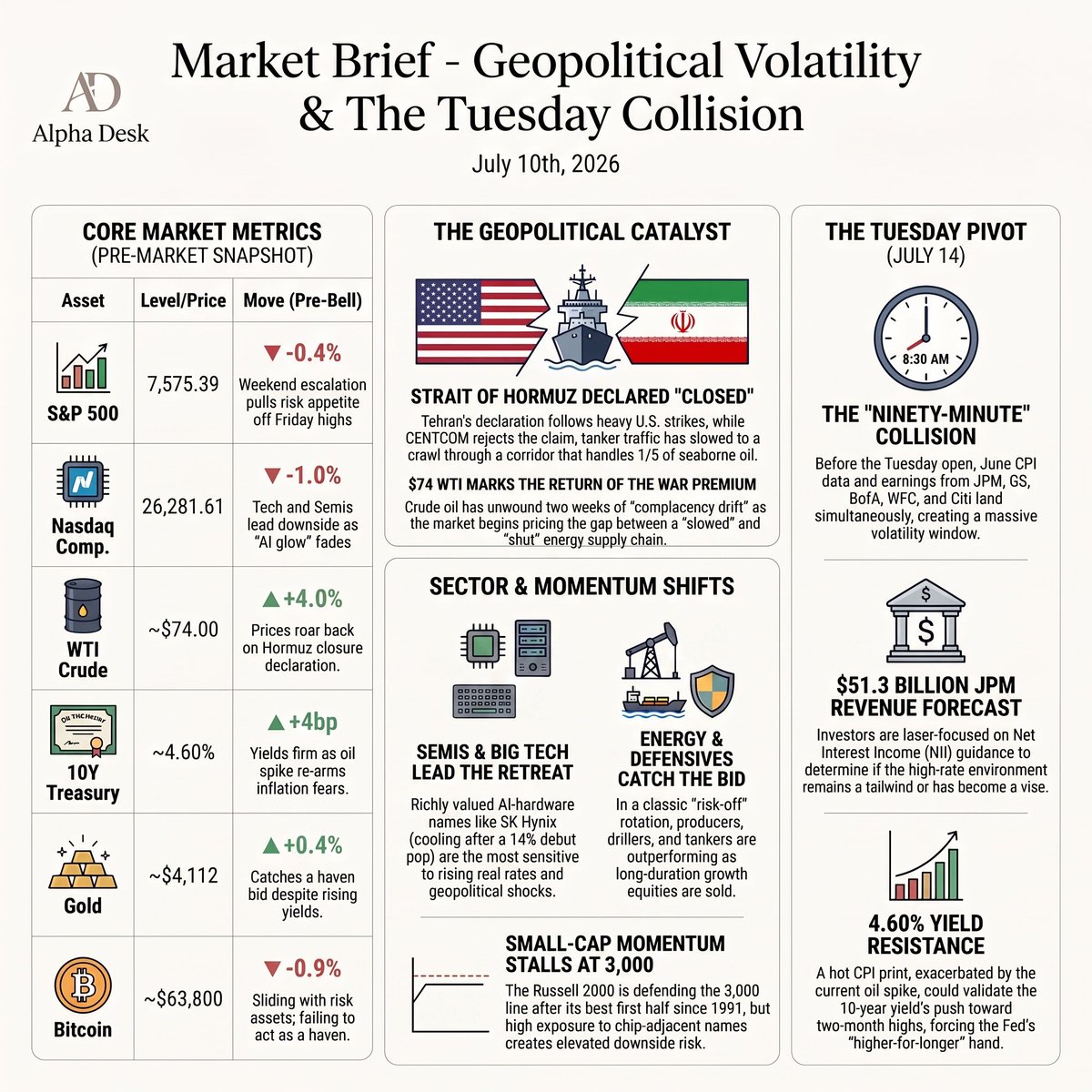
A sudden escalation in the Middle East has triggered a classic risk-off rotation this morning. While military commands contest the announced closure of a major shipping strait handling 20% of global seaborne oil, tanker traffic is slowing, driving tech down and sending energy premiums roaring back into the tape.
Crude oil spiked 4.0% to roughly $74.00, snapping a two-week decline after a regional power declared a key shipping lane closed.
Nasdaq futures fell 1.0% to 26,281.61 as crowded AI growth names bore the brunt of the selloff, while the S&P 500 slipped 0.4% to 7,575.39.
The 10-year Treasury yield jumped 4 basis points to 4.60% as oil-driven inflation fears resurfaced. Despite higher rates, safe-haven gold picked up 0.4% to $4,112, while$BTC dropped 0.9% to $63,800, moving in tandem with high-beta equities.
The Russel stalled out right at its critical 3,000 line, feeling downside pressure due to high concentration in tech-adjacent firms.
On Tuesday, July 14th, at 8:30 AM ET, Wall Street faces a high-volatility collision as marquee June CPI data drops simultaneously with major bank Q2 earnings.
Goldman Sachs is in the crosshairs with a $51.3 billion revenue forecast, where analysts will aggressively parse net interest income guidance to see if current rates have flipped from a tailwind to a burden.
If Tuesday's CPI print comes in hot alongside hawkish net interest income guidance from Goldman Sachs, the 10-year Treasury yield will violently break past 4.65%, instantly forcing the small-cap index to surrender its 3,000 baseline. Consequently, this macro double-whammy will likely trigger a sharp liquidity drain across high-multiple tech, dragging $BTC out of its consolidation pattern and flushing it down to test the $60,500 support level before mid-week.
Tech indices are bracing for a massive structural supply shock today as Nasdaq futures edge down 0.2% to 26,206.89. All eyes are on the monumental U.S. trading debut of South Korea's memory chip giant, serving as a high-stakes referendum on the durability of the global AI infrastructure cycle.
South Korea's memory powerhouse officially debuts its American Depositary Receipts on the Nasdaq today under the ticker $SKHYV. Pricing 177.9 million shares at $149 each, the transaction marks the largest-ever U.S. listing by a foreign company, completely eclipsing Alibaba's 2014 record.
Massive global demand saw the book-building process oversubscribed more than seven times, attracting over $170B in total orders from sovereign wealth and long-only funds. Uniquely, the ADRs priced at a 2.9% premium to their Seoul-listed common stock, defying typical IPO discounts.
SK Hynix will utilize the $26.51B in raw proceeds to aggressively build out its massive Yongin Semiconductor Cluster and expand advanced chip packaging facilities in Cheongju to lock down its 56.4% global dominance in high-bandwidth memory (HBM4) supply.
The 10-year Treasury yield cooled 5 basis points to 4.54% as global crude prices retreated to $72.00, blunting immediate energy-driven inflation anxieties despite ongoing shipping friction.
Easing yields prompted a solid risk-on bid in digital assets, allowing $BTC to jump 2.7% and reclaim technical ground at $64,400.
The broad index is holding flat at 7,543.64 as stronger industrial value names offset defensive tech positioning. Meanwhile, $META saw a 4.7% pre-market software pop, while the small-cap Russell style index firmed at 3,005 to defend its crucial 3,000 baseline.
Monday opens the gate for big-bank Q2 earnings reports, with major financial institutions offering critical commentary on consumer credit health and soft-landing metrics.
Tuesday’s June CPI inflation data will act as a major hurdle, directly testing the technical ceiling on the U.S. 10-year Treasury yield ahead of retail sales metrics.
The immense institutional demand for $SKHYV will likely spark a massive opening day pop past $170, triggering an instant, multi-billion dollar capital reallocation out of direct hardware competitors like $MU and $AMD as funds recalibrate their AI memory weights. However, if Tuesday's June CPI print prints hotter than expected, the temporary relief rally in $BTC will aggressively reverse, flushing the asset back below $61,000 as bond yields hammer high-multiple tech.
A massive regulatory breakthrough in Beijing is helping Wall Street look past escalating Persian Gulf tensions and surging bond yields. Tech futures are leading the advance, with Nasdaq futures climbing 0.7% to 25,818.69, while the broader S&P 500 edges up 0.1% to 7,482.71.
In a major policy shift, China's regulators have quietly granted three of its top domestic AI champions—Alibaba, ByteDance, and DeepSeek—official clearance to import specialized AI hardware.
Total approvals are tightly capped at fewer than 200,000 units. The Nvidia H200 chips are strictly earmarked for training complex large language models where Huawei’s Ascend lineup still trails, while everyday inference workloads are mandated to remain on domestic Chinese silicon.
The regulatory thawing sparked an immediate institutional bid, driving $NVDA up 3.5% pre-market and helping the chip giant decisively reclaim key valuation territory, reversing the bulk of its mid-May correction.
Global hardware desks are laser-focused on Friday’s multi-billion dollar public share sale of South Korea’s memory powerhouse, marking the second-largest equity listing in market history and a major litmus test for secular AI hardware demand.
The 10-year U.S. Treasury yield vaulted 8 basis points to hit a fresh two-month high of 4.59%. Fixed-income desks are aggressively dumping duration following yesterday's deeply divided, 9-to-9 hawkish Federal Reserve meeting minutes and a persistent oil-driven inflation impulse.
Crude oil prices held steady up 0.8% at $74.60, keeping a tight supply-disruption premium embedded as naval forces maintain defensive lines across the strategic Strait of Hormuz.
If this morning's weekly U.S. jobless claims print softer than the 218k consensus, the 10-year Treasury yield will confidently break past 4.65%, instantly freezing the $NVDA pre-market recovery and forcing a deeper liquidation in high-multiple tech. Furthermore, the massive liquidity draw required to absorb tomorrow's historic SK Hynix memory chip share listing will likely trigger a harsh capital drain across the rest of the semi complex, knocking $BTC below $61,500 into the weekend.
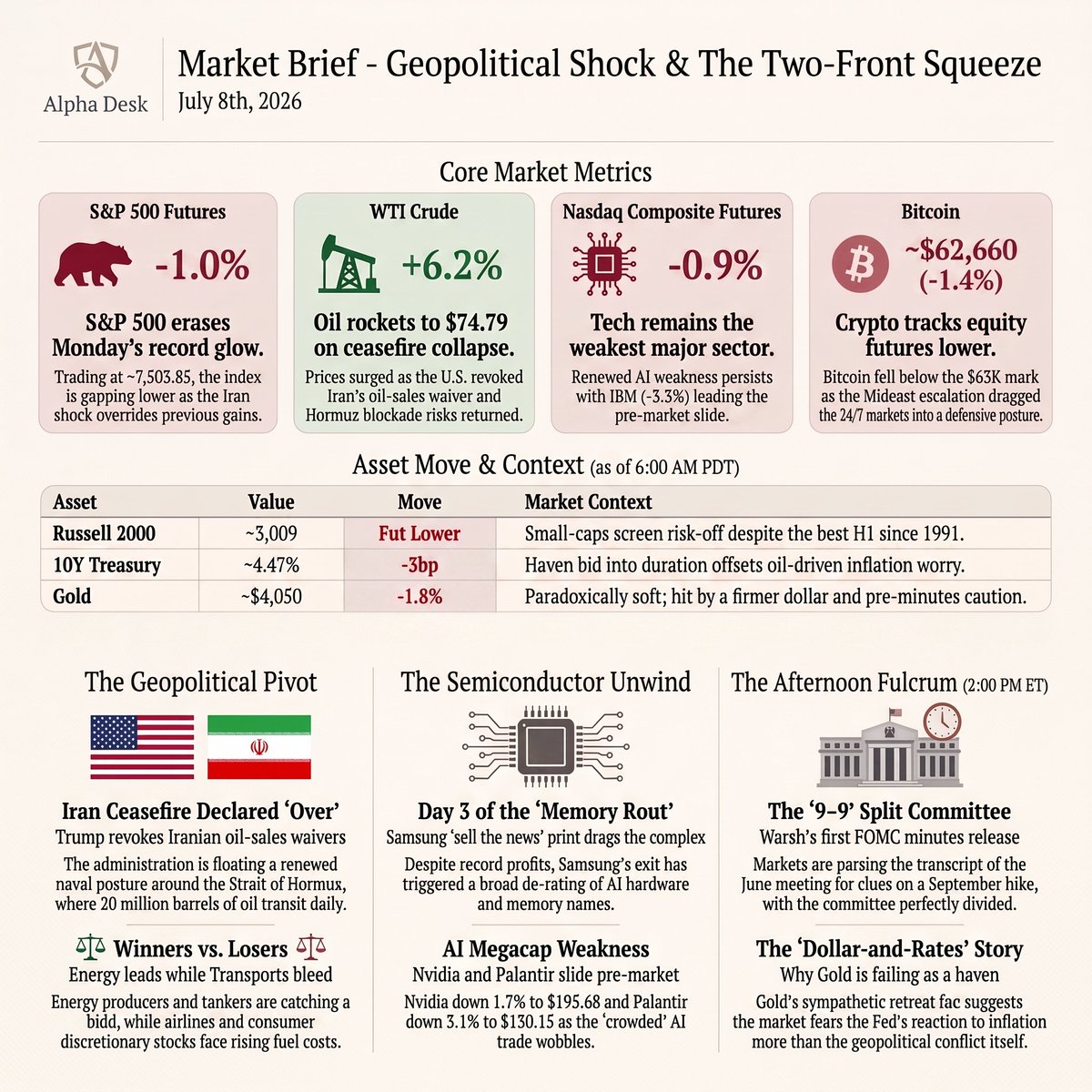
A violent geopolitical shock has triggered a massive, cross-asset liquidity scramble on Wall Street this morning. Global equity futures are sliding heavily as a critical Middle East ceasefire completely falls apart, forcing institutional desks into a defensive risk-off posture right as the automated AI memory chip liquidation enters its third consecutive day.
The administration has officially declared the temporary regional ceasefire over, revoking key oil-sales waivers and deploying a heavy naval defensive posture around a primary shipping strait handling 20 million barrels per day.
The sudden threat to global energy transit sent crude oil tracking up a sharp 6.2% to $74.79, benefiting energy producers and tankers while severely punishing airlines and consumer discretionary names.
Broad market futures rolled over to slide 1.0% to 7,503.85, erasing recent record achievements. High-beta risk assets tracking the drop dragged $BTC down 1.4% to breach the key technical baseline, trading at $62,660.
The 10-year Treasury yield dipped 3 basis points to 4.47% as frantic defensive rotation into duration offset immediate energy-driven inflation fears. Safe-haven gold was unexpectedly sold for raw cash to meet sudden margin calls, dropping 1.8% to $4,050 on a strengthening dollar.
Profit-taking from Samsung's recent earnings print has snowballed into a broad sector-wide de-rating of AI hardware and infrastructure plays.
Heavy tech concentration continues to act as a core source of market fragility. Mega-cap tech futures slid 0.9% pre-market, with key hardware and software bellwethers shedding 1.7% to $195.68 and 3.1% to $130.15 respectively as the crowded long trade unwinds.
Russell index was pulled back down to the 3,009 level, underperforming despite its historic first-half breakout as institutional desks pull collateral from micro-cap lines.
Global macro desks are laser-focused on the 2:00 PM ET release of the central bank meeting minutes. The document will layout a highly critical, historic 9-to-9 committee gridlock over whether sticky underlying service data warrants an aggressive interest rate hike this September.
If this afternoon's deadlocked central bank minutes tilt heavily hawkish on inflation, the 10-year Treasury yield will instantly reverse higher past 4.55%, breaking the small-cap index below its critical 3,000 support floor. Furthermore, the combination of a direct naval escalation and ongoing margin liquidations in AI chips will likely flush $BTC through its localized support and down toward the $58,500 level before the weekend.
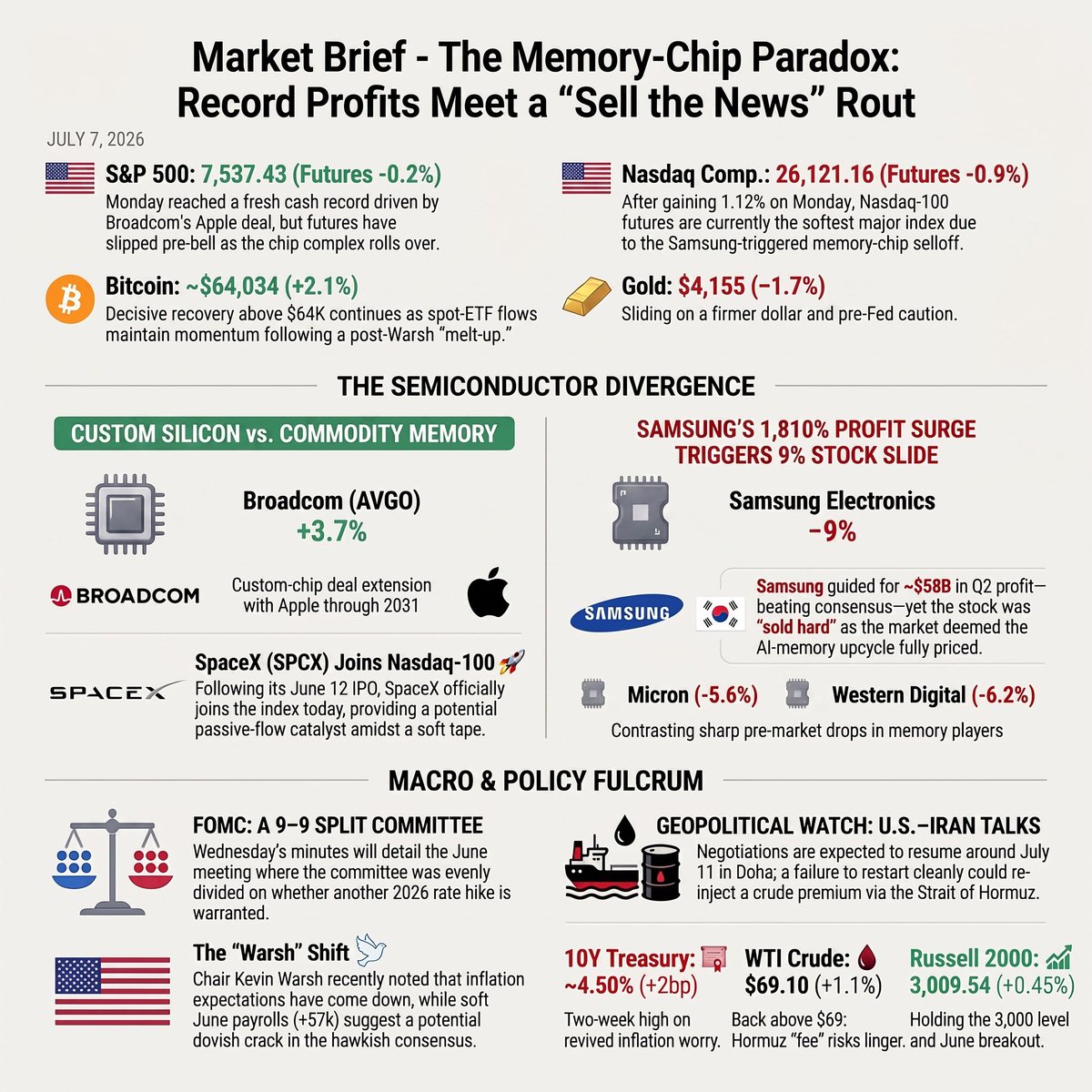
A severe "sell the news" liquidation cycle is shaking the tech sector this morning. Despite booking block-buster earnings, global semiconductor giants are facing heavy institutional profit-taking, dragging the tech-heavy index down 0.9% to 26,121.16 while the broader large-cap index edges down 0.2% to 7,537.43.
Samsung guided for an eye-popping $58 billion second-quarter profit—smashed analyst estimates—yet the stock collapsed 9% in overnight trading as asset managers declare the AI hardware upcycle fully priced.
The commodity memory selloff quickly contaminated US pre-market trading, with $MU sliding 5.6% and Western Digital dropping 6.2%. Bucking the trend, Broadcom jumped 3.7% after securing a multi-year extension to its proprietary custom-silicon chip pipeline with Apple through 2031.
tech bulls a minor shield, newly listed aerospace juggernaut $SPCX officially joins the technology-heavy index today, introducing massive mandatory passive index buying.
Fixed-income desks are bracing for tomorrow's central bank meeting minutes, which will show a historic 9-to-9 committee split on whether sticky inflation warrants a final 2026 interest rate hike.
June nonfarm payrolls printed at a sluggish +57k, validating statements from the committee chair that secular inflation expectations are structurally cooling.
The 10-year Treasury yield firmed slightly up 2 basis points to 4.50%, while the small-cap Russell style index gained 0.45% to hold its historical breakout above the 3,009.54 milestone.
Global oil ticked back up to $69.10 on lingering Hormuz transit fee risks ahead of Doha negotiations on July 11. Meanwhile, gold fell 1.7% to $4,155 on dollar strength, while $BTC surged 2.1% to $64,034 on persistent institutional spot ETF inflows.
If tomorrow's deadlocked central bank minutes tilt hawkish, the 10-year Treasury yield will easily clear 4.55%, breaking the small-cap rotation and crushing the 3,000 index support level. However, the sheer gravity of passive fund managers mandatory-buying $SPCX for its index debut today will likely trigger a massive localized short squeeze, popping the space stock back past $180 by the cash close.
Global indices are logging a strong post-holiday session as risk-on sentiment returns, pushing the tech-heavy index up 1.0% to 25,832.67 and large-caps up 0.4% to 7,483.24. Despite a soft June jobs report anchoring the front end of the curve, equities are shrugging off macro drag to focus on individual tech and commodity drivers.
Chip infrastructure is staging a vital pre-market recovery, with the primary semiconductor industry fund rising 2.4% to defend its core AI leadership floor following a sharp two-day slide.
Passive index fund managers are bracing for massive rebalancing flows today as the recently listed aerospace giant $SPCX officially gets added to the major technology index.
The weakening dollar has sparked a swift safe-haven rotation into precious metals, driving silver up 2.43% to $62.55 and gold up 0.92% to $4,163.60.
Benchmark crude oil fell 0.52% to $68.33 after a global oil producer group unexpectedly agreed to lift August production allocations by 188,000 barrels per day.
Energy traders remain highly cautious ahead of Friday's international diplomatic talks between Washington and Tehran, attempting to parse whether a resolution can be reached regarding Iran's new regional transit fee demands.
The 10-year Treasury yield is idling at 4.42% as fixed-income desks await tomorrow's central bank meeting minutes to look for shifts in the underlying rate consensus.
If tomorrow's central bank minutes reveal a growing internal consensus to cut rates following the soft June jobs data, the 10-year yield will likely flush below 4.35%, sparking a massive short squeeze that catapults small-caps past the 3,000 psychological barrier. Additionally, the official index inclusion of $SPCX today should trigger an intense, automated passive buying wave, forcing structural capital out of legacy hardware plays like $INTC to fund the tracking weight.