It goes without saying that in a world where global firms (mostly US firms) report earning EUR 300b in Ireland & up to $300b in Singapore (Table 2 in the staff report, primary income payments) the United States is losing a lot of tax revenue to global tax arbitrages
11/11
https://t.co/4shkK7wuG0
@CtheLala@BharatRamamurti As I understand, way more feasible for FTB to only have to determine residency & valuation once, rather than every year, absent big boost of resources to FTB. So helps collect more $ in early years / let less revenue slip away thru avoidance.
@CtheLala@BharatRamamurti Totally agree. Design choices were logical downstream from accepted wisdom that temporary = more public support. But also invited their own PR headaches; meanwhile I don't think anyone really believed it would actually be only temporary.
@CtheLala Agree with @BharatRamamurti that an ongoing 1% tax may have been more palatable than a "5%" "retroactive" measure, which can be made to sound scarier despite actually being more modest. Interesting lessons for the future.
@CtheLala And once you make it temporary, there are huge administrative advantages to making it one-time. But agree that going forward it's worth reassessing that perception in light of Prop 40 vs success of, e.g., MA's Fair Share Amendment & CO's Amendment 87, both permanent.
1) Political mess. Unions split on it, partly because of infighting, partly because of political pressure from Newsom.
2) Money isn't everything, but the level of spending against was enormous. By far the most expensive ballot measure campaign in history. And the message the opposition spread was not 'the tax is badly written' but things like 'this tax has a loophole that will come for everyone next,' which was pretty much a lie. But the message really stuck, especially because the prop Prop 40 campaign never got enough money to really get on TV or get its money out. I believe outsized spending does matter if the other side gets basically no air time to get their own message out.
@TheStalwart Some of this was internal coalition dynamics; some was Newsom deciding to oppose and pushing his allies to join him.
https://t.co/V3wuWXRlnZ
1) It didn’t get crushed. It’s down <7% with 5 million CA votes left to count, which typically trend more progressive. I bet it’s quite close when all is said and done.
2) The fact the proposal dedicated all revenue to a single (important) cause ended up fracturing the natural coalition that would normally exist around a wealth tax proposal.
3) Specific design here — one-time, retroactive, larger rate — while understandable in this context, made it easier to attack in my view than an annually applied tax at a smaller rate.
4) Opponents outspent proponents by hundreds of millions on ads (will be true re: almost any effort to meaningfully tax the rich, so Dems need to be prepared for this for all non-wealth tax efforts too).
5) The push to establish a federal income tax took many years, ultimately including a constitutional amendment. There were many hiccups along the way. Need to learn from this and keep up the fight for smart, politically salient, economically efficient ways to better tax wealth/capital income.
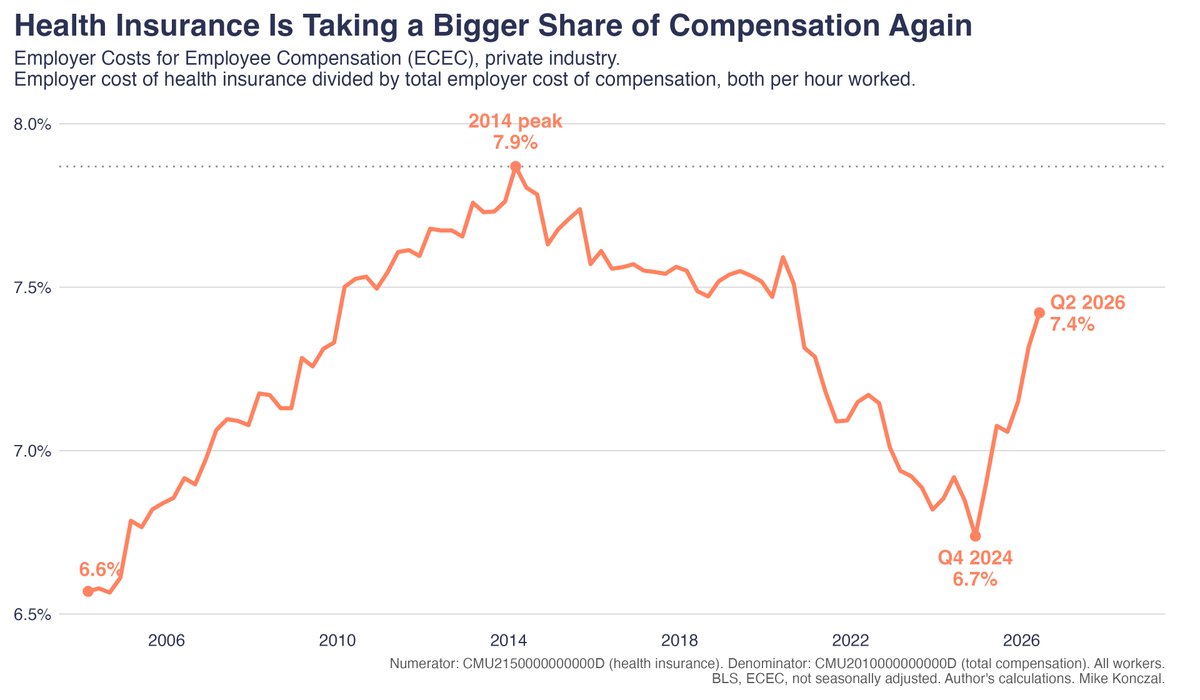
I was curious and dug more, and this is even more notable.
From ECEC data, the employer payment for health insurance as a percent of all compensation, which hit decades low at the end of 2024, is skyrocketing under Trump.
You enjoy all that extra healthcare instead of wages? /2
A very strange assumption in the Rauh paper:
Migration is assumed permanent if the tax passes and is struck down in court. But if the tax fails in the polls, all billionaires return!
This combination reduces the NPV without concluding that the migration loss is already baked-in
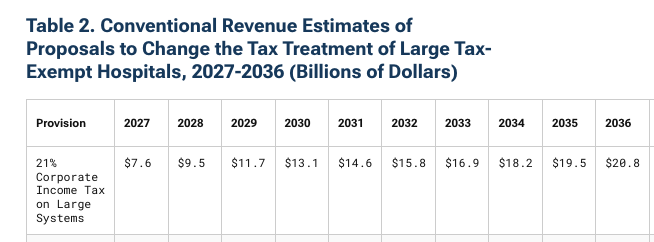
.@GS_Watson and I explored policy options to reform the tax treatment of nonprofit hospitals.
We estimate that subjecting large hospital systems to the 21% corporate tax would raise nearly $150B over 10 years.
(1/5)
@jasonfurman@pdriessentax proposes a perfectly consistent way to model w/o predicting renewal.
Projecting 100+ yrs into future w/o any belief updates, as the paper does, strains the entire exercise IMO. Pick one or the other, which is what I take Zucman to be saying.
https://t.co/x2slu3q71q
Here's what a 'neutral' estimator would do:
(1) Convention requires assumption of no second CA wealth tax
(2) Predict who leaves, and economic activity, during relevant budget period. That means not only looking at 2027, but also, say, 2037
1/2
https://t.co/dN3GeO0yso
@jasonfurman But, if purporting to estimate effects 100+ yrs into future, I think it becomes more relevant whether the tax is revived. If after several decades it is never renewed, I'd expect some updating of beliefs & resultant behavioral effects. Not considering seems like a mistake. (2/2)