This was one hell of an engineering challenge. A real NLE in the browser!
Multiplayer, agent-first, with audio and color that works. Fully fleshed out.
Super excited for this one!
A multi-player semantic editor is the new frontier of video editing. We are rolling this out over the next 2 weeks as capacity expands. Servers are burning as agents are using this in the background. It's agentic, in the browser, collaborative and can work offline. Comes with a Digital Asset Management system. It was a loooong build cycle
I agree.
I think a lot of the folks in the "software is solved" camp aren't being bold enough.
If you try to do something really really difficult, well beyond what anyone has previously achieved in the field, you'll see the limitations and opportunities clearly.
✅ ✅ ✅
People who aren’t themselves excellent at product do not have the capacity to understand the significance of what @bchesky is saying here and why it is so.
Professional investors and analytically gifted people often argue: “but surely as a founder you can delegate this”.
Truth is that you can only delegate it to a handful of people on the planet, and those people are founding their own companies or are otherwise creating tremendous value for themselves, so it is rare to be able to hire a product person who can do what you do.
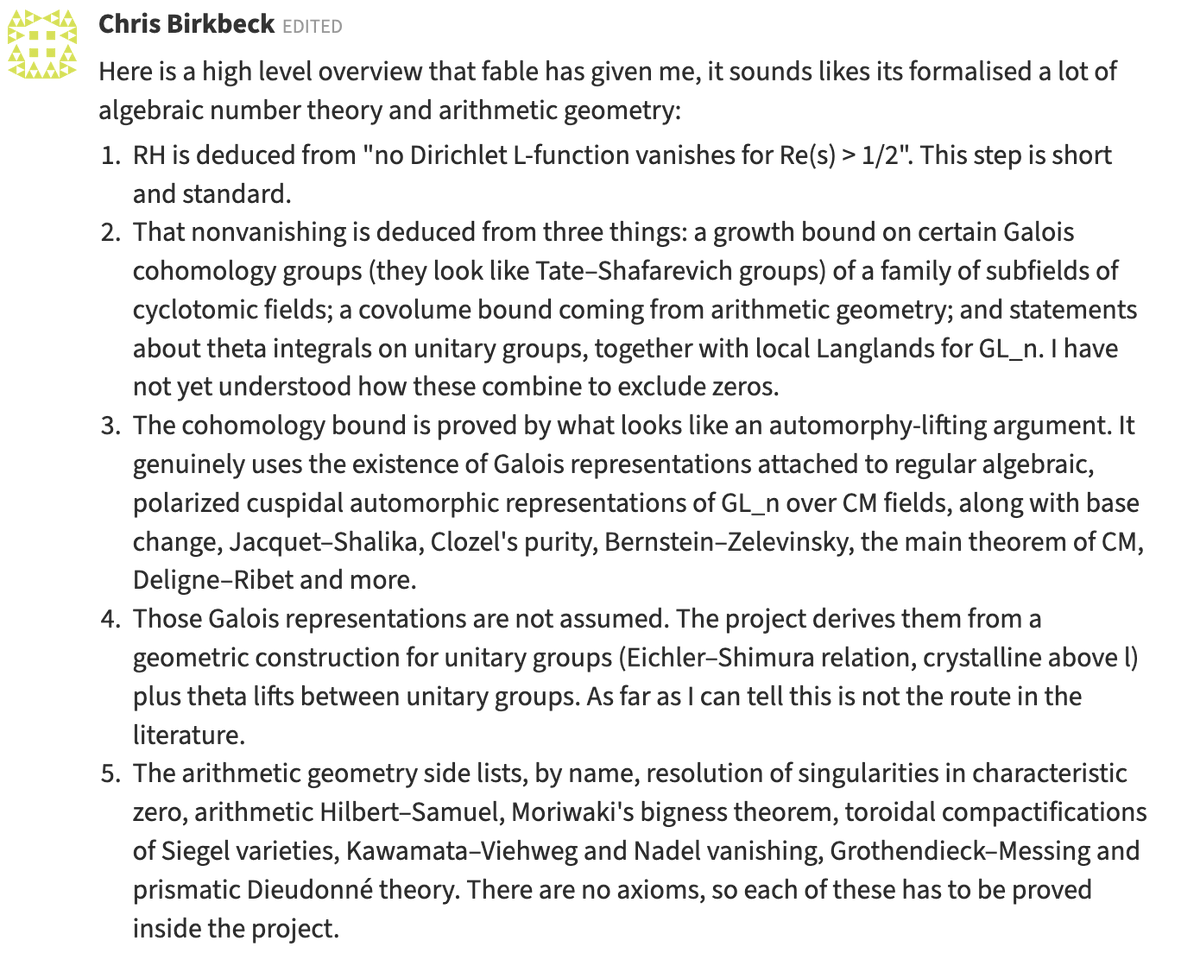
Like most mathematicians, I believed the Riemann Hypothesis to be completely out of reach at present (even with the best AI tools), because I expected it to require substantial theory-building, probably in arithmetic geometry. The kind of new theory-building that fills entire books, and that AI isn't so good at yet.
Mathematicians have a notion of how deep a problem is. A sufficiently deep problem is generally intractable until enough of the theory is in place. If difficult problems are like valuable mineral reserves buried miles underground, you first need to build the infrastructure to reach them.
What Levent's proof seems to have done instead is something completely different. It takes an incredibly complicated tour through the infrastructure built for a hundred other mineral reserves, situated far from the destination, and somehow create a wormhole to the original destination.
This is not theory-building in the usual sense. It is something much weirder and more alien. The best human mathematicians know how to build theory, painstakingly, to reach a goal. But no human brain, on its own, is capable of creating a wormhole that requires a 25,000 page long tour through existing infrastructure with no obvious or realistic connection to the goal. But huge credit to Levent here: I think no current AI, on its own, is capable of this either.
I had never worked on or thought too much about the Riemann Hypothesis: it seemed very far removed from my own area of number theory.
But the astonishing thing about Levent's claimed proof of RH (which I think has a very good chance of being correct) is that it uses a huge number of precisely the things that are central to my own corner of number theory:
- Theta functions and other automorphic forms on unitary groups
- Gan–Gross–Prasad period formulas
- Relative trace formulas
Etc., etc.
A problem that I had always assumed would require new theories in arithmetic geometry may instead turn out to be tractable through an inhuman chain of existing (deep) results in higher-rank automorphic forms (and a lot else).
Inkling 2 Mini is a looped transformer that runs on a laptop.
Looping lets a model think more and write less. At this scale, its thought process remains monitorable; this may not stay the case. We’re also sharing a variable-loop research model to enable further study.
Over the past week, I’ve been overwhelmed by the love and support of friends, industry colleagues, and people I've never met. Thank you to everyone who has shown kindness to my family and me. It means the world to me.
I came to the United States 53 years ago, and becoming an American citizen is one of the greatest gifts and proudest moments of my life. NVIDIA has been my life’s work. Building it into the company it is today alongside my colleagues has been a privilege and an honor. Nowhere but in America could a company like NVIDIA be possible. I love our country, and I love NVIDIA.
I did not live up to the standards expected of everyone at NVIDIA, and I have made serious mistakes in my personal life. I created problems for the Board that I deeply regret. I own my mistakes completely, and I am committed to cooperating with the Board’s independent investigation.
Since my departure, I’ve seen an outpouring of calls from NVIDIA’s employees, investors, business partners, and customers for me to return as CEO. Many continue to reach out to me directly as the company navigates complex technology, market, competitive, and geopolitical dynamics. NVIDIA is a once-in-a-generation company. If the Board of Directors decides that my return is in the best interest of our shareholders, our employees, the company, and America, I would be honored to answer these calls and return as CEO.
Thank you again to everyone who has shared their good wishes. I am profoundly humbled by your support. To my family: I love you, and I will spend the rest of my life being worthy of yours.
Jensen
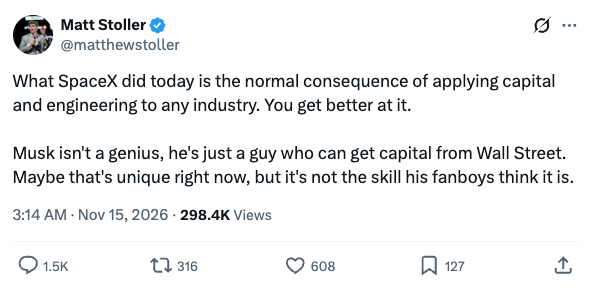
You work your ass off solving really hard problems day after day for decades, and this is what you get: anyone could have done it.
As an investor, I can tell you the limiting factor isn't investment. It's founder ability.
"We all must have experienced how lazily, and, consequently, how ineffectually, instruction is received when forced upon the mind by others. Few have been taught to any purpose who have not been their own teachers."
— Joshua Reynolds
https://t.co/TT92PdVdXw
By now you have probably heard about the sshhole bug. I didn't want to talk about on X until it had already attracted enough notice here that my analysis wouldn't be revealing anything to potential bad guys.
It's really, really bad for Alpine Linux systems and others using MUSL as their C library. However, I think we've dodged the bullet that was the worst possible case: it could have opened a gaping root-access hole in any router running OpenWRT. That's, like, maybe 30% of them? On the order of 100-500M units worldwide.
These are not yet confirmed findings, because frickin' chatGPT doesn't consider me authorized to do security analysis using it. I'm posting this hoping a real infosec guy with those creds can confirm.
I first learned of this bug this morning when @dfranke texted me "Anyone with an OpenWRT router needs to unplug it. Now. Run."
On further investigation, though, the bug only seems to bite if you have a root account that has shell access and a password field of "*" (disabled).
Out of the box, OpenWRT ships with an empty root password. This is not the same as a "*" password field and should prevent the MUSL bug from biting. And while it's quite common to disable password access to that account, usually people do that with SSH server-side configuration rather than by modifying the password file in the dangerous way.
All the other avccounts OpenWRT configures in have a shell entry "/bin/false", So you can exercise this bug on the ones with password field "*", but you can't exploit it.
So unless you've done something rather weird to its configuration, your OpenWRT based router is probably okay. You should, however, inspect it to make sure that your root account has a password ("x" entry in the hash field) and all the accounts that don't have shell access safely directed to /bin/false.
But again, this is not a confirmed result. If you're an infosec guy with the right tools, please check it immediately.