@mordrissera Au-delà de ça être père ou mère n'est pas un acte politique. Considérer ses propres enfants comme des moyens politiques et non pas des finalités en en soi est horrible.
@pegobry_en Music + Lyrics is likely all AI, made with @suno or something similar. Video is trickier. The shots look planned by a human then generated.
I have said all along that I am not taking a public stance against or in favor of the SSPX, and that remains true. As a result, fire-breathing opponents of the Society, some of whom (I am ashamed to say) even rejoice in today’s excommunications, will no doubt write me off as a duplicitous agent, while adamant defenders of it may call me a coward or a half-hearted defender of tradition. And so on. I’ve heard it all before.
But it’s not fundamentally about attitudes, it’s about theology. As a philosopher and theologian, I can make convincing arguments on both sides all day long.
The one side takes as its first principle that communion in the Church requires, above all else and before all else, union with and submission to the pope of Rome; and therefore absolutely nothing could ever “compete,” as it were, with this good. It is the “summum bonum” as far as the Church on earth is concerned; one may never, in any circumstance whatsoever, defy church authority.
The other side takes as its first principle “salus animarum suprema lex” (the health, welfare, salvation of souls is the highest law)—a law, they argue, which can, in peculiar circumstances, suspend or modify the usual rights of the Church hierarchy, which has as its raison d'être bringing souls the goods they need and deserve (the pope as “servus servorum Dei”; another way of putting it is that authority loses its binding force when it threatens or undermines the common good).
Obviously, this is a mere sketch of the two sides, and whole books have been written from and for the one or the other perspective. (I have contributed to this literature with several books, among them "True Obedience in the Church: A Guide to Discernment in Challenging Times" and “Bound by Truth: Authority, Obedience, Tradition, and the Common Good.")
If you think the one or the other position is obviously, self-evidently, exceptionlessly correct—a “no brainer”—then I believe you might be a simpleton. You might be deceiving yourself if you have no moment of hesitation or doubt, no sympathy that might tug you toward the opposite point of view. That is why I consider this moment to be especially tragic: it causes division not only within the Church at large, but also within the breast of every educated and attentive Catholic, in whom the tension between tradition and authority is like a perpetual tug of war. *It should not be this way* and that itself is a sign of the depth of our crisis.
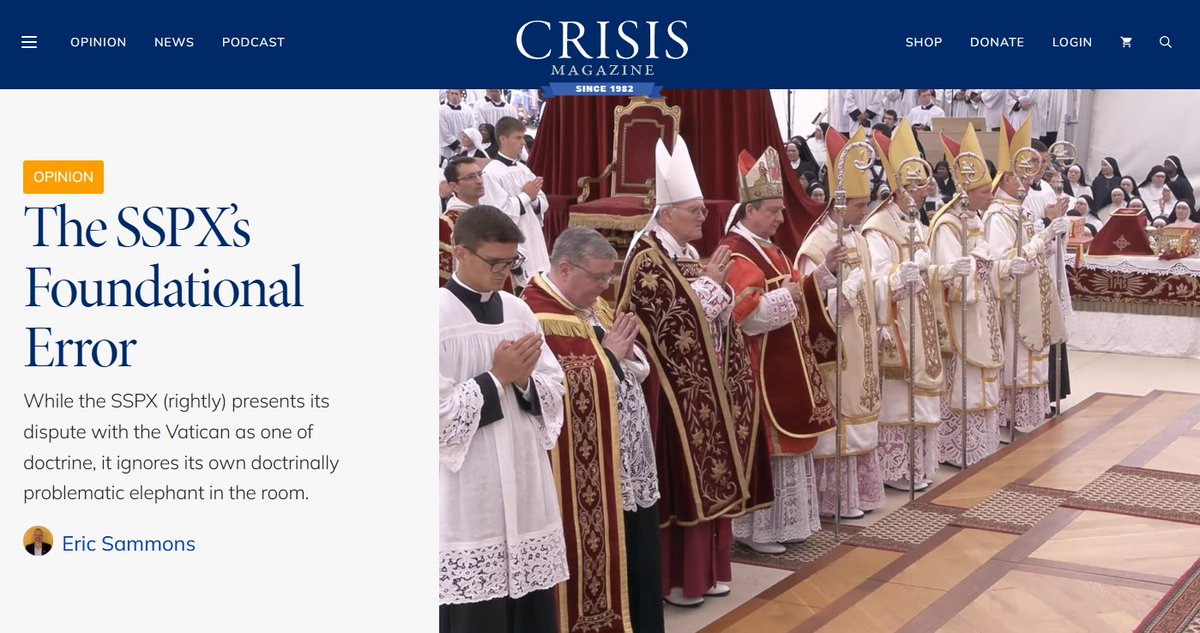
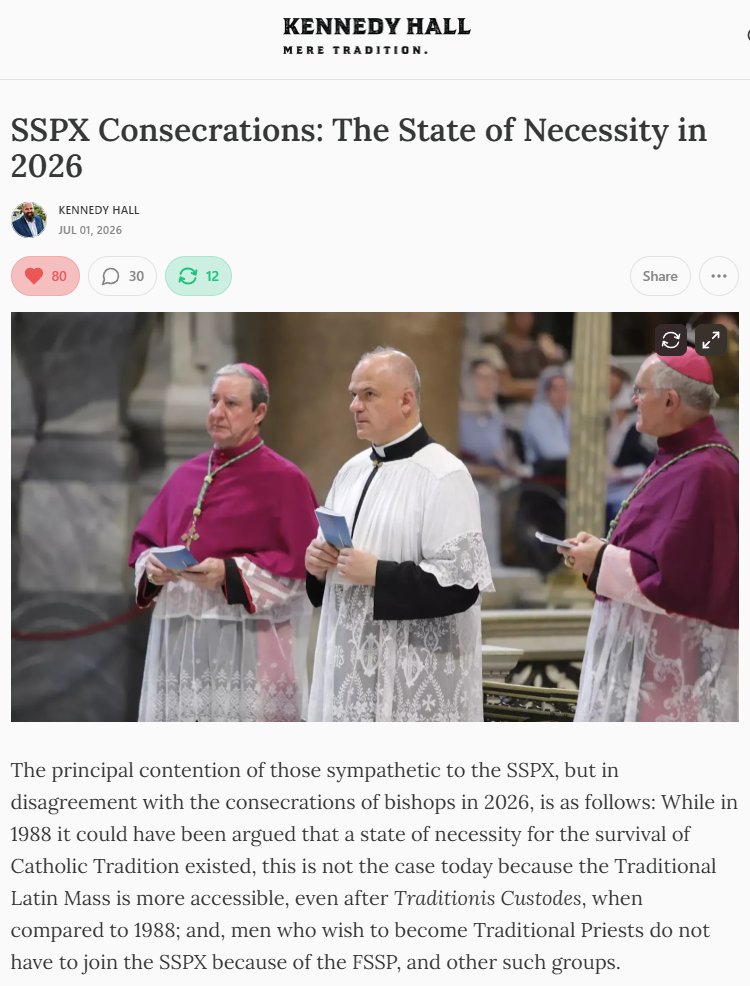
So much is being written about these things that one can feel overwhelmed, like a swimmer drowning in a stormy ocean. For this reason, I would like to present two essays that seem to me to convey effectively the two positions sketched above: one, against the SSPX, by Eric Sammons; the other, by Kennedy Hall, in favor of it (links below).
I defy anyone to read these carefully and then to say, of either one, “It’s worthless, he has no case to make, it’s a closed book—just obey! (or: just shake the dust off your feet!).” I don’t think anyone, not a single person, has a slam-dunk case at this moment. To be completely honest and transparent, THAT is why I don’t come down more definitively on these questions. My conscience would not allow me to do so, and I’m enough of a disciple of St. Thomas Aquinas and St. John Henry Newman to know that I cannot act against my conscience.
No one, at any rate, could call into question my devotion and dedication to liturgical tradition, which I consider the single most important issue facing the Latin Church—yes, in a way, even greater than doctrinal issues. After all, in the very diverse world of Catholic traditionalism, the traditional Roman Rite is perhaps the one and only thing on which every type of traditionalist agrees. It has at least a pragmatic priority as a non-negotiable pastoral good. Regardless of how much the SSPX may insist on “doctrine” as its principal focus, the TLM is inseparable from its overall case (can you imagine an SSPX with the Novus Ordo?).
And that is why, as long as ‘Traditionis Custodes’ remains on the books and bishops are allowed to destroy TLM communities with impunity, there will be no prospect of peace on the horizon, and the Society will continue to expand. The key to overcoming this purported schism rests firmly in the hands of the Church hierarchy, which can end the liturgical (and doctrinal and moral) crisis whenever it truly desires to do so or even begins to desire to do so. That may still be a very long time.
“O God, the heathens are come into thy inheritance, they have defiled thy holy temple… We are become a reproach to our neighbours: a scorn and derision to them that are round about us. How long, O Lord, wilt thou be angry for ever: shall thy zeal be kindled like a fire?... Remember not our former iniquities: let thy mercies speedily prevent us, for we are become exceeding poor. Help us, O God, our saviour: and for the glory of thy name, O Lord, deliver us: and forgive us our sins for thy name's sake… Let the sighing of the prisoners come in before thee.” Psalm 79 (DR)
Eric Sammons:
https://t.co/wWcVCTwLnV
Kennedy Hall:
https://t.co/JmOtjliVEi
"True Obedience in the Church"
https://t.co/iLcc6v2d8f
"Bound by Truth"
https://t.co/x9JNdzvZRh
@Peste_Lente En parlant de metal australien je te conseille *très* chaudement Be'lakor, peut-être mon groupe préféré. (ils font du melodic death metal, sans aucune surprise venant de ma part).