Your invite expired at noon. MongoDB might still have it at 12:01.
TTL indexes remove expired documents in the background. Check expiresAt when someone opens the invite so access ends on time. Let TTL handle deletion.
#MongoDB#BackendDev
MongoDB returned 20 documents after examining 80,000. The response body won’t tell you that.
Run explain("executionStats") and compare totalDocsExamined with nReturned. A big gap gives you a reason to inspect the query plan.
#MongoDB#Databases
In Express, “me” can accidentally become a user ID.
Register /users/:id first and it can catch GET /users/me. Put the literal /users/me route above the parameterized one, then test both URLs.
#ExpressJS#WebDev
Express 5 can save you a try/catch block in every async route.
When a promise returned by the handler rejects, Express forwards the error automatically. Put your four-argument error middleware after the routes to handle those failures in one place.
#ExpressJS#NodeJS
A 2 GB download shouldn’t need 2 GB of server memory.
In Node.js, stream the file with pipeline(). If the client downloads slowly, backpressure slows the read so your server doesn’t have to buffer the whole file.
#NodeJS#BackendDev
One expensive loop can make every Node.js request behind it wait.
Adding async won’t move the calculation off the event loop. For recurring CPU-heavy work, a worker_threads pool can keep that work off the main thread.
#NodeJS#JavaScript
Your repository test passed. PostgreSQL still rejected the query.
If production uses Postgres, run integration tests against a Postgres container. Spring Boot’s @ServiceConnection can supply the connection details from Testcontainers.
#SpringBoot#Testcontainers
A 200 OK can still take five seconds.
Spring Boot Actuator gives you a health endpoint and access to request timing metrics. Use both. An API can be up while users are staring at a spinner.
#SpringBoot#Observability
Spring Boot - Java
A strong choice for large, complex applications.
Pros:-
• Great for enterprise applications
• Strong security and scalability
• Excellent database integration
Cons:-
• Steeper learning curve
• Can use more memory
Best for: Enterprise systems, banking apps, and microservices.
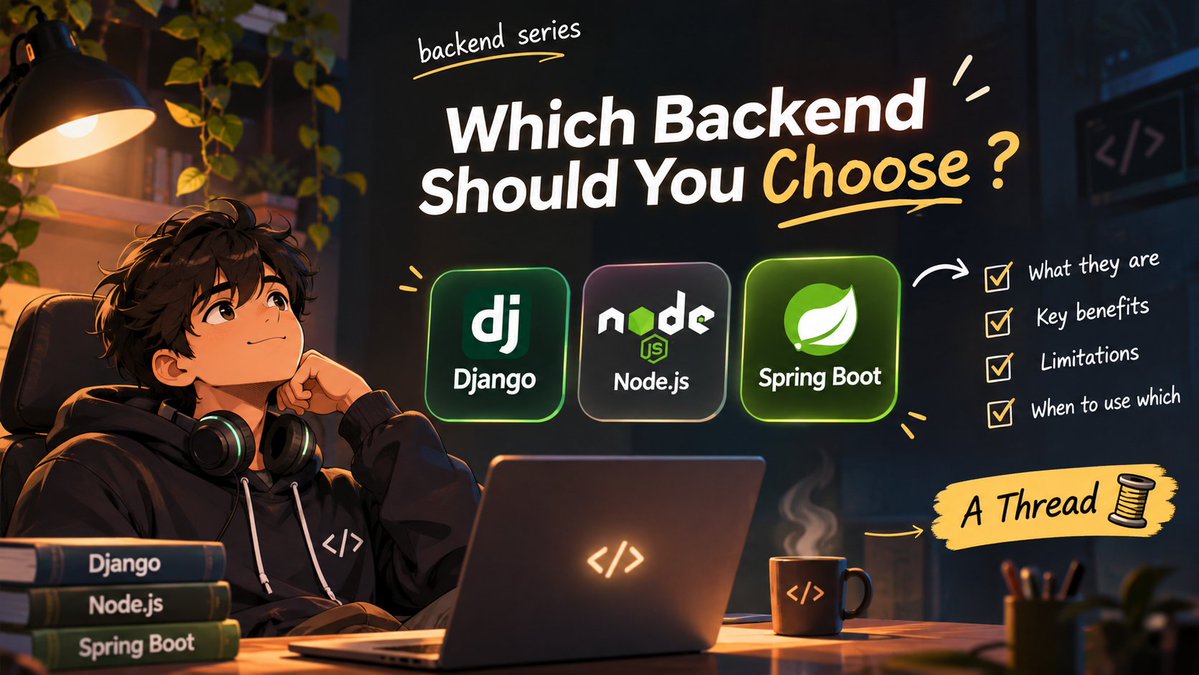
Django, Node.js, or Spring Boot?
Which backend should you choose?
Let's compare their strengths, weaknesses, and best use cases.
#Backend#WebDev#Programming
Node.js - JavaScript
A great choice for fast, real-time applications.
Pros:-
• JavaScript on both frontend and backend
• Great for real-time apps and APIs
• Huge npm ecosystem
Cons:-
• CPU-heavy tasks can block the event loop
• Requires more setup and library choices
Best for: APIs, chat apps, and real-time services.
A typo in mail.timeout should break startup before it breaks your first email.
In Spring Boot, group your mail settings with @ConfigurationProperties. Add @Validated and constraints so invalid values fail when the app starts.
#SpringBoot#Java
The cheapest Django query is the one you skip.
If you only need a yes/no answer, use .exists(). If you’re about to loop through the same unevaluated QuerySet anyway, .exists() can add a database trip before you fetch the rows.
#Django#Python
The customer got “Order confirmed.” The order never made it into the database.
That can happen when you send an email inside a Django transaction that later rolls back. Register the send with transaction.on_commit() so it runs after the commit.
#Django#BackendDev