Guys & girls!
Exactly a year ago I promised over 15 bugs in win32k.
You're welcome to read and find out about my biggest research so far: #win32k#SmashTheRef bug class - https://t.co/niPACKBBLd
Check out the paper and the POCs, there are some crazy stuff going on. Promise!
@yo_yo_yo_jbo Yeah
But the amount of work for a book is insane. I’ve been writing content (blogs and articles and presentations) all my life and a book goes a few times beyond.
Unless you go into describing personal journeys and experiences, then I’d personally wouldn’t bother.
Some stats on #php2shell. In the 10 hours before it was publicly announced, across the @Cloudflare network we saw thousands of attempts to exploit it. That jumped to tens of thousands in the 45 minutes post announcement, hundreds of thousands within 2 hours, and millions now.
Crazy 72 hours in security. Three major incidents dropped back-to-back: eMudhra, PingCAP (TiDB Cloud), and PHP.
Here is the short version of what happened and who got hit.
1. eMudhra (Trusted CA compromise)
eMudhra generated 8 intermediate CA certificates in April 2025 (cross-signed by Sectigo). A bug in their HSM key-wrapping test script created a second set of P-384 keys where the private keys were single-byte numbers under 256. Operators picked the wrong key labels and signed them into real CA certs.
One of the intermediate CA private keys was literally the number 4.
The other seven: 56, 66, 115, 155, 156, 230, 237.
Three weeks later (May 2025), their CRL signatures started failing because the CRL signer was using the real keys instead of the weak ones. Instead of asking why the keys didn't match, someone switched the CRL signer to the weak keys and closed the ticket.
• Browsers are safe: Chrome, Firefox, Apple, and Microsoft already blocked them, and zero rogue certs hit CT logs.
• Servers are not: curl, Python (certifi), Go binaries, and Docker base images don't check CRLs. Update ca-certificates, certifi, and Go (1.27.3 / 1.26.10).
• 10-second check on any server:
curl https://t.co/vhiGLxNhIS
(TLS error = safe. 200 OK = still vulnerable.)
2. PingCAP / TiDB Cloud (10.6 TB breach)
Attackers found GCP and Azure credentials committed inside PingCAP's own repos. They set up a replication feed of TiDB Cloud's production control plane and exported the entire database every 6 hours for 22 straight days. 88 full exports, zero alerts. 200 GB is already out on torrents.
Beyond the 413 private repos and 20.6M customer SQL queries logged from their web SQL Editor, PingCAP engineers were pasting customer secrets into Jira tickets.
Who is affected in the leaked records:
• Live credentials exposed in support tickets:
- Pinterest: AWS keys for their pingcap-logs S3 bucket
- CardX / Silverlake (NPCI-linked env): AWS admin key in a backup log with full access to 258 external S3 buckets
- DeBank: 38 presigned S3 URLs
- An unnamed AI/dev platform: a 314 MB slow-query log attached to a ticket containing 8,027 live customer secrets (an AWS root key, a GitHub admin PAT over 1,701 repos, 7,485 AWS STS tokens, and 192 OpenAI/Anthropic/Gemini keys)
• Tenants with infra metadata, VPC CIDRs, app-server IPs, or contract pricing exposed:
- Tech: Atlassian, Databricks, Airbnb, Baidu, LINE, Nylas, Persona, PatSnap
- E-comm & Travel: https://t.co/C512KFOEq5, Shopee, Flipkart, Mercari, ZOZO, AEON, Delhivery, Klook
- Gaming: Capcom, Square Enix, Konami, Bandai Namco, Cygames, Colopl, DMM
- Finance: PayPay, SoftBank, SBI, SB Payment Service, Fujitsu, TOPPAN, Bank of China, China Life
- Crypto: Bitget (said only public trade logs were on it and they already left), Pionex, DigiPlus, NFTscan, Chainbase
• Developer profiles leaked (from a purchased https://t.co/28tjHqd5Wr table in PingCAP's BigQuery):
- 24,900 personal emails + GitHub/LinkedIn profiles of engineers at Tencent (3,327), Huawei (2,726), ByteDance (2,475), AIG (2,140), Mastercard, Flipkart, and bKash.
If you use TiDB Cloud: rotate your console API keys, DB passwords, and anything you ever pasted into a support ticket.
3. PHP "PHP2Shell" (CVE-2026-109618 & CVE-2026-109619)
Two CVSS 9.2 pre-auth RCEs leaked yesterday ahead of today's 14:00 UTC patch.
Public writeups trace it to a heap Use-After-Free in PHP's native C multipart/form-data session upload-progress handler (ext/session/session.c).
Because C-level multipart parsing runs before line 1 of index.php:
• App auth, Laravel/WordPress middleware, and file_uploads = Off do not stop it.
• Only PHP 8.2–8.5 get official patches today (59% of PHP servers on Shodan are on EOL <= 8.1).
• Until you patch php-fpm: lock php_admin_flag[session.upload_progress.enabled] = off and block unexpected multipart requests at Nginx/Apache/Cloudflare.
@yo_yo_yo_jbo Easier to fix software vs firmware.
The terms make it self explanatory.
But you’re right that updating software en mass that everybody uses will be harder. And Microsoft will need to intervene…
True!
But the good thing is that in a few months once all the low hanging fruits vulns will be behind us, and it’s gonna hurt, it will be back to belong to the best researchers again.
I’ll be honest here.
I don’t feel the same excitement about iOS exploitation anymore like it was during the Lookout days in 2016 with the NSO exploit chains.
Today you can run commodity AI like DeepSeek, you run an AI swarm into a problem, it might cost you $3000 via API or nothing if you own some DGX, and you will find vulns. You will find the exact same vulns with $30,000 spent on openAI.
I think the only people left finding something are the ones building special fuzzing harnesses steered by an LLM to explore paths that weren’t explored before (there are already open source projects for this). And of course the upstream bugs that Apple keep introducing after each release.
Knowing that with an LLM you can reverse engineer anything end to end, plus you have access to better harness now and you can 1-shot your own:
Vulnerability research only constraints looks to be money (granted you have the skills already)
If you are rich you will find vulns.
If you are poor it means you missed all the previous cycles to make money on VR and you have a skill problem, or maybe you just started. If you just started it will be exponentially hard to find anything useful going forward the bar is extremely high and most importantly exponentially expensive.
Bad news for threat actors in cybercrime.
That leaves us with nation states or well funded firms / having resources to find new bugs.
If you are independent VR guy I wish you good luck.
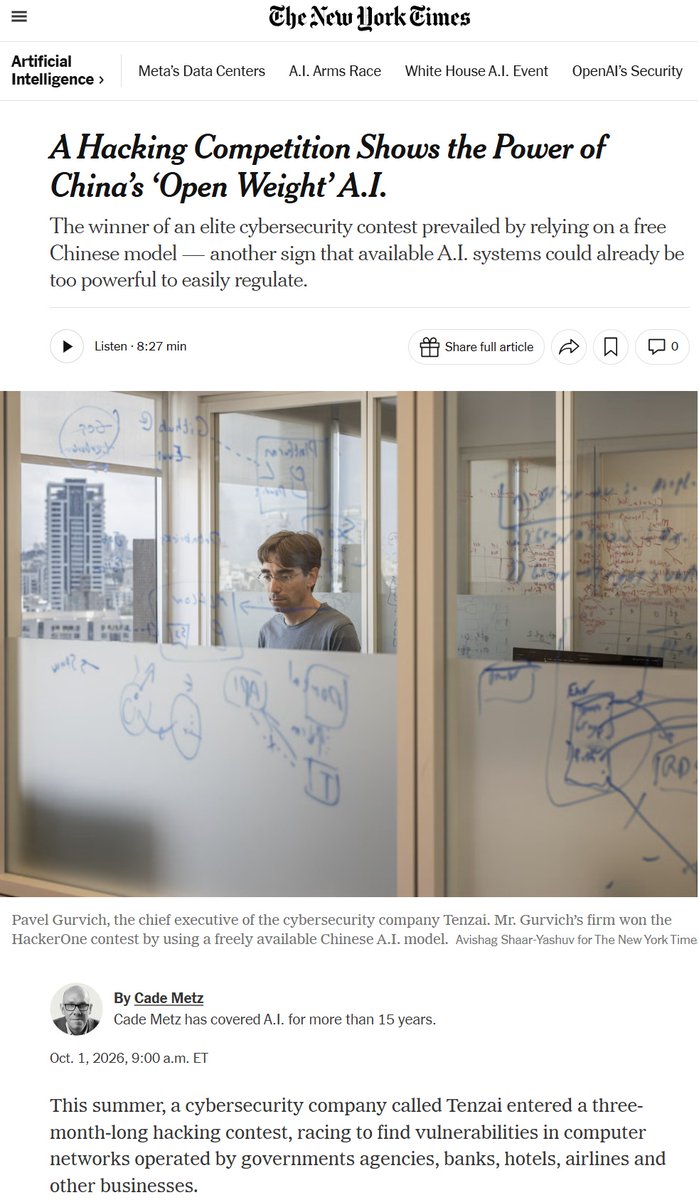
@Tenzai_Labs finished #1 on @Hacker0x01's VDP business leaderboard again this quarter.
Last Q we ran on US frontier models; this quarter we used GLM 5.2 & 5.3, open-weight models from https://t.co/cI9WTfESwz.
We still came out on top, with just 3.5% false positives, and roughly 30% lower cost per report.
For us, it shows the harness matters more than the model underneath it - we built Tenzai to work with a choice of models.
The bigger point is the warning. Open weight models are freely available and highly capable to power offensive AI operations at scale. Attackers can and will build malicious agents with these models.
@nytimes covered it today: https://t.co/ynYq3Tt4ys
If you're defending applications, networks and infrastructure the window to test them continuously, before someone else does, is closing.
Full write-up on how we did it: https://t.co/B74eI9C8DX
Yeah, really liked Emergence Capital. Gordon and Santi there are wonderful. But we could never get a deal with them because another partner was skeptical. Years later I ran into him and he said: “You know, I always thought you were completely full of shit, but you proved me wrong. My loss. Congratulations on all your success.” And I totally get it because early on we were full of shit but we figured it out, day after day.