BTC and KAS is not your coffee money!
Hold the Gold and Silver, spend the trash fiat money. BTC and Kaspa are the ultimate collateral, not your coffee money.
Rational actors don't spend appreciating assets; they borrow against them. Bitcoin and Kaspa will not be for daily payments—they will be the engine of the global exchange and collateral system.
Limited supply means maximum leverage. Why spend what grows when you can spend what devalues? HODL is not just waiting; it's building a bulletproof balance sheet for borrowing.
--SEC Legal Green Light for #Kaspa--
Digital Commodity Definition::
Programmatic Operation, not Managerial Effort
Currently, $KAS price action is perfectly aligned with its fundamental.
@kryhiasl Of course, it will be put into practice in financial activities among systems and people for a long time before being a store of value. It is thousand times smaller than BTC right now.
Yet again, KAS will inevitably be a ultimate store of value like BTC.
BTC and KAS is not your coffee money!
Hold the Gold and Silver, spend the trash fiat money. BTC and Kaspa are the ultimate collateral, not your coffee money.
Rational actors don't spend appreciating assets; they borrow against them. Bitcoin and Kaspa will not be for daily payments—they will be the engine of the global exchange and collateral system.
Limited supply means maximum leverage. Why spend what grows when you can spend what devalues? HODL is not just waiting; it's building a bulletproof balance sheet for borrowing.
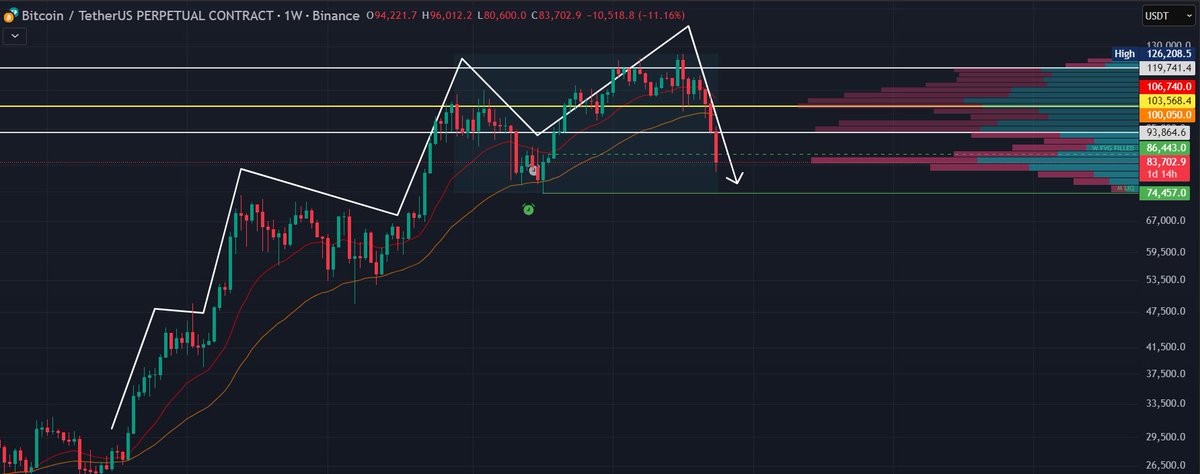
The corrections are getting bigger in $BTC. 124.000$ level might be an SMR.
MAers say the bull market is over because it is below 50 SMA.
I don't use MAs. I prefer to use MMXM. Looks like 124.000$ looks like an SMR. Original consolidation area will be reached. Seems like 32.000$. Who knows when exactly buyers will be aggressive? Maybe 50.000$. No certainty here.
This correction will likely be the end of bull market or aggressive buyers will step in after 74.457$ liquidity sweep or 80-85k accumulation.
In terms of macro, the business cycle and the rate cut has been delayed this much for the first time since 15 years ago.
So this time is not different but delayed.
2026 might be played out as it is on magical "The Benner Cycle".
The kid who finds the treasure first had to run faster than ALL the other kids in the world put together. Just showing the treasure is proof—he doesn't need to ask anyone for permission! $KAS @michaelsuttonil
Excellent write-up! Easy-to-grab! Now I understand better tx inclusion and confirmation in different scenarios. Thank you for sharing it.
I am not a tech guy but the only part I don't quite understand about pow finality is that "It samples the hardware space without requiring the protocol to explicitly collect evidence from a majority of miners. Each block is itself a statistical proof that the finder out-competed the full network’s hash power."
The case for the uniqueness of fast pow
tl;dr
Finality has two moving parts: (i) fast inclusion (= high bps, how quickly a tx gets into a block), and (ii) fast confirmations (= how quickly that tx becomes irreversible). Any system with rapid block production can achieve the first. The second is where the tension shows: in pos, fast confirmations press directly against decentralization. In fast pow, the two properties are decoupled.
prologue
A few weeks ago I came across Solana’s founder claiming: “Solana is the fastest monetary system in the world”. Since Kaspa already runs at a faster block rate, I was curious to check Solana’s finality times. That curiosity quickly pointed me to a deeper issue: not raw speed, but how speed interacts with decentralization.
——————
The tension is structural. In pos, finality means accumulating staked votes, and the more decentralized the stake distribution, the more time is required to reach finality. Here I’m not talking about hardware requirements or validator specs. The axis I’m discussing is centralization around the security mechanism itself: stake in pos vs. hardware in pow. To be secure, a block must be confirmed by a supermajority--typically >66.7% of the total economic stake. In a truly decentralized network, where n stakers with uniform share grows without bound, the time to coordinate this supermajority becomes a real bottleneck.
Pow works differently. It samples the hardware space without requiring the protocol to explicitly collect evidence from a majority of miners. Each block is itself a statistical proof that the finder out-competed the full network’s hash power. This process--and its timing--remains independent of how many individual miners participate.
Ethereum’s researchers understood this when moving to pos. Unlike Solana, which tolerates concentration to reach ~13-second finality, Ethereum’s designers could not accept that trade-off. Their solution was to introduce rotating committees. A rotating committee is a smaller subset of validators, randomly chosen from the full set, that votes on behalf of everyone else.
But this comes with a different security model, known in the literature as exposure to a BFT adaptive attacker. The committee is selected first and then votes. That “select-then-work” sequence is theoretically exposed to adaptive attackers, since members are known in advance. Pow, by contrast, is “work-then-select”: the winner is only revealed after the work is done. Think of it this way: in pos, you know who the referees are before the game starts, which gives an attacker time to pressure them. In pow, you only learn who won after the work is already done, which removes that attack surface. So n confirmations provide consistent confidence regardless of miner granularity, and the system stays secure even under adaptive targeting.
Beyond attack subtleties, the real issue is economic weight. When I send a billion-dollar transfer in a pos system, the question I care about is simple: how much stake is actually securing it? A committee vote provides strong statistical evidence, but only a true supermajority puts the full economic stake of the network behind my confirmation. In other words, a sampled committee may convince me that things are probably safe, but only the weight of the entire stake provides an overwhelming guarantee. And this is exactly where pow shines: each confirmation is not just a probability estimate, but a direct proof of work done against the full hash power of the network, no matter how many miners there are.
closing remark
I don’t claim to know every engineering detail of Ethereum or Solana. But I’m convinced the core principle holds.
I’ll state it simply: fast pow uniquely enables fast finality without forcing a compromise on decentralization.