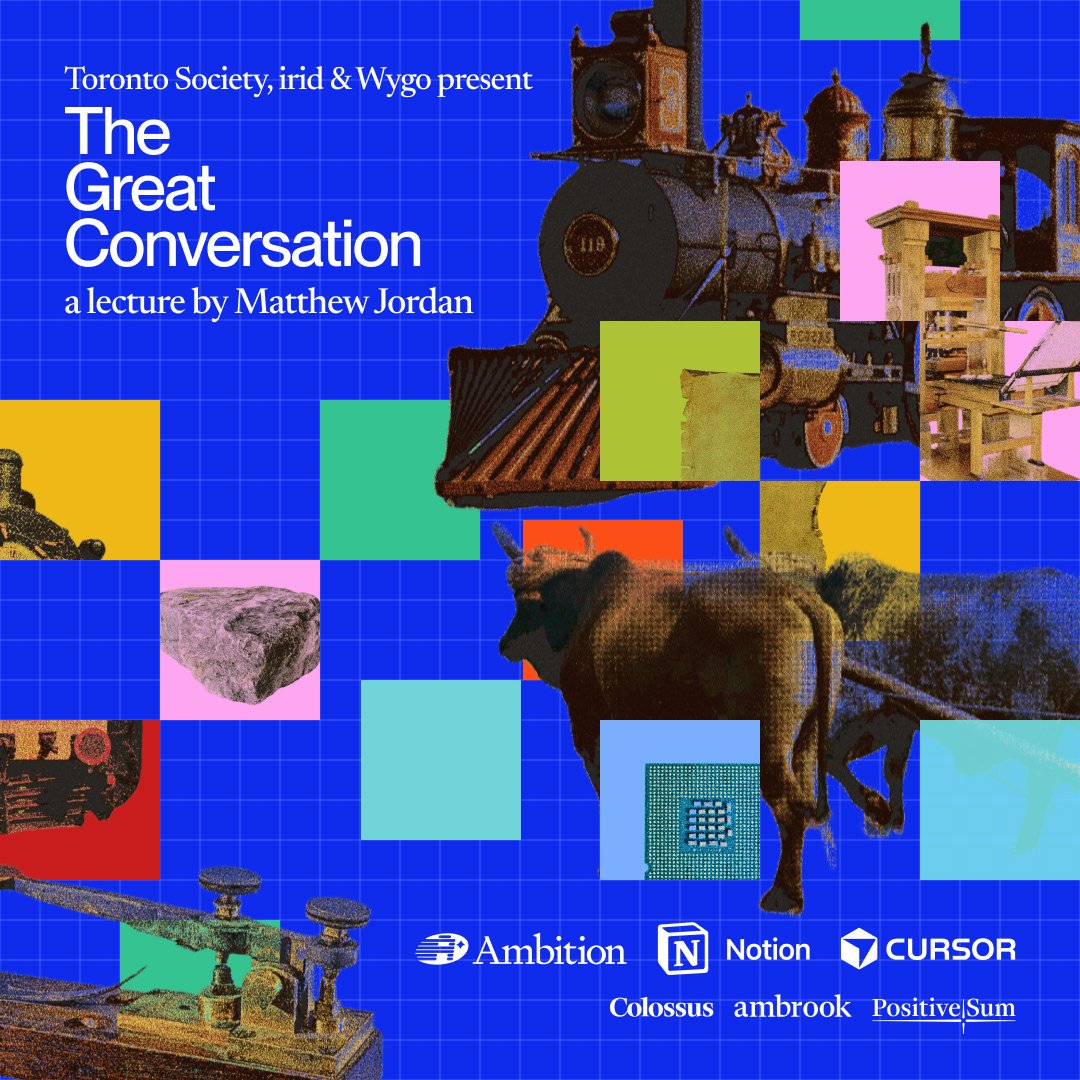
When I first started talking with @mattyj612 a couple years ago, it transformed my life.
Through conversations about games and the art of agency, statecraft, Frederick Gardiner, air pumps, leviathans, and lithography, he brought me into dialogue with the history of technologies and the wider culture they interact with.
I've seen him do this for hundreds of people.
If you work in technology. If you are an engineer, a designer, or a writer. If you are interested in the technical marvels that seem to constantly drag us into a new reality.
Come join the conversation on May 27th during Toronto Tech Week.
There is nothing stopping you from engaging with the paradigms and background beliefs that shape the world long before our tools arrive.
We’ve been telling the story of technology backwards. Our tools take center stage, but these artifacts are the lagging indicators of progress, not the drivers.
What propels the world forward is dialogue, a swirling conversation across generations about what it means to be human.
You have been part of this conversation your entire life. You just haven't been formally introduced.
On May 27th, during @TOTechWeek we invite you to join The Great Conversation, a lecture about how technologists shape history.
Hosted with @ambitionlabsinc, @NotionHQ, @cursor_ai, @AmbrookAG, @colossusmag, @psumvc, and many more.
Tickets on sale now!
There's a general principle here of government zone of competence. The city is just going to end up being very bad at managing every tree on private land. But in the public owned and globally managed streetscape they could do incredibly productive things.
Your pics from MXC made me very jealous. Really want to plan a trip now.
I travelled to Mexico City with my wife last week. It was our first time.
Like most first-timers, we spent most of our time in “el pollo,” the part of town that includes Roma, Condesa, Juárez, Polanco, Chapultepec, parts of Coyoacán, and parts of Centro.
Roma Norte and Condesa in particular were among the nicest neighbourhoods I’ve ever visited. Beautiful architecture, nice walkable streets, a tonne of greenery, and some of the best food I’ve ever had in my life.
It was a great trip.
It also made me think more about what Toronto should be doing to nail urban design.
I made a joke at the Missing Middle Summit (https://t.co/CDrf3J1M3b) that Toronto housing policy needs to be both more libertarian and more communist. More libertarian in the sense of being more permissive, less prescriptive, and less rule-bound. More communist in the sense of having a more communal understanding of how we handle amenity space, garbage pickup, bicycle infrastructure, and trees.
The tree point in particular really hit home in CDMX.
As with the nicer parts of Manhattan and Brooklyn, which we also recently visited, the streets of Roma Norte are incredibly green, with world-class tree canopies, despite very few trees remaining on private property.
Developers cut those trees down to develop buildings. Then the city planted a bunch of new trees in the right-of-way.
In Toronto, one of our perpetual frustrations when underwriting sites for acquisition is the uncertainty around whether larger by-law protected trees can be removed. City staff have told me that they’re struggling with a dual mandate from Council to both increase housing options in neighbourhoods (missing middle housing) and increase the tree canopy.
But this conflict is mostly self-imposed.
The solution is very obviously to allow the removal of trees that interfere with development on private property as-of-right, while planting far more street trees in the public right-of-way.
We should be less precious about trees on private property, especially when they stand in the way of new housing, and much more serious about building a continuous, high-quality, publicly managed urban canopy.
Given that most of Toronto’s streets and rights-of-way are oversized, there is plenty of opportunity to expand sidewalk widths and plant more street trees, especially where doing so does not interfere with infill development. That is where the canopy should go: along the streets, where everyone benefits from it, where it improves the public realm, and where it can be planned, maintained, and replaced properly over time.
The Great Conversation wouldn’t have happened without Toronto Tech Week.
We were inspired by what @skanwar and the whole team were putting together and wanted to be part of it. To provide our own perspective on technology in this city
In particular a foundational belief for everyone that worked on the event is that one of the things the Toronto tech community is capable of, deserves, and (frankly) needs is a clear intellectual perspective—a set of ideas that it can offer to the global discourse about technology.
In the creation of new technology there is the work of building and distributing. But, there is also an intellectual side of things. A discussion about what should be built, why it should be built, how it connects to our politics, our philosophy, our art, our science and our humanity.
One of the many things I learned from @mattyj612 is that Toronto has a long history of being part of this discussion: Marshall McLuhan, Ursula Franklin, George Grant, all of the intellectual work that went into the deep learning revolution. This is something we should be proud of and continue to contribute to.
To really participate in the great conversation, though, we need to act as a community, not a set of isolated individuals. The creation and dissemination of ideas always happens face to face with your peers. Great intellectual lineages and artistic expressions come from groups.
So, a specific thank you to the @TOtechweek team and @skanwar for everything they did last week.
Events like tech week can play a huge role in showing that a scene exists. This kind of thing is difficult and risky. In the end it is an incredible gift they have offered us to form a community that can have important discussions.
Thank you for taking part in The Great Conversation.
The lecture was the beginning of a dialogue we hope to carry forward for the rest of our lives. It is an honour to be in this tradition with all of you.
A funny and underrated thing is that doing the readings really is like going to the gym.
If you do it consistently, your skill and strength will grow. You can achieve a new baseline level of health. It can be extremely pleasurable and gratifying once you get good at it. The harder you push, the better your results.
People can tell if you have done the work and it makes you sexy (they can also tell if you haven't).
I think people still know this intuitively, but it's worthwhile to talk about it more.
100%! I am assigning *more* reading this year than previously. 2020 led to a lot of bad societal habits, and "set low expectations" was one of them. Don't blame the kids for our errors!
@aedison Streetcars truly are one of Toronto's most underused resources.
We keep doing these (literally) surface fixes lile painting streets red.
If we actually optimised around them it would transform the way the city feels.
There is a way that it seems deeply lacking in grace. If you can accept what God has done for you shouldn't it produce certainty and an overflowing of that same kind of generosity?
The double entendre of grace as a way of moving and being and the grace God offers is not accidental.
I’m looking for people in Toronto who can help me pull off the 2nd season of Toronto School of Foundation Modelling. Have a few exciting guest speakers locked in already. I have more ambitious goals for this season. I’m looking for someone who
- can actually commit time every week to planning season 2. Talk is cheap, you want to do the work alongside me
- fairly technical / has the appetite to learn intensely
- you love learning and feel energized by the process and not just the outcome
These are my promises:
You’ll be paid for your work. You will learn a lot. Your name will be everywhere TSFM is. You’ll feel fulfilled by the impact you’ll have on the people here and you’ll be left inspired by the commitment the cohort will exhibit.
@WillManidis Like the great historical period of emergent millenarianism it suggest there is something in the water for these ideas to have such a powerful sway.
If it *wasn't* the ending of a paradigm we fully inhabited in some way none of these stories could stick.
https://t.co/FqPsE9ZuZn
@millerman Truly. I can't wait for Brian Cantwell Smith's book this year. I expect it will be the most contemporary look at these questions working in the same seams that Dreyfus explored.