More than 1 in 4 American adults owed medical debt in 2025 with 50% owing money for services received from hospitals. The communities hit hardest: Black and Hispanic adults, people with disabilities, and those with low to moderate incomes — the very patients safety-net hospitals are built to serve.
Check out the Urban Institute's one pager for more on medical debt: https://t.co/R2CsQlKsDN
The #340B program wasn't created to subsidize large hospital systems. It was created to keep the doors open for hospitals serving the most vulnerable patients.
Now, CMS is proposing to cut Medicare #340B drug payments by $4.55 billion - the largest single cut to the program in its history. For safety-net hospitals, that means billions less to fund care for the communities that need it most.
We’re proud to partner with @lilydalefbc, an organization dedicated to strengthening communities across Chicago, IL, especially those supporting vulnerable patient populations.
The #340B program was designed to help vulnerable patients. Yet now, hospitals use the program to generate revenue while patients face higher healthcare costs and fewer care options in their communities.
With Congress back in session, our experts are calling for accountability. Watch our webinar highlights to see how we can get the 340B program back on track.
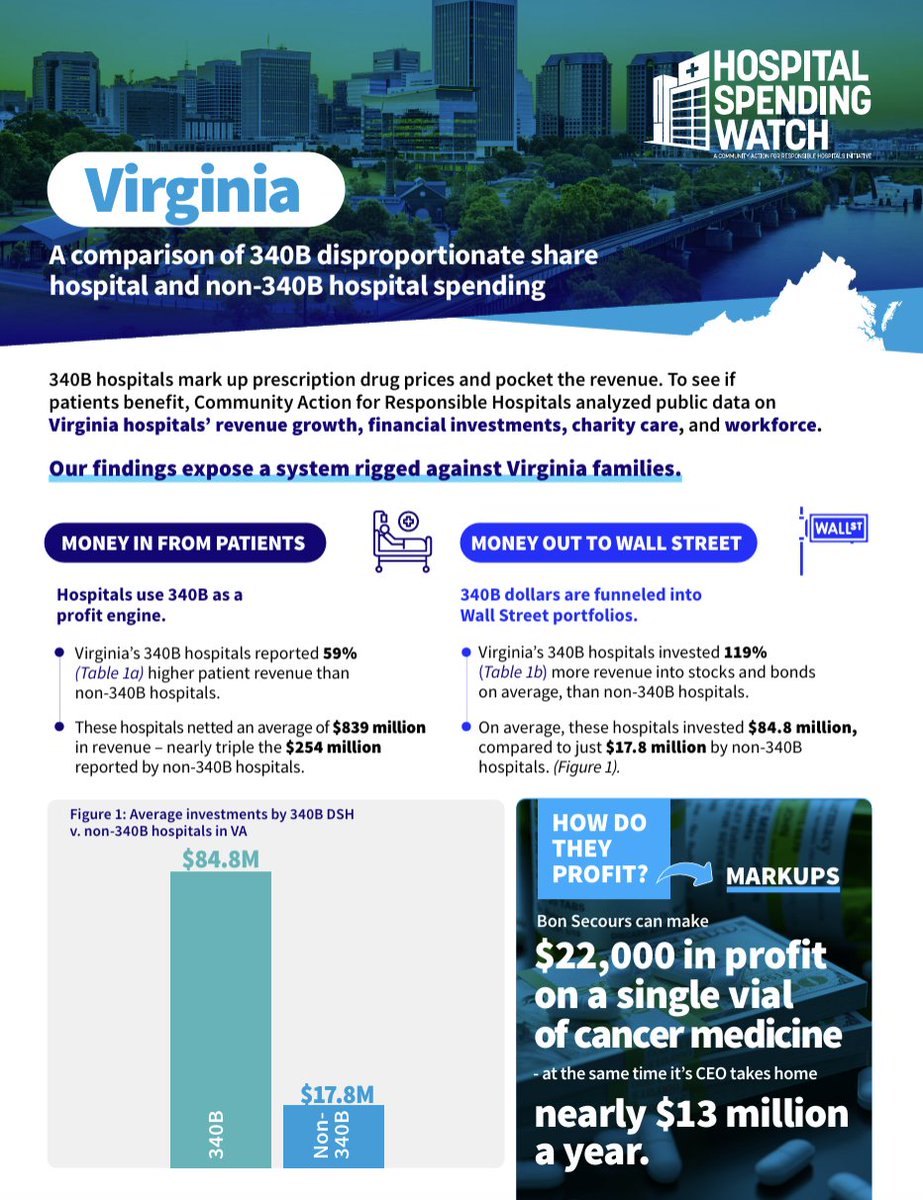
Virginia’s #340B hospitals reported 59% higher patient revenue than non-340B hospitals, netting an average of $839 million in revenue – nearly triple the $254 million reported by non-340B hospitals.
Our Hospital Spending Watch series exposes how hospitals in several states including Virginia are using #340B as a profit engine.
"Quorum is in the process of converting to a nonprofit organization, bringing all 11 of its hospitals along with it. Individual private equity-owned hospitals have transitioned to nonprofit status before, but it’s unheard of for an entire chain to do so. The change promises tax advantages, discounted drugs through the 340B program, and the ability to apply for grants."
The #340B program was never meant to be a profit center, but when a private equity-backed chain converts to nonprofit status specifically to unlock its benefits, discounts designed for vulnerable patients become a financial strategy to generate revenue for the hospital.
https://t.co/z4aGAOinVT
"Insurers are buying doctors' practices and specialty pharmacies and sometimes merging with pharmacy chains. Hospitals are buying or creating insurers. Private equity firms are behind many of the deals, buying practices, reorganizing operations, paring costs, then selling at a profit...”
See full article in thread:
We’re proud to partner with @CHLActionPlan, an organization working to expanding access to essential health services through trusted Black churches. Together, we’re ensuring communities have access to the care they need.
Rapid expansion of the #340B program underscores the urgency for reform as little evidence that increased participation has translated into meaningful improvements in access or affordability for low-income patients.
We strongly support efforts, including reforms in @SenBillCassidy's discussion draft, to ensure 340B savings lead to reduced out-of-pocket costs for patients and greater transparency and accountability.
In 2024, Minnesota's largest #340B hospitals generated $1.3B in revenue, with one hospital pocketing $335M alone. Yet these hospitals provided little to no charity care. Patients deserve better.
Read the full store here: https://t.co/Y2ZPz7NXoA
We're proud to welcome @sistersnetwork as a new partner! Sisters Network is a national breast cancer patient advocacy organization based in Dallas, TX, dedicated to helping Black women and vulnerable communities.
We look forward to working together to ensure patients can access the care they need.