@yitongcute The distinction that matters to me is how the two fail. A budget honoured after the fact is a receipt you can point at. A 5% reserve plus a gated draw can still pay nothing even if you did every task. The check is which condition I can verify today, not how the last sale felt.
Past and present are easy to mash together here, so I am keeping them apart.
Past: in the Squid sale, eligible Republic quest participants had their rewards committed before the wider allocation, and Squid said those were honoured separately from a fixed budget. That is the concrete result: eligible Republic participants in that sale received an allocation. It was not the same as the main Legion pool, where Squid said 77.8% of applicants received one and some were excluded.
Source: https://t.co/RcMkk5wpo2
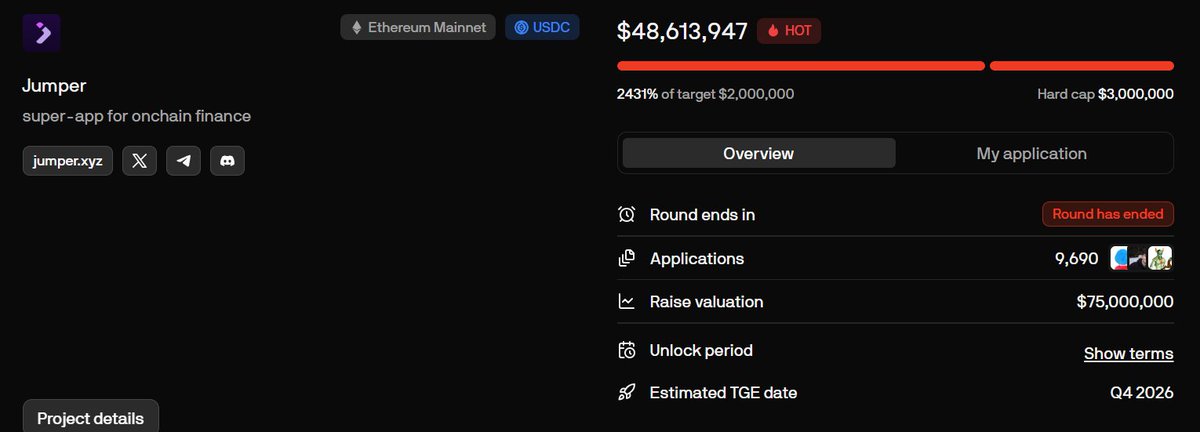
Present: Legion says Jumper has reserved 5% of allocations for The Republic. The same post says participation does not guarantee an allocation, and any allocation is subject to eligibility, geographic limits, KYC/AML, and the sale terms.
Source: https://t.co/gehLaRktWo
I am not reading the Squid outcome as a forecast for Jumper. One was a committed quest budget that was honoured after the fact. The other is a reserved slice and a draw that is still gated. Same community track, different rule. The useful check for me is whether I actually meet the current conditions, not whether the last sale felt fair.
Disclosure: this post is part of a Republic campaign, and I may earn participation rewards if it is approved.
Genuine question on Jumper routing. Docs say it balances security, speed, clicks and cost, showing gas, fees, price impact and the bridge used. Is "most efficient" fixed, or can I steer it to an audited bridge on big swaps? Part of a Republic campaign, for participation rewards.
@DendiRedemption The line worth keeping refuses the comparison. A 5% reserve for The Republic is a set-aside, and it does not say who inside it receives what, or when. Squid paying every participant is one past outcome, not a term here. Read the reserve as access to a pool, not a payout.
Past all Republic participants received an allocation in Squid.
Now: Jumper has reserved 5% for The Republic. That’s an opportunity, not a promise that Squid’s outcome repeats.
Sources: Republic + Campaign Journey
Disclosure: Republic campaign; participation rewards may apply.
@inoCcCent Both filters answer a different question. Assets I hold shows where idle coins can work without a swap first. TVL shows which pools survived long enough to attract size. Neither says what the yield will be next week, so I use them to narrow the list, not to pick.
On Jumper you can look for earn opportunities :
- filtering by assets : look for coins you simply own
- or by filtering TVL : the pools with the most TVL are well established
These are just two ways out of many others.
@0xBadKoi@jumperapp The distinction that matters is what XP is not. It records swaps, bridges, and Earn use, and that record moves a level which opens perks. It does not become a token claim and does not count toward sale eligibility. The number on the Pass page is a usage history, not a balance.
@i_liu25@jumperapp The useful split is who chooses. For You ranks by wallet context, so a USDC holder on a chain they use sees a compatible pool first. All Markets is the check: a higher APR on an asset I do not hold shows up there, so I can see what the feed left out. Fit first, yield second.
Two lists, one Earn page. I would not start with the highest APR.
For You is the personalized view. @jumperapp says it scores opportunities from wallet context: holdings, idle assets, chains you already use, liquidity size, and risk appetite, then shows a feed for you. All Markets is the broader list of integrated DeFi markets, which you sort and filter yourself by asset, chain, or protocol. Source: https://t.co/W2WH9s6nx7
The criterion I would use is fit, not the headline yield. If I hold USDC on a chain I already use, For You should surface a compatible pool first. All Markets is where I check what that feed left out, including a higher APR on an asset or chain I do not hold. A higher advertised yield is not a guaranteed return. It can change, and it does not include smart-contract, liquidity, or depeg risk.
Jumper’s docs describe the same split: a recommendation engine versus All Markets search. Source: https://t.co/ukWoRnhY8p
⚠️ This post is part of a Republic( @legiondotcc ) campaign earning participation rewards.
@hvp_9@legiondotcc The line worth pressing is fee capture. Volume across 60 chains shows people route through it, but volume routed and fees kept are different numbers. The 115 vaults and perps are product surface, not margin. The dilution cliffs decide if a $75M FDV is cheap.
THE HOOK
Cross-chain bridging is broken: commoditized wrappers, mercenary TVL, and zero fee capture.
Yet @JumperExchange just crossed $40B+ volume across 60+ chains ahead of its $75M FDV launch on @legiondotcc.
We audited the tokenomics, dilution cliffs and Here is the data: 🧵👇
My Republic inventory, still sealed: 12 ores, 1 crate, 2 mysteries. A crate opens into ore. A mystery can return VP, a crate, both, or nothing, so I will not price one before it opens. Posted for a rewarded Republic campaign.
@Vandal213832781 The number people trip on is the denominator. 5% of the Legion allocation is the size of the pot, and everyone eligible draws against that same pot. More members finishing missions means more entries competing for it, so one person's odds shrink as the pool gets busier.