Institutional advocacy is not conducted on X.
It is conducted directly with principals, CTOs, risk committees, legal counsel and compliance officers.
Kaspa’s native programmable layer is only a few weeks old. Security auditors are still studying covenants and the blockDAG architecture. That learning curve alone takes time.
Beyond the technology itself sit far heavier requirements that social-media commentary routinely ignores:
• Institutional custody frameworks demand proven controls, independent audits, insurance wrappers, and operational maturity before any serious capital is placed on a new layer.
• Procurement and public/private tendering processes follow multi-stage RFPs, due-diligence cycles, vendor risk assessments and board-level approvals that routinely run 12–24 months.
• Each industry carries its own mandatory standards - financial messaging (ISO 20022), energy settlement, supply-chain provenance, sanctions screening, data-residency rules and sector-specific regulatory sandboxes. Meeting those standards is not optional and cannot be accelerated by tweets.
Sandbox testing, formal verification, regulatory engagement and independent security review all operate on institutional timelines, not crypto-Twitter timelines. Asking major institutions to move valuable assets onto a newly programmable layer without that groundwork is not “ambition” - it is ignorance of how these organisations actually work.
Those of us doing the substantive work understand the sequence and the constraints. Those who do not should stop confusing volume of posts with progress. Patience is part of getting it right.
Kaspa Native is live!
A new X account and YouTube channel for native Kaspa development.
Starting with an Argent live coding session, building a simple multi-actor ticketing app from start to finish
>
started to record a short 10-min live-coding argent episode: a basic multi-actor ticketing app.
one hour later, episode 01 exists 😅
start here:
https://t.co/Hjb9Tksypu
written code:
https://t.co/qdI40DaIoX
Just a reminder $KAS stay away from memes. Its a waste of time doesn't help adoption. No, I am not buying any tokens coming out recently. What I am buying still is $KAS though.
A few developer-facing Kaspa updates:
- sources tell me Silverscript’s audit, and hence its first release, is nearing completion
- Argent has a new home:
https://t.co/lvMLZwvWmH
- Argent has grown up significantly since my last report:
- route planning and related graph algos
- cross-app linking
- compiler-model consolidation
- a unified, simple and intuitive runtime tx-construction API
- and many, many more improvements and fixes
- demo apps now range from the most elementary counter-state example, through a full DEX demo, to chess
Chess was fully ported from the manual-routing implementation that originally inspired Argent to an equivalent automatically generated routing system, completely hidden from the dev/user. Each move is verified through L1 scripts with bounded onchain script cost (<5 KB).
I’m also preparing the first short video episode, showcasing live end-to-end coding of a simple multi-actor Argent app.
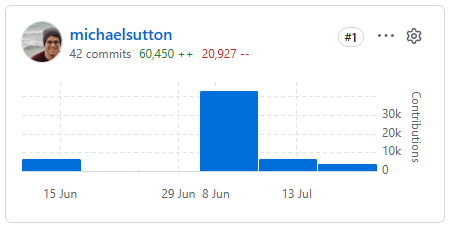
I’m finishing my argent compiler sprint (proof attached) and then I’ll do my best to communicate. Thing is, I think you are not my target audience despite indeed being a very informed investor. Talk is cheap, I want you to be INFORMED through the first serious app launching natively on Kaspa L1 and making you ask yourself “wait, how the hell is this even possible on KAS L1??”
Toccata was the opening act. DAGKnight is the main event
Kaspa's next consensus upgrade replaces GHOSTDAG with a model that adapts to real network latency, targeting block times of 25 to 40 milliseconds. Core developers are aiming for a hard fork by the end of Q3.
Founder @hashdag has proposed bundling it with a ZK bridge in one fork, with a 100 blocks-per-second target to follow in 2027. $KAS
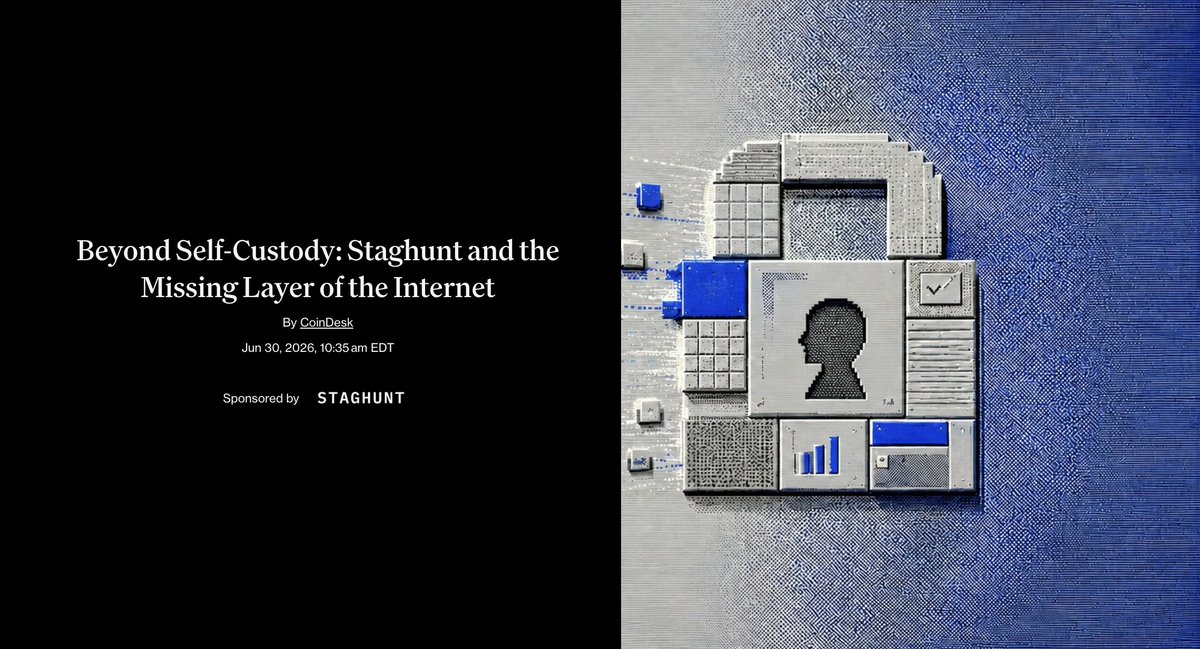
Crypto gave individuals sovereignty. Staghunt is betting the next frontier is the group version: coordination markets.
Read more at our latest thought leadership in partnership with @hashdag
https://t.co/VJQ15N0ka0
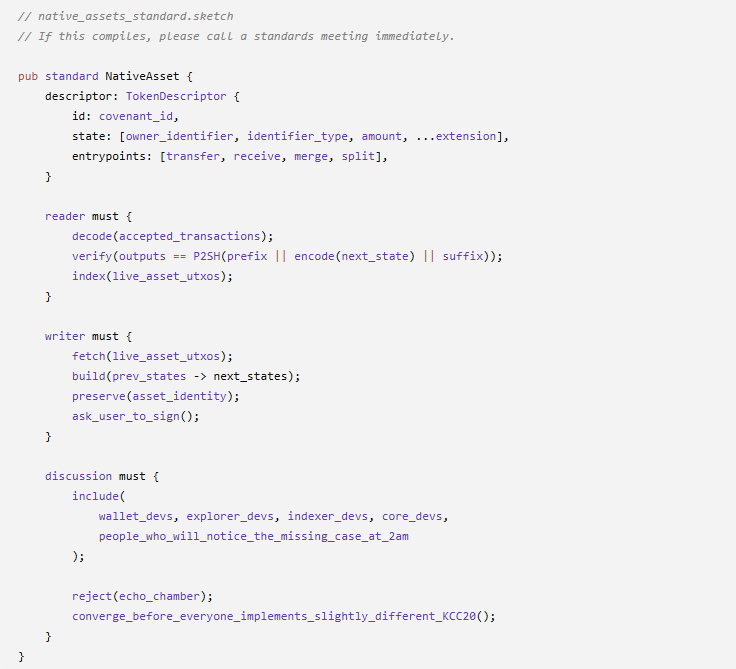
Now that we have programmability paths on Kaspa, the need to converge on ecosystem standards in the right way becomes paramount.
It appears we lack a fitting forum for such discussions.
A primary and timely example would be a standard specification for native assets. We need a place for technical discussions where wallet devs, explorer devs, community thinkers, and core devs can brainstorm and rapidly converge on ideas without communication gaps, and without important ideas and messages getting lost to oblivion.
As a start, here is a call for community discussion on native assets.
An initial discussion on kas pub rnd is linked below, but again, to me this feels like an echo chamber, with probably the most important voices missing.
>>
I decided to publish a v0 of the toccata dev book nonetheless. The writing style is a bit too AI-ish for my taste, but the content, emphasis, and ideas are by yours truly.
Made a big effort to keep it 100% accurate despite the writing speed, but you (or your llm) should read it with a grain of salt and a critical eye.
Any feedback is welcome. Happy Kaspa Toccata day, and may it all go well and smoothly 🤞
https://t.co/hf3IEWcxWF
The Architectural Edge: Why Kaspa Outpaces Ethereum for DEX Infrastructure
Building a Decentralized Exchange (DEX) on a traditional single-chain blockchain like Ethereum is like trying to run a high-frequency trading firm on a narrow, one-lane highway. While Ethereum pioneered automated market makers (AMMs), its sequential design forces every transaction to wait in a single queue.
Kaspa’s BlockDAG architecture��complemented by the Toccata hard fork—rebuilds the Layer 1 foundation to handle the intensive demands of decentralized trading natively. Kaspa offers several architectural advantages that make it a superior backbone for a modern DEX compared to Ethereum.
Parallel Processing vs. Sequential Bottlenecks
Ethereum processes transactions sequentially. One block is added at a time, roughly every 12 seconds. When thousands of traders rush to swap assets during market volatility, the network bottlenecks, causing a massive surge in gas fees.
Kaspa replaces the single blockchain with a Directed Acyclic Graph (**BlockDAG**). Using the GHOSTDAG protocol, the network processes multiple blocks **in parallel** simultaneously (~10 blocks per second on mainnet). For a DEX, this means transactions don’t get jammed in a single queue; trades are woven together concurrently without degrading network performance.
Structural Defense Against Predatory MEV
Because Ethereum relies on a public mempool where a single block producer dictates the exact sequential order of transactions every 12 seconds, **Maximal Extractable Value (MEV)** bots thrive. They spot a pending trade and "sandwich" the user—buying right before them and selling right after—forcing the trader to execute at a worse price.
Kaspa's Advantage: Real-time decentralization dismantles the mechanics of MEV bots. With Kaspa producing blocks at a rapid-fire pace, there is no single consensus leader holding a monopoly over transaction ordering for long intervals. Rapid parallel block creation and real-time sequencing make it virtually impossible for bots to accurately predict the state and insert predatory sandwich attacks. Traders get the exact execution price they expect.
Sub-Second Latency (CEX Speed, DEX Security)
Waiting 12 seconds for a block—and minutes for true finality—is a lifetime in live trading. While Layer 2 rollups speed up execution, they fragment liquidity, introduce bridge vulnerabilities, and complicate the user experience.
Driven by the Rusty Kaspa engine, the network features sub-second block times. After just 10 seconds, a trade has accumulated roughly 10 layers of confirmation deep within the DAG structure. A DEX on Kaspa delivers the instant, responsive user experience of a Centralized Exchange (CEX) while settling entirely on an ultra-secure, decentralized Layer 1.
.
Predictable, Sub-Cent Transaction Fees
High traffic turns Ethereum into a playground for whales, where a simple token swap can easily cost $20 to $100+ in gas fees.
Because Kaspa scales horizontally at the base layer rather than relying on vertical scaling, the throughput handles massive volume natively. Transaction fees remain consistently sub-cent (<$0.01), making micro-swaps and algorithmic high-frequency trading economically viable for retail users.
Kaspa Toccata mainnet process update:
Today we plan to publish the v1.3.0 mainnet pre-release, without activation, for 1–2 days of broader network sanity testing.
Assuming everything looks good, the following release will be v2.0.0, with activation planned for June 30, 4 weeks from today
If there’s one thing I’ve learned after all these years in crypto, it’s this:
You do not bet against a real community.
Charts matter. Liquidity matters. Narratives matter. But when a community is locked in, obsessed with the asset, and willing to look insane longer than everyone else can stay patient, that becomes something different.
That’s not just holders.
That’s belief.
You can laugh at them, fade them, call them delusional, tell them they’re wrong, and they’ll still be there posting, buying, building, defending, and refusing to leave.
That’s why strong communities are so dangerous in crypto.
They don’t just hold the asset.
They become the asset.
why I’m personally excited about Kaspa’s upcoming Toccata covenants
- for the first time, I can build creative, complex apps directly over infrastructure I helped design and build
- we designed under architectural constraints, but the result came out surprisingly expressive and powerful
- Silverscript is cool as hell
- I can literally open a *.sil file and write a complex contract that will be fully verified on Kaspa L1
- (nottoself: create a 10-minute video showing the building of such an app e2e)
- I can design my own vaults and safeguards, and manage funds securely without risking a heart attack each time I touch a wallet
- covenant ids, contract templates, and inter-covenant communication (ICC) feel like a new set of axioms, or a new algebra to work with and discover
- sig verify from stack / sighash anyone-can-pay + covenant ids can allow interesting shared-state covenants (requires a non-consensus miner policy; kudos to @maxibitcat for pushing this line of thinking)
- complex contract systems can be deployed in one spk hash. no storage rent, no deployment tax; users pay only the transient mass for tx data as they use it
- as I’ve mentioned in the past, this becomes especially interesting for AI/agentic environments, where bots could cheaply create one-time agreements between themselves
- I didn’t even mention based apps yet. That’s a whole vertical that isn’t ready for exploration yet, but will be very soon
Introducing the Kaspa Orbital Node Initiative (KONI) 🛰️
We’re sending a Kaspa node into space.
For decentralisation. For resilience. For the future.
Why space?
• No borders
• Passive validation from orbit
• Resilience beyond Earth
• A symbol of cryptographic neutrality
We’re opening the KONI mission to collaborators, and partners from the Kaspa Community.
#KONI #Kaspa #DAGinSpace #SpaceNode