This is not true. The Malawians, Zimbabweans and Mozambiqueans who worked in the mines during Apartheid procreated with South African women.
That's why today you have Phiris who are South Africans but that surname is originally from Malawi.
Lol there is no Phiri who is a native South African.
Phiri is from Malawi. Ask an elderly person who live in Johannesburg during apartheid, specifically Soweto they will tell you that that Phiri surname came with the Malawian mine workers.
Lol black men were the primary victims of the apartheid system.
Black men were the most killed, harassed, incarcerated and enslaved.
They were bought to the cities to do manual slave labour with little to no pay, career progression, and were treated as disposable bodies. Black men died in mines or got sick on farms and were buried where they stood, if they died underground that was a cheap funeral.
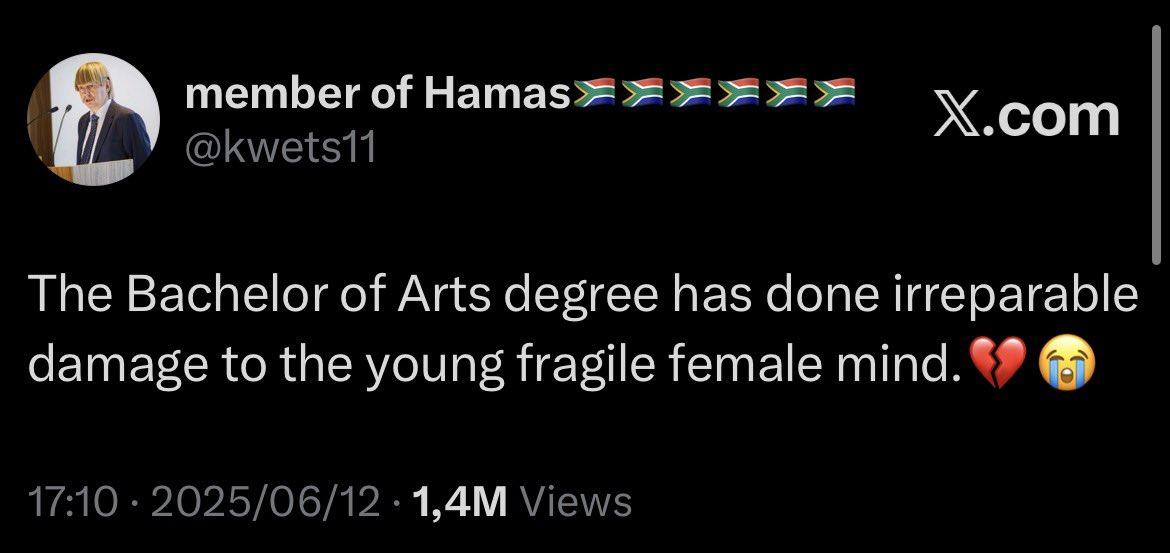
Then this so called “educated” fatty will come here and say we had a “huge” advantage because we were the preferred slaves for the field while they stayed home?😭😂✋🏾✋🏾
And here's something really interesting, Isaiah 38 tells this same story but also includes what Hezekiah wrote after he recovered
"The living, only the living, can thank You, as I do today"
Isaiah 38:19
2 Kings tells us God gave him 15 more years, but Isaiah lets us hear his gratitude afterward, go read Isaiah 38:9–20, it's worth it
⛔️‼️Willow Smith being trashed is very telling of how listening to music has become an entirely different thing. Huge chunks of this new generation simply don't know what real music sounds like. Let me explain.
The only real music is LIVE music. Everything else deserves the label 'processed'.
Live music is by definition imperfect. A voice won't be 100% in tune all the time. Even with the best musicians, small mistakes (timing, wrong note, etc.) will happen. And guess what: when these imperfections are few and little, they make the whole experience greater rather than weaker.
In these imperfections, the human 'soul' is expressed. And music, like all art, is human expression.
Only by technical manipulation can these imperfections be smoothed out. And once you do that, you have already started to erase the soul from the performance.
In the seventies, for album recording, engineers started to apply 'comping'. This means that the vocalist would sing their track multiple times, and the best parts of each performance would be glued together in a way that made it seem like one performance. Comping could rarely erase all imperfections. This is why you still hear them in music from that time.
In the late 90's, however, with the advent of advanced digital audio-editing, this could be taken many steps further. Autotune is a household name; but those familiar with modern recording processes also know Melodyne, which enables incredibly precise editing of pitch and timing.
Almost ALL recordings of the 21st century are 'melodyned'. Junior (Gen Z) ears are therefore predominantly tuned by 'perfect vocals' that never actually happened. Live performances in this century are heavily assisted by a complex system of pre-recorded backing tracks and live auto-tuning, even if the musicians are actually playing and singing.
When your ears are tuned this way, your auditory system/memory develops a deep aversion for anomalies, mistakes, and deviations. You believe you are as sharp a judge as Simon Cowell, and sure, you do hear (some of) the mistakes when music and song aren't processed. The problem is that you have raised the bar to what is fair for processed, but is not fair for real.
Now, we are in a new era, with AI having entered into music. AI will definitely not weave pitch errors into its output (unless by way of glitch). Young people are listening to AI music. And the bar goes higher again: it's that 'sterile perfection' that their ears are craving for.
Add to that that songwriting died a painful death in this century. All of that together is now called 'production'. You don't have to write a song that tells a real and human story - in fact, try not to, unless you are anxiously avoiding to score a hit. Avoid all kinds of complexity in chord sequences and melody. Only in rhythm do you still have some leeway to do unusual things (but hey, not too unusual!).
The percentage of real, unprocessed, live performances, in comparison to highly fine-tuned processed music, that those young ears are exposed to is heavily tilted towards the latter. Unwillingly, they have become extremely poor judges of what a real human will put forward when you give them a microphone, and let them plug in a guitar, without any technical modifiers to protect them from mistakes.
I don't mean to cause a discussion, but you can if you want to. I've used all those techniques I have described myself, so I am not saying I am against them. Our ears all love perfection. It's hard to resist an existing tool that can make something sound 'better', and saves you, for instance, the relentless and tiring process of singing the same vocal 20 times until you have one 'perfect' take. Which - trust me - no one does anymore these days.
I don't care about Willow Smith as a person. But the way her performance got trashed all over the internet triggered me to write this. I find it absolutely ridiculous. She did a damn fine job, and if you were unable to hear that (not saying you have to LIKE it!), then I advise you to just read the above again and again, until the truth sinks in.
And hey, go and listen to her Radio 1 Live Lounge performance instead of unleashing your poison on one circulating clip (which by the way sounds awesome). She is a great talent - there is absolutely no doubt about it.
Over and out!
Whoever roasts or trashes this - doesn't know the first thing about music.
Not saying you have to like it. But if you don't recognize the talent, your auditory system is ruined by decades of junk music.
Willow Smith. Smashing it!
Good example of how this website is distorting your reality. An account you expect to bring dunks on 'pronoun people' primes you for hearing bad vocals, and that is what his followers hear.
Except that is not what is happening, Willow Smith is really talented!