@gro_tsen I stumbled on this blog post precisely today and it turns out what you describe has recently received the name of "lostalgia"
https://t.co/LAOhiRXlu0
There is a certain irony in crying "bloody murder" about distillation when your entire business model is built on "distilling" humanity's collective knowledge without paying for it.
Cela ne me paraît pas du tout évident. La prévalence des réseaux sociaux repose en grande partie sur les effets de réseau.
Ces effets de réseau rendent plus coûteux, pour la vie sociale des ados, le fait de ne pas y participer, même lorsqu’ils n’en ont pas réellement envie.
Introduire une contrainte susceptible de réduire la part des ados qui utilisent les réseaux sociaux, ainsi que la fréquence à laquelle ils les utilisent, peut affaiblir ces effets de réseau et, par conséquent, avoir un impact important. Cela peut être vrai même si la contrainte est techniquement contournable : il suffit qu’elle introduise une friction supplémentaire. Il est difficile d’en anticiper l’ampleur.
En revanche, cela ne résout pas la question du contrôle des adultes qu’une telle politique implique.
Obliger tout le monde à faire vérifier son identité pour pouvoir s'exprimer sur les réseaux sociaux, à un an d'une possible victoire de l'extrême droite à la présidentielle MAIS QUELLE EXCELLENTE IDÉE JE NE VOIS PAS COMMENT ÇA POURRAIT MAL TOURNER
Où vont les 1670 milliards ou 57% du PIB de dépense publique et comment sont-ils financés ?
Enfin un graphique exhaustif et clair de @StrategiePlan. Maintenant, tout le monde sait.
Il faudrait vraiment analyser l'origine de ce courant de pensée qui prétend que «rafraîchir son logement quand il fait trop chaud dehors» est un luxe frivole et un gâchis d'énergie, alors que PERSONNE ne le pense pour «réchauffer son logement quand il fait trop froid dehors».
Anyone who can't see what is happening is blind.
1) Banning of the ability to have privacy with a cellphone
2) Banning of the ability to own a foreign router (which may not "comply" with future "required" legislation )
3) Identity checks at the OS, App Store and Service provider levels.
4) Ability to restrict individuals access to the internet, to given types of content, etc
5) Forced front and center "official" news media forced into online services.
6) Control over AI algorithms
7) Control over algorithms for visibility/sharing of content
8) Control over peoples cars (remote kill switches, embedded biometrics, automated reporting to LEO, inebriation checks).
9) Forced biometrics to login to computers, phones, etc
10) Digital ID to replace physical ID.
11) Digital cash to replace physical cash
12) Millions of biometrics and license place cameras + millions of "gun shot detection" systems
13) Banning of mobile applications and endpoint software the government deems wrong, dangerous, or incorrect, etc. (Tiktok, Kaspersky, etc)
14) AI being embedded in every processor, mobile device, desktop OS, etc.
15) Laws demanding "backdoored" encryption.
16) Laws demanding client side scanning.
17) Laws demanding control over speech deemed harmful, violent, dangerous, upsetting, etc
18) Charges and convictions against anyone releasing privacy focused software (tornado cash).
19) AI predictive policing and predictive dissent detection
20) Centralizing of all healthcare, psychological, financial, online, offline, travel and government records.
21) Forced biometrics collection to travel, attend public events, etc
Just passed the 300k followers mark. Genuine thanks to all. Many interesting follow ups and discussions. Still only very few insults.
But there is something interesting and worrisome here. Since March, I have seen the number of new followers per day being about 20 times what it was earlier. It is not because I had great tweets; I had fewer than usual. It is not because of bots: most new followers seem legit. It seems that it is due to a change in the X algorithm, which puts more weight on tweets which appear to trigger good discussions (I do not know the exact criteria).
Now, obviously, I am delighted by the change. But the scary part is how an algorithm, depending on what it wants to promote, can multiply (and presumably divide ☹️…) visibility by a factor of 20.
En France, le gouvernement s’apprête à donner un «permis de tuer» aux policiers.
Le 7 juillet, l’Assemblée nationale doit voter une loi qui considèrerait légal TOUT TIR de policier ou gendarme.
Ce serait une bascule historique. Voici en 5 points ce que cette loi changerait.👇
Does AI have a role in LDL-C management?
📺 Cardiologist Dr. Campbell Rogers explores imaging in the age of AI
Watch now to see highlights from his presentation at a EuroPCR 2026 satellite symposium, ‘LDL-C management: Should it begin in the cath lab?’
Brought to you by COR2ED Medical Affairs in collaboration with Amgen
On the money. Until now, most of the AI infra supply chain could underwrite the same trade: rising orders, better pricing, longer visibility. Volume was so strong that everyone could win at once.
Memory scarcity & further absorption of incremental capex $ changes that. AI infra is entering the phase where the supply chain stops moving as one trade and starts fighting over the profit pool. If DRAM/HBM absorbs the next incremental dollar, everyone else has to choose: accept weaker bargaining power to keep the train moving, or push price too.
That is classic cycle behavior. The difference now is visibility. When memory inflation was buried inside hyperscaler capex, few cared outside the AI infra trade. Once it spills into PCs, phones, and Apple pricing, the pressure becomes consumer-facing.
That draws attention from suppliers up and down the stack who can look around and say: why does the memory producer get to drive 60-80% margins and absorb the incremental pricing power, but not me?
This is why the AI infra trade can seemingly crack even with underlying demand still intact. As investors, customers, and partners start asking whether incremental capex is buying more capacity or simply transferring more economics to constrained suppliers, “raise capex again” becomes harder to defend.
That is when the trade starts to fracture between true capacity beneficiaries and input-cost pass-through stories, and the drumbeat shifts from “spend more” to “slow the capex velocity and intensity" get a lot louder.
@PythiaR@JaredKubin
This rise in unhappiness is not just important in its own right, but because it's affecting politics. This big pool of discontented men = potential energy for unscrupulous politicians.
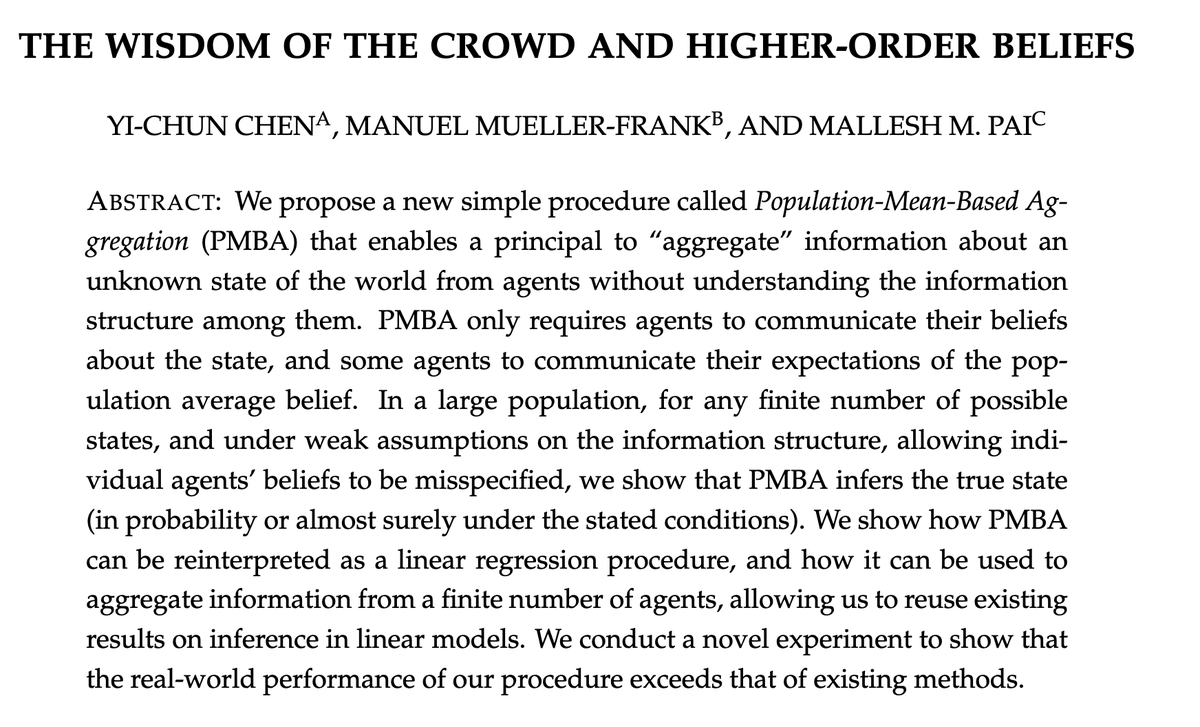
Updated Paper 🚨 (with Yi-Chun Chen and @ProfMMF)
The “wisdom of the crowd” is one of the oldest and prettiest ideas in social science: Ask enough people, average their answers, and the random errors cancel out. Underlies Aristotlean philosophy, Galton and the Ox, and these days, Prediction Markets.
Beautiful, magical when it works, but sometimes… completely wrong! 🧵
La tasa de fecundidad global de los castellanohablantes ronda el 1,5, bien por debajo del nivel de reemplazo. Y, lo más sorprendente, ya no queda ninguna población de esta comunidad por encima de 2,1.
Repasemos los países con al menos 20 millones de habitantes, por orden de población. El gigante demográfico, México, estuvo en 2025 cerca de 1,52, y en 1,45 si descontamos a las madres que usan sobre todo una lengua indígena.
Colombia, en 1,01.
España, en 1,1, y probablemente en 1,05 si descontamos a las madres de origen africano.
Argentina ronda el 1,2 y Perú, el 1,6.
De Venezuela tenemos datos pésimos, pero su fecundidad está, con total seguridad, por debajo de 2.
Chile es el caso extremo. Con 0,99, es el primer país de cierto tamaño fuera de Asia oriental que cae por debajo de 1,0.
Por debajo de los 20 millones, la situación no mejora, aunque su peso demográfico es menor.
Queda una comunidad de hablantes muy importante en Estados Unidos, aunque es difícil medir su fecundidad por uso lingüístico, y no por la mera etiqueta administrativa de “hispano”. Dada su fecundidad total, debe rondar el 1,8 pero cae muy deprisa.
Cabría señalar la excepción parcial de Guinea Ecuatorial, pero allí el castellano es más una lengua de administración que de uso familiar.
¿Y la inmigración? Como me fijo en la fecundidad del conjunto de la comunidad castellanohablante, un colombiano que se mude a España o un venezolano que se mude a Chile no altera la dinámica lingüística.
España recibe inmigración neta de fuera de la comunidad, pero probablemente es menor que la emigración neta de Latinoamérica hacia Estados Unidos, Canadá y otros países europeos. En suma, la comunidad castellanohablante pierde parte de su población por la emigración.
En conclusión, el futuro demográfico del castellano (o español) no es halagüeño. Su base de hablantes es lo bastante grande como para que la baja fecundidad no pese demasiado durante al menos un siglo, pero el “pico” de su influencia como idioma probablemente ya ha pasado. Otros idiomas, como el inglés (y, en parte, el francés), tienen la ventaja de estar extendidos en zonas que aún mantienen fecundidades altas o relativamente altas.
Por supuesto, otros idiomas verán caer su importancia aún más deprisa en las próximas décadas, empezando por el chino. Y dentro de los países castellanohablantes, la mayoría de las lenguas minoritarias afrontan una situación aún más complicada. El futuro demográfico del catalán, por ejemplo, es muy, muy difícil.
Pero si los hablantes de una lengua deciden no tener hijos, no hay otra.
Guys, bio shit is super serious too - it's not all about cyber
Totally fair + correct to shit on Anthropic for silent degradation stuff but big picture, they are right to be worried about several things + to emphasize that things are going quickly
See? The American Justice function is perfectly functional: even the rich and powerful can punished for their misdeeds, with fines going as far as… <checks notes> …two hundred dollars.