⚖️ IVE: DENUNCIAN FILTRACIÓN DE DATOS PERSONALES Y VIOLACIÓN DEL SECRETO MÉDICO
📌 Alejandra Iriarte, integrante de la Red de Abogadas Feministas, denunció que sus datos personales habrían sido filtrados luego de enviar a su obra social la autorización para acceder a misoprostol tras un embarazo que no pudo llegar a término.
📲 Según relató, poco después comenzó a recibir mensajes de una organización antiderechos que buscaba “charlar sobre su embarazo”.
🗣️ “Tenían la narrativa típica de los grupos antiderechos. Inmediatamente, hice la denuncia penal”, señaló Iriarte en #LaMañana por @am750.
#IVE #Derechos #Salud #SecretoMédico #AM750 #Argentina #Misoprostol
🚨‼️LosFamiliares de Niños del Garrahan me pasan la siguiente info.
•El hospital está sin calefacción
Desde que empezó el frío, jamás prendieron la caldera.
•La dexametasona es un corticoides re común . No hay en ampollas, x lo q parten las pastillas y le dan por boca a los bebés
•No hay dipirona, antipitetico básico para la fiebre en pacientes internados
•De las 300 camas que compraron, -además de que ya se están Rompiendo varias ( mala calidad)- ninguna es apta para niños, son de adultos, haciendo que el riesgo de caídas sea inmenso
•No responden los mails a pacientes del interior, haciendo que se atrasen sus controles
Hay un nene que espera transplante hepático en Lago Puelo y no puede venir a control por ejemplo.
Por todo esto el próximo 20/05 hacen una marcha en reclamo de la atención de sus hijos.
A psychologist at the University of North Carolina spent 20 years proving that a single 20-second hug rewires the human cardiovascular system, and the experiment she ran is so simple you can replicate it tonight at home.
Her name is Karen Grewen.
She works inside the UNC School of Medicine's Department of Psychiatry. The paper that made her famous was published in 2003, and almost nobody outside her field has read it.
Here is what she actually did.
She recruited 183 healthy adults living with a long-term partner. She split them into two groups. The warm contact group sat together for 10 minutes holding hands while watching a romantic video. Then they stood up and hugged each other for exactly 20 seconds.
The control group sat alone in a separate room for the same amount of time doing nothing.
Then she made every single one of them give a public speech in front of a panel.
Public speaking is one of the cleanest stressors in psychology. Heart rate spikes. Blood pressure climbs. Cortisol floods the system within minutes. It is the laboratory version of every stressful moment you have ever had at work.
The people who had been hugged for 20 seconds before walking into that room had measurably lower blood pressure responses to the stress. Lower systolic. Lower diastolic. Lower heart rate increases. Everything was the same.. the speech, the panel, and fear. But this time completely different physiological response.
The hug had not made the stress disappear. It had changed how the body was allowed to respond to it.
Two years later Grewen ran the follow-up study that explained why. She drew blood from 38 couples before and after the same warm contact protocol and measured what was actually changing inside them. The answer was a hormone called oxytocin.
Oxytocin is the chemical your body releases during childbirth, breastfeeding, and orgasm. It is the same molecule that makes a mother feel calm holding her newborn.
Grewen's data showed that 20 seconds of physical contact with a trusted partner triggered a measurable spike in plasma oxytocin in both men and women, and the size of that spike directly predicted how much their blood pressure dropped.
The mechanism turned out to be older than recorded history. Oxytocin binds to receptors in your heart, your blood vessels, and the part of your brainstem that controls how aggressively your nervous system reacts to threat.
When the hormone shows up, the entire fight-or-flight machine downshifts. Your blood vessels widen. Your heart slows. Your cortisol production gets suppressed.
This is not a feeling. This is a chemical instruction your body sends to itself that you can measure with a blood pressure cuff.
The detail Grewen kept emphasizing in her interviews was the duration. Three seconds is the average length of a hug between two humans. It is too short.
The hormonal cascade does not have time to start. 20 seconds is the threshold where the oxytocin actually crosses into the bloodstream in a quantity large enough to do something measurable.
A follow-up study tracked 59 premenopausal women over time and found that the ones who hugged their partners most frequently had lower resting blood pressure and higher baseline oxytocin levels than the ones who did not. The effect compounded. Daily hugs produced a permanent shift in the cardiovascular baseline.
A separate review of long-term partner contact research found that married adults with frequent affectionate touch had significantly lower rates of heart disease and all-cause mortality than equally healthy adults without it.
The American Heart Association now cites this body of research when explaining why social isolation is treated as a cardiovascular risk factor on the same level as smoking.
The most haunting line in Grewen's research is one she said in an interview after publishing the second paper. She pointed out that the average American touches another human being less than they did 50 years ago. Phones replaced eye contact. Texts replaced visits. Hugs at the door got shorter.
The thing that used to regulate our cardiovascular system multiple times a day quietly disappeared from most adult lives.
Your body still expects it. The hormone receptors are still there waiting. The system was designed to be reset by physical contact with people who feel safe, and the reset takes 20 seconds.
You can run the experiment yourself tonight. Hug someone you love for 20 full seconds. Count it out. The first 10 will feel awkward. Around 15 something shifts. By 20 the shoulders drop, the breathing slows, the chest opens.
That is not in your head. That is your bloodstream changing.
Iceland was the only Arctic country without mosquitoes. That ended last October when a hobbyist caught three in a wine-soaked ribbon meant for moths.
Björn Hjaltason had set the ribbon out at a farm in Kjós, just north of Reykjavík. On October 16, 2025, he found three mosquitoes stuck to it instead. Iceland’s Natural Science Institute confirmed the species five days later. It was Culiseta annulata, a cold-tolerant European mosquito common across the UK and Scandinavia.
Iceland’s defense was something stranger than cold. Mosquitoes lay their eggs on water, and the young live in that water for weeks before they grow into adults. Iceland’s water keeps freezing and thawing, sometimes within a single week. Each freeze kills the developing young. The water thaws, mosquitoes lay fresh eggs, and the next freeze wipes them out too. This same species thrives in Sweden, Finland, and parts of Siberia. Iceland’s chaotic winters did the work.
That rhythm is breaking down. 2025 was Iceland’s warmest year ever recorded, running 1.1°C hotter than the average from 1991 to 2020. In May, a record heatwave pushed daily highs 13°C (23°F) above normal, peaking at 26.6°C (79.9°F) at Egilsstaðir Airport on May 15, a national May record. On Christmas Eve, Seyðisfjörður in eastern Iceland climbed to 19.8°C (67.6°F), breaking the December record. The Arctic is now warming roughly four times faster than the rest of the planet, according to a 2022 study from the Finnish Meteorological Institute.
The tweet calls Iceland the last place on Earth without mosquitoes. Antarctica still holds that title. Iceland was the last Arctic country to fall. Of the world’s 3,700 mosquito species, only a handful tolerate Arctic cold. This one mostly bites without spreading disease in cold climates. The dangerous ones, spreading malaria, dengue, and West Nile, kill around 760,000 people every year. Their range is shifting north as the planet warms.
Whether those three mosquitoes can survive an Icelandic winter and breed there is the open question. In an April 2026 editorial in the journal Science, researchers Amanda Koltz at UT Austin and Lauren Culler at Dartmouth called the find a warning. The Arctic ecosystem is changing faster than scientists can keep track of it, and Iceland was the last place anyone expected to lose.
📝 Este bichito Patagónico no es una zarigüeya, ni una marmosa, ni una comadreja 🐭
A los Monitos del Monte se los considera fósiles vivientes, ya que es el único sobreviviente de un orden antiguo (Microbiotheria) que se separó hace más de 60-67 millones de años. Están más emparentados con los marsupiales de Australia que con los de América al tener una bolsa chiquita en su panza para llevar sus crías 🦘
Vive solo en los bosques andino-patagónicos de Argentina y Chile, dispersa semillas y es clave para la regeneración del bosque 🇦🇷🇨🇱
🚨 Su estado de conservación esta catalogado como “Casi Amenazado” por la @IUCN por la pérdida de bosque nativo, incendios y depredadores introducidos. Por eso está protegido y es muy difícil de ver 🐾
Felices de seguir aprendiendo de nuestros #BichosArgentos ❤️
📷 IG: Aviahuelahuella y Guardaparques
#FaunaNativa #Marsupial
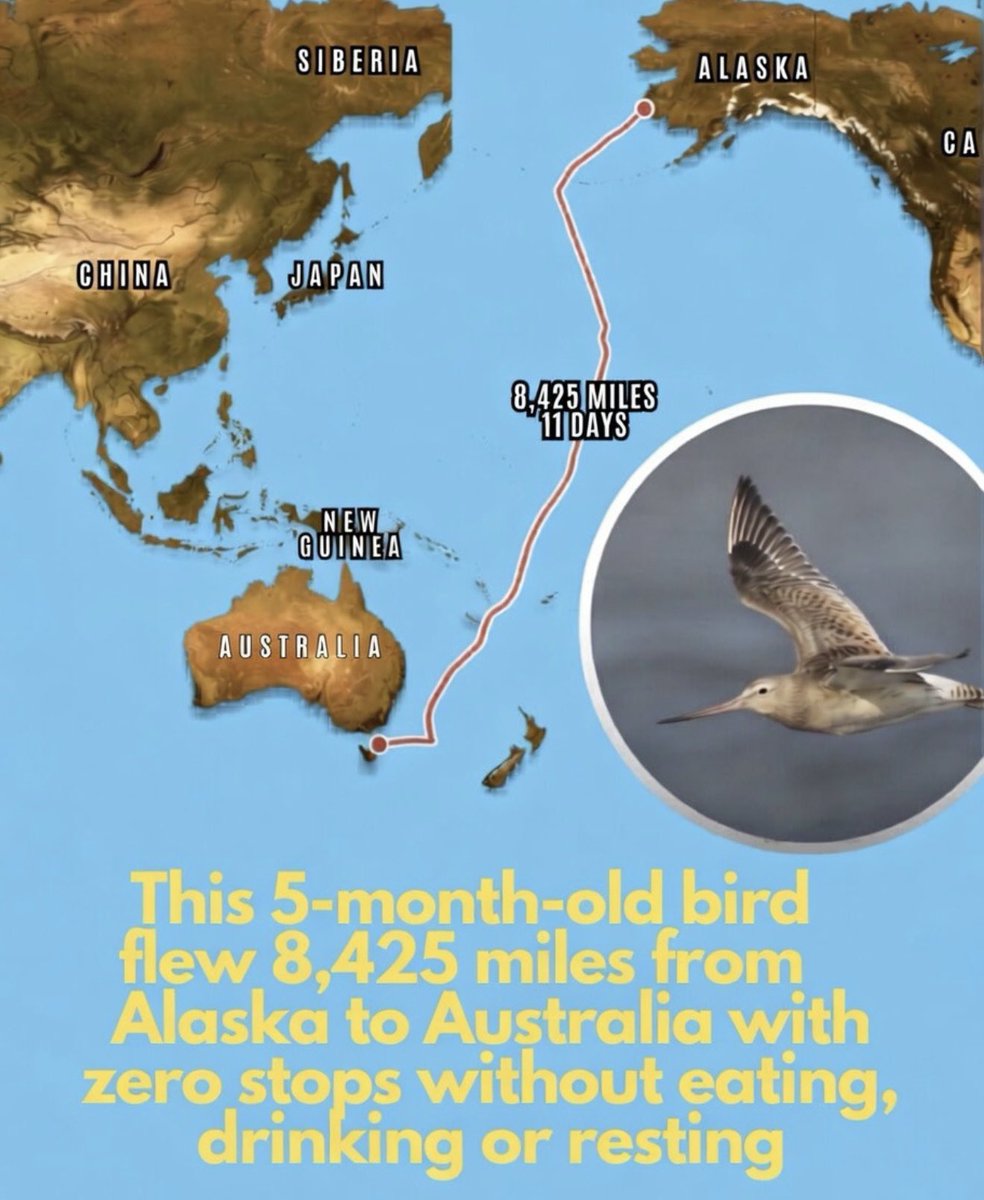
A single bird has completed a journey covering nearly one-third of Earth’s circumference, without stopping to eat, drink, or rest.
A five-month-old Bar-tailed Godwit, set a new record for the longest nonstop flight ever documented in a bird. It traveled from Alaska to Tasmania, Australia, covering about 8,425 miles in just over 11 days.
This remarkable migration took place entirely over the Pacific Ocean, with no opportunity to land. What makes the achievement even more striking is that it was the bird’s first migration, yet it navigated thousands of miles of open ocean with extraordinary accuracy.
The journey is made possible by extreme physiological adaptation. Before departure, the bird builds up large fat reserves, nearly half its body weight, to serve as fuel. At the same time, some internal organs, including parts of the digestive system, temporarily shrink to reduce weight and conserve energy.
Unlike seabirds that rely heavily on gliding, this young godwit maintained continuous flapping flight for the entire trip, enduring changing winds and weather conditions along the way.
Researchers at the Pūkōroro Auckland Shorebird Centre say findings like this are reshaping our understanding of what migratory birds can achieve. Their endurance, navigation, and energy efficiency highlight biological capabilities that rival even advanced human engineering.
Ahora sí hablemos en serio de la foto. Este es un trino para interesados en fotografía, astrofotografía y el que quiera ¿Por qué esta foto es increíble? Algún conspiranóico, dándoselas de suspicaz, preguntó que por qué esta foto tomada por el comandante del Artemis II se veía más opaca que la foto tomada por la tripulación del Apolo 17 en 1972. Bueno. Acá viene lo emocionante. Esta fotografía hubiera sido imposible tomarla con una cámara análoga; y no cualquier cámara digital puede tomarla. El archivo original de esta foto está disponible para su descarga en la página de la NASA. En las propiedades del archivo se puede ver con qué cámara fue tomada y los ajustes de exposición que se usaron. Hasta el serial de la cámara. Esto, primero que todo, garantiza que la foto que estamos viendo no fue creada digitalmente, ni con IA, sino capturada por una cámara real por un humano. Sé que no es suficiente argumento para los conspiranóicos, pero ni modos. Esa que está ahí es la Tierra. Ahora sí lo interesante. ¿Por qué se ve como más opaca que la del 72? porque resulta que en la cara de la tierra que vemos en esa foto, está de noche; si hacen zoom pueden ver el brillo de la iluminación nocturna. Pero ¿cómo, si es de noche, puede verse como si fuera de día? Porque la foto se hizo con un altísimo ISO de 51200! El ISO es la sensibilidad del sensor a la luz. Con la mayoría de cámaras digitales, con ISOs de más de 6400, el ruido es tanto que la foto se ve prácticamente ilegible. Pero la cámara que tiene el comandante Reid Wiseman es una NIKON D5, que no es una cámara muy nueva; tiene 10 años de haber sido lanzada. Pero su sensor es reconocido por garantizar una calidad decente de imagen con ISOs altos. Y eso, para los que siempre preguntan cómo se hace una buena foto del cielo, es fundamental ¿Por qué? Pues para poder tomar fotos de los astros sin tener que bajar mucho la velocidad de exposición. Porque si bajas mucho la exposición apra que entre más luz, queda capturado el movimiento de los astros y de la rotación de la Tierra, cuando estás en la Tierra. Así que un iSO tan alto hizo posible que Wiserman pudiera disparar a una velocidad de 1/4 de segundo. Que es baja, pero no tanto. Es digamos, el límite para la astrofotografía. Por eso esta foto tiene ruido, porque de todas formas es un ISO altísimo.
Pero lo que más me emociona a mí, es que la tomó con un lente 14 -24mm F2.8. Es decir, en terminos coloquiales, que esta foto no tiene zoom. Para que lo dimensionen: cuando uno quiere tomar una foto de la Luna desde la Tierra que salga así de "cerca" tiene que usar un lente de unos 400mm de distancia focal. Wiserman usó un ¡gran angular de 22mm! Es decir que él estaba viendo la Tierra asi de grande frente a sus ojos. Porque la foto no fue recortada en edición y eso lo sabemos porque en las propiedades del archivo siempre aparece cuando una foto fue editada. El archivo está limpio, tiene la resolución original de la cámara. La tierra era inmensa frente a su mirada. Hermoso.
Pero para mí lo más mágico de esta foto, incluso más que las auroras boreales, es que se ve como la luz de sol, que está del otro lado de la tierra, ilumina nuestra atmosfera. Y eso es magia pura, porque esa atmosfera tiene una composición milimétricamente perfecta para permitir que la vida, tal y como la conocemos, sea posible. Esta foto, es un regalo precioso para la humanidad.
Les dejo al link para que descarguen la foto en alta resolución y el pantallazo de las propuedades del archivo.