Specialized agents made sense two years ago when the models needed so much direction. Models are so good now that that same direction / overly specific prompting is hurtful.
So many enterprises building internally have become obsessed with the idea of creating many specialized agents / agent marketplaces.
The differentiation comes down to system prompt and tool sets, thats it. 90% of the time a general agent with standardized tools for retrieving information and a sandbox to build in, with a general system prompt and skills, performs better and is easier to scale across use cases.
Specific and restrictive system prompts can actually hurt performance, especially as the models have become so good.
I build a similar tool for consultancies and we believe the idea of speed is becoming (and for some firms, already is) attractive as a lot of consulting work moves to fixed cost / outcome based pricing. Do you ever see law moving in the same direction or do you think it will always be billed hourly?
Used 6.2 astra for a whole 30 minutes before switching back to opus. I should probably use it for more things but the difference in usability was very noticeable
We did this a month ago with our own internal coding tool (a lot of infrastructure around and extensions to the frontier harnesses). Collaborative Word, Powerpoint, and Excel editing with full feature parity is in Verra!
How Phil built a collaborative Word editor with no human engineers.
Inspired by @russelljkaplan's story of how @cognition builds their Android app with just a swarm of Devins. https://t.co/6dDxnygL0m
3. Sentinel - Because our tool is so well integrated to our observability stack and our day to day work, we can have one of our "projects" on a cron job to check production infrastructure. Because this agent knows exactly what is being worked on, what was pushed, who did what, etc, when it sees issues in our deployments, it can immediately give tailored advice (which it sends to us in an email) and even attribute who should own the fix. It didn't take much effort to build, but because it is so well integrated with our day to day, its better than any SaaS product offering we've seen.
We built out our own internal coding tool @verrainc (extension of the frontier harnesses) and have been iterating on it over the past few months. Here are some of the things that I couldn't live without:
2. Projects - Most of our "chats" are no longer single agents. Instead, its an orchestrator and many persistent subagents. Based on your initial conversation and request, the orchestrator will spawn persistent workers to handle specific aspects of the request. These subagents communicate with eachother as well as with the orchestrator and persist indefinitely. If I come back to a chat a week later, those subagents still exist, each with rich context in the specific area its responsible for, and my orchestrator can delegate / ask questions. Ephemeral subagents are a waste imo - they gain great context on something specific, return a diluted answer back to the main agent, and all of that context is then lost.
This architecture has improved the quality and speed of our work.
3) Our engine has to run across thousands of resource constrained agent sandboxes. Our engine is built in rust; it performs faster and with more memory efficiency than the most popular open source libraries meant to handle the same tasks.
1) Over the past couple of months, we've realized how important deliverable generation is to our users. For consultants, that work happens almost entirely in Office files: Word, Powerpoint, and Excel.
Agents work with these files by generating code, but editing the raw XML directly is slow and inconsistent, and most prebuilt frameworks do not provide enough of a surface for the agent to be as proficient as a consultant.
So, we built an entire office suite from the ground up, giving our users an office native, in-app interface, and our agents the most extensive editing surface we've ever seen.
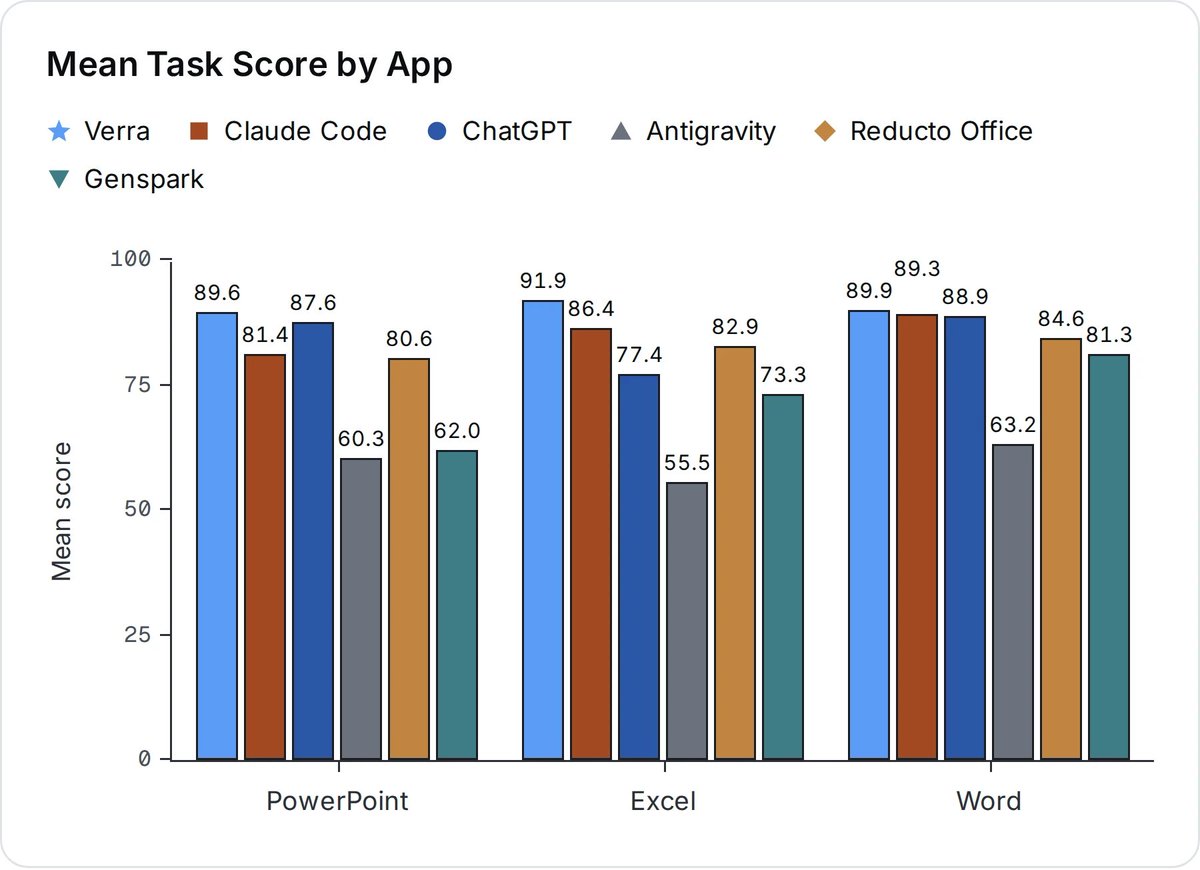
We benchmarked it on 95 consulting tasks against Claude Code, ChatGPT, Reducto Office, Genspark and Antigravity:
✅ Highest mean score in PowerPoint (89.5), Excel (91.9) and Word (89.9)
✅ Most consistent from run to run
✅ Faster bulk operations across Word, Powerpoint, and Excel when compared to the Office native desktop apps
The full write-up covers how we built the architecture, how co-editing with the agent works, and the benchmark. See below🧵
2) Every tool you have in an office desktop app is available to our agents. Because of that, we see the highest consistency across consulting tasks compared to all other harnesses.
Today @verrainc, we had our weekly product meeting about some need to haves.
Right now, our agent cites and explains its work (and does so very well), but this is purely in chat, separate from the files that it creates. This makes the job of auditing / checking the claims more difficult for the user.
We need something seamlessly embedded in our file viewer.
Took 10 minutes to type out some direction for opus 5.5, had it run for 3 hours straight, and it spit out the exact image I had in my head.
This is a fable class model, absolutely insane. I don't think fable 5.1 would have done this good of a job.
experimented with jev for a few days and saw all the few-day projects people spun up
still haven't seen many people talk about the implications on work in professional services
more surface level, information needs to be reliably extracted to create search indexes over large amounts of documents, jev essentially solves this and many have already acknowledged this
more importantly though, jev is a more reliable and consistent decision maker
one of the biggest skepticisms of AI I see in professional services is the reliability and consistency of output - how are claims in final decks / docs grounded and tied back to source documents
LLMs can do this, but with complex analysis over many docs in long deliverables, they can often times yield errors. And even with instructions to link claims back to source documents with confidence, an LLM outputted confidence score is usually out of touch.
with jev we can rely on LLMs for free form generation, with a harness setup to allow it to link its claims back to sources. in theory, jev can (with lower chance of hallucination) decide if these sources truly validate the claims being made, and do so CONSISTENTLY. many times we are asked if the same question asked in two isolated agent instances would yield the exact same answer. the answer is often that it would be very close, but never exactly the same.
jev gets us one step closer to the consistency that fosters trust in these agents
taking it a step further, jev could drive entire agent flows. you can't rely on an LLM to ALWAYS choose the next best tool or action. but, you can rely on an LLM to generate the top five possible best next steps. jev, with a confidence score, can decide which one is actually best.
in practice, RLCD models are far from perfect (for now). i am excited to see where @typesafeai takes us in the next few months