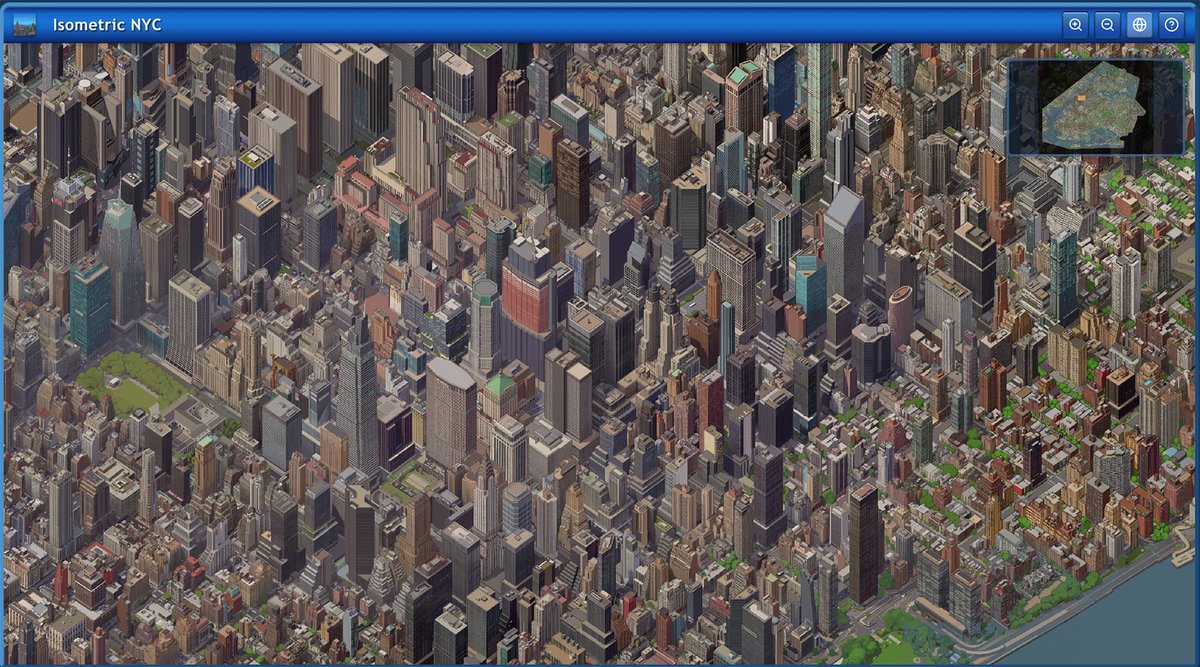
I wanted to share something I built over the last few weeks: https://t.co/QRqMK9CpTR is a massive isometric pixel art map of NYC, built with nano banana and coding agents.
I didn't write a single line of code.
This is Chromium... inside Linux... running on my browser. 🤠
unkernel now has a GPU and a Desktop that runs unmodified Wayland, X and GL apps with hardware acceleration in high resolution.
Introducing Dubai Isometric: an illustrated map of the whole city that you can zoom into street by street, from Jebel Ali and the Palm to Deira and Mirdif.
The map: https://t.co/pkuj60IgAu
How it was made: https://t.co/PqqMRA027Z
Numbers:
• 948 km² of Dubai City
• 21.6 billion pixels, painted
• 35,536 generated images
• 506 hours
• 8.1 billion tokens
It's built only on publicly available data, from OpenStreetMap and Overture Maps.
It was built in Codex with Sol 6.1/6.2, using Codex's built-in image generation, which was very impressive at generating and fixing the tiles.
Inspired by @_coenen's Isometric NYC.
before AI: the first 90% takes 10%, and the last 10% takes 90%
after AI: the first 99% takes 1%, and the last 1% takes 99%
thanks for coming to my linkedin page
hardest problems in agents rn:
- multiplayer access and authorization controls
- good ol’ search retrieval
- proactive actions
- orchestration & human attention
Crazy how the well these models now handle multiple questions and requests being sent at the same time.
Reminder: forget most of the context management practices you thought were important 4 months ago.
open sourcing a new project!
wland: a Wayland compositor in your browser.
• Up to 120 FPS ⚡
• Pixel-perfect on Retina 💎
• Written in Zig, compiled to WebAssembly (~65 kB gz)
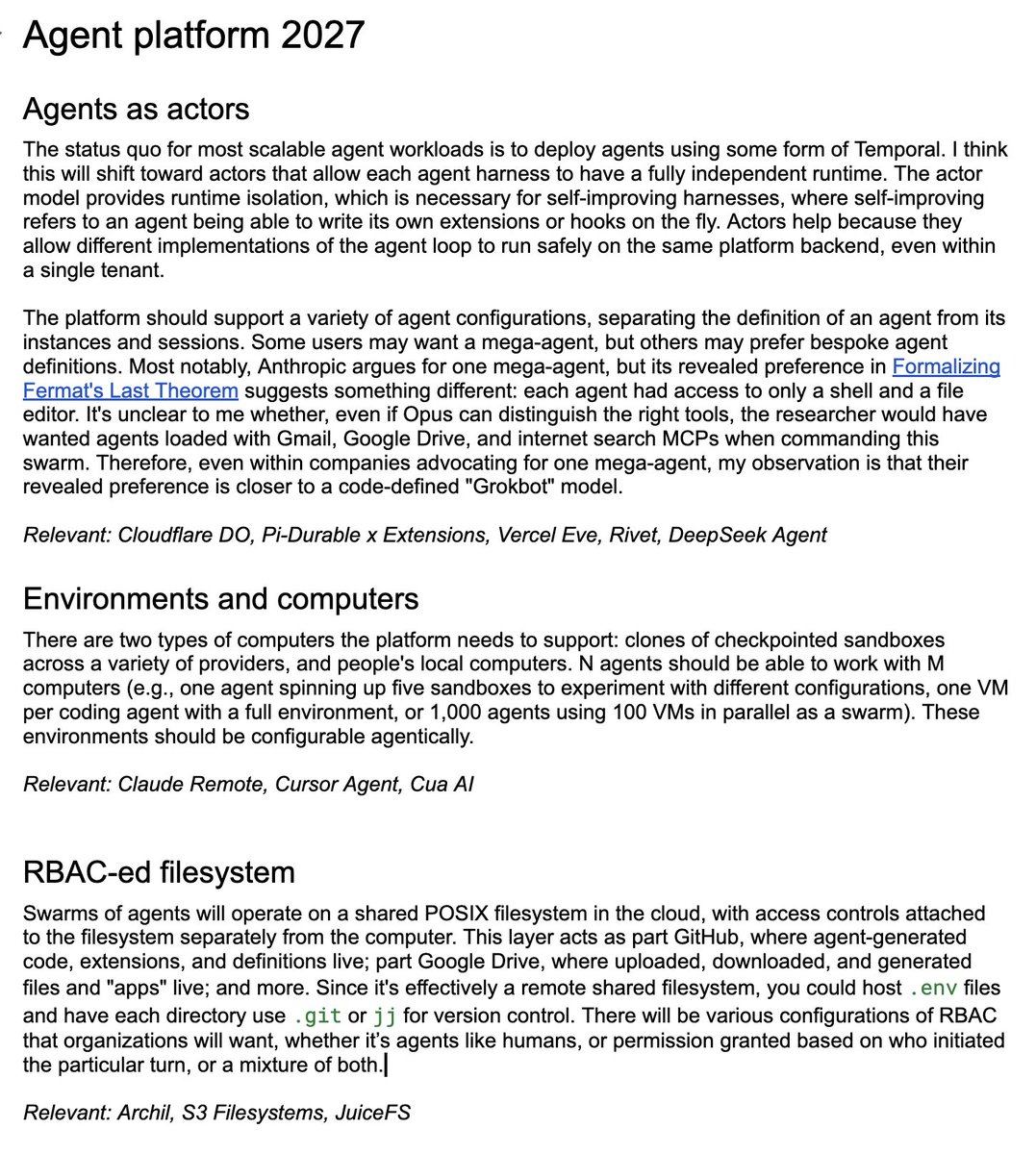
Agent platform of 2027.
This is the end game. This is the blueprint for the one and only application layer software that will exist. Every other software will effectively become databases for this layer, the everything agentic operating system for the million agent swarm to work on top of.
This is obviously the end game vision for the application layer of ChatGPT and Claude. I have reasons to believe that an independent company will own this product layer. But most ADE, "enterprise agent platform", or vertical saas companies, are focused on the wrong things far too narrowly, not technically competent, and do not have the product / technical vision to see this inevitable future.
The correct agent platform that wins will function like the base of a garden, from which customers will plant their unique "seeds" to grow their own plants and trees, managed and evolved by agents, humans, and signals from the sensors of the business. This presents a clearer picture than "factory of a factory" imo.
Gemini 4 Neon just made Thinking Machines' Inkling 2 Mini run almost 6x faster on AMD hardware, by writing and optimizing custom GPU kernels on its own.
An AMD engineer gave Gemini 4 Neon the Inkling 2 Mini GGUF and let it handle the entire process on a Strix Halo (8060S) GPU: writing kernels, profiling them, finding bottlenecks, optimizing and benchmarking.
It worked for 4.3 hours and made around 490 tool calls.
The final results compared to llama.cpp on ROCm:
Decode: 44.8 tok/s vs 23.8 — 1.88x faster
Prefill: 1,465 tok/s vs 233 — 5.9x faster
4-stream aggregate: 100.8 tok/s vs 54.1 — 1.86x faster
The generated kernels reached around 80% of the GPU's theoretical memory bandwidth.
An AI model autonomously writing and optimizing low-level GPU code to get this kind of performance is genuinely impressive.