No debates now on whether that G2 team is the real deal now.
And a reminder that the reason they are the one shining beacon in the entire West: is that they do it all right.
I laughed when I heard that they make Hans Sama do cold face plunges to regulate his nerves. I found it a bit much when I saw that they’d partially rebuilt the LEC stage in their practice room to simulate practice. I smiled when I heard that they knew that Carbs caused a late burst of lethargy for one player and so they couldn’t eat them before scrims.
From the top down: Culture is the most important word for them.
You can make arguments that this rigid structure has removed the Dionysian spirit of G2 rosters gone by, that spark that put them ahead creatively. But it becomes increasingly clear after time that they are attempting to create a framework for that creativity to grow through.
And you talk about difficult decisions, Yike and Miky out. Some people would’ve called for Hans head, or Brokenblade: difficult decisions in the market - that have been vindicated. Both of those players who have gone are top talents: but Skewmond and Labrov have showed an even higher level for the right now.
Buy low. Sell high. Making the decision based on your perspective, your truth that you see before the fans, and being confident in that vantage. That’s running a successful team - that’s having winning at the centre of your culture.
Scrim accountability: strict no bothering the players on their off day. That’s culture from @RomainBigeard.
Bringing Perkz back as both personality and because you believe he was at the forefront of your previous winning culture: it’s no different to a legend of a club becoming the assistant manager of a football club. That’s culture.
What this G2 team do that’s different to everyone else is being so sure of their methodology. That results cannot shake them. Results for them are a product of this methodology, not of rapid and frequent 90 degree shifts.
It’s not just everything on the rift. The players play great, but culture drives everything.
Thank you @G2League@AlbanDechelotte@Perkz@IsmaPedraza@MementoLoL@rodrigo_rlt
I lived in 🇻🇳 Vietnam for 3 months and most people travel via Motor Bike, and the way Vietnamese use the horn is different than anywhere else in the world.
When they use the horn its basically saying "I'm here"
As they pass trucks, or move around other bikes.
Playing on the VN server I noticed they pinged in a similar way, to communicate how they are going to act, and the group is informed and acts accordingly.
Making it possible to do way here level setups and teamfights at much lower ranks.
Compared to danger and assistance spam in NA & EU.
it sucks so much when you realise how you value other people way more than how they value you.
why am i always the person who put
s in the effort to maintain and grow the relationship? why am i always the person who initiates thing?
i'm tired....
🏆Feedback on @TFT's Tier 2 Circuit 🏆
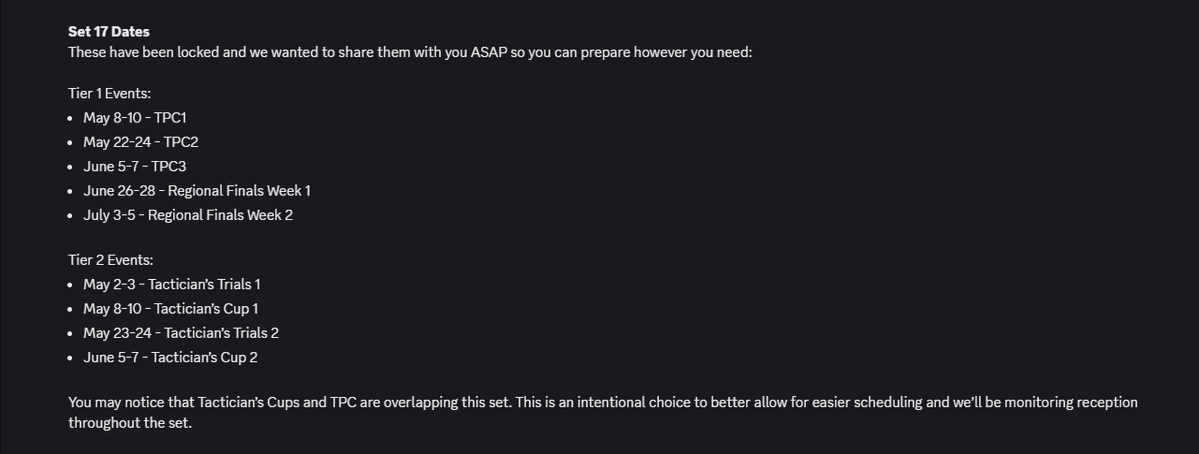
A couple weeks ago Riot announced the dates/format for Set 17 TFT esports, both for T1(pro) & T2(aspirational) circuits. I wanted to share some thoughts regarding these announcements and some constructive criticism on some of the pain points I personally believe the T2 circuit has and open a discussion around possible solutions that can be implemented going forward.
To preface/contextualize the post for those who don't know me, I have been involved with TFT as an esports caster since Set 6, and have worked closely with Riot on essentially every single major tournament broadcast since then, as well as behind the scenes in different capacities focusing on esports narrative/format/player relations. I also enjoy competing, and since the cancellation of official broadcasts for regular season tournaments I have shifted my focus to competition the last two sets, competing in the Tier 2 Trials/Cups and making it to TC day3 and peaking around 1.4k LP on ladder, just to say I have direct experience as a competitor with the T2 circuit.
The major issues I wish to address:
1) Disproportionately long offseason
2) The Dead Ladder Issue
3) Consistency of T2 Cup qualification routes
4) Tier2 Circuit Visibility
1) Disproportionately long offseason:
Using Set 16 as an example: The tournament season for T2 if you don't make regionals lasts a total of 31 days. 1 month in which all competitive tournaments are played(Trials#1, Cup#1, Trials#2, Cup#2) while if you are a top T2 player qualifying directly to cup and skipping Trials(roughly 15-20% of competitors) your season lasts 25 days. Only 32 T2 players per set qualify to Regionals via Cups/Ladder, the hundreds of remaining T2 competitors have no direct incentive to compete in any capacity until next set's launch, over two months after their last tournament day. This same bulk group of T2 players will not have any competitive tournament experience within the official circuit until roughly THREE months later with Trials#1 in Set 17(May 2nd).
2) Dead Ladder Issue:
Due to the elimination of a 3rd T2 Cup and with all qualification routes to Play-Ins/Regionals Week1 being finalized by the end of Cup#2, there is ZERO competitive incentive to play ranked ladder from that point onward. There is nothing to qualify for, nothing to play for(outside of the love of the game). If you do choose to play, the quality of competitive matches and the level of play even at the highest MMR echelons take a nosedive in comparison to the "active" part of the season due to the aforementioned lack of incentives, making it a significantly less enjoyable experience than I think it should/could be, especially taking into account the considerably more refined competitive environment the end of a set may offer in regards to balance(consider the fact less that only a very small minority of competitive players get to experience a patch like 16.6(in a competitive setting), with considerable improvements in balance/system changes when it comes to competing in Set 16, which is a shame).
3) Consistency of T2 Qualification Routes:
As it currently stands, there are two paths towards Regional Qualification from T2
a) Qualifying via ladder snapshots: 12 best performing players in the region
b) Qualifying via Cup performances: 10 best players from Cup#1 + 10 best players from Cup#2
Ladder qualification is decided across 6 snapshots spanning hundreds of games and across a period of 2.5months and multiple patches
Tournament qualification is decided across two seperate weekends, spanning a maximum of 18 games(30 if including Trials) sample size and a singular patch for each tournament. Failing to finish among the top 10/128 in either Cup offers no reward, as there is no cumulative point total system where consistency is rewarded and no amount of regional slots are allocated for this purpose.
In addition, single-tournament cup results are rewarded more heavily than ladder play, as the top 8(80% of) tournament performers in each cup qualify directly to RW1 and skip play-ins, while only the 4(33%) best ladder performers qualify to RW1 and the rest must play first go through the Play-In phase, despite proving their ability through a considerably longer and harder qualification route with 10x sample size. This was changed from Set 15 in which ladder qualification was more heavily rewarded for the following reason "Ultimately this change was made, because we felt that it's important to maintain a system where TPC players don't feel like they are offered an easier path to Regional Finals if they play in the Tier 2 ecosystem." which I don't believe should factor as the primary factor in making a decision regarding the T2 circuit in which TPC players are not even a part of in the first place.
A final point is the idea of re-introducing a qualification path via point accumulation across both tournaments, to rewards consistency in the same way changes were made to T1 to directly qualify top pro point earner to Tac Crown if they hadn't won a TPC cup.
4) Tier2 Visibility
Starting with Set 17, Tier2 Cups will be played at exactly the same time/days as TPC. This means the most important tournaments for Tier2 will be given the same preferential treatment when it comes to syncing with balance patches that favor competitive integrity in the best way possible, which I believe is a big positive. It also syncs together a lot of the TFT esports action into less total weekends, giving creators deeply involved with the ecosystem more free weekends throughout the set and not being "forced" to engage every single weekend of the set essentially with TFT which for a small number of people could be relevant I suppose.
This also means that there will be essentially be close to zero visibility for the T2 scene, either for players who may choose to stream their tournament experience or even with co-streams who choose to cover the Tier2 scene(or like in my case, players/creators who would now have to choose between competing or co-streaming/covering Tier 1 TPC tournaments). This will create an even bigger rift between competing in Tier1/Tier 2, with Tier1 players being propped up in terms of their career sustainbility/visibility(deservedly so) but at the expense of T2 being buried deeper down in comparison.
My suggestions/feedback to help remedy these issues:
a) Add an LCQ tournament on the weekend prior to Regional Play-Ins/Week 1. Top 64 ladder players(snapshot few days prior) not already qualified to any phase of Regionals qualify, two days, 6-7 games per day, top X(8, most likely) qualify to Play-Ins. Keep 4 other Cup players in Play-Ins(#9-10 from Cup1&2) and move ladder players back to Regionals Week 1 and increase starting field of players there back to 48. Extends ladder importance with a 2-3 week longer period with the snapshot for this proposed lcq. Keeps T2 players engaged for longer and adds more tournament sample size for them to spike if they can't rely on consistency. Can also be used in some capacity as a guinea pig test run on the final competitive patch build for regionals/TacCrown(the weekend of 16.5 for example this past set). Also adds a sole weekend of visibility/hype for T2 with hero-building opportunities and no contest on that weekend with TPC.
This helps address every single point:
1) Extends season for T2
2) Extends relevance of ladder
3) Rewards consistency for ladder qualification by moving majority of slots back to Week1Day1 and adds another chance for tournament qualification to combat variance/sample size concerns.
4) Adds a weekend where T2 is fully highlighted
Other considerations:
b) Add meaningful end of ladder incentives:
Afaik, the only current end-of-set rewards for your ranked performance in TFT is a victorious LL(Victorious Noctero). Finish Challenger? That's your reward. Finish Gold+...yup, same reward. Surely top ranking player can be incentivized with more meaningful cosmetic rewards(at no extra cost to Riot) for the player who do value this and potentially would be more incentivized to not decay away or continue playing ranked in the end of the season. Either much better cosmetic rewards generally per rank(chall-gm-master) like some kind of exchangeable token/code/cosmetic currency for Chibi LL or boards and something marginally better for diamond-gold or even truly special high value LL/boards for the absolutely highest positions on ladder.
c) Different rank reset for new season depending on ladder finish:
Not 100% sold on this idea but happy to open discussion around it. Currently there is no real difference on your rank reset at the start of the next TFT season depending on what rank you finished the set before. Is there not a possibility of rewarding Challenger players with a less aggresive reset(Say, Emerald IV for all Challenger players in a region and Gold IV for all GMs) with the rest of competitors being reset as usual. Any other competitors who wish to decay would still be able to do well enough in their 5 placement games to land somewhere in high gold anyway iirc so it isn't a huge punish anyway. I can assume this would also make start of set matchmaking a tiny bit better(not entirely sure how matchmaking threshholds work for placements matches in a new set so can't confirm on this).
tagging some involved community/riot folks for vis in case they care to chime in from comp ops/costreamer perspectives and competitors with t2 experience(sorry)
@Naturesbf@DylanFraley@Frodan@TheoDokhy @DalesomHS @BrosephTech@demacianraptor@kevinparkertft@Loescherdinger@SamuelKristan1
Winning a worlds should not be the only way people measure a player’s legacy.
LoL is heavily shaped by shifting metas. The meta at FST, MSI, and Worlds can all be completely different, and unlike traditional sports, LoL teams cannot rotate players as freely. Every five-man roster has its own strengths, styles, and champion pools, so excelling in a specific meta is already an achievement in itself.
Even in Major League Baseball, many Hall of Fame players never won a championship, and some never even reached the World Series. They are still respected for their individual greatness, consistency, and impact on the game.
It should not be the only standard used to define a great player, nor should it be used as an excuse to downplay an excellent player’s performance.
I don't get why folks who are anti AI focus so much on the quality of its output instead of the fact that it's inherently disgusting to see entire industries wiped out by it & the creation of art slowly being relegated more and more to machines.
AI will continue to get better and better until it's outputs are indistinguishable from reality, but I still will believe art not created by humans is inherently soulless. The value in the art to me has always been in the skill and story of the artist who created it, and were able to evoke whatever emotion in us as a result.
By focusing so much on the quality of the output being the issue instead of the fact that it's inherently wrong & unwanted I feel like we send the wrong message to it's creators. We let them know that they only have to eliminate the tells AI art still has for us to accept AI created art as being of the same value as that created by humans.