INSIGHT: XRP Ledger developers are testing a way to create accounts with zero $XRP balance, letting apps and AI agents create wallets without pre-funding each one, potentially removing a key friction point for mass adoption.
🇺🇸 HUGE: US Treasury Secretary Scott Bessent says America is "going to win" in crypto.
"We are going to win in the digital asset stack," Bessent told Ripple's Swell conference.
The Treasury Secretary thinks that will "continue to fortify the dollar."
With over 90% of stablecoins backed by US dollars, he sees them as "an important source of funding for the Treasury."
Bessent called Congress's failure to pass the CLARITY Act a disappointment, but says Treasury could work with the SEC and CFTC instead.
This is the bigger picture.
Ripple’s vision has always been the Internet of Value.
And Brad just said XRP can be part of the “heartbeat” of that global financial system.
That’s a massive statement.
We’re kicking off 10 years of @RippleSwell with a bang!
1/ Goes without saying, but it was an honor to open up our conference with @SecScottBessent. His leadership, alongside the current administration, has been instrumental in ensuring that responsible crypto can thrive in the US. I’m extremely grateful he spent time with us today.
2/ BIG partner news 🚨 we're bringing Ripple’s infrastructure to @RobinhoodApp (supporting both customer-facing services and core financial operations), from $RLUSD settlement on the @XRP Ledger to prime brokerage and treasury operations & expanding our relationship with @BNYglobal across custody and tokenized trade finance with RLUSD, XRP and the XRP Ledger.
3/ We are bringing digital assets to corporates 👀 → Ripple Treasury introduced 24/7 Returns designed to help corporates put idle cash to work outside banking hours utilizing stablecoins (this is one step further to realizing the vision of our Treasury management business).
4/ Last but certainly not least, @USOCC granted final approval for Ripple National Trust Bank!
And it’s only day 0 (technically the Swell main event starts tomorrow!). More to come this week…
🔥BULLISH: Moody's awards Ripple's $2.6B $RLUSD stablecoin an A2 investment-grade rating and its HIGHEST short-term rating, P-1.
The grades signal STRONG credit quality and top-tier short-term repayment capacity, backed by U.S. Treasuries and cash with a 103% reserve coverage target.
The milestone follows Ripple's FINAL U.S. approval for its national trust bank, marking a major boost to RLUSD's institutional credibility.
Big news heading into @RippleSwell: the @USOCC has granted final approval for Ripple National Trust Bank.
This gives Ripple a federally supervised platform to support $RLUSD and provide digital asset custody to enterprises.
We’ve always said crypto and banks work better together — this is what that looks like. Real innovation, real accountability, federal oversight.
The revolution isn't happening outside the system. It's happening from within it.
The world is preparing for the internet to SHUT DOWN.
Yesterday, the UK government urged households to keep 3 days of food, water and cash at home.
Among the risks are CYBERATTACKS that could disrupt power, internet access and card payments.
And this week showed how quickly that can happen.
As news of critical PHP flaws spread, attempts to exploit them climbed into the MILLIONS.
Several websites gone dark while they worked to secure them.
Now imagine a wider outage affecting several essential services at once.
You’re buying groceries, but the checkout can’t process your card.
You try withdrawing cash, but the ATM is offline.
Your rent is due, but your banking app won’t load.
You need medication, but the pharmacy can’t access your prescription.
You arrive for surgery, but the hospital’s systems are down.
You’re stranded at the airport because your airline can’t check you in.
You log in for work, but your company’s systems are locked.
You try calling your family, but the mobile network is down.
These are ALL possible consequences of major outages.
Your own phone or laptop doesn’t have to be hacked for you to feel the impact.
The services you depend on just have to stop working.
Prepare while everything still works.
⚠️ ALERT: More “Black October” PHP2SHELL breach reports are emerging, including a massive new allegation involving PwC.
Everest group claims to have stolen 590.69 GB of PwC files, including sensitive employee and HR data.
Many other verified breaches have emerged such as Capcom's exposure of 11.77 million email addresses, and Onamae Cloud's discovery of malware on customer servers.
These incidents are a reminder to do our part to protect our accounts.
Here are 5 precautions to take to stay safe:
1. Expect fake “Breach alerts”
“Your account was exposed.”
“Install this emergency security update.”
“Verify your details to avoid suspension.”
A real incident gives scammers a believable story.
Open the company’s app or use a saved bookmark to check. Don’t use the link or phone number supplied in an unexpected message.
2. Don’t install a “PHP security patch” from a message
PHP2Shell is a server-side problem. Ordinary visitors do not need to install PHP software on their phone or laptop to browse.
Keep your browser, operating system and apps updated through their built-in settings or official stores.
Do not follow a website’s instructions to paste commands, install certificates or disable security protections to “fix” this incident.
3. Check your accounts for changes
Look for unfamiliar devices, changed recovery details, unexpected purchases and messages you didn’t send.
For email, check forwarding rules and filters too. An attacker can use them to keep receiving your messages.
4. Secure your main email first
Your inbox receives password-reset links for other accounts.
Give it a unique password, review its recovery email and phone number, and enable a passkey or two-factor authentication.
5. Use passkeys where available
Passkeys resist fake login pages because they are tied to the genuine service.
Where passkeys aren’t available, enable two-factor authentication. Prefer a security key or authenticator app where supported.
We can’t prevent every company breach. But unique passwords, passkeys and quick action can help stop one breach from spreading to our other accounts.
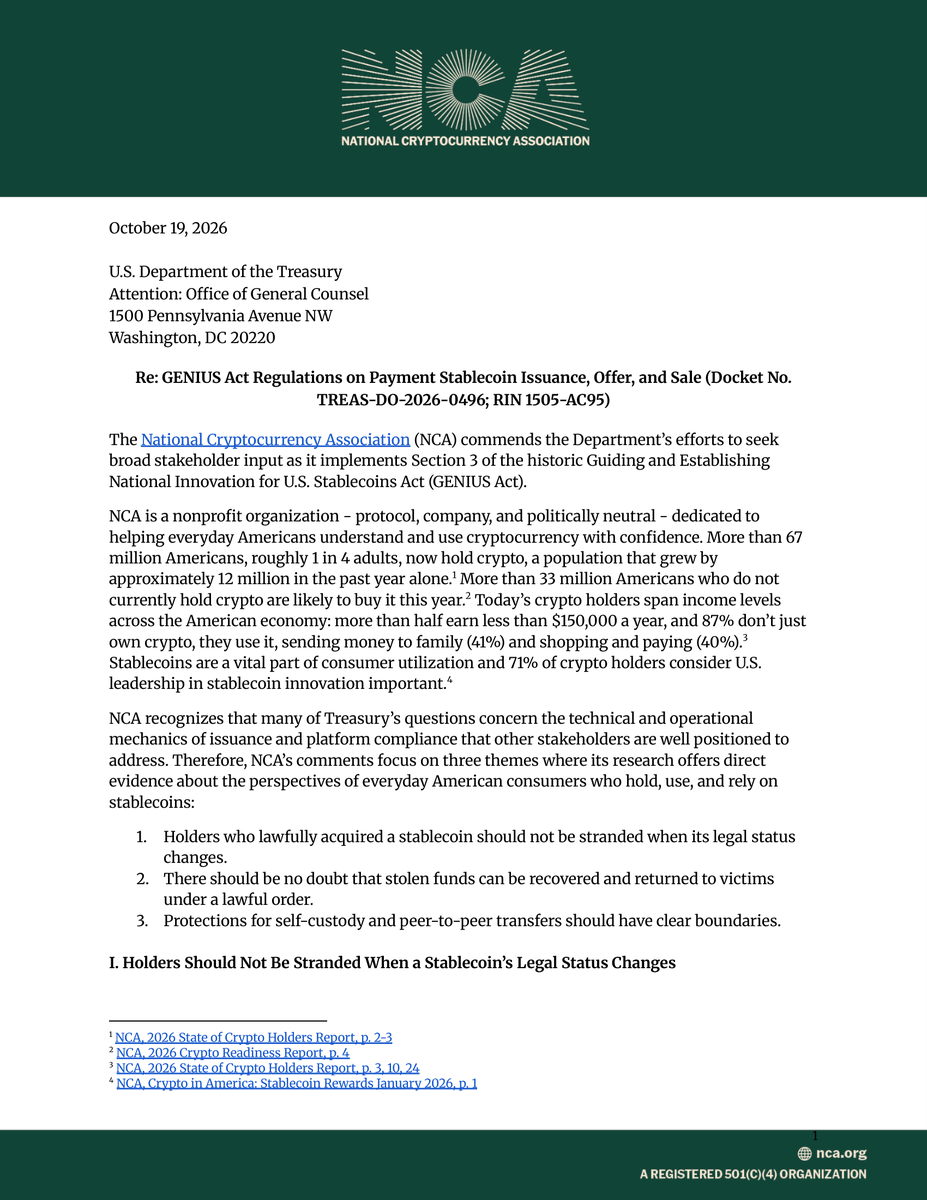
📣 Today NCA submitted comments to @USTreasury on its proposed GENIUS Act rules for payment stablecoins.
Stablecoins are becoming part of everyday life for consumers and businesses. Our comments focus on protecting holders as the new rules take effect: giving them time to redeem, sell, or convert their stablecoins if their legal status changes, making sure stolen funds could be returned to victims, and keeping self-custody and peer-to-peer transfers protected.
Read the full letter 👇