With a CAD $195 million investment from the Canadian Federal Government, Project OPTIMISM is officially underway.
It was an honour to have Canada’s Minister of Artificial Intelligence and Digital Innovation Evan Solomon (@EvanLSolomon) and Etobicoke—Lakeshore Minister of Parliament James Maloney (@j_maloney) join us at our new Inception facility to announce this milestone investment in the future of quantum computing.
Learn more: https://t.co/08ZLVTzCKk
What would you do if you had access to a utility-scale quantum computer?
We have a lot of ideas, like running our XPRIZE vibronics algorithm to explore singlet fission for next-generation solar cells. ☀️
https://t.co/9p2PfhBUvG
In collaboration with HyperLight, Xanadu achieved a nearly 3x reduction in optical switch loss, reducing to only 7 mdB.
Achieving ultra-low-loss switch performance is a major step toward utility-scale quantum computing, but could offer value beyond quantum as well.
We believe our technology could contribute to achieving higher speed, less energy intensive data centers for AI and communications.
Learn more: https://t.co/PbZTBnpohc
Quantum software news moves fast. ⏩
Get your roundup of all the latest in open-source updates, events, demos, tech breakthroughs and community highlights by signing up for our PennyLane newsletter: https://t.co/Nr5veD3Mum
.@NVIDIAAI ’s open-source Holoscan Sensor Bridge (HSB) is a powerful tool for GPU interfacing. Now you can use it in Backline.
Using HSB with an existing workstation, network card and cable, we saw the round-trip time from FPGA to CPU and back fall from 2.47 µs to 1.74 µs. To our knowledge, this is the lowest round-trip time for quantum control between an FPGA and a CPU over a switched network protocol.
Read more and learn how Backline can accelerate your workflows on the @PennyLaneAI blog: https://t.co/uXshyVzH0P
I don’t think anything scales faster and is more easily understood than
data centre ➡️ quantum data centre. Even after the stock sales and the shorties the $XNDU target is still +1275%. Mind boggling. ((🧠))
Keep your powder dry, folks!
Thanks to S Ratan Kumar and Valli Kumari Vatsavayi for their overview of PennyLane and hybrid quantum machine learning on @OpenSourceForU.
Open source has always been at the core of PennyLane’s mission, with a team committed to lowering the barrier to quantum computing by letting developers use the tools and integrations they are familiar with in Python as they learn and build.
Read the full piece here: https://t.co/MYxL7x6Fb0
We are still so thrilled to see how the quantum open source software community showed up to make the 2026 Unitary Foundation Quantum Open Source Software (QOSS) survey the biggest dataset yet! 🥳
In case you missed it, 2026 was a huge year for PennyLane. Here are the highlights from the QOSS survey. 👇
“People probably underestimate how difficult it is to network quantum computers together. We’ve already shown that we can do it.”
Dive into the full conversation with our Founder and CEO @_cweedbrook in an interview with @Pep_Invest on the future of photonic quantum computing: https://t.co/wCfXTCcP5p
Software enables research.
Josh Izaac, Sr. Staff Scientist, spoke at the Munich Quantum Software Forum last month.
Over 400 participants joined from around the globe for two days dedicated to programming the quantum future.
All talks are now available on the MQSF website.
https://t.co/h9Dl7AUZlv
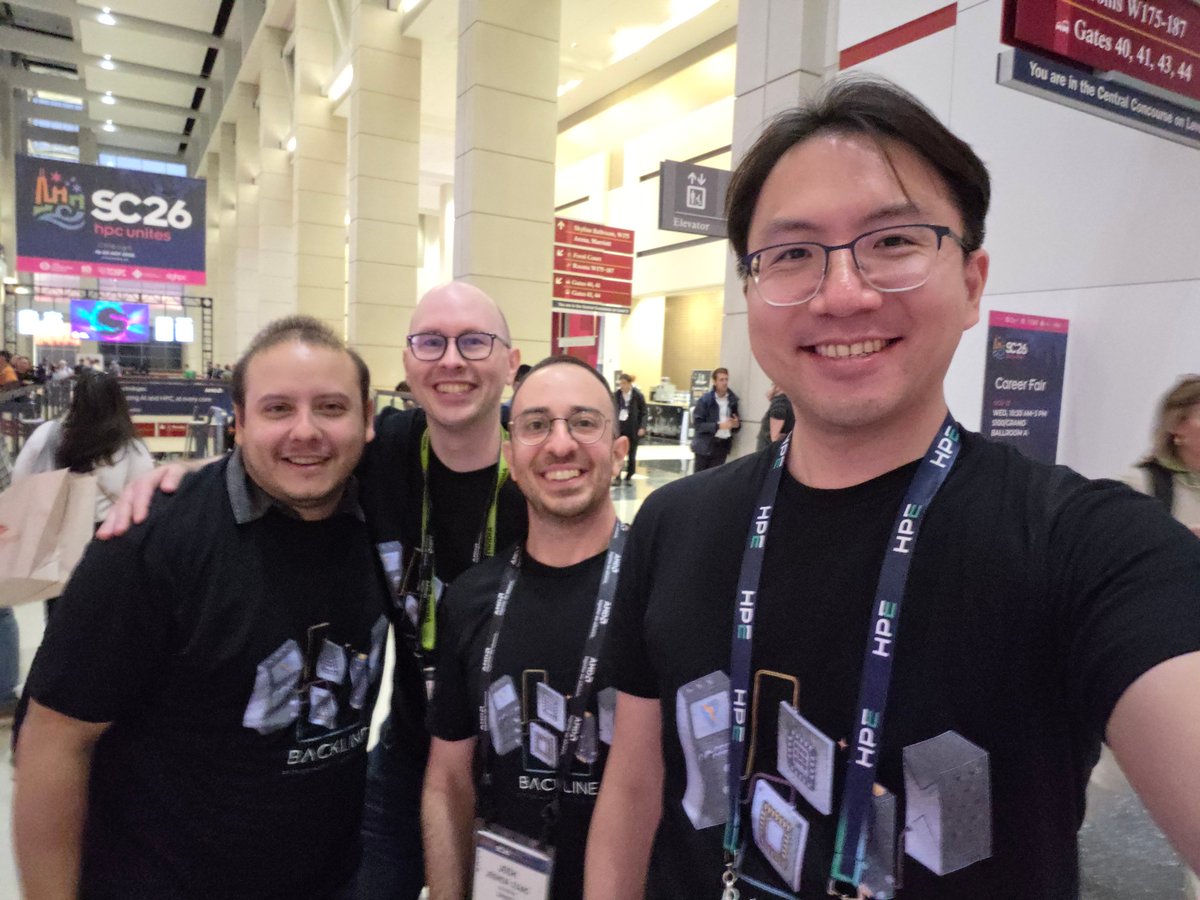
Computational speed is a topic on everyone’s mind, especially at #SC26, and for good reason. But how do you use our tools to speed up your work? 🏎️
Our experts have put together the quantum compilation hub, aka your home base for PennyLane tools that minimize time-to-research.
☑️ Drastically reduce the size of your circuits,
☑️ Explore explanations and implementations of important compilation passes and techniques,
And more. 👀
Check it out: https://t.co/uSM1OcK5ri
The merged entity that replaces BDC and EDC needs deeper pockets and higher risk tolerance than its forerunners to help firms scale, say business leaders.
https://t.co/qFbcMjwHRX
one thing i like about xanadu's compiler work is that they're giving catalyst a way to describe the classical processors and communication paths around the quantum hardware. error correction needs measurement results processed and sent back within tight timing limits, so the choice of processor and how the data gets there can make a big difference. they've already demonstrated parts of this with CPUs, GPUs, and FPGAs. curious if experimenting with different decoders and communication setups could help them find ways to simplify the hardware or reduce the amount of classical infrastructure they need. would be a pretty useful thing to figure out before building the next system. https://t.co/asCTqQBUoZ
Quantum computing full-stack execution in action. While @XanaduAI accelerates our photonic hardware roadmap, our open-source software layer @PennyLaneAI just saw a 36% surge in usership and took #1 in resource estimation in the 2026 @unitaryfdn survey. Developer adoption is the tip of the spear of which ecosystems will endure in the long-term.
The results of the 2026 @unitaryfdn Quantum Open Source Software (QOSS) Survey have placed @PennyLaneAI, Xanadu’s quantum open-source software platform, among the top open-source tools in the quantum ecosystem.
The QOSS Survey is the largest global survey of the quantum open-source community and helps shape the future of the ecosystem.
In 2026, PennyLane:
-Saw a 36% increase in usership,
-Was ranked the #1 tool for quantum resource estimation (QRE),
-Was ranked the #2 overall quantum SDK, alongside PennyLane Lightning as the #2 choice for simulation and Catalyst as the #2 choice for compilation.
Thank you to everyone who filled out the survey; we look forward to continuing to build the future of quantum open-source software together.