Servant leader of tech leaders, father, cynic, optimist, consequentialist. All opinions expressed are my own, subject to revision as further evidence emerges.
@MarkusWerle@allenholub That distinction would indeed be ridiculous. I mean to distinguish between the archetypal social, organisational and communication patterns in use, not the individuals. Glibly: loosely collaborating individuals, vs tight, collaborative teams.
@allenholub IMO code reviews make sense in open source communities (low trust, loosely coupled individuals) but are imported without analysis into product teams (high trust, tightly coupled teams of collaborators) where they typically do more harm than good. Few realise alternatives exist.
Was asked "what are the challenges when doing code review." I see no value in code review. They add context swaps, delay and bottlenecks, damage your feedback loop, and don't usually find much of value to fix. 1/3
@TheSmithLea @allenholub I think an economist would say something like “Economic value is the value that person places on a good/service, based on the benefit that they derive from it”.
Makes me suspect the only true direct measure is to have (a sample of) customers self-report.
@warren_s THIS. Most of the difference between a professional and a hack is what you take responsibility for, and how this shapes you over the course of your career.
If you’re a software engineer who doesn’t care how your stuff gets to and stays working in production, maybe it’s time to take a good hard look at yourself in the mirror and ask yourself if this is really the profession for you?
As a tech lead or eng manager, you so frequently get request from above or from other teams to drop what you are doing and work on this thing they need, *now*.
During my 4 years at Uber after asking these questions, 9 out of 10 times it turned out it wasn't really urgent:
Twitter thread based on demand and cause I can't be bothered to spend 6 months writing a blog post: platform teams are dead.
Platform teams as in teams that build an internal platform that "abstracts the cloud" and "makes things easier for developers" and "our k8s platform" ⚰️
@johncutlefish Yes, but: is reliability a particular kind of something else? Effectiveness, perhaps?
If credibility is knowing about a problem, is reliability standing in for the ability to usefully contribute to its solution?
@johncutlefish Nice.
Would it be oversimplifying to remove reliability?
I suppose there’s explanatory power in the distinction between knowledge and the ability to deliver. It feels like credibility implies reliability, though.
Hemingway's Law - the maximum number of syllables per word you should use in addressing an audience is an inverse function of the size of the audience.
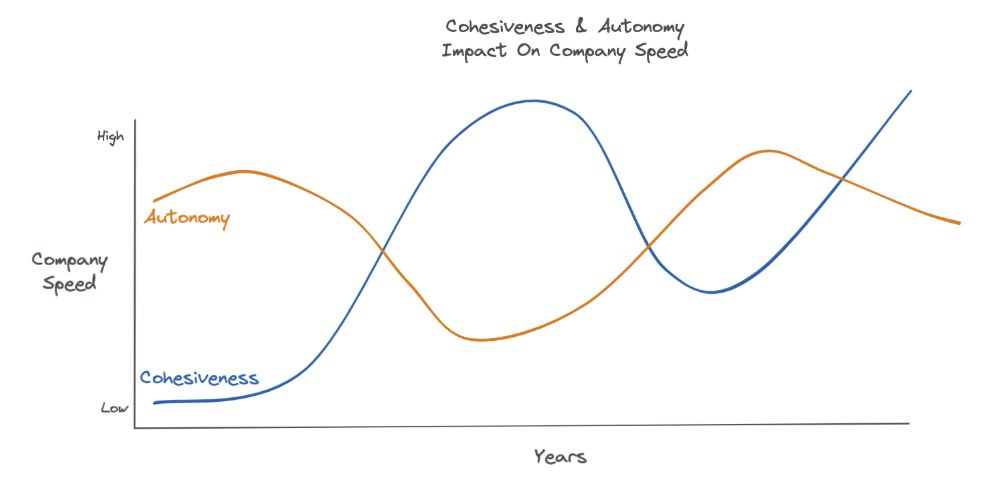
36/ You stay fast by consistently working on autonomy and cohesiveness initiatives.
Teams I work with that do both well are much faster than others that don’t.
@johncutlefish@frontutah Two things I love about your “mandate levels”:
- they provide a simple, explicit, judgement-free framework for alignment conversations
- they avoid the various traps which surround any discussion of autonomy without defining what is meant by the term
@buritica Spotify Model (noun): an approach to agile management where an organisational design pattern is heavily branded and publicised, then quietly abandoned at the originating company. Improves brand recognition; confuses naive practitioners.
See also “situationally harmful”.