Shipped Delayt (https://t.co/LbraX3nbcf), an open source API latency tester. Web app and CLI.
Paste an endpoint, run sequential HTTP requests, get p50, p95, and p99. No signup. Share results with a link.
Your dashboard's favorite metric might also be its most misleading one: average latency.
186ms average looks healthy. Ship it. But p99 at 2.3s means 1 in 100 users is waiting seconds while everything stays green. Averages smooth over the tail. Percentiles don't.
p50 ... what most users actually feel
p95 ... where 1 in 20 starts waiting
p99 ... your worst case that averages silently hide
Also has a CLI for CI pipelines. Set your own threshold:
npx @delayt/cli run --url https://t.co/T3ywrF54X5 --assert-p99=800
Exit code 1 if p99 breaches it. Regressions never ship silently.
Open source. MIT. Try it on one of your APIs and see what your average has been hiding.
Repo: https://t.co/4FSdgKANh9
#opensource #devtools #buildinpublic
GSoC 2026, done.
Spent May to August with UC OSPO, rebuilding the dashboard for DirtViz.
9 merged PRs later it reads sensor types straight from the DB, streams live equations, dedupes panels, exports CSV at whatever zoom you're on.
Learned more from review comments this summer than most of college.
Project: https://t.co/zHRwbcAhFe
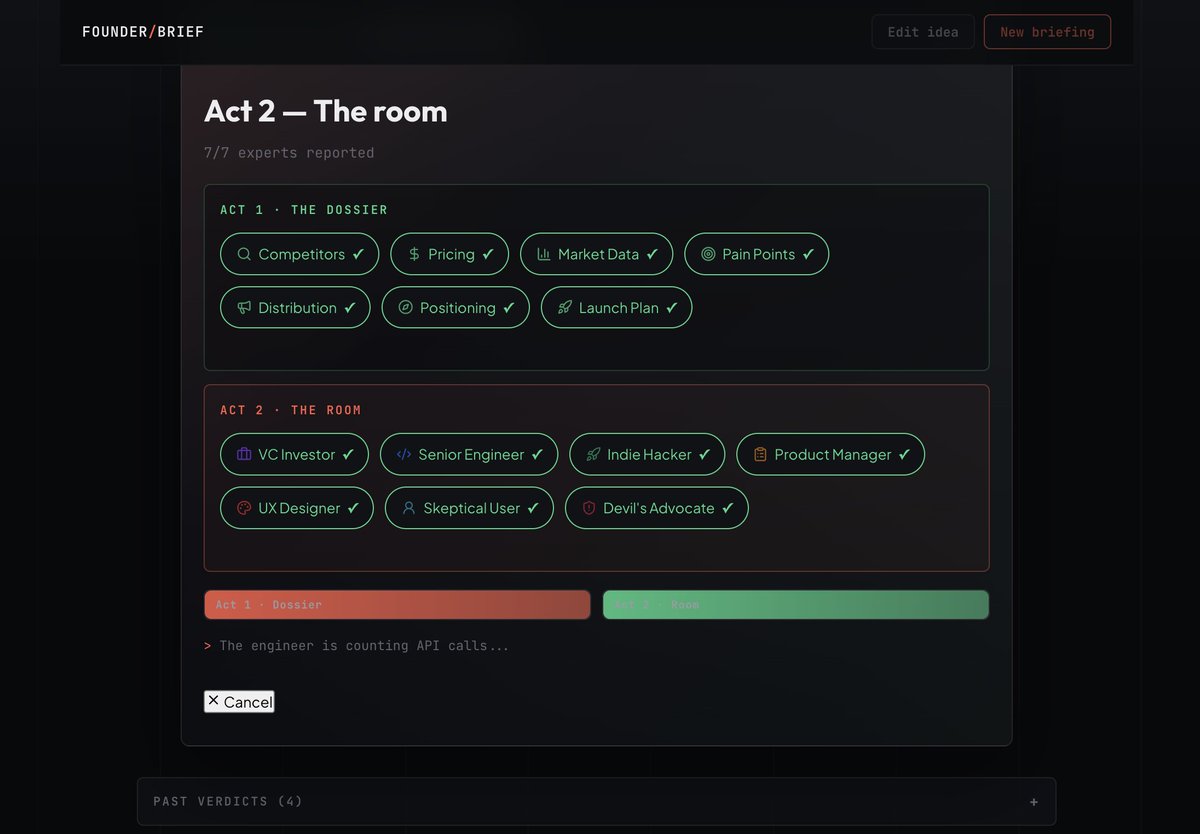
How I'm orchestrating 7 AI agents to tear your idea apart:
Each agent has a role, a prompt, and a seat at the table.
The trick isn't making them smart. It's making them disagree.
VC challenges assumptions. Engineer finds technical holes. Skeptical user asks "why would I pay for this?" Devil's advocate just watches the world burn.
They talk to each other, not just to me. One agent's output feeds another's input. Contradictions surface. Consensus is boring. Friction is the product.
Still wiring it up. But the arguments are already good.
Every project I've built died the same way. Months in, doubt hits, "this probably won't work," and I quietly drop it.
The problem was never the doubt. It was finding out too late.
So I'm building a multi-agent system, 7 AI personas (VC, engineer, indie hacker, PM, UX designer, skeptical user, devil's advocate) that tear your idea apart on day 1, not month 6.
Verdict: ship it, pivot, or kill it.
I’m building a tool that researches your product idea, then has a bunch of agents argue and give a verdict: ship, pivot, or kill.
That argument needs real competitor prices. If Calendly is $12 and the report says $40, the whole “you’re too cheap / the market’s crowded” take is garbage.
Right now I only search the web. Search gives links and a short blurb - not the actual pricing page. So the model guesses the numbers.
That is when I came to know about @firecrawl. It just opens those pages and pulls the real pricing table. Same research, actual prices, less made-up data.
Every project I've built died the same way. Months in, doubt hits, "this probably won't work," and I quietly drop it.
The problem was never the doubt. It was finding out too late.
So I'm building a multi-agent system, 7 AI personas (VC, engineer, indie hacker, PM, UX designer, skeptical user, devil's advocate) that tear your idea apart on day 1, not month 6.
Verdict: ship it, pivot, or kill it.